
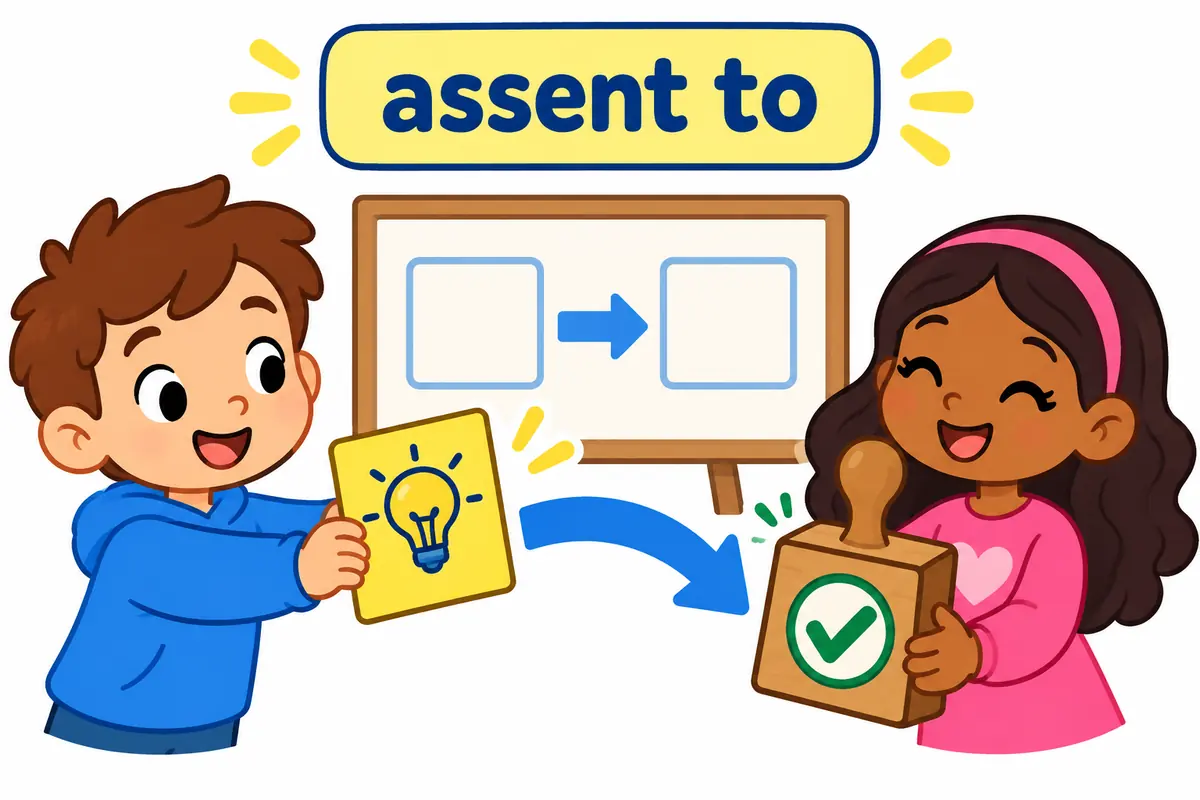
Assent is a noun meaning agreement or approval, and a verb meaning to agree or give consent. To use assent in a sentence, name what is approved and link the verb with to: “The board assented to the plan.” As a noun it is usually uncountable, so it takes a possessive rather than an article.
Assent at a glance
- Assent is both a noun and a verb, and both are pronounced the same.
- As a verb it is intransitive and always takes the preposition to.
- As a noun it is usually uncountable: give your assent, not give an assent.
- It belongs to formal, legal and official writing more than to chat.
- The commonest error is confusing assent with ascent, which means a climb.
What does assent mean?
Assent is a noun meaning agreement or approval, and a verb meaning to agree or give consent. The Cambridge entry for assent records both the noun and the verb and their shared pronunciation. The noun names the approval itself, and the verb names the act of granting it. Where a person simply shares an opinion, concur with a finding with a finding is the closer phrase, because concur stresses agreement between views rather than formal approval of a plan.
| Sense | Plain meaning | Example sentence |
|---|---|---|
| Noun: approval | Formal agreement to a plan or request | The board gave its assent to the plan. |
| Verb: agree | Say yes to a proposal or request | The board assented to the plan. |
| Fixed phrase | General agreement of a group | By common assent, the meeting closed early. |
One limitation is worth stating plainly. Assent does not mean enthusiastic support, and it does not mean a vote. A person can give assent while still doubting, because the word records formal agreement rather than warmth; where real enthusiasm is meant, approval or backing fits better.
How do you use assent in a sentence?
As a verb, assent is intransitive and always takes to: assent to a plan, assent to a request. As a noun, it is usually uncountable, so it follows a possessive such as his or the board's rather than an article. Five patterns cover almost every real sentence, and the preposition to is the rule learners break most often. Where a body formally puts its name to a text, endorse a proposal is the stronger verb.
| Pattern | Example | What it signals |
|---|---|---|
| assent to + noun | The board assented to the plan. | Verb; to is required. |
| give/grant + assent | The mayor gave her assent. | Noun; uncountable with a possessive. |
| with / without + assent | The change was made without his assent. | Noun in a prepositional phrase. |
| assent to + gerund | They assented to joining the scheme. | Verb followed by a verbal noun. |
| by common assent | By common assent, the meeting closed early. | Fixed phrase for group agreement. |
Assent in a sentence: examples across contexts
Assent keeps the same formal approval at its centre while the setting changes. The nine sentences below move from a classroom to a legal document, and each one keeps the noun uncountable or the verb attached to to.
| Context | Example sentence | Why this works |
|---|---|---|
| Classroom | The class gave its assent to the new seating plan. | Uncountable noun with a possessive. |
| Workplace email | The director assented to the revised budget. | Verb with the required to. |
| News report | The senate gave its assent after a short debate. | Formal approval in an official setting. |
| Legal writing | No transfer is valid without the owner's assent. | Noun in a precise condition. |
| Committee minutes | The members assented to the minutes without comment. | Verb followed by to and a noun. |
| History essay | By common assent, the treaty ended the dispute. | Fixed phrase for general agreement. |
| Conversation | He nodded his assent and left the room. | Uncountable noun after a possessive. |
| Diplomatic report | Both states assented to the border survey. | Verb with a formal object. |
| Charity letter | We thank the trustees for their assent to the project. | Noun in a courteous formula. |
Notice that the noun never appears as an assent. Keeping it uncountable, or attaching the verb to to, is the clearest sign that the writer knows the word.
Assent vs consent
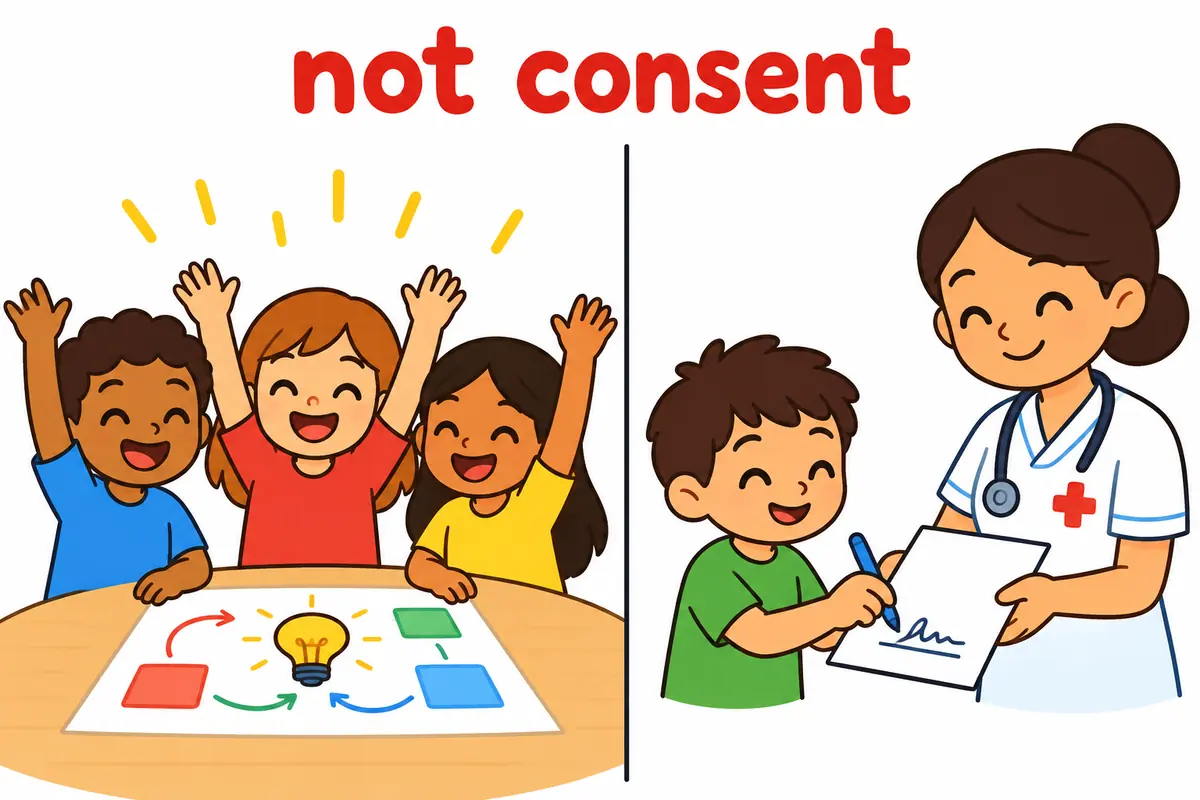
The two nouns both describe saying yes, but they answer different questions. Assent is approval of a proposal or plan, often by a body; consent is permission for something that touches the person giving it, such as medical treatment or a marriage. A committee gives its assent, while a patient gives consent.
| Attribute | assent | consent |
|---|---|---|
| Core job | Approve a plan or request | Permit something affecting you |
| Who gives it | A body, official or group | A person with a stake in the matter |
| Usual object | A plan, proposal or treaty | Treatment, marriage or an action |
| Register | Formal and official | Formal and personal |
| Opposite | Dissent and refusal | Refusal or objection |
Verdict: choose assent for formal approval of a plan, and consent for personal permission. Where a group openly disagrees, dissent is the exact opposite of assent, and it fits the same formal register.
Word forms and grammar of assent
Assent is a double-duty word whose noun and verb look identical, and its forms are regular. The table also lists the forms learners build by mistake, so the non-standard ones are clearly marked.
| Form | Part of speech | Example |
|---|---|---|
| assent | noun, uncountable | She gave her assent at once. |
| assent | verb, base | They assent to the change. |
| assents | verb, third person | He assents to every request. |
| assented | verb, past and past participle | The council assented to the plan. |
| assenting | verb, present participle | She is assenting to the proposal. |
| ascent | different noun | ascent of the mountain |
Common mistakes with assent
- Incorrect:
She assented the proposal.Correct: She assented to the proposal. Rule: As a verb assent is intransitive and needs to. - Incorrect:
They gave an assent.Correct: They gave their assent. Rule: The noun is uncountable, so a possessive replaces the article. - Incorrect:
He gave his ascent to the plan.Correct: He gave his assent to the plan. Rule: Assent means agreement; ascent means a climb. - Incorrect:
The committee was assent.Correct: The committee gave its assent. Rule: Assent is a noun or a verb, never an adjective. - Incorrect:
She assented with the change.Correct: She assented to the change. Rule: The verb pairs with to, not with.
Practice using assent
Work through the six items, then read the reasoning rather than only the answer.
- Fill the gap: The trustees gave their ______ to the new building.
- Choose the better word: The patient signed a form to give (assent / consent) to the operation.
- Correct the error: The council assented the road closure.
- Build a sentence: use assent to about a club agreeing to a rule change.
- Spot the register: which belongs in official minutes — the board gave its assent, or the board was like, sure?
- Rewrite as a verb: The principal gave her assent to the trip. Use assented.
Answers
- assent — the uncountable noun follows the possessive their.
- consent — the permission touches the patient, which is the personal sense.
- The council assented to the road closure — the verb requires the preposition to.
- Model answer: The club assented to the rule change at its meeting.
- The board gave its assent — official minutes keep the formal uncountable noun.
- The principal assented to the trip — the verb takes to and needs no other change.
The bottom line
Use assent in a sentence for formal approval, keeping the noun uncountable and attaching the verb to to. The two details that decide most sentences are these: the verb is intransitive, so it never takes a direct object, and the noun needs a possessive rather than an article. Where the approval is enthusiastic rather than formal, approve the minutes is the plainer verb, and where a body finally agrees to a request, accede to a request carries the sense of yielding to it.
Frequently asked questions about assent
Is assent a noun or a verb?
Assent is both. As a noun it means formal agreement or approval, as in the board gave its assent. As a verb it means to agree, as in the board assented to the plan. The two forms are pronounced identically, so only the grammar around the word reveals which one is in use.
Does assent always take the preposition to?
As a verb, yes. Assent is intransitive, so it cannot take a direct object and always needs to before the thing approved: assent to a plan, assent to a request. The noun takes no preposition, but it usually follows a possessive such as his or their.
Is assent the same as ascent?
No. Assent means agreement or approval, while ascent means a climb or an upward movement, as in the ascent of the mountain. The two words sound alike, which causes the confusion, but only assent belongs with plans and proposals and only ascent belongs with heights.
Can you use assent in everyday speech?
Assent sounds formal, so it is rare in casual conversation. In speech most people say yes, agree or give the go-ahead instead. Keep assent for official writing, legal documents and minutes, where its precise, restrained tone fits the setting and marks a genuine record of approval.
Do you know what it means to give your assent? Assent refers to the act of expressing approval or agreement to something, whether it be a statement, idea, or proposal. It is a simple yet powerful way of indicating your agreement or support for a particular matter.
When you assent to something, you are essentially giving your consent or acknowledgment to it. This can be done verbally, through a nod, or even through a written signature. Assenting to a statement shows that you are in agreement with it and that you approve of what has been proposed.
7 Examples Of Assent Used In a Sentence For Kids
- We all need to assent before we start playing.
- Can you assent by nodding your head?
- Let’s assent if we want to go to the park today.
- It’s important to assent when agreeing with others.
- Raise your hand to assent if you like the story.
- Remember to assent politely when someone asks you a question.
- Give a big assent if you are having fun!
14 Sentences with Assent Examples
- Assent from all members is required for the new club to be officially recognized on campus.
- Students in the class unanimously gave their assent to extend the deadline for the assignment.
- The faculty members are awaiting assent from the administration regarding the proposed changes to the course curriculum.
- The student body president asked for assent from the student council before making a decision on the budget allocation.
- The professor requested assent from the students before moving forward with the experiment in the laboratory.
- The college administration is seeking assent from the students for implementing a new dress code policy.
- The debate team members showed their assent by raising their hands in agreement with the proposed topic.
- The librarian asked for assent from the students before rearranging the books in the library.
- The student committee sought assent from the college dean before organizing the annual cultural fest.
- The event organizers required assent from the student volunteers for the upcoming college fest.
- The research team awaited assent from the professor before beginning their study on environmental sustainability.
- The student council discussed the proposal and gave their assent to host a charity drive on campus.
- The college newspaper editorial team sought assent from the readers on social media for the upcoming issue’s cover story.
- The student union members unanimously gave their assent to organize a protest against the hike in tuition fees.
How To Use Assent in Sentences?
To use the word “Assent” in a sentence correctly, follow these simple steps:
-
Understand the Meaning: Before using the word “Assent,” make sure you understand its meaning. “Assent” is a verb that means to express agreement or approval.
-
Choose the Right Context: Ensure that you select a context where expressing agreement or approval is appropriate.
-
Construct Your Sentence: Start your sentence with a subject (noun or pronoun), followed by the word “Assent,” and end with the rest of the sentence that presents the agreement or approval.
-
Example Sentences: Here are a few examples of how you can use the word “Assent” correctly in a sentence:
- She assented to his proposal to implement a new marketing strategy.
- The committee members unanimously assented to the new policy changes.
- I eagerly assent to your plan for the weekend getaway.
-
Practice Makes Perfect: To get more comfortable with using “Assent” in sentences, try incorporating it into your everyday conversations or writing.
By following these steps and practicing, you will become more confident in using the word “Assent” correctly in your sentences. Remember, clarity and context are key when using new vocabulary like “Assent.”
Conclusion
In conclusion, the act of assenting is a crucial aspect of communication and decision-making. It involves agreeing or expressing consent to an idea, opinion, or proposal. Examples of sentences with assent include “I assent to the proposal,” “With a nod of assent, she agreed to the terms,” and “The audience’s murmurs of assent indicated their approval.”
Assenting plays a key role in indicating agreement, understanding, and cooperation in various settings, from casual conversations to formal agreements. It helps to establish common ground, build consensus, and move discussions forward. Understanding the significance of assent in communication can enhance clarity and promote effective interaction among individuals and groups.


