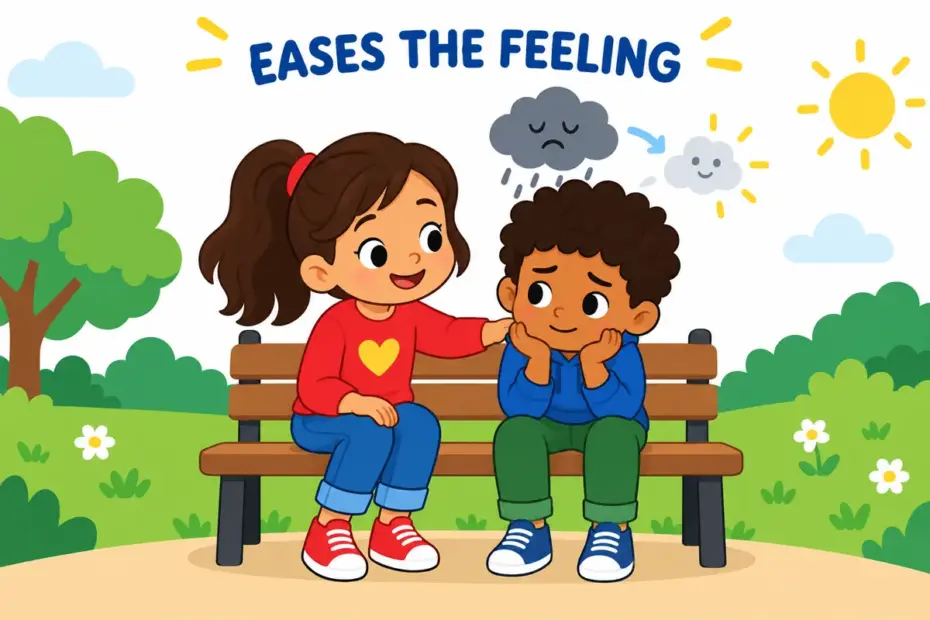
Assuage means to make a painful or unpleasant feeling less intense. To use assuage in a sentence, name the feeling and the action that eases it: “A quiet apology assuaged her anger.” The verb is transitive and belongs to formal writing rather than chat.
Assuage at a glance
- Assuage is a transitive verb; its forms are assuages, assuaged, assuaging and assuagement.
- The object is almost always a feeling such as fear, guilt, anger, grief, hunger or pain.
- The usual subjects are words, actions, food or time rather than people on their own.
- It is a formal verb, common in news, fiction and academic writing.
- The commonest error is aiming assuage at a person instead of at the feeling.
What does assuage mean?
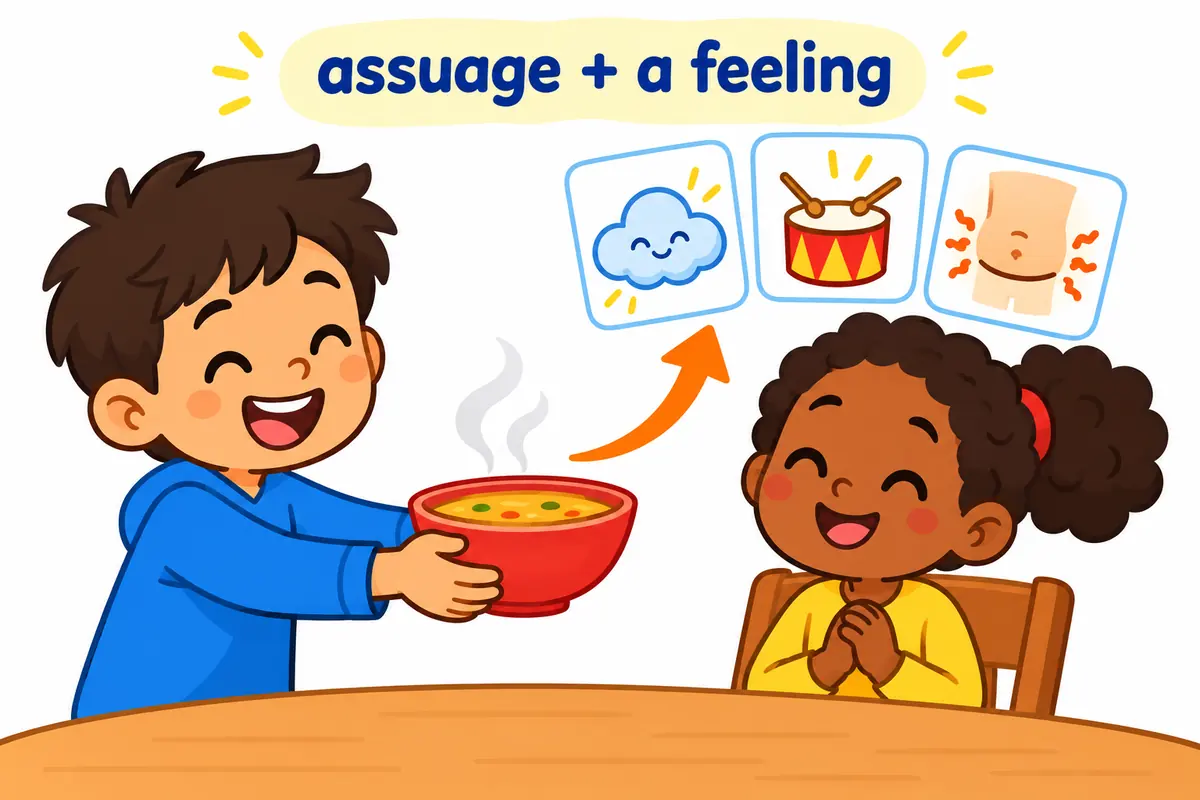
Assuage is a transitive verb meaning to make a painful or unpleasant feeling less intense. The Cambridge entry for assuage records the sense of making a strong feeling less strong, and the word works on emotions and needs rather than on objects. A cup of tea can assuage hunger; a kind word can assuage grief.
| Sense | Plain meaning | Example sentence |
|---|---|---|
| Ease a painful feeling | Make fear, grief or anger less sharp | A kind word assuaged his grief. |
| Satisfy a need | Make hunger or longing less pressing | The meal assuaged their hunger. |
| Soften strong emotion | Calm anger or doubt with care | Her calm reply assuaged the crowd. |
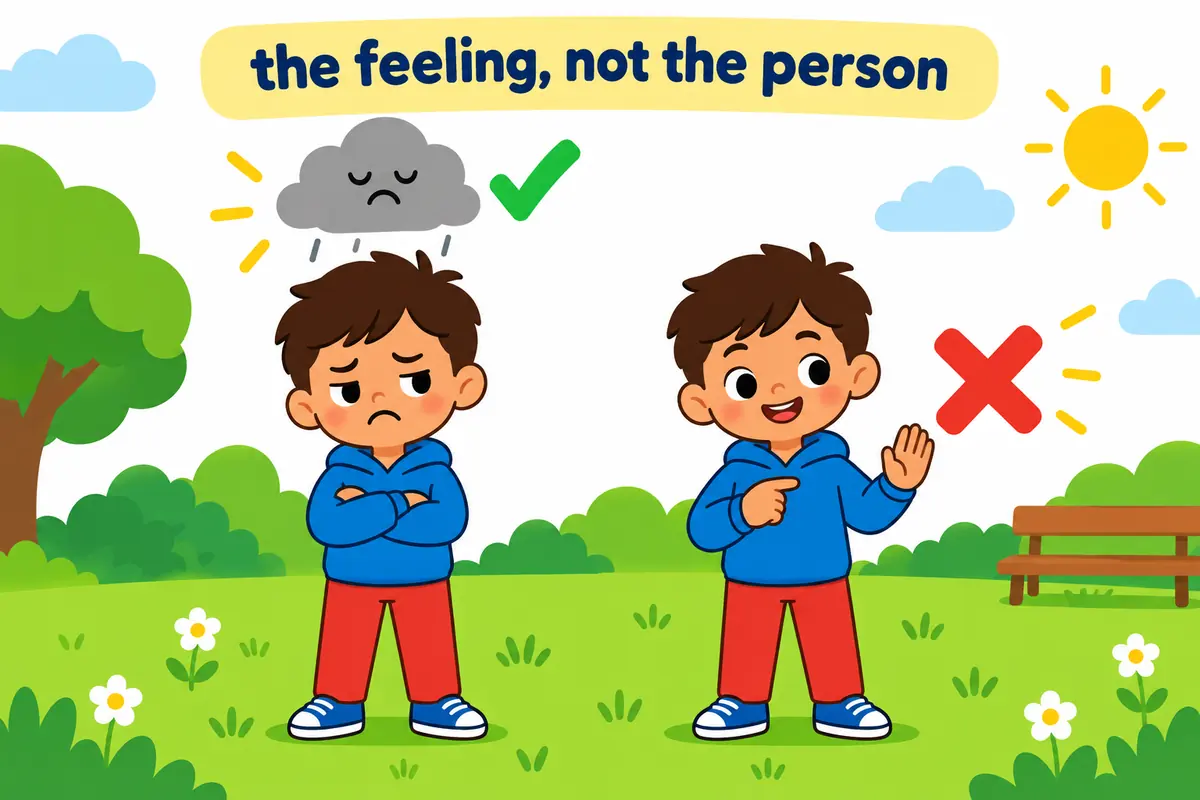
Assuage does not mean cure or remove. It makes a feeling less sharp, so grief can be assuaged and still present, and it never takes a person as its direct object: you assuage someone’s fear, not the someone. Where the goal is a plain, everyday word, ease a worry does the same work without the literary tone.
How do you use assuage in a sentence?
Assuage keeps a feeling or a need as its object, and the five patterns below cover almost every natural sentence. The fixed frame did little to assuage is the one that appears most often in news writing.
| Pattern | Example | What it signals |
|---|---|---|
| assuage + feeling | The apology assuaged her anger. | The object is an emotion or a need. |
| assuage + possessive + feeling | He tried to assuage their fears. | Names whose feeling is being eased. |
| did little to assuage | The statement did little to assuage public concern. | The commonest fixed frame in reporting. |
| be assuaged by | Her doubts were assuaged by the evidence. | Passive use that keeps the feeling in focus. |
| assuage with + noun | They assuaged the shock with warm food. | Names the means of easing. |
Assuage in a sentence: examples across contexts
The nine sentences below keep the same verb while moving from a classroom to medical writing, and each one names the feeling or need being eased. Where the target is physical pain rather than an emotion, soothe a sore throat is often the more concrete verb.
| Context | Example sentence | Why this works |
|---|---|---|
| Classroom | A kind note assuaged the new pupil’s worry. | A small action eases a named feeling. |
| Workplace email | We hope the refund will assuage any frustration. | Formal courtesy in a client message. |
| News report | The measures did little to assuage public anger. | Uses the fixed frame did little to assuage. |
| Medical writing | The drug assuaged the patient’s pain for hours. | Technical but natural object. |
| Literary fiction | Music assuaged his grief in the long evenings. | Shows the feeling as the direct object. |
| Academic prose | The findings assuaged doubts about the method. | Formal subject with an abstract feeling. |
| Conversation | A cup of tea assuaged my hunger. | Everyday use with food as the means. |
| Customer service | A clear timetable assuaged their anxiety. | Ties the action to the emotion. |
| Diary | Walking home assuaged her disappointment. | Shows a routine easing a mood. |
Assuage vs alleviate and appease
Assuage is routinely swapped for two near neighbours. To alleviate a problem is to make pain or a shortage less severe, while to appease a person is to calm them by giving them what they want. A follow-up note may mollify an angry reader in the same way that an apology assuages anger.
| Attribute | assuage | alleviate | appease |
|---|---|---|---|
| Core job | Make a feeling less intense | Make pain or a problem less severe | Calm someone by giving in |
| Typical object | Fear, guilt, grief, hunger | Pain, symptoms, a shortage | An angry person or group |
| Focus | The emotion | The physical problem | The person |
| Register | Formal and literary | Neutral to formal, medical | Neutral to formal, political |
| What it implies | Soothing, not removing | A measurable reduction | Concession and compromise |
Verdict: choose assuage for a feeling, alleviate for a measurable problem, and appease only when somebody is calmed by being given what they demanded.
Word forms and grammar of assuage
Assuage inflects regularly, and its noun assuagement is rare enough that many writers reach for relief instead. The table also lists the adjective most learners never meet. To mitigate a risk is a related formal verb, though it works on harm rather than on feelings.
| Form | Part of speech | Example |
|---|---|---|
| assuage | verb, base form | Time will assuage the shock. |
| assuages | verb, third person | A thank-you note assuages hurt feelings. |
| assuaged | verb, past and participle | The apology assuaged her doubts. |
| assuaging | verb, present participle | He kept assuaging their worries. |
| assuagement | noun | The letter offered little assuagement. |
Common mistakes with assuage
- Incorrect:
The nurse assuaged the patient.Correct: The nurse assuaged the patient’s pain. Rule: Assuage takes a feeling or need, not the person who feels it. - Incorrect:
Nothing could assuage him to stay.Correct: Nothing could persuade him to stay. Rule: Assuage cannot introduce a to-infinitive; use persuade or urge. - Incorrect:
The rain assuaged the drought completely.Correct: The rain alleviated the drought. Rule: Assuage is for feelings and needs, while alleviate suits a physical shortage. - Incorrect:
She assuaged that the news was true.Correct: The news assuaged her fears. Rule: The verb is transitive and takes a noun, never a that-clause.
Practice using assuage
Work through the six items, then check the reasoning rather than only the answer.
- Fill the gap: A short break ______ the children’s restlessness.
- Choose the better word: A cup of soup (assuaged / alleviated) his hunger.
- Correct the error: The manager assuaged the customer.
- Build a sentence: use do little to assuage about public worry.
- Spot the register: which belongs in a formal letter — We hope this refund assuages your frustration, or Sorry, hope that fixes your mad feelings.
- Rewrite with the noun: The music calmed her grief. Use assuagement instead.
Answers
- assuaged — restlessness is a feeling, which is the object the verb needs.
- assuaged — hunger is a need, and alleviated would suit a shortage or symptom.
- The manager assuaged the customer’s anger — the feeling, not the person, is the object.
- Model answer: The briefing did little to assuage public worry about the delays.
- We hope this refund assuages your frustration — it names the feeling and keeps the register formal.
- The music brought her a measure of assuagement — the noun takes an article and sounds formal.
The bottom line
Use assuage in a sentence to say that a painful feeling or pressing need has been made less sharp, and keep a feeling as the object. Two details decide most sentences: the verb describes soothing rather than removing, and it belongs to formal and literary registers. Where the target is physical pain or a shortage, alleviate is the more accurate choice.
Frequently asked questions about assuage
Is assuage a common word?
Assuage is formal rather than common in speech. It appears in news reports, fiction and academic writing, often in the frame did little to assuage. In everyday talk most people say ease, calm or soothe, so using assuage in a text message can sound deliberately literary.
What kinds of feelings can you assuage?
The verb suits negative feelings and pressing needs: fear, guilt, grief, anger, doubt, anxiety, hunger and thirst. You assuage a feeling rather than a person, and the feeling is usually strong enough to be noticeable. A mild preference is not normally assuaged.
What is the difference between assuage and alleviate?
Assuage eases a feeling such as fear or grief; alleviate reduces physical pain, symptoms or a problem such as a shortage. Both mean make less, but assuage works on emotions and needs while alleviate works on measurable conditions. The rain alleviates a drought, while an apology assuages resentment.
Does assuage mean the same as appease?
No. Assuage makes a feeling less intense, while appease calms a person by giving them something they want, often at a cost. You assuage someone’s anger by soothing it; you appease an angry crowd by conceding to its demands. Appease often implies a weak concession that assuage does not.
Have you ever needed to calm someone’s fears or doubts? That’s where the term “assuage” comes in handy. It means to make something less intense or severe, to ease or alleviate feelings of guilt, fear, or worry.
By using the word “assuage,” you can communicate effectively when discussing ways to relieve stress, soothe tensions, or lessen discomfort. This term provides a concise and powerful way to convey the idea of making someone feel better or smoothing out a difficult situation.
7 Examples Of Assuage Used In a Sentence For Kids
- Assuage your friend’s sadness by giving them a hug.
- Let’s sing a song to assuage our worries away.
- A sweet treat can help assuage your hunger.
- Holding hands can assuage your fears.
- Saying sorry can assuage a fight between friends.
- A kind word can assuage someone’s pain.
- A warm smile can assuage a bad mood.
14 Sentences with Assuage Examples
- Assuage your anxiety about exams by starting your preparations well in advance.
- It is important to assuage your hunger with healthy snacks during late-night study sessions.
- Assuage your stress by taking short breaks and practicing deep breathing exercises.
- A cup of hot tea can assuage your homesickness when you miss your family.
- To assuage your boredom, consider joining a club or extracurricular activity on campus.
- Physical exercise can help assuage your feelings of restlessness and improve your focus in class.
- Music therapy can be a great way to assuage any feelings of loneliness you may be experiencing.
- Joining a study group can help assuage your confusion and clarify difficult concepts.
- Eating a balanced diet with plenty of fruits and vegetables can assuage your worries about falling ill.
- Keeping a budget and tracking your expenses can assuage your financial concerns as a college student.
- Prioritizing self-care can assuage the burnout you may feel from balancing academics and social life.
- Setting achievable goals can assuage your fears about the future after college.
- Learning time management skills can assuage your anxiety about meeting deadlines for assignments.
- Connecting with a mentor or counselor can assuage your feelings of uncertainty about your career path after graduation.
How To Use Assuage in Sentences?
Assuage means to make something unpleasant less intense or severe. To use assuage in a sentence, simply follow these easy steps:
-
Identify a situation where you want to describe the act of lessening intensity or severity.
-
Determine the subject that is experiencing the unpleasant feeling or emotion that needs to be alleviated.
-
Locate an action or method that can be used to ease or pacify the situation.
-
Form a sentence that combines the subject, action, and assuage in a coherent manner. For example, “She tried to assuage his fears by reassuring him that everything would be okay.”
-
Ensure that the sentence flows smoothly and accurately conveys the idea of reducing the intensity or severity of the unpleasant feeling.
-
Practice using assuage in various sentences to become more comfortable with its usage and nuances.
Remember that assuage is a powerful word that can effectively communicate the act of soothing or calming a situation. By incorporating it into your vocabulary, you can convey your thoughts and feelings more precisely. Experiment with different contexts and scenarios to fully grasp the versatility of assuage in expressing a wide range of emotions and situations.
Conclusion
In conclusion, the use of assuage in sentences helps to convey a sense of calming, comforting, or soothing a feeling of distress or grief. By using this word in context, writers can effectively show how something eases or lessens a negative emotion or situation. Take for example, “She tried to assuage his guilt by reassuring him that it wasn’t his fault.” This demonstrates how assuage can be used to describe the act of alleviating a sense of responsibility or regret.
Overall, incorporating examples of sentences with assuage into writing can enhance the expression of emotions, actions, and outcomes in a clear and impactful manner. Whether used to depict the soothing of physical pain, the alleviation of worries, or the calming of fears, this word adds depth and nuance to descriptions and narratives, facilitating a more vivid and engaging reading experience.


