Austere is an adjective meaning severely plain or strict, with no decoration and no comfort to spare. To use austere in a sentence, pair it with the thing or manner it describes: “They lived in an austere room with one chair.” The word can praise simplicity or criticise coldness, depending on the noun.
Austere at a glance
- Austere is an adjective, so it describes a place, a style, a diet or a manner.
- It carries two linked senses: severely plain in appearance, and strict or serious in manner.
- The usual nouns it modifies are room, design, style, expression and measures.
- It can be approving when simplicity is the aim, and cold when comfort is missing.
- The commonest error is building the comparison as austerer instead of more austere.
What does austere mean?
Austere is an adjective meaning severely simple and without decoration, or strict and serious in manner. The Cambridge entry for austere records both the plain-appearance sense and the stern-manner sense, and the noun that follows usually shows which is meant. An austere building is bare; an austere teacher is severe. Where the meaning is self-denial rather than style, ascetic in habit is the more precise adjective.
| Sense | Plain meaning | Example sentence |
|---|---|---|
| Severely plain | Without decoration or comfort | The chapel was austere, with bare stone walls. |
| Strict and serious | Severe in manner or discipline | Her austere expression silenced the room. |
| Frugal and self-denying | Very simple, often by choice | They kept an austere household for years. |
One limitation is worth stating plainly. Austere is not the same as poor or ugly, and it is not a synonym for expensive restraint. A room can be austere by design and still be beautiful, and a budget can be austere without anyone going hungry. Where the only meaning is strict and unkind, stern or severe is often the truer word.
How do you use austere in a sentence?
Place austere before the noun it describes, or after a linking verb such as be, seem or look. Five patterns cover almost every real sentence, and the noun usually names the exact thing that is bare or strict.
| Pattern | Example | What it signals |
|---|---|---|
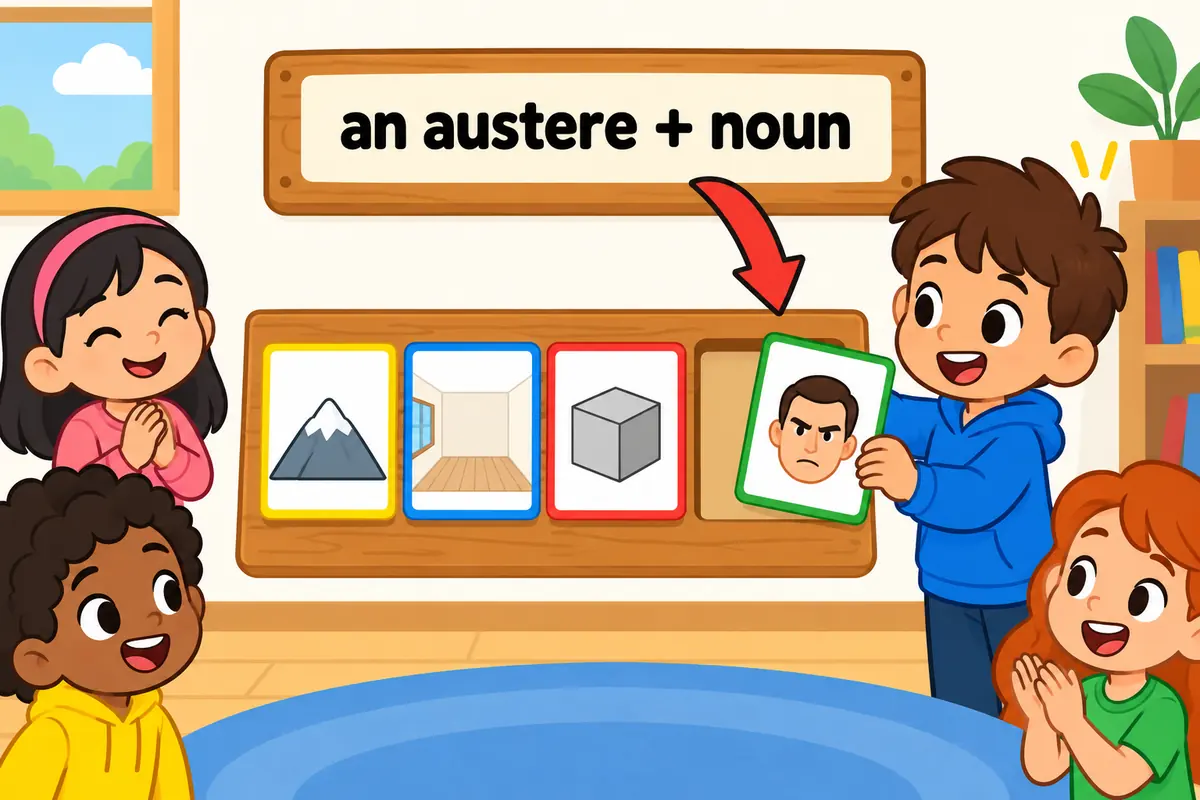
| austere + noun | The office had an austere dignity. | Adjective before the thing it describes. |
| be + austere | The meal was austere but delicious. | Predicative judgement after a linking verb. |
| austere in + noun | The monks were austere in their habits. | Names the area of strictness. |
| an austere + style | She favours an austere design. | A common collocation with style or design. |
| more / most austere | This hall is the most austere on campus. | Comparison with more, never -er. |
The third pattern is the one learners miss. Austere in their habits marks the manner, while the same adjective before room marks the appearance, and only context tells the reader which sense is active. Where the tone is merely harsh, severe with staff is the plainer choice.
Austere in a sentence: examples across contexts
Austere moves between design and discipline without changing its core idea of plainness. The nine sentences below show that range, and the last few would keep their meaning with spartan in the dormitory, which stresses hardship a little more strongly.
| Context | Example sentence | Why this works |
|---|---|---|
| Architecture | The gallery is austere, all concrete and clean lines. | Describes a deliberate lack of ornament. |
| Workplace | Staff worked in an austere office with no pictures. | Shows plainness as a working condition. |
| Economics | The government announced austere measures to cut borrowing. | Applies the word to strict policy. |
| Education | The head teacher ran an austere regime of early starts. | Points at discipline rather than appearance. |
| History writing | The monks kept an austere routine of prayer and work. | Names a self-denying way of life. |
| Fashion | Her austere black coat had no buttons at all. | Simplicity becomes a style statement. |
| Food writing | The austere menu offered bread, soup and little else. | Plainness applied to a meal. |
| Art review | Critics praised the painter’s austere palette. | Names a restricted choice of colour. |
| Conversation | The flat felt austere after the warm clutter of home. | Records a personal impression of coldness. |
The last row shows the negative edge: the same absence of decoration that a gallery celebrates can make a home feel unwelcoming.
Austere vs ascetic and severe
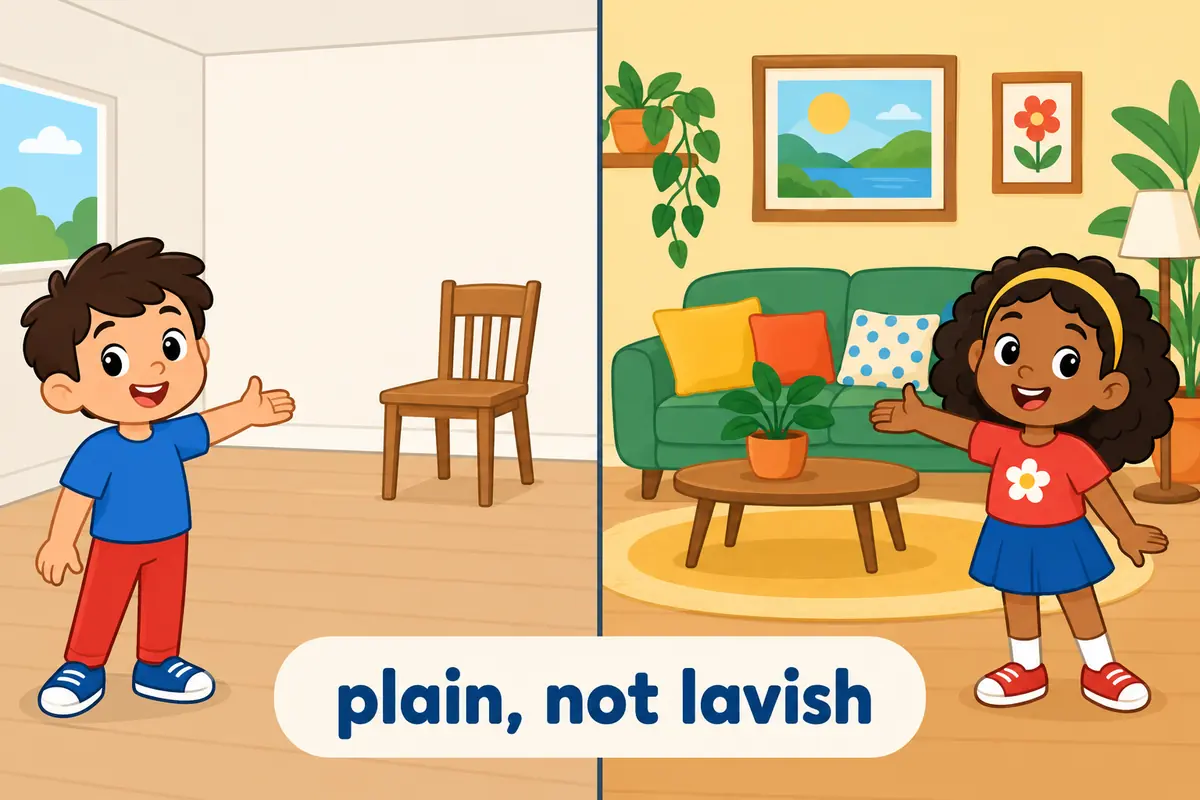
Austere sits close to ascetic and severe, and the three divide by what they describe. An ascetic life is chosen for discipline, an austere design is simply bare, and a severe manner is harsh. The opposite of an austere room is a lavish interior, rich in every surface.
| Attribute | austere | ascetic | severe |
|---|---|---|---|
| What it describes | Plain appearance or strict manner | A self-denying way of life | Harshness or intensity |
| Source of plainness | Design, budget or taste | Personal discipline | Not about plainness at all |
| Typical noun | Room, design, measures, expression | Ascetic practices, a life | Pain, weather, punishment, criticism |
| Positive use | Yes, for elegant restraint | Yes, for dedication | Rarely |
| Register | Formal and descriptive | Formal and specialised | Neutral and wide |
Verdict: choose ascetic when the plainness is a chosen discipline, severe when the quality is harshness rather than simplicity, and austere when a place or manner is stripped bare.
Word forms and grammar of austere
Austere has an adverb and a noun that learners often miss. The noun austerity names the condition or the policy of cutting back, while the adverb austerely describes how something is done or furnished.
| Form | Part of speech | Example |
|---|---|---|
| austere | adjective, base form | The hall was austere and cold. |
| more austere | comparative adjective | Her later designs grew more austere. |
| most austere | superlative adjective | It is the most austere room in the building. |
| austerely | adverb | The office was austerely furnished. |
| austerity | noun | The years of austerity changed the town. |
| austerer | not standard | The new wing is more austere than the old one. |
Note the last row: austere compares with more, not with -er, so austerer is never correct in standard writing.
Common mistakes with austere
- Incorrect:
The room was decorated with austere.Correct: The room was austere in its decoration. Rule: austere is an adjective, so it describes a noun or follows a linking verb. - Incorrect:
He lived in austere.Correct: He lived in austere conditions. Rule: the adjective needs a noun unless it follows be, seem or look. - Incorrect:
This design is austerer than that one.Correct: This design is more austere than that one. Rule: long adjectives compare with more, never with -er. - Incorrect:
The austere meal meant the family was poor.Correct: The austere meal was plain, whether by choice or necessity. Rule: austere means plain or strict, not automatically poor. - Incorrect:
She spoke austere to the class.Correct: She spoke austerely to the class. Rule: use the adverb to describe how something is done.
Practice using austere
Work through the six items, then check the reasoning rather than only the answer.
- Fill the gap: The dormitory was ______, with a bed, a desk and nothing more.
- Choose the better word: For a life of chosen self-denial, use (austere / ascetic).
- Correct the error: The new library is austerer than the old reading room.
- Build a sentence: use austere in + noun about a strict daily routine.
- Spot the register: which suits an architecture review — an austere concrete facade, or a dead plain front?
- Rewrite with the noun: The budget cuts were austere. Use austerity.
Answers
- austere — the bare room is the plain-appearance sense of the adjective.
- ascetic — ascetic stresses a chosen, disciplined way of life rather than mere plainness.
- The new library is more austere than the old reading room — long adjectives compare with more.
- Model answer: The monks were austere in their daily routine of prayer and work.
- An austere concrete facade — the formal noun phrase matches the register of a design review.
- The budget cuts meant years of austerity — the noun names the policy or condition, not the style.
The bottom line
Use austere in a sentence to describe something stripped bare or someone strictly serious, placing it before a noun or after a linking verb. The two details that settle most sentences are these: the word covers both plain appearance and stern manner, and it compares with more rather than -er. Where the plainness is a chosen discipline, ascetic in habit remains the sharper word.
Frequently asked questions about austere
Is austere positive or negative?
Austere is neutral and takes its tone from the noun. An austere design can win praise for elegant restraint, while an austere room can feel cold and unwelcoming. The word itself means plain or strict; whether that is good depends entirely on what is being described.
What is the difference between austere and ascetic?
Austere describes a plain appearance or a strict manner, and it can apply to buildings, budgets and faces. Ascetic is narrower and describes a way of life chosen for discipline, usually involving self-denial. An ascetic person is almost always austere, but an austere room says nothing about anyone’s choices.
What is the noun of austere?
The noun is austerity, as in years of austerity. It names the condition of being austere or the policy of severe cutbacks. Austereness also exists but is rare. The adverb austerely is used for how something is done, as in the office was austerely furnished.
Can austere describe a person?
Yes, when it names a manner rather than an appearance. An austere teacher is strict and unsmiling, and an austere expression is severe. For a person, austere means serious and disciplined, not plain-looking, so the noun that follows the adjective usually makes the sense clear.
Have you ever encountered a sentence so bare and unembellished that it communicated a sense of strictness and simplicity? This type of sentence can be described as austere, characterized by its severity and lack of adornment.
In writing, an austere sentence serves the purpose of conveying a message in the most straightforward and unadorned manner possible, often devoid of unnecessary embellishments or flourishes. The use of austere sentences can result in a tone that is direct, serious, and to the point, making them particularly effective in contexts where brevity and clarity are valued.
7 Examples Of Austere Used In a Sentence For Kids
- The monk lived an austere life in a simple hut.
- The room was decorated in an austere style with minimal furniture.
- The teacher’s rules were austere, requiring good behavior at all times.
- The soldier wore an austere uniform with no fancy decorations.
- The palace had austere decorations, with plain walls and no ornaments.
- The king lived in an austere castle without any extravagant luxuries.
- The classroom had an austere atmosphere, encouraging focus and discipline.
14 Sentences with Austere Examples
- Austere living is necessary for college students to save money for textbooks and food.
- Many college hostels enforce austere rules to ensure discipline and focus in academic pursuits.
- As a part of their training, medical students must adhere to austere standards of cleanliness and hygiene.
- The library provides an environment of austere silence for students to concentrate on their studies.
- Time management is key to balancing an austere college schedule with extracurricular activities.
- Some professors prefer an austere classroom setup to minimize distractions and promote learning.
- The hostel rooms have austere furnishings, emphasizing the importance of simplicity and minimalism.
- Participating in volunteer work can teach students the value of austere living and giving back to society.
- Maintaining an austere diet can improve students’ health and overall well-being during exams.
- Student unions often organize austere events to raise funds for charitable causes.
- The college canteen offers austere meal options for students on a tight budget.
- Some students choose to adopt an austere lifestyle to reduce their carbon footprint and environmental impact.
- Attending austere study groups can enhance collaboration and mutual support among classmates.
- Young entrepreneurs often start their businesses with an austere budget to test their ideas and concepts.
How To Use Austere in Sentences?
To use the word Austere in a sentence, you must first understand its meaning. Austere is an adjective that describes something simple, plain, or stern in appearance or manner.
Here is a beginner-friendly guide on how to use Austere in a sentence:
-
Choose a noun that you want to describe as simple, plain, or stern. For example, “The office design was very austere.”
-
Place the word Austere before the noun you want to describe. For instance, “The austere office design created a minimalist and professional atmosphere.”
-
Remember that Austere is used to describe things that lack adornment or are stern in nature. You could say, “The monk lived an austere life of simplicity and self-discipline.”
-
Ensure that the sentence makes sense and conveys the intended meaning clearly. For example, “The austere decorations at the wedding reflected the couple’s preference for understated elegance.”
-
Practice using Austere in different sentences to become more comfortable with its usage. Experiment with various contexts and scenarios to deepen your understanding of the word and how it can be applied.
By following these steps and practicing regularly, you will be able to confidently use the word Austere in your writing and conversations.
Conclusion
In conclusion, the sentences with the keyword “austere” often convey a sense of strictness, simplicity, and seriousness. These sentences typically describe a setting, environment, or person as plain, simple, and lacking in luxury or indulgence. The use of the word “austere” evokes a feeling of seriousness and austerity, often highlighting a lack of adornment or extravagance.
Overall, sentences with the keyword “austere” paint a picture of a restrained and unembellished quality, emphasizing a sense of simplicity and seriousness. Whether describing a room, a lifestyle, or a person’s demeanor, the word “austere” brings to mind a lack of excess and a focus on the essentials.


