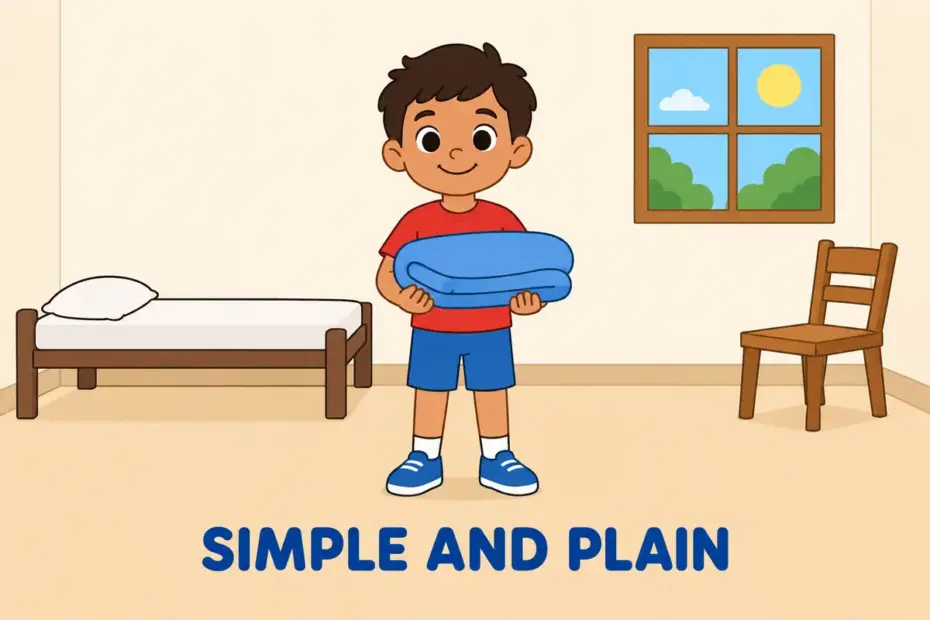
Spartan describes something severely simple and without comfort, in the style once linked to ancient Sparta. To use spartan in a sentence, place it before the noun it describes: “a spartan classroom” or “spartan conditions”. The adjective also carries a second sense of tough, self-disciplined endurance.
Spartan at a glance
- Spartan is an adjective meaning severely simple, plain and without luxury.
- It is usually attributive, placed before the noun: a spartan office.
- A second sense describes tough, disciplined endurance: a spartan training routine.
- It commonly partners with room, meal, diet, regime, conditions and existence.
- Capitalise it only for ancient Sparta or its people; the everyday adjective is lowercase.
What does spartan mean?
Spartan is an adjective meaning severely simple and without comfort or luxury, and it also describes a tough, self-disciplined way of living. The Cambridge entry for spartan records both senses, which differ in what is missing: the first lacks decoration, the second lacks ease. A guest room with a bare bed and one chair is plain in the first sense; a runner who trains before dawn every day lives a spartan life in the second. A room can be simple by accident, but spartan suggests the bareness was chosen or endured.
| Sense | Plain meaning | Example sentence |
|---|---|---|
| Severely simple | Bare, unadorned, without comfort | They slept in a spartan hut with a plank bed and a single lamp. |
| Self-disciplined | Tough, rigorous, denying easy pleasure | His spartan routine began at five with a cold run. |
| Of ancient Sparta | Belonging to Sparta or its citizens | A Spartan shield stood propped against the museum wall. |
One honest limit. Spartan does not mean dirty, broken or neglected. A spartan room is deliberately bare and usually clean and orderly; if the point is that a place is squalid, choose filthy or run-down instead. Nor does it mean poor by force: the word praises restraint at least as often as it reports hardship.
How do you use spartan in a sentence?
Spartan works in two positions: directly before a noun, or after a linking verb such as be, seem or remain. Its partners are almost always things that could otherwise be comfortable, which is why the word sounds like a comment on excess.
| Pattern | Example | What it signals |
|---|---|---|
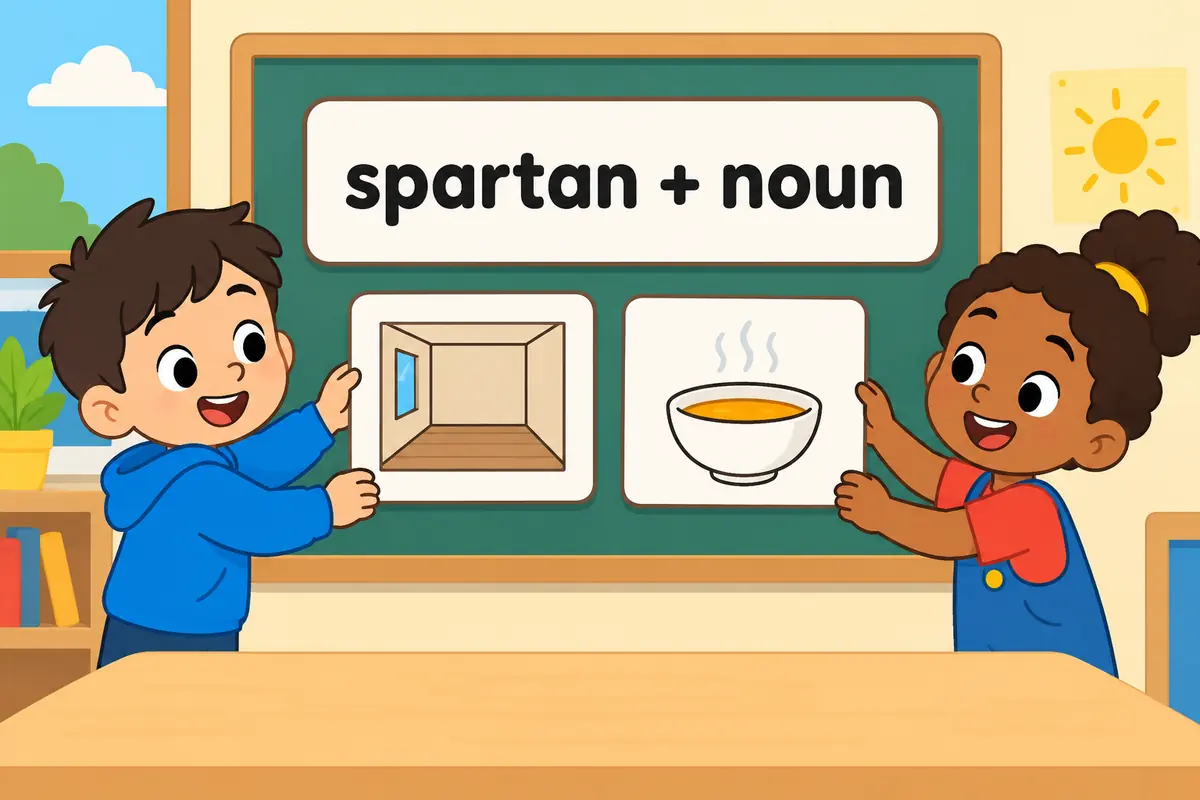
| spartan + noun (attributive) | We worked all term in a spartan seminar room with no heating. | The bareness is a standing quality of the noun |
| be / seem / remain spartan (predicative) | The hostel rooms were spartan but spotless. | The condition is noticed or assessed |
| more / most spartan (comparative) | The new cabin is even more spartan than the old one. | Degrees of plainness compared |
| a spartan + lifestyle noun | She kept to a spartan diet of rice, beans and water. | A chosen, disciplined way of living |
Spartan in a sentence: examples across contexts
| Context | Example sentence | Why this works |
|---|---|---|
| Interior description | The flat was spartan: white walls, one table, a chair and a kettle. | Concrete details show the missing comfort. |
| Travel writing | Beyond the pass we found a spartan refuge with bunks and a wood stove. | The bare shelter contrasts with the journey. |
| Sports training | Her spartan pre-season schedule allowed no rest days at all. | The disciplined sense fits athletic preparation. |
| Workplace memo | The team moved to a spartan corner with desks and nothing else. | Frames a plain office without complaint. |
| History essay | A Spartan upbringing was designed to produce soldiers, not scholars. | The capital-S proper adjective names ancient Sparta. |
| Food writing | The menu was frugal and frankly spartan: bread, soup and an apple. | Links thrift with deliberate plainness. |
| News report | Aid workers described the camps as severe and spartan, with one tap for two hundred people. | Adds harshness to the bareness. |
| Art review | The stark, spartan gallery leaves the visitor alone with the painting. | Stacks two words of severity for effect. |
| Classroom discussion | Would you rather study in a spartan library or a crowded cafe? | Tests the word in a comparison of environments. |
Spartan vs austere
Both adjectives describe a lack of comfort, and both are used to praise restraint. The difference is where the severity points.
| Attribute | Spartan | Austere |
|---|---|---|
| Core meaning | Severely simple, without luxury | Severe and strict, often forbidding |
| Typical focus | Physical plainness and discipline | Manner, design or morality |
| Usual tone | Admiring or neutral | Cold, serious, slightly distant |
| Common partners | room, meal, regime, conditions | beauty, style, face, rules |
| Opposite sense | Comfortable, lavish | Warm, gentle, indulgent |
Verdict: use spartan for a bare room or a disciplined routine, and austere when the severity feels rule-bound or emotionally cold. A lavish hotel is the direct opposite of a spartan one, while an indulgent meal sits opposite an austere diet.
Word forms and grammar of spartan
| Form | Part of speech | Example |
|---|---|---|
| spartan | adjective | The dormitory was spartan but warm. |
| more spartan, most spartan | comparative / superlative | Each year the camps grew more spartan. |
| Spartan | proper adjective / noun | A Spartan general led the march. |
| spartanic, spartanesque | non-standard coinages | Not accepted forms; use spartan instead. |
Common mistakes with spartan
Incorrect: They spent a spartan holiday in a five-star resort. Correct: They spent a luxurious holiday in a five-star resort. Rule: Spartan means without luxury, so it cannot describe an indulgent setting.
Incorrect: The spartan room was filthy and the sheets were torn. Correct: The spartan room was bare but spotless. Rule: Spartan means plain and unadorned, not dirty or damaged.
Incorrect: A spartan soldier of ancient Greece carried a long spear. Correct: A Spartan soldier of ancient Greece carried a long spear. Rule: Capitalise the word when it names Sparta or its people.
Incorrect: Her spartanic routine impressed the coach. Correct: Her spartan routine impressed the coach. Rule: English forms no adjective spartanic; spartan already does the work.
Incorrect: The spartan rules punished every mistake. Correct: The austere rules punished every mistake. Rule: Use austere for strictness of rule and spartan for bareness of living.
Practice using spartan
- Fill in the blank: After the flood, the family moved into a ___ shelter with two beds and a stove.
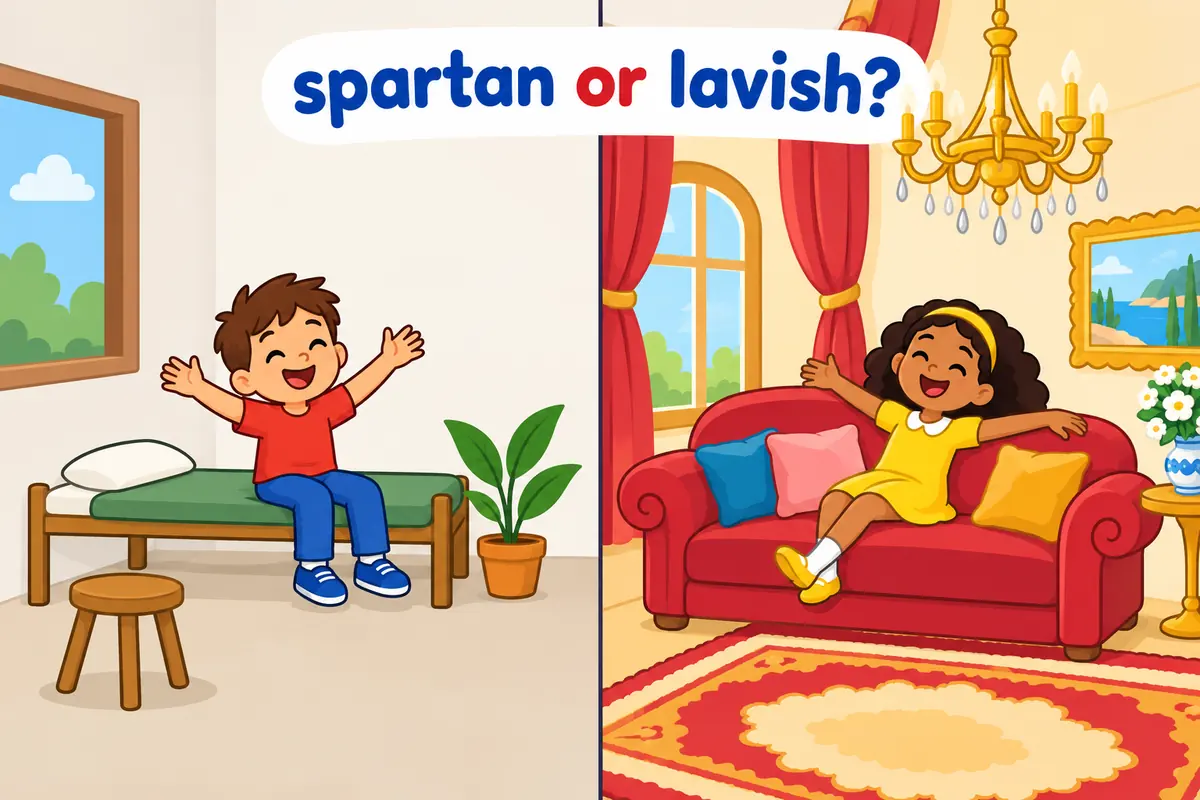
- Choose the better word: The monks kept a ___ diet, while the palace offered ___ feasts. (spartan / lavish)
- Correct the error: Her spartanic training schedule left no room for rest.
- Build a sentence: use spartan about a bedroom that has been cleared of everything unnecessary.
- Spot the register: which sentence belongs in a travel review – The room was a bit basic, or The room was spartan but immaculate?
- Fill in the blank: A ___ upbringing taught the young soldiers to endure cold and hunger.
Answers
- spartan – a bare shelter with only essentials suits the word.
- spartan then lavish – the two words mark the opposite extremes of plain and rich.
- Her spartan training schedule left no room for rest. – spartanic is not an English word.
- We stripped the bedroom to a spartan space with a bed, a lamp and a single chair. – the bareness is the point.
- The second sentence – spartan is precise, neutral and formal enough for a review.
- spartan – the word ties toughness and self-discipline to the training.
The bottom line
Spartan is an adjective for something severely simple and without comfort, and it extends to a tough, self-disciplined way of life. Put it before the noun, as in a spartan room or a spartan regime, and keep it lowercase unless it refers to ancient Sparta. Spartan in a sentence praises restraint; it never means dirty or neglected.
Frequently asked questions about spartan
Is spartan spelled with a capital letter?
Only when it refers to ancient Sparta, its citizens or their culture. The everyday adjective meaning plain and without luxury is written in lowercase, as in a spartan office. If you can replace the word with bare, use lowercase; if it names the city-state, use a capital S.
Does spartan mean poor?
No. Spartan describes a lack of comfort and decoration, not a lack of money. A wealthy household can choose a spartan style, and a spartan room may contain expensive minimal furnishings. The word comments on plainness and discipline, not on poverty, which needs words such as destitute or impoverished.
What is the difference between spartan and austere?
Spartan emphasises physical plainness and self-discipline, and it often sounds admiring. Austere emphasises strictness and coldness, whether in rules, faces or design, and it can sound forbidding. A spartan cabin is bare by choice; an austere manor is severe by manner and mood.
Can spartan describe a person?
Yes, though usually through their habits rather than their body. A spartan athlete trains hard and accepts few comforts, and a spartan lifestyle is one of restraint. When the word describes a person directly, it means self-disciplined and frugal, not muscular or fierce.
Have you ever heard of the term “spartan” being used to describe something simple or minimalist? The word “spartan” refers to a lifestyle or design that is characterized by austerity, simplicity, and efficiency.
In the context of writing, a spartan sentence is one that conveys the intended message effectively with minimum words and embellishments. It aims to be concise, direct, and to the point without sacrificing clarity or impact.
7 Examples Of Spartan Used In a Sentence For Kids
- Spartan was a brave warrior in ancient Greece.
- I played with a Spartan toy soldier today.
- My dad told me a story about the strong Spartan soldiers.
- The Spartan helmet looks very cool and shiny.
- Let’s pretend to be brave like the Spartan warriors!
- The Spartan shield had a scary image on it.
- I drew a picture of a big Spartan sword.
14 Sentences with Spartan Examples
- Spartan lifestyles can help college students save money and prioritize their expenses.
- Having a Spartan study routine can improve academic performance and reduce procrastination.
- College hostels often have Spartan accommodations, teaching students to live with minimal luxuries.
- Adopting a Spartan diet of simple, nutritious meals can improve overall health and focus.
- Choosing Spartan clothing options can make getting ready for college easier and more efficient.
- A Spartan approach to socializing can help students focus on their studies and career goals.
- Attending a college with a Spartan campus can foster a sense of discipline among students.
- Spartan exercise routines can help college students stay fit and energized throughout the day.
- Many college libraries have Spartan design aesthetics to promote a quiet and focused studying environment.
- Creating a Spartan budget plan can help college students manage their finances responsibly.
- A Spartan approach to time management can help students balance their academic, social, and personal commitments.
- Group study sessions are often more productive in Spartan environments with limited distractions.
- Choosing a Spartan dormitory setup can lead to a more organized and clutter-free living space.
- In a Spartan college environment, students learn to appreciate the value of simplicity and minimalism.
How To Use Spartan in Sentences?
Spartan is a word that can be used to describe something simple, frugal, or disciplined. Here is a guide for beginners on how to use Spartan in a sentence effectively:
-
Spartan can be used as an adjective to describe someone or something as plain or lacking luxury. For example, “He lived a Spartan lifestyle, only owning the essentials.”
-
Spartan can also be used to describe someone’s attitude or behavior as disciplined or strict. For instance, “The coach had a Spartan approach to training, pushing the players to their limits.”
-
Another way to use Spartan is to convey a sense of bravery or resilience in difficult or challenging situations. For instance, “Her Spartan courage in the face of adversity inspired others.”
-
In the context of design or aesthetics, Spartan can be used to describe a minimalist or unadorned style. For example, “The room was decorated in a Spartan fashion, with only a few simple pieces of furniture.”
By incorporating Spartan into your vocabulary, you can add depth and nuance to your descriptions and convey a sense of simplicity, discipline, or toughness. Practice using Spartan in various contexts to become more comfortable with its usage.
Conclusion
In conclusion, sentences containing the keyword “Spartan” often refer to something austere, simple, or lacking in luxury. These sentences convey a sense of minimalism, toughness, and discipline, often drawing inspiration from the historic practices of the ancient Spartan society.
Through the use of the keyword “Spartan” in sentences, a stark contrast is created, highlighting the essence of simplicity, frugality, and rigorous discipline. Whether describing a Spartan lifestyle, a Spartan diet, or a Spartan design, these sentences effectively capture the idea of bare essentials, embodying a sense of toughness and resilience in various contexts.