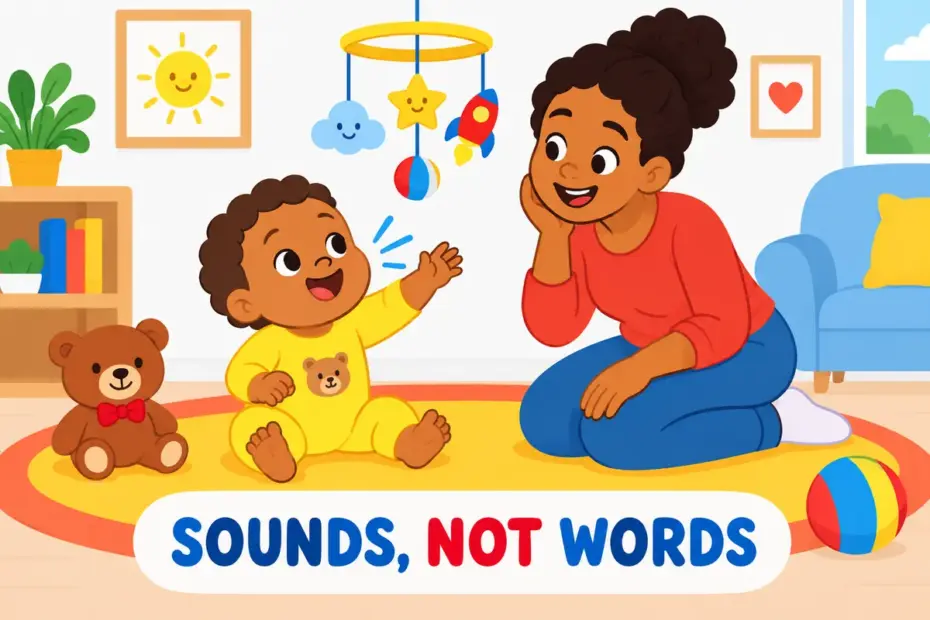
Babble means to speak quickly and unclearly, or to make the soft sounds a baby makes before real words appear. To use babble in a sentence, name who is speaking and what the speech sounds like: “The toddler babbled happily at the cat.” The verb works alone or takes an object, as in babble an excuse.
Babble at a glance
- Babble is a verb and a noun; its forms are babbles, babbled and babbling.
- The core senses are unclear rapid speech and the sounds of a baby.
- The usual subjects are babies, excited crowds and people talking nonsense.
- Babble can be intransitive or take an object such as an apology.
- The commonest error is missing babble on, which stresses unwanted length.
What does babble mean?
Babble is a word for speech that flows faster than it can be understood. The Cambridge entry for babble records three related senses: a person talking quickly and foolishly, the pre-word sounds of an infant, and the gentle sound of running water. A stream can babble just as a toddler can, though the water sense is calm while the human sense is usually critical. For harmless fast talk, prattle is a gentler cousin.
| Sense | Plain meaning | Example sentence |
|---|---|---|
| Human speech | Talk quickly and unclearly | He babbled an apology. |
| Baby sounds | Make pre-word sounds | The baby babbled at the mobile. |
| Water sound | Make a gentle running sound | The brook babbled over the stones. |
Babble is not neutral when a person is the subject. Calling an adult’s speech babble is dismissive, so it suits criticism and humour rather than a fair summary of a serious argument. For merely quick speech, chatter is kinder.
How do you use babble in a sentence?
The verb works alone, with the particle on, or with an object that names what was said. The five patterns below cover the ordinary uses.
| Pattern | Example | What it signals |
|---|---|---|
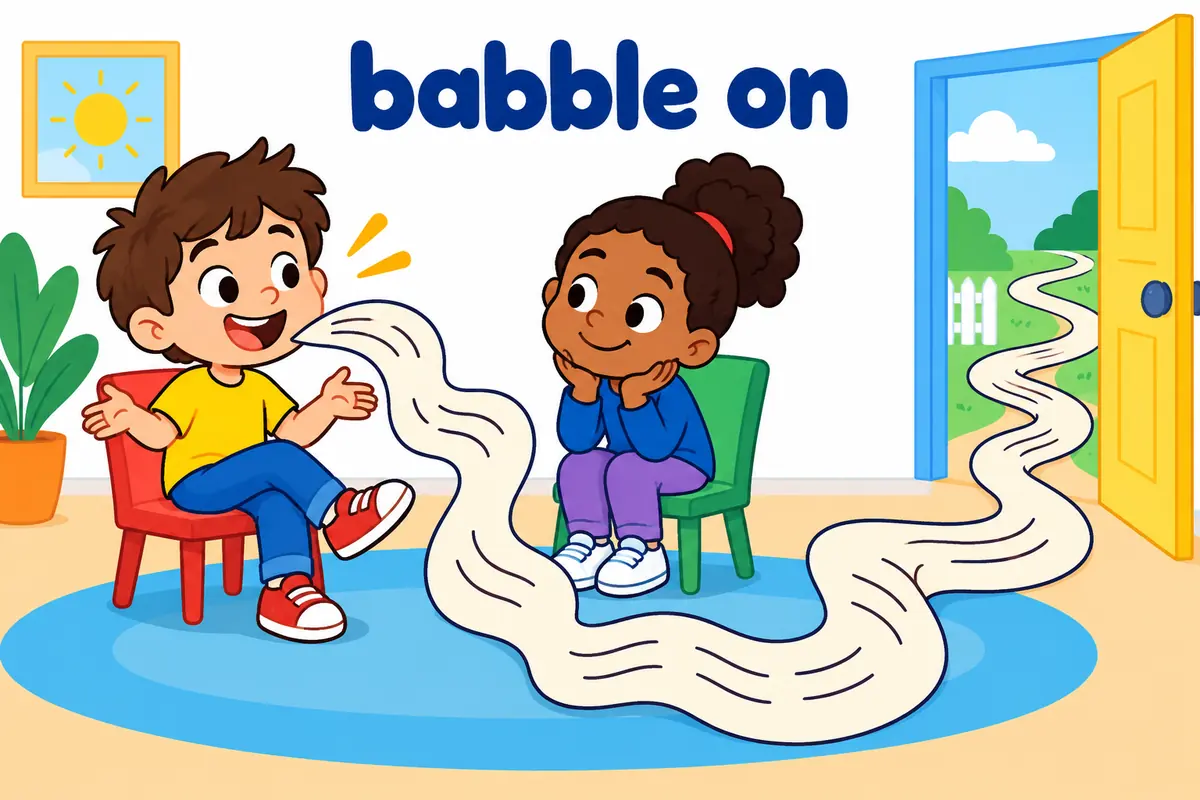
| babble on | She babbled on about nothing. | The particle adds the idea of unwanted length. |
| babble + an object | He babbled an excuse and left. | The object is the thing said, not the listener. |
| babble at or to + person | The baby babbled at her sister. | Names the audience of the sound. |
| babble with + emotion | He babbled with excitement. | Names the cause of the rush. |
| babble as a mass noun | A babble of voices filled the hall. | Bundles many sounds into one word. |
Babble in a sentence: examples across contexts
The word moves from the nursery to the newsroom, but each use keeps the sense of speech too quick or too shapeless to follow.
| Context | Example sentence | Why this works |
|---|---|---|
| Parenting | The baby babbled at the colourful mobile above the cot. | Baby sounds are the neutral, affectionate use. |
| Classroom | The excited class babbled about the trip before the bell. | A group subject takes the mass-noun flavour. |
| News report | The minister babbled an answer that raised more questions. | The dismissive sense drives the criticism. |
| Literature | A babble of voices rose from the market square. | The mass noun paints the sound of a crowd. |
| Nature writing | The stream babbled between the smooth stones. | The water sense is gentle and peaceful. |
| Comedy writing | He babbled on while the kettle quietly boiled dry. | The particle on makes the length the joke. |
| Workplace | She babbled through the briefing, losing the room. | Names the failure to communicate clearly. |
| Diary | I babbled with nerves when the head teacher called my name. | With names the emotion behind the rush. |
| Academic prose | The transcript is little more than babble about the weather. | Uses babble as a noun of criticism. |
Babble vs chatter
Chatter is the closest neutral neighbour of babble: both describe a stream of talk, but only one of them judges the content.
| Attribute | babble | chatter |
|---|---|---|
| Core meaning | Unclear or empty talk | Quick, light talk |
| Implied judgement | Dismissive | Neutral or friendly |
| Typical subject | A baby, a flustered adult, a brook | A group, children, birds |
| What it implies | The speech is hard to follow | The speech is simply quick |
| Best register | Criticism and humour | Descriptive and everyday |
Verdict: choose babble to criticise speech you cannot follow or respect, and choose chatter when the talk is quick but harmless.
Word forms and grammar of babble
Babble has a compact family, and the participle does double duty as a noun. The table lists the forms learners meet most often.
| Form | Part of speech | Example |
|---|---|---|
| babble | verb, base form | Babies babble before they speak. |
| babbled | verb, past and past participle | He babbled an apology. |
| babbling | verb participle or noun | Her babbling kept the room entertained. |
| babble | noun, mass | The babble of the crowd died away. |
| babbler | noun, a person | The babbler never let anyone finish. |
| babble on | phrasal verb | He babbled on for an hour. |
The participle babbling names the developmental stage itself, and the near-synonym gabble suggests speech that is even harder to follow.
Common mistakes with babble
- Incorrect:
The crowd babbled clearly so everyone understood.Correct: The crowd chattered clearly so everyone understood. Rule: Babble implies unclear or meaningless sound, so it clashes with clearly. - Incorrect:
He babbled the news to be long.Correct: He babbled on about the news. Rule: On carries the idea of unwanted length; babble alone does not take an infinitive of purpose. - Incorrect:
The teacher babbled the instructions.Correct: The teacher explained the instructions. Rule: Babble is dismissive, so it is wrong when the speech is useful. - Incorrect:
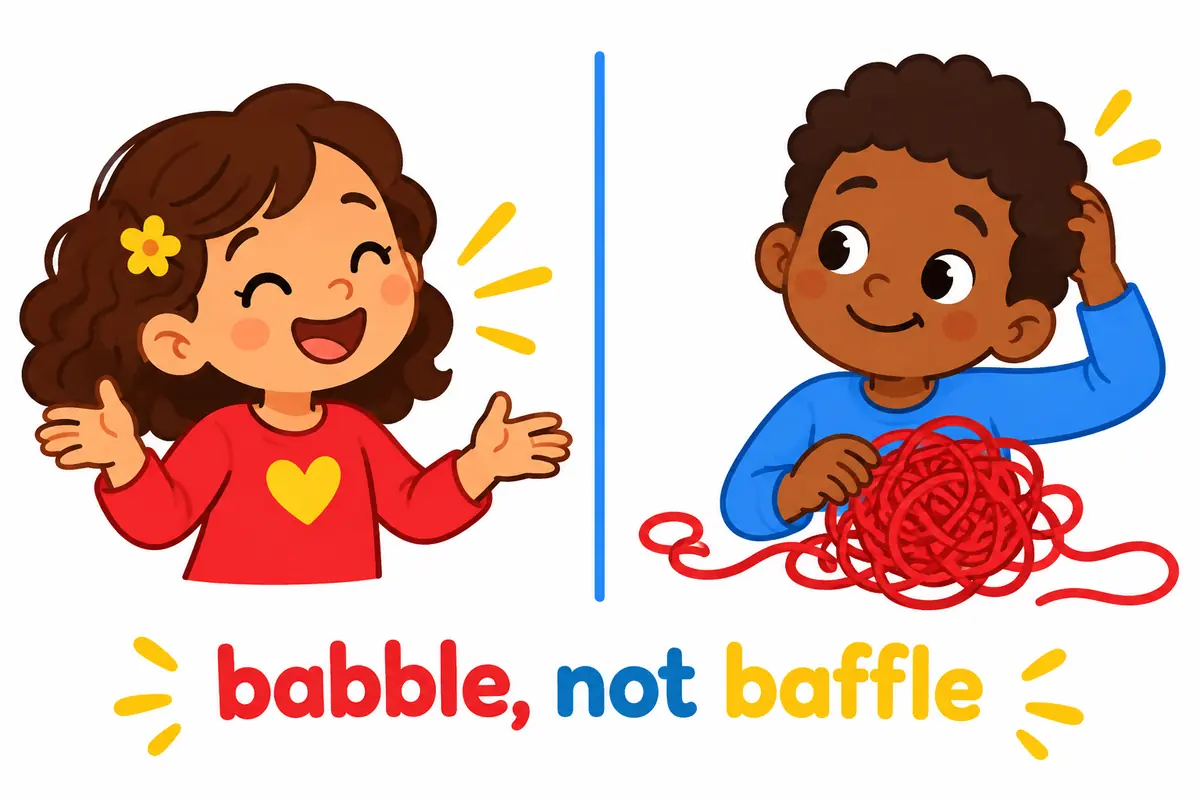
Do not baffle your plans at the meeting.Correct: Do not babble your plans at the meeting. Rule: Baffle means to confuse someone; babble means to speak unclearly. - Incorrect:
His words were babbled by the poor signal.Correct: His words were garbled by the poor signal. Rule: Garble means to distort a message; babble means to speak unclearly. - Incorrect:
The stream babbled loudly with voices.Correct: The stream babbled over the rocks. Rule: When the subject is water, babble describes a gentle sound, not speech.
Practice using babble
Work through the six items, then check the reason as well as the answer.
- Fill the gap: The tired child ______ on about dragons until she fell asleep.
- Choose the better word: The quiet library had a low (babble / chatter) of friendly voices.
- Correct the error: The stream babbled with excitement.
- Build a sentence: use babble on about a long phone call.
- Spot the register: which fits a nature book — the brook babbled over the stones, or the brook babbled, like, nonstop?
- Rewrite with the noun: The crowd babbled gently. Use babble as a noun.
Answers
- babbled — on signals the talk went on at length.
- chatter — friendly voices need the neutral word; babble would judge them.
- The stream babbled over the rocks — water babbles gently, so with excitement does not fit.
- Model answer: My uncle babbled on about his car for twenty minutes.
- The brook babbled over the stones — a nature book avoids the casual like and nonstop.
- The babble of the crowd was gentle — the mass noun names the sound itself.
The bottom line
Use babble in a sentence for speech that runs too fast or too shapeless to follow, or for the comforting sounds of a baby or a brook. The two details that decide most sentences are that the word judges human speech while treating water and infants gently, and that on adds length to the complaint. Where the talk is quick but harmless, chatter is the fairer word.
Frequently asked questions about babble
Is babble a verb or a noun?
Both. As a verb it means to speak in an unclear, rushing way or to make baby sounds; as a noun it names that speech, as in a babble of happy voices. The two share every meaning, so choose the noun when you want to bundle many sounds into one word.
What is the difference between babble and babbling?
Babble is the plain verb or noun, while babbling is its present participle, used for an action in progress or as a describing word. The baby is babbling right now, while the babble of the crowd filled the hall. Babbling also names the developmental stage itself.
Does babble always mean nonsense?
No. It can describe genuine language that is simply hard to follow, and it names the normal pre-word sounds of infants. It turns dismissive only when an adult’s serious speech is called babble. Context and the speaker decide whether the word is neutral, affectionate or critical.
What preposition follows babble?
The verb often takes on to mean talking at length, at or to before the listener, and with before the emotion that causes the rush. She babbled on, the baby babbled at the dog, and he babbled with nerves are all natural. Babble about is also common when the topic is named.
Have you ever found yourself lost in a conversation where someone seems to be talking on and on without making much sense? This kind of aimless chatter is commonly referred to as “babble.”
Babble is a term used to describe rapid, continuous, and often incoherent speech that lacks clarity or purpose. People might babble when they are nervous, excited, or simply because their mind is wandering. It is characterized by a stream of words that may not be meaningful or relevant to the topic at hand.
7 Examples Of Babble Used In a Sentence For Kids
- Babble is a sound we make when we talk a lot.
- The baby loves to babble and giggle all day long.
- It’s fun to listen to the birds babble in the morning.
- The river makes a gentle babble as it flows over the rocks.
- Sometimes I like to babble silly words just for fun.
- My little brother likes to babble when he’s excited.
- Let’s all join in and babble together like a group of happy ducks.
14 Sentences with Babble Examples
- Babble over coffee at the college canteen is a common sight among students.
- It’s fun to babble about random topics with your classmates during study breaks.
- Group projects often lead to endless babble in the library.
- The student club meetings are always filled with enthusiastic babble about upcoming events.
- I love attending seminars where students and professors babble about their research and experiences.
- Hostel nights are filled with laughter and babble as friends catch up on each other’s lives.
- The late-night study sessions often turn into passionate babble about academic theories and concepts.
- It’s amusing to babble about Bollywood movies with friends during lunch breaks.
- The pre-exam jitters always lead to nervous babble among students waiting outside the examination hall.
- The career fair is a great place to babble with recruiters and professionals about job opportunities.
- I enjoy listening to the seniors babble about their college memories and experiences.
- During cultural events, students babble excitedly about performances and competitions.
- The internship presentation was filled with nervous babble as students awaited their turn to speak.
- The campus protest sparked intense babble among students about social issues and activism.
How To Use Babble in Sentences?
Babble is a versatile word that can be used in various contexts in sentences. One common way to use babble is to describe the sound of someone speaking incoherently or in a rapid and continuous manner. For example, “The toddler began to babble excitedly as he tried to tell his parents about his day at the park.”
Another way to use babble is to describe the sound of a stream or river flowing gently and creating a soothing background noise. For instance, “We could hear the gentle babble of the nearby brook as we relaxed in the peaceful garden.”
Additionally, babble can be used to describe someone talking in a confused or nonsensical way. For example, “She began to babble nervously during the job interview, struggling to find the right words.”
When using babble in a sentence, it’s important to consider the context in which it is being used to ensure that the meaning is clear to the reader or listener. Whether describing the cheerful chatter of children, the soothing sound of a babbling brook, or the confused ramblings of someone under stress, babble is a versatile word that adds depth and meaning to your sentences.
Conclusion
In conclusion, the examples of sentences with “babble” illustrate the meaning of speaking rapidly and incoherently, often associated with confusion or excitement. These sentences show how the word can be used to describe nonsensical or unintelligible speech, capturing a sense of chatter or prattle that lacks coherence. From the playful babble of a child to the rambling of someone under stress, the word “babble” conveys a wide range of contexts where speech may be not only rapid but also disconnected or hard to follow.
Through these examples, it is evident that “babble” can describe both the joyful, jumbled expressions of a happy crowd or the confused, disorganized utterances of a troubled mind. By highlighting the various instances in which this word can be utilized, we see how it paints a vivid picture of chaotic or unstructured speech, offering insight into moments of frenzied communication or muddled thoughts.


