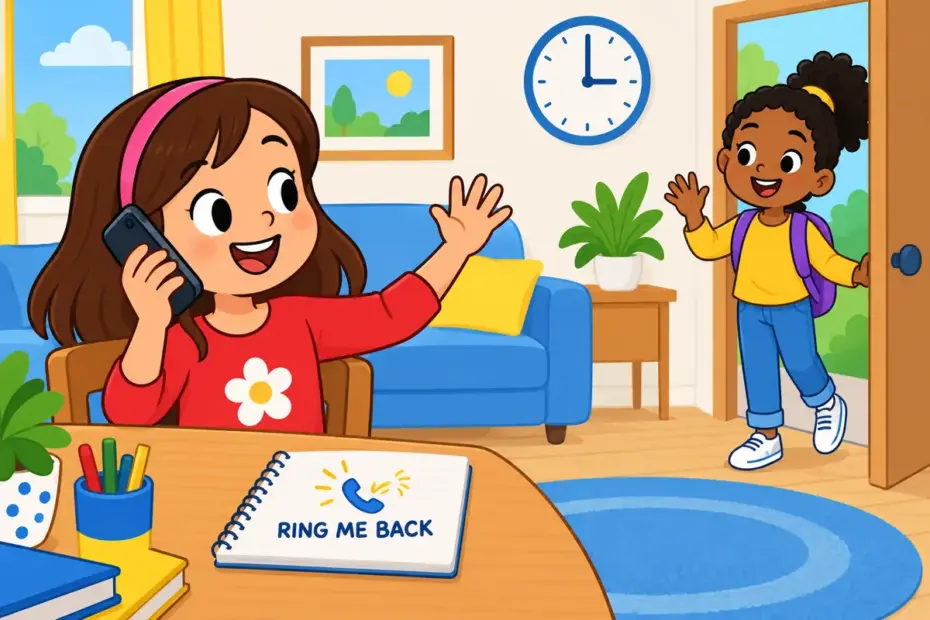
Call back is a phrasal verb meaning to return a phone call, or to summon someone to return to a place. In a sentence the object often fits between the two words: “I will call the manager back.” A pronoun object must always sit in that middle slot, while a noun may follow the whole verb.
Call back at a glance
- Call back is a separable phrasal verb made from the verb call and the particle back.
- Its two main senses are returning a phone call and summoning someone back.
- A noun object can follow the whole verb, but a pronoun object must go between call and back.
- The related noun is callback, written as a single word.
- Common collocations include call you back, call back later and call back the winner.
What does call back mean?
Call back is a phrasal verb meaning to telephone someone who has just called you, or to ask a person or animal to return. The Cambridge entry for call back records both the telephone sense and the summoning sense, and the setting usually makes clear which one is meant.
| Sense | Plain meaning | Example sentence |
|---|---|---|
| Return a call | Phone someone after a missed call | I missed your call, so I will call you back after lunch. |
| Summon back | Ask someone to return to a place or group | The coach called the striker back from a loan spell. |
| Invite on stage again | Ask a performer to return | The crowd cheered until the band was called back for an encore. |
Call back is not the same as answer a call. You answer a phone when it rings; you call back when you return the call later. The verb also rarely takes an abstract object, so a writer who wants to reply in writing reaches for a different phrase entirely.
How do you use call back in a sentence?
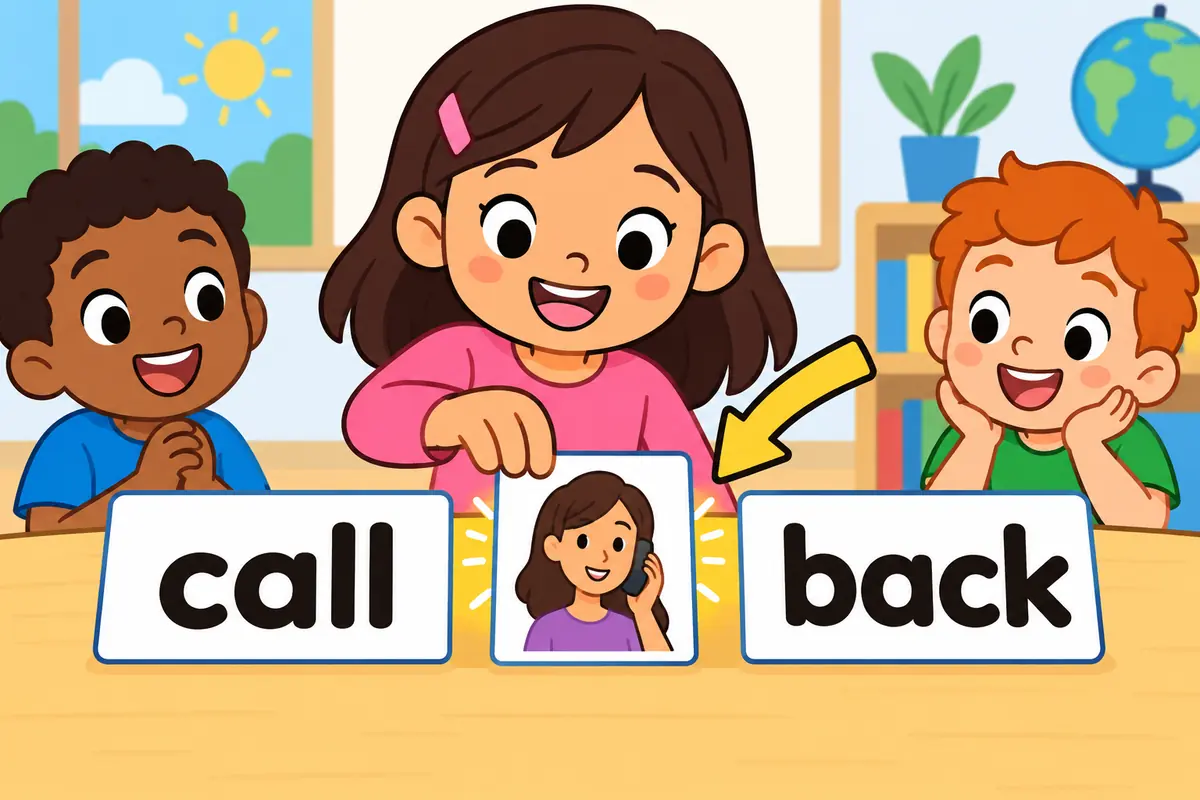
Call back is transitive in the summoning sense and often intransitive in the telephone sense, and it is separable when an object is present. The particle may strand after a noun object, but never after a pronoun, which is the rule that trips learners most often.
| Pattern | Example | What it signals |
|---|---|---|
| call + object + back | She called the office back at once. | The standard separable shape with a noun object. |
| call + back + noun object | She called back the office at once. | Allowed with a noun, though the split form is commoner. |
| call + pronoun + back | I will call them back tonight. | A pronoun object must sit in the middle. |
| call back (no object) | He promised to call back before six. | Intransitive: the caller returns the call. |
| call + object + back + from | They called the team back from leave. | The summoning sense, naming the source. |
Call back in a sentence: examples across contexts
The two senses divide neatly by setting. Office, clinic and customer contexts use the telephone sense, while sport, work and military contexts use the summoning sense, as the rows below show.
| Context | Example sentence | Why this works |
|---|---|---|
| Office voicemail | Please leave a message and I will call you back within the hour. | A fixed polite formula for returning a call. |
| Customer service | The agent said she would call back once the file was checked. | Promises a return call without fixing the exact time. |
| Family conversation | If the doctor’s office rings, tell them I will call back after dinner. | Uses ring, then the return verb, in natural speech. |
| Sport report | The manager called the winger back into the squad. | The summoning sense, with a clear goal. |
| Workplace email | The director was called back early from her holiday. | Passive form keeps the focus on the person recalled. |
| News report | Rescue teams were called back as the storm approached. | Formal passive suited to a live bulletin. |
| School notice | Pupils who arrive late must call back the office before lessons. | The noun object follows the whole verb. |
| Technical support | Do not call back the same number twice; the queue will reset. | A warning sentence with a noun object after the verb. |
| Everyday chat | I meant to reply to your message yesterday. | Shows the written cousin that is not call back. |
Call back vs call off
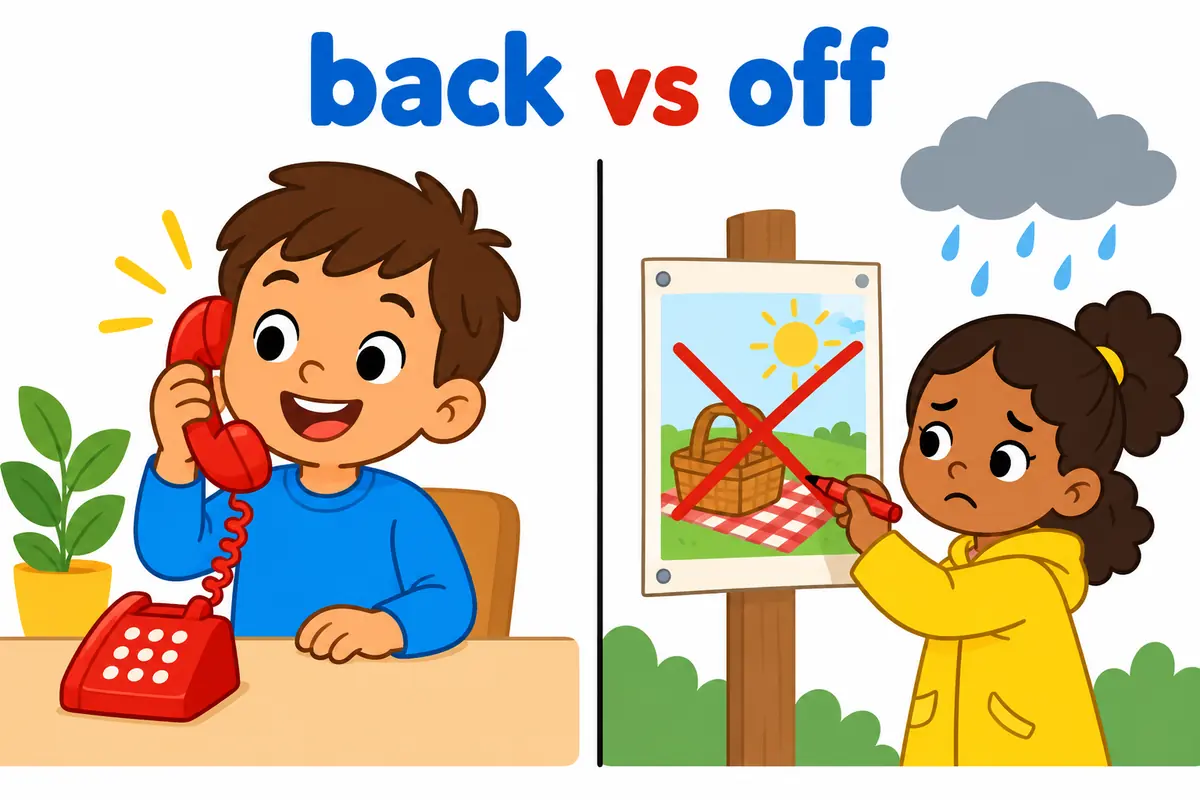
Both verbs pair call with a particle, and the particle carries the whole meaning. Call back returns a call or a person; call off cancels something. A related everyday choice is reply, which fits writing rather than a phone.
| Attribute | Call back | Call off |
|---|---|---|
| Core meaning | Return a call or summon someone | Cancel a planned event |
| Typical object | a caller, a player, the office | a match, a search, a wedding |
| Separability | Separable: call her back | Separable: call it off |
| Register | Neutral, common in speech | Neutral, common in planning |
| What it implies | Contact or return will happen | The plan will not happen |
Choose call back when someone is expected to return or to make contact again, and call off when an event is cancelled outright. Because both are separable, the pronoun rule applies to each: call her back and call it off, never call back her or call off it.
Word forms and grammar of call back
| Form | Part of speech | Example |
|---|---|---|
| call back | phrasal verb, base form | I will call back later. |
| called back | past and past participle | The nurse called me back at noon. |
| calling back | present participle | She is calling the client back now. |
| callback | noun, one word | There were no callbacks that afternoon. |
| call-back | attributive adjective | Leave a call-back number with reception. |
Other verbs share the base call with a different particle and a different meaning, so they are worth keeping apart. Call for means to require or demand, and call in means to ask a specialist to attend, as in call in a doctor. The particle, not the base verb, decides the sense.
Common mistakes with call back
- Wrong pronoun position.
I will call back you tomorrow.Correct: I will call you back tomorrow. Rule: a pronoun object must sit between the verb and the particle. - Writing the verb as one word.
Please callback me before noon.Correct: Please call me back before noon. Rule: callback is a noun; the verb is always two words. - Using it for written replies.
She called back my email the next day.Correct: She replied to my email the next day. Rule: call back concerns a phone call, not a message. - Adding a preposition.
He called back to me on Friday.Correct: He called me back on Friday. Rule: the object needs no preposition with call back. - Confusing it with call off.
They called the meeting back because of the storm.Correct: They called the meeting off because of the storm. Rule: back means return; off means cancel.
A final trap is the bounce-back pattern, where a caller keeps missing a colleague. In that case you bounce back a message rather than call back, because the object is data, not a person.
Practice using call back
- Fill in the blank: The receptionist promised to call ______ back before five.
- Choose the better word: The referee (called back / called off) the match when lightning began.
- Correct the error: I will call back them after the meeting.
- Build a sentence: use call + pronoun + back about a plumber who will phone you later.
- Spot the register: which sentence belongs in a voicemail greeting? (A) Call me back when you get this. (B) Please return my telephone communication at your earliest convenience.
- Fill in the blank: The club ______ the winger back from his loan spell.
Answers
- me. A pronoun object must go between call and back, giving call me back.
- called off. The match is cancelled, not returned, so the particle is off.
- I will call them back after the meeting. The pronoun moves into the middle slot.
- Sample: The plumber said he would call us back before the end of the day.
- Sentence A. The short split form is natural in a spoken greeting; sentence B is needlessly formal.
- called. The past tense of the separable verb is called back, with the object after called.
The bottom line
Call back is a separable phrasal verb meaning to return a phone call or to summon someone back. Keep the pronoun in the middle, write the noun as two words, and reserve callback for the noun form. When the meaning is cancellation, switch the particle and use call off, because a single word changes the whole sentence.
Frequently asked questions about call back
Is call back one word or two?
The verb is always two words: call back. The noun and the attributive adjective are written as one word, callback, as in there were three callbacks, or leave a callback number. Students who write the verb as one word produce a real mistake, because callback cannot take an object the way the phrasal verb can.
Where does the pronoun go with call back?
A pronoun object must sit between the verb and the particle, so you write call her back, call them back or call me back. You cannot write call back her. A noun object is freer and may follow the whole verb, as in call back the office, though the split form remains the commoner choice.
Can call back mean to summon someone?
Yes. Beyond returning a phone call, call back can mean to ask a person to return to a place or group, as in the coach called the striker back from loan. Context makes the sense clear: a phone or a voicemail points to the telephone meaning, while a team, a stage or a posting points to the summoning meaning.
What is the difference between call back and call off?
Call back means to return a call or summon someone, while call off means to cancel an event. The base verb is the same and both are separable, so the pronoun rule is identical, but the particle carries the meaning. Call her back asks her to make contact; call it off cancels the plan.
Have you ever left a voicemail and anxiously awaited a call back? In communication terms, a “call back” refers to a returning communication initiated by a previous message or interaction. It’s essentially a response to a prior attempt to connect.
In various scenarios, a call back might signify a reply to an unanswered phone call, a follow-up conversation to address specific points, or a response to a job interview. Understanding the concept of a call back can help clarify expectations in professional, personal, and social interactions.
7 Examples Of Call Back Used In a Sentence For Kids
- Call back the color of the sky.
- Let’s call back the sound of the birds.
- Can you call back your favorite animal noise?
- It’s time to call back the shapes we learned.
- Remember to call back the numbers we counted.
- Let’s all call back our favorite fruit.
- Don’t forget to call back the actions we practiced.
14 Sentences with Call Back Examples
- Call back for the group study session tomorrow at 10 AM.
- Don’t forget to call back the professor to confirm the deadline for the assignment.
- Make sure to call back your friend to finalize the plans for the weekend trip.
- Call back the internship coordinator to inquire about the interview schedule.
- I need to call back the library to renew my books before they are due.
- Call back the career counselor to discuss potential job opportunities.
- Remember to call back the student club president to RSVP for the event.
- It’s important to call back the classmate who offered to share their notes with you.
- Call back the mentor for guidance on how to prepare for the upcoming exams.
- I should call back the sports team coach to confirm the practice timings.
- Don’t forget to call back the placement cell for updates on job placements.
- I need to call back the project partner to discuss the next steps.
- Have you called back the alumni for networking opportunities as discussed?
- We should call back the event coordinator to inquire about volunteer opportunities.
How To Use Call Back in Sentences?
To use Call Back in a sentence, follow these simple steps. A Call Back is a linguistic term that refers to the repetition of a word, phrase, or idea for emphasis or clarification.
-
Identify the key word or phrase you want to call back in your sentence. This is usually a word that you want to emphasize or clarify.
-
Introduce the key word or phrase in your initial sentence. For example, “I love to travel to new places.”
-
Reiterate the key word or phrase in a subsequent sentence to call back to it. For instance, “When I travel, I love exploring new cultures and trying new foods. Traveling opens up a world of possibilities.”
-
Ensure that the Call Back adds value to your sentence and helps to reinforce the main idea. Avoid overusing call backs as it can make your writing repetitive.
-
Practice using Call Back in sentences. Experiment with different ways of calling back to key words or phrases to see what works best for your writing style.
In conclusion, using Call Back in a sentence can be an effective way to emphasize key words or phrases and reinforce the main idea of your writing. By following these simple steps and practicing regularly, you can improve your writing skills and make your sentences more cohesive and impactful.
Conclusion
In conclusion, incorporating call back features in customer service can greatly enhance the overall experience for clients. By utilizing call back options, businesses can eliminate long wait times and provide prompt assistance to their customers. This leads to improved customer satisfaction and loyalty, as individuals feel valued and well taken care of.
Moreover, call back services also contribute to increased efficiency and productivity within a company. Employees can follow up on calls at more convenient times, allowing them to focus on other tasks in the meantime. Ultimately, implementing call back features not only benefits the customer but also enhances the operational effectiveness of the organization.