
Call in is a phrasal verb meaning to summon someone for help, to report something by telephone, or to demand money or goods. To use call in in a sentence, name what is summoned and keep the particle with the verb: “call in a doctor”. A listener who rings a radio studio calls in.
Call in at a glance
- Call in is a phrasal verb built from call plus the particle in; its forms are calls in, called in and calling in.
- The object may sit between verb and particle (call the doctor in) or follow the particle (call in the doctor).
- The main senses are summoning a person, reporting by telephone, and demanding repayment of a loan.
- Common collocations are call in sick, call in a favour, call in a loan and call in the army.
What does call in mean?
Call in is a phrasal verb meaning to ask someone to come and help, to report something by telephone, or to order that money or goods be returned. The Cambridge entry for call in records the summon-and-consult senses that dominate everyday use. When the phone replaces the doorway, call in becomes reporting: a worker calls in sick, a motorist calls in an accident, a viewer calls in to a debate. The money sense belongs to banking and retail, where a lender calls in a loan and a maker calls in a faulty batch. Where a person leans on a rule rather than a person, invoke a clause is the verb to choose.
| Sense | Plain meaning | Example sentence |
|---|---|---|
| Summon for help | Ask someone qualified to come and assist | The manager called in a technician at midnight. |
| Report by telephone | Tell an employer or authority by phone | Three nurses called in sick on the same morning. |
| Demand repayment | Order money or goods to be handed back | The bank called in the loan after two missed payments. |
| Phone a broadcast | Join a live radio or television show by phone | Dozens of listeners called in to complain about the noise. |
| Withdraw from sale | Order a faulty product back from customers | The maker called in every batch produced before June. |
One limitation is worth stating plainly. Call in is not the verb for inviting a friend or paying a short visit; that is call on. It does not mean cancel, which is call off. Choose call in only when a person is summoned, a report is made by phone, or goods are demanded back. A bank that withdraws the offer ends it outright.
How do you use call in in a sentence?
Call in is separable, so a noun object may sit between the verb and the particle or after it, and a pronoun must sit between them. The table shows the patterns that cover almost every real sentence, including fixed expressions.
| Pattern | Example | What it signals |
|---|---|---|
| call + object + in | The principal called the electrician in. | A short object is split across the phrase. |
| call + in + object | The principal called in the electrician. | The default order; a long object follows the particle. |
| call + it/them + in | Call it in before noon. | A pronoun must stay between verb and particle. |
| call in sick | She called in sick at seven. | Fixed report-by-phone use; no object follows in. |
| call in + favour/loan | He called in a favour from an old colleague. | Invokes something that is owed to you. |
| call in to + show | Thousands called in to the phone-in. | to introduces the programme you are joining. |
The separator test is the fastest check: if the object can move in front of the particle, call in is separable; if it refuses, you probably want call on.

Call in in a sentence: examples across contexts
Call in changes register more than it changes shape. The seven sentences below move from a playground to a bank, and each names the person, report or debt being called in.
| Context | Example sentence | Why this works |
|---|---|---|
| Classroom | The teacher called in the school nurse when Leo felt dizzy. | Names the person summoned and the reason, the standard pattern. |
| Workplace email | Two engineers have called in sick, so the release slips. | The report-by-phone sense in a neutral professional register. |
| News report | The government called in the army after the floods. | An authority and a body, the pattern headlines prefer. |
| Legal writing | The court called in the disputed files for review. | Uses call in for an official demand, not a friendly request. |
| Radio phone-in | Listeners called in to back the campaign. | The broadcast sense, where callers join a live show. |
| Banking | The lender called in the overdraft without warning. | The money sense, in which a debt is demanded back. |
| Conversation | I will call in a favour and get us the tickets. | The idiomatic sense of drawing on goodwill you are owed. |
Call in vs summon
Call in overlaps with summon and is interchangeable with it only when a person is being ordered to appear. Call in is the broader, friendlier phrase; summon carries an authority that the caller is using.
| Attribute | call in | summon |
|---|---|---|
| Core job | Ask or order someone to come, often by phone | Order someone to appear under authority |
| Formality | Neutral to formal | Formal and often legal |
| Who uses it | Managers, doctors, banks, listeners | Courts, councils, officials |
| Typical object | A person, a report, a loan, a product | A person, most often a witness |
| Implies authority | Sometimes, not always | Always |
To summon a specialist is to compel attendance; to call one in is to ask them to attend. Verdict: choose summon when an institution exercises power, and call in for the everyday request, the phone report and the recalled debt.
Word forms and phrasal family of call in
Call in inflects through call like any regular verb, and the hyphenated call-in is a separate noun or adjective. The table lists the forms learners need, including the compound that drops the hyphen in meaning rather than in spelling.
| Form | Part of speech | Example |
|---|---|---|
| call in | phrasal verb, base form | Call in the specialist now. |
| calls in | phrasal verb, third person singular | The bank calls in the loan on Friday. |
| called in | phrasal verb, past and past participle | They called in the reserves. |
| calling in | phrasal verb, present participle | She is calling in sick today. |
| call-in | noun or adjective, hyphenated | A call-in show takes listener calls. |
| call-in | noun, chiefly American | The staff held a call-in about the rota. |
Keep the phrase apart from its cousins. To call off the event is to cancel it, which removes something; to call for volunteers is to demand or collect them, which reaches outward rather than inward. Call in always brings a person, a report or a debt toward the speaker.
Common mistakes with call in
- Incorrect:
She called sick yesterday.Correct: She called in sick yesterday. Rule: The fixed expression needs the particle in; call sick alone is not English. - Incorrect:
Call in it before noon.Correct: Call it in before noon. Rule: A pronoun object must sit between the verb and the particle in a separable phrasal verb. - Incorrect:
The teacher called in to the nurse.Correct: The teacher called in the nurse. Rule: The person summoned is a direct object with no preposition, not an indirect one with to. - Incorrect:
They called in the meeting because of snow.Correct: They called off the meeting because of snow. Rule: Call in summons or reports; call off cancels.
Practice using call in
Work through the six items, then check the reasoning rather than only the answer.
- Fill the gap: When the pipe burst, the caretaker ______ a plumber immediately.
- Choose the better word: The airline (called in / called off) the flight because of the storm.
- Correct the error: Please call in it as soon as you reach the office.
- Build a sentence: use call in sick about a chef who cannot work on Saturday.
- Spot the register: which belongs in a news report, the government called in the army, or the government got the army in?
- Rewrite with a pronoun: The manager called the guard in. Use him instead of the guard.
Answers
- called in – the caretaker summons a tradesperson, which is the core sense.
- called off – the storm cancels the flight; call in would summon something.
- Please call it in as soon as you reach the office – the pronoun goes between call and in.
- Model answer: The head chef called in sick, so the sous-chef ran the kitchen on Saturday.
- The government called in the army – a report keeps the full phrase and formal nouns.
- The manager called him in – the pronoun splits the separable phrasal verb.
The bottom line
Use call in in a sentence when someone is summoned, a report is made by telephone, or a debt or product is demanded back, and keep the particle attached to the verb. Two details decide most sentences: the verb is separable, so a pronoun must sit between call and in, and the phrase implies an institution behind the request rather than a casual social visit. Where a rule rather than a person is doing the work, invoke is more precise; where an event is being cancelled, call off is the only choice.
Frequently asked questions about call in
Can you say call in sick?
Yes. Call in sick is standard, fixed English meaning to tell your employer by telephone that you cannot work. Three nurses called in sick is entirely natural. The verb is call, the particle is in, and sick supplies the reason.
Is call in one word or two?
As a verb phrase, call in is two words, as in call the doctor in or call in the doctor. The hyphenated call-in is a noun or adjective, as in a call-in show or a staff call-in. Write two words when the phrase acts as a verb and one hyphenated word when it names a thing.
What is the difference between call in and call on?
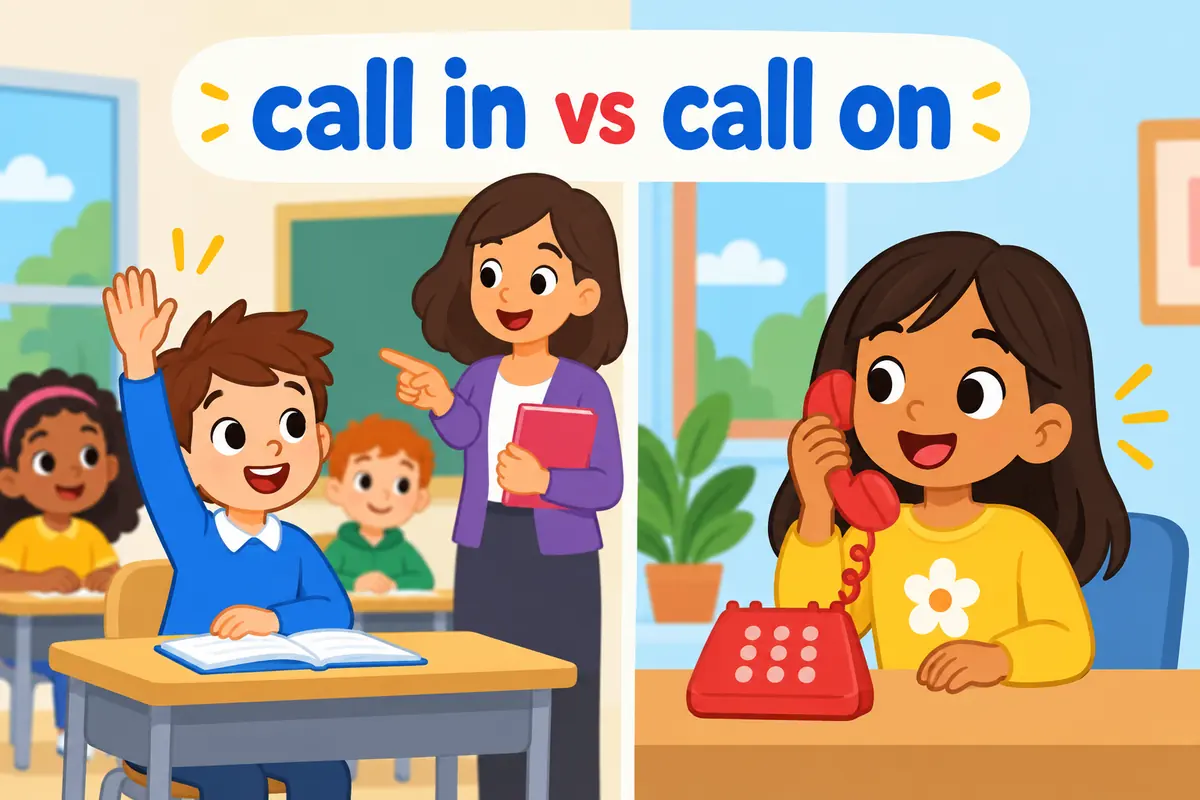
Call in means to summon someone, report by telephone, or demand something back. Call on means to visit briefly, invite someone to speak, or appeal to them. A teacher calls in a nurse but calls on a pupil to answer, and call in is separable while call on never splits.
Does call in mean cancel?
No. Call in brings a person, a report or a debt toward you, while call off cancels an event or stops an action. The match was called off, not called in. If nothing is being summoned, reported or reclaimed, call in is the wrong choice and call off is the one you want.
Have you ever needed to request someone’s presence or expertise by phone? This is what “call in” refers to – the act of phoning someone to come or contribute.
“Call in” essentially means to contact or summon someone by telephone for a particular purpose. It is commonly used in professional settings, such as asking an employee to attend a meeting or consulting an expert for assistance.
7 Examples Of Call In Used In a Sentence For Kids
- Call in your friends for a game of hide and seek.
- Let’s call in the teacher to help us with this new lesson.
- It’s time to call in the dogs for dinner.
- Can you call in your sister to join us for the movie?
- Remember to always call in your parents if you need help.
- We will call in a doctor if anyone gets hurt.
- Call in the rain dance for good luck.
14 Sentences with Call In Examples
- Call in sick to your professor if you’re unable to make it to class due to illness.
- Remember to call in to your group project meeting so you can contribute your ideas remotely.
- Don’t forget to call in your order to your favorite food joint to avoid waiting in line.
- You can call in to the library to renew your books if you can’t make it there in person.
- If you’re running late for a lecture, it’s a good idea to call in and inform the faculty.
- Make sure to call in and reserve your spot for the upcoming seminar.
- When you’re feeling overwhelmed with assignments, it’s okay to call in for an extension.
- If you’re going to miss an important class discussion, try to call in and get the notes from a classmate.
- It’s always a good idea to call in a study group session to go over difficult material.
- Sometimes it’s necessary to call in a tutor for extra help with challenging subjects.
- Don’t hesitate to call in a mental health counselor if you’re struggling with stress or anxiety.
- You can also call in a maintenance request for any issues in your dorm room.
- If you’re feeling unwell during an exam, make sure to call in a proctor for assistance.
- Get into the habit of calling in regularly to your parents to update them on your college life.
How To Use Call In in Sentences?
To use Call In in a sentence, follow these simple steps:
-
Identify the context where you want to use the term Call In. This could be in a conversation, a written document, or any other situation where you need to refer to bringing someone in or summoning someone.
-
Determine the subject or action you want to attribute to the term Call In. For example, you might say, “I need to call in a favor from a friend,” or “We had to call in reinforcements.”
-
Insert the term Call In into your sentence at the appropriate place. Remember that it is a phrasal verb commonly used in informal speech.
-
Make sure the sentence makes sense in the context of your communication. Consider the tone and formality of your language to ensure that Call In fits naturally.
-
Modify the sentence as needed to convey your message clearly. You can use synonyms or rearrange the structure of the sentence if necessary.
Here’s an example sentence using Call In: “The manager had to call in a meeting to address the project delays.” Remember to practice using Call In in different contexts to improve your language skills.
Conclusion
In conclusion, the examples of sentences with “call in” highlight the use of this phrasal verb to describe summoning someone or something. Whether it’s requesting assistance, bringing in a professional, or asking for input from others, “call in” is a versatile expression that can be used in various contexts. From calling in sick to work to calling in experts for advice, this phrase is commonly used in everyday communication to convey the act of reaching out and bringing in help or support when needed.
Overall, understanding how to use “call in” in sentences can enhance communication skills and effectively convey the action of requesting or inviting someone to be involved in a particular situation. Utilizing this phrasal verb can help to clearly express the need for help, guidance, or expertise in different scenarios, making it a valuable addition to one’s vocabulary.


