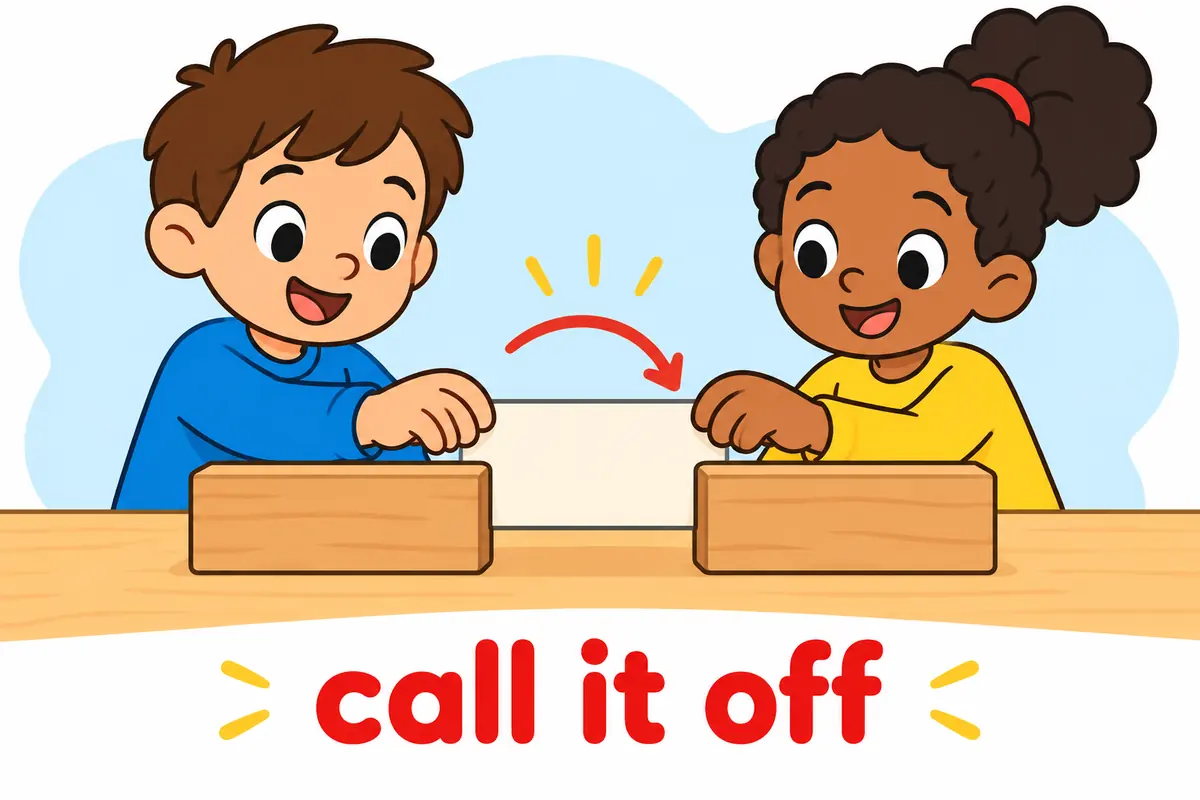
Call off means to cancel an event or stop an activity that was already planned or under way. To use call off in a sentence, name the event as the object: “They called off the parade.” The verb is separable, so a pronoun must sit between the two words, as in call it off.
Call off at a glance
- Call off is a transitive, separable phrasal verb; its past form is called off.
- It means to cancel a planned event or halt an activity in progress.
- The object may follow the particle or sit between the two parts.
- A pronoun always goes between: call it off, never call off it.
- The commonest error is confusing call off with the unrelated call for or call back.
What does call off mean?
Call off is a phrasal verb meaning to cancel something planned, such as a match, a meeting or a search, or to order an activity to stop. The Cambridge entry for call off records both the cancellation sense and the sense of calling a dog off. The word is neutral in register and appears in news reports, notices and everyday speech alike.
| Sense | Plain meaning | Example sentence |
|---|---|---|
| Cancel an event | Decide a planned event will not happen | They called off the wedding. |
| Halt an activity | Order something in progress to stop | Police called off the search at dusk. |
| Call a dog off | Order a dog to stop attacking | The handler called the dog off. |
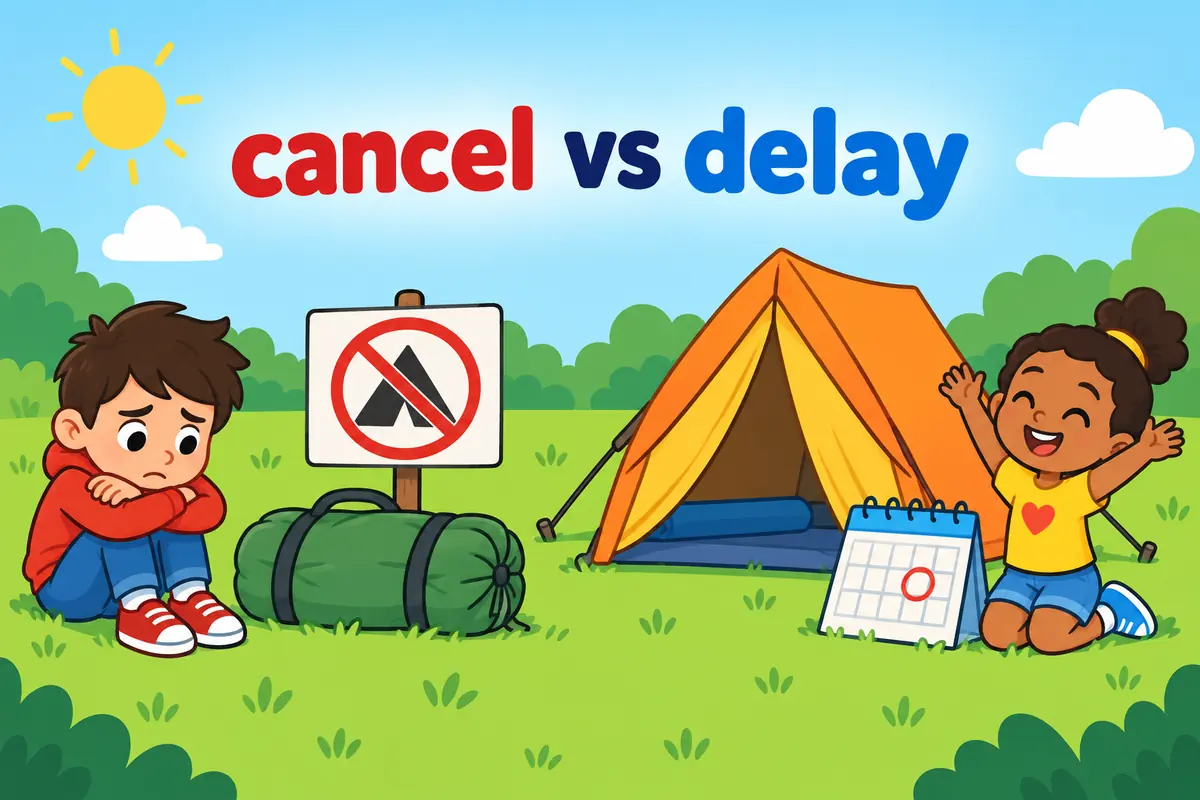
One limitation is worth stating. Call off means cancel, not postpone. A postponed match happens later; a cancelled one does not. If the event is only being moved, say put back or reschedule, because call off settles the matter.
How do you use call off in a sentence?
Call off takes a direct object and is separable: call off the meeting and call the meeting off are both correct. When the object is a pronoun, it must go in the middle, giving call it off. The phrase is transitive, so a sentence with nothing after off is incomplete.
| Pattern | Example | What it signals |
|---|---|---|
| call off + object | The club called off the fixture. | The object follows the particle. |
| call + object + off | The club called the fixture off. | The object sits in the middle. |
| call + pronoun + off | They called it off at noon. | Pronouns must go between the parts. |
| be called off | The flight was called off in the storm. | Passive; the event is the focus. |
| call off + a search | Rescue teams called off the search. | Halting an activity already running. |
To stop something abruptly rather than cancel it in advance, halt is the tighter verb and fits formal announcements.
Call off in a sentence: examples across contexts
Call off keeps the same shape across registers, though the object decides the tone. The ten sentences below move from a news report to a wedding plan, and each one names the event that will not happen.
| Context | Example sentence | Why this works |
|---|---|---|
| News report | The airline called off dozens of flights before the storm. | A mass cancellation suits a news frame. |
| Sports report | Heavy rain called off the final match. | The classic sporting use. |
| Workplace email | We have called off Thursday’s review until the data is ready. | Shows the object after the particle. |
| School notice | The sports day was called off because of the heat. | Passive keeps the event central. |
| Conversation | Let us call the picnic off and stay indoors. | Shows the split, separable order. |
| Emergency services | Crews called off the search after two days. | Halting an activity already running. |
| Wedding planning | They called it off three weeks before the date. | The pronoun sits in the middle. |
| Business writing | The supplier called off the order at the last moment. | Applies the verb to a transaction. |
| Community group | The committee called off the fundraiser. | A straightforward planned event. |
| Travel | Fog called off the morning ferry. | A weather subject cancels a scheduled service. |
The same particle builds unrelated phrases, so keep call off apart from back off, which means to retreat.
Call off vs postpone
Call off and postpone both change an event’s fate, and the difference is whether it survives. Postpone moves an event to a later date; call off cancels it altogether. A postponed concert is still coming, while a called-off concert is not.
| Attribute | call off | postpone |
|---|---|---|
| Core meaning | Cancel an event | Move it to a later date |
| Does it still happen | No | Yes, later |
| Typical object | A match, a meeting, a search | A match, a meeting, a launch |
| Reversibility | Final for that date | A new date is expected |
| Register | Neutral and common | Neutral, slightly formal |
Verdict: choose call off when an event will not happen, and postpone when it will happen at a later date.
Word forms and grammar of call off
Call off changes the verb for tense and number while the particle stays fixed. The table lists the forms learners need, including the rare noun.
| Form | Part of speech | Example |
|---|---|---|
| call off | phrasal verb, base form | They may call off the event. |
| calls off | verb, third person singular | She calls off the meeting often. |
| called off | verb, past and past participle | The race was called off. |
| calling off | verb, present participle | Calling off the trip was wise. |
| call-off | noun (rare) | A late call-off upset the fans. |
The base verb also forms call for, meaning to demand or require, which is often mistaken for call off.
Common mistakes with call off
- Incorrect:
They called off it.Correct: They called it off. Rule: A pronoun object goes between the verb and the particle. - Incorrect:
The match called off.Correct: The match was called off. Rule: The verb is transitive, so it needs an object, and the event cannot cancel itself. - Incorrect:
They called off the meeting to next week.Correct: They postponed the meeting until next week. Rule: Call off cancels, so use postpone when a new date is coming. - Incorrect:
The team called off the plan, so it will happen tomorrow.Correct: The team postponed the plan, so it will happen tomorrow. Rule: Call off and a later date conflict.
For a formal decision reversed by an authority, rescind is more precise than call off, because it names the act of withdrawing a ruling.
Practice using call off
Work through the six items, then read the reasoning rather than only the key.
- Fill the gap: The organisers ______ the concert when the storm warnings arrived.
- Choose the better word: The match will now happen on Sunday, so they (called it off / postponed it).
- Correct the error: They called off it at the last minute.
- Build a sentence: use call off about a school trip cancelled because of snow.
- Spot the register: which belongs in a formal notice — the event is cancelled, or we called it off?
- Rewrite with the pronoun: They called off the party. Use it.
Answers
- called off — the object follows the particle in this split order.
- postponed it — the match will happen later, so call off is wrong.
- They called it off at the last minute — a pronoun goes between the two parts.
- Model answer: The teachers called off the trip when the snow blocked the road.
- The event is cancelled — a formal notice avoids the phrasal verb.
- They called it off — the pronoun must sit between call and off.
The bottom line
Use call off in a sentence to say an event will not happen, and remember that the phrase separates around a pronoun. The two nuances that decide most sentences are these: call off cancels rather than delays, and it is transitive and separable, so scrap and postpone describe related but different decisions.
Frequently asked questions about call off
Is call off separable?
Yes. Call off is a separable phrasal verb, so the object may follow the particle or sit between the two words: call off the meeting or call the meeting off. A pronoun, however, must always go between, giving call it off rather than call off it.
Does call off mean postpone?
No, and the difference matters. Call off means the event will not happen at all, while postpone means it will happen later at a new date. A postponed match is rescheduled; a called-off match is cancelled, so the two verbs describe opposite outcomes for the same fixture.
What is the past tense of call off?
The past tense and past participle are both called off, as in they called off the party and the party was called off. Only the verb changes for tense; the particle off never changes. The third person singular is calls off, and the present participle is calling off.
What is the difference between call off and call back?
Call off means to cancel a planned event. Call back means to return a phone call or to ask someone to return. The shared base verb causes confusion, but the particle decides the meaning, so keep call off, call back, call for and call in clearly apart in your writing.
Have you ever needed to cancel plans or events at the last minute? This is commonly known as “calling off.” When you call off something, you are canceling or abandoning it.
Calling off can refer to a variety of situations, from a simple gathering with friends to a more formal event or arrangement. It is a flexible term that can be used in both personal and professional contexts.
7 Examples Of Call Off Used In a Sentence For Kids
- Let’s call off the game and go home.
- We need to call off the picnic due to rain.
- The teacher had to call off the field trip.
- Please call off your dog from chasing the cat.
- They had to call off the party because of illness.
- The referee decided to call off the match due to bad weather.
- It’s time to call off the treasure hunt and have some snacks.
14 Sentences with Call Off Examples
- Call off the party tonight, I have to study for my exams.
- Let’s call off our trip to Goa and plan a budget-friendly trip to Lonavala instead.
- I think we should call off the group project, it’s too much work for all of us.
- The college committee decided to call off the sports fest due to bad weather.
- Call off the debate competition, not enough students have signed up to participate.
- I’m feeling under the weather, I might have to call off attending the seminar tomorrow.
- The student council had to call off the cultural event due to unresolved technical issues.
- The professor had to call off the class field trip at the last minute due to transportation issues.
- Let’s call off the movie night and have a study session instead.
- The college administration had to call off the lecture series due to unforeseen circumstances.
- I’m not feeling well, I might have to call off the presentation tomorrow.
- I think we should call off the group study session tonight and focus on studying individually.
- Due to a scheduling conflict, the college had to call off the guest lecture by a renowned economist.
- The student club decided to call off the fundraiser event as they didn’t meet their target amount.
How To Use Call Off in Sentences?
To properly use Call Off in a sentence, you must understand its meaning and appropriate context for using it. Call Off means to cancel or terminate something, such as an event, a meeting, or an arrangement.
Here are some examples of Call Off used in a sentence:
1. I had to call off the picnic due to the bad weather forecast.
2. The boss decided to call off the meeting because most of the team was out sick.
3. They had to call off their vacation plans because of a family emergency.
4. The airline had to call off all flights due to a strike by the pilots’ union.
5. The school had to call off the field trip because not enough students signed up.
When using Call Off in a sentence, make sure to follow these guidelines:
– Use the phrase when referring to canceling or terminating something.
– Place Call Off before the action being canceled.
– Be clear and specific about what is being canceled.
– Use Call Off in situations where an event, appointment, or agreement needs to be stopped.
By following these tips, you can effectively incorporate Call Off into your sentences and communicate the cancellation of various activities or plans.
Conclusion
In conclusion, the phrase “call off” is commonly used when canceling or stopping something previously planned or scheduled. This can include canceling events, meetings, appointments, or activities. For example, “The event was called off due to the bad weather,” and “She had to call off the meeting at the last minute.” The term is straightforward and widely understood in everyday language, conveying the idea of discontinuing or halting something that was originally intended to take place. Whether it’s a social gathering or a business engagement, to “call off” signifies a change in plans or course of action, often because of unforeseen circumstances or a change in priorities.


