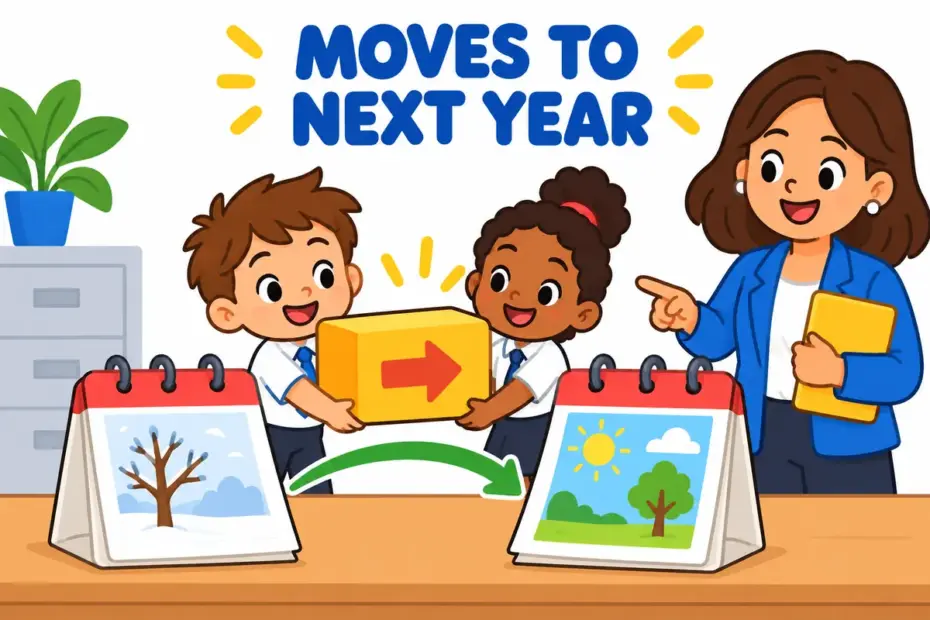
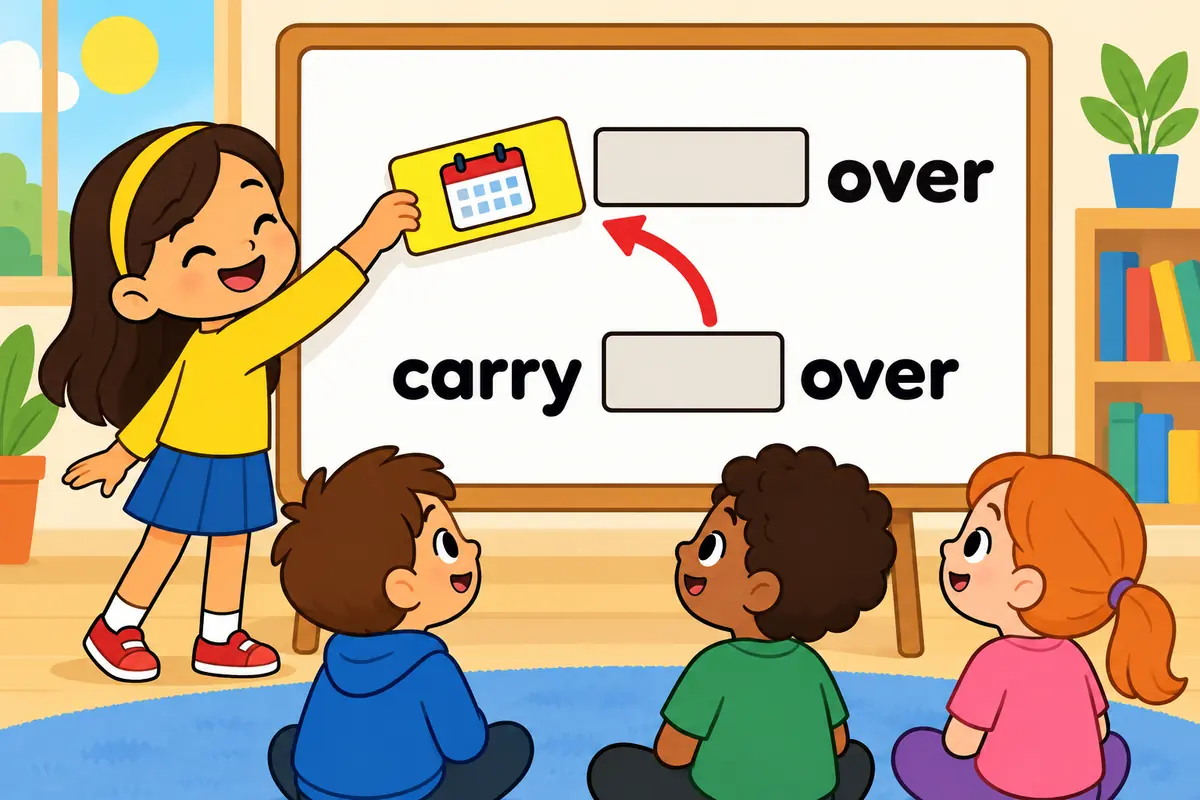
Carry over means to move something, such as money, leave or a feeling, from one period or place to the next. To use carry over in a sentence, name what moves and where it lands: “Unused leave carries over to January.” The verb is separable and works both with an object and without one.
Carry over at a glance
- Carry over is a phrasal verb; its forms are carry over, carries over, carried over and carrying over.
- The unlimited object sits after over or between carry and over.
- The usual subjects are leave, credit, stock, losses and a mood or habit.
- Carry over belongs to finance, human resources and neutral reporting.
- The commonest error is confusing carry over with carry on, which means to continue.
What does carry over mean?
Carry over is a phrasal verb meaning to move an unused amount into the next period, or to persist from one situation into a later one. The Cambridge entry for carry over records both the transfer sense and the sense of continuing to affect something. Where the movement is between accounts rather than between dates, transfer a balance is the more specific verb.
| Sense | Plain meaning | Example sentence |
|---|---|---|
| Transfer an amount | Move unused money, leave or credit into the next period | The balance carries over to the next invoice. |
| Persist into a later situation | Continue to exist and affect what follows | A quiet calm carried over from the morning meeting. |
| Move to a later date | Reschedule an event or item | The final fixture was carried over to Monday evening. |
One limitation matters in practice. Carry over describes a transfer, not a fresh grant: nothing new is created, the same amount or feeling simply moves forward. It also says nothing about whether the move is good, so a carried-over loss and a carried-over bonus use identical grammar and opposite moods.
How do you use carry over in a sentence?
Carry over is separable when it means to transfer, but intransitive when it means to persist. The pattern decides whether you need an object, and a pronoun forces the object into the middle. For the neutral idea of simply keeping going, continue the work is the plainer verb.
| Pattern | Example | What it signals |
|---|---|---|
| carry over + object | We carry over unused leave. | The neutral transfer order. |
| carry + object + over | We carry the leave over. | The same meaning with the object moved forward. |
| carry + pronoun + over | We carry them over. | The only order allowed with a pronoun. |
| be carried over | The credits were carried over automatically. | Passive; the amount matters more than the person. |
| carry over (no object) | The tension carried over into Tuesday. | Intransitive; a state persists by itself. |
Carry over in a sentence: examples across contexts
Carry over appears wherever one period hands something to the next. The sentences below keep the verb while changing the field, from payroll to sport.
| Context | Example sentence | Why this works |
|---|---|---|
| Accounting | The year-end surplus carries over to the next budget. | Names a figure and its destination period. |
| Payroll | Staff may carry over five days of annual leave. | A modal and a limit make the policy precise. |
| Workplace email | We will carry the remaining hours over to March. | Future tense states a decision, not a wish. |
| Retail | Loyalty points carry over for twelve months. | A time span tells the reader how long the transfer lasts. |
| Sport | The washed-out match was carried over to Monday. | Passive voice with a new date explains a postponement. |
| Academic | Unfinished credits cannot be carried over to a new degree. | A negative states the rule as an exception. |
| Tax | Losses may be carried over against future profits. | Legal phrasing pairs the transfer with its purpose. |
| Mood and place | The good humour from lunch carried over into the workshop. | Intransitive use: a feeling persists by itself. |
| Conversation | I carried it over so nothing went to waste. | Pronoun between the halves, as in speech. |
Only one sentence here is intransitive, which shows the balance: the transfer sense dominates written business English, while the persist sense is more common in description.
Carry over vs carry on
Carry over and carry on share a verb and are constantly mixed. Carry over moves something into a later period; carry on means to keep doing what you were doing.
| Attribute | carry over | carry on |
|---|---|---|
| Core meaning | Move an amount or state forward | Continue an activity |
| What is involved | Money, leave, credit, a mood | Work, a journey, a conversation |
| Needs an object | Usually, in the transfer sense | No, it is intransitive |
| Typical time frame | Across a period boundary | Within the same activity |
| Register | Business, finance, admin | Everyday and conversational |
Verdict: if something unused moves to a later period, use carry over; if an activity simply keeps going, use carry on.
Word forms and grammar of carry over
The verb inflects regularly, and the noun splits into a British and an American spelling. The table also lists the forms learners build wrongly. For the related idea of doing a task to completion, carry out is a different verb with a different meaning.
| Form | Part of speech | Example |
|---|---|---|
| carry over | verb, base form | We carry over the balance. |
| carries over | verb, third person singular | The holiday carries over to March. |
| carried over | verb, past and past participle | The surplus was carried over. |
| carrying over | verb, present participle | We are carrying over two days. |
| carry-over | noun, chiefly British | A carry-over of unused leave is allowed. |
| carryover | noun, chiefly American | The carryover appears on line nine. |
Common mistakes with carry over
- Incorrect:
We will carry over it to June.Correct: We will carry it over to June. Rule: A pronoun object goes between carry and over. - Incorrect:
The team carried over with the plan.Correct: The team carried on with the plan. Rule: Continuing an activity is carry on, not carry over. - Incorrect:
The leave carries over at the new year into more days.Correct: The leave carries over into the new year. Rule: Carry over moves the same amount; it never creates extra days. - Incorrect:
She carried the box over to the next week.Correct: She carried the box across the room. Rule: Physical carrying across a space uses carry, not the phrasal verb for time. - Incorrect:
The surplus carried over last year.Correct: The surplus was carried over from last year. Rule: The transfer sense is usually passive when the amount is the subject.
Practice using carry over
Work through the six items, then check the reasoning as well as the answer.
- Fill the gap: Unused credit ______ over to the next term.
- Choose the better word: When the break ended, the class (carried over / carried on) with the lesson.
- Correct the error: Please carry over it to next month.
- Build a sentence: use be carried over about holiday days.
- Spot the register: which belongs in a finance report — the balance carries over, or the balance rolls on to next time?
- Rewrite with the object in the middle: The company carried over the losses.
Answers
- carries — the singular subject credit needs the third person form.
- carried on — the lesson continued; carry over needs something transferred.
- Please carry it over to next month — the pronoun belongs between carry and over.
- Model answer: Two holiday days were carried over to the new year.
- The balance carries over — the finance phrase avoids the informal rolling idiom.
- The company carried the losses over — the object moves before the particle.
The bottom line
Use carry over in a sentence when an unused amount or a lingering state moves into the next period, and keep the object after over or between carry and over. Two details decide most sentences: the transfer sense takes an object while the persist sense does not, and a pronoun must sit in the middle. When you simply mean to keep going, choose carry on.
Frequently asked questions about carry over
Is carry over one word or two?
As a verb it is always two words, as in the balance carries over. As a noun it becomes one word or hyphenated: carryover in American English and carry-over in British English. Keep the two-word verb form in every ordinary sentence you write.
Can holiday days be carried over?
They can, if a workplace allows it. The passive sentence unused leave can be carried over is standard in policy writing. The phrase itself says nothing about a limit, so a good policy sentence usually adds one, for example a maximum of five days.
What is the difference between carry over and carry on?
Carry over moves an amount or state into a later period, so something unused is transferred. Carry on means to continue an activity that is already happening. A budget can carry over, but a conversation carries on; swapping them changes the meaning completely.
Does carry over mean the same as postpone?
Only in the narrow sense of an event moving to a later date, as when a fixture is carried over to Monday. For meetings and appointments, postpone or defer is clearer and far more common, so reserve carry over for money, leave, points and continuing feelings.
If you’ve ever wondered about the term “carry over” in writing, you’re in the right place. To “carry over” in a sentence means to bring forward or continue a specific element from one part to another for coherence and clarity.
In written communication, carrying over a point or idea can enhance the flow of your content and provide a seamless transition between different sections or paragraphs. By mastering the skill of incorporating relevant information through carry over, you can create a more engaging and cohesive piece of writing.
7 Examples Of Carry Over Used In a Sentence For Kids
- Carry over the crayons to the next table.
- Can you carry over the book to the reading corner?
- Let’s carry over the blocks to the building area.
- Don’t forget to carry over the puzzles to the play area.
- We need to carry over the pencils to the drawing station.
- Remember to carry over the toys to the playtime zone.
- Please help carry over the books to the story corner.
14 Sentences with Carry Over Examples
- Make sure to study well so you don’t have any carry over subjects from this semester.
- I can’t believe I have to carry over Chemistry; I should have studied more.
- It’s important to manage your time effectively to avoid any carry overs in your exams.
- I hope I don’t have to carry over any project deadlines; I need to stay on top of my assignments.
- I regret not attending classes regularly; now I may have to carry over some courses.
- I have already completed all my exams this semester, so there is no carry over for me.
- I am determined to perform well in my exams so that I don’t have any carry overs in my final year.
- I heard some of my friends have to carry over their internships due to unforeseen circumstances.
- Planning your study schedule in advance can help minimize the chances of experiencing carry overs in your courses.
- I’m worried about my physics exam; I really can’t afford to carry over that subject.
- After a lot of hard work, I managed to clear all my carry overs and secure good grades this semester.
- I need to start focusing more on my studies; I can’t afford to carry over any subjects going forward.
- Having to carry over a subject can be demotivating, but it’s important to stay positive and work hard to clear it next time.
- The counseling session helped me understand the consequences of carry overs and motivated me to perform better in my exams.
How To Use Carry Over in Sentences?
To effectively use Carry Over in a sentence, it’s important to understand its meaning and how it functions in a sentence. Carry Over is a term used to describe the process of transferring something from one place to another, typically from one period to the next.
When incorporating Carry Over into a sentence, you should consider the context in which it is being used. For example, you can use Carry Over in a financial context by saying, “I will carry over my remaining budget to the next quarter.” This implies that you will transfer the remaining budget from the current period to the following one.
Another way to use Carry Over in a sentence is in a sports context. For instance, you could say, “The team’s momentum from the last game will carry over to the next match.” This suggests that the positive momentum from the previous game will continue into the upcoming match.
In summary, Carry Over is a versatile term that can be used in various contexts to convey the idea of transferring something from one point to another. By understanding its definition and how it operates in a sentence, you can effectively incorporate Carry Over into your writing to express continuity or transfer of something from one period to the next.
Conclusion
In various contexts, sentences with the phrase “carry over” can refer to the transfer or continuation of something from one situation to another. These sentences can indicate the persistence or remaining of a particular element, concept, or effect that extends beyond a specific point in time or context.
Whether it’s a carry-over of emotions from one day to the next, funds from one account to another, or tasks from one project to the next, understanding the implications of sentences with “carry over” can help individuals navigate various aspects of their lives more effectively. Recognizing when something carries over can offer insights into how past experiences or resources impact present situations, allowing for more informed decision-making and better planning for the future.