
Champion is a noun for a winner and a verb meaning to support a cause or a person publicly. To use champion in a sentence, decide the job first: “She is the champion” names a winner, while “She championed the reform” names an advocate. The noun takes no object; the verb always does.
Champion at a glance
- Champion works as both a noun and a verb; the forms are champions, championed and championing.
- As a noun it means a winner or a defender of a cause.
- As a verb it means to support or fight for something in public.
- The usual verb objects are a right, a cause, a policy or a person.
- The commonest error is using the noun where the verb is needed, as in champion for a cause.
What does champion mean?
Champion is a noun meaning a winner of a contest or a person who defends a cause, and a verb meaning to support that cause actively. The Cambridge entry for champion records both the sporting and the advocacy senses, and the gap between them is large enough to shape the whole sentence. A champion of a charity does not have to win anything; the word means a committed backer.
| Sense | Plain meaning | Example sentence |
|---|---|---|
| Winner (noun) | A person or team that beats all rivals | The champion lifted the cup in front of the crowd. |
| Defender (noun) | A public supporter of a cause or group | She became a champion of free legal advice. |
| Advocate (verb) | To speak or act in support of something | The doctor championed shorter waiting times. |
| Praise (verb, rare) | To commend someone formally | The report champions the work of local volunteers. |
One limitation is worth stating plainly. The verb champion sounds public and deliberate, so it is the wrong choice for quiet, private agreement; support or back fits an ordinary favour better. It also does not mean to win, so a sentence such as he championed the race is a category error rather than a bold image.
How do you use champion in a sentence?
The two parts of speech follow different grammar, and the table below keeps them apart. The noun is countable and often takes of; the verb is transitive and takes a direct object with no preposition.
| Pattern | Example | What it signals |
|---|---|---|
| the champion (noun) | The reigning champion withdrew. | Names the current title holder. |
| a champion of + cause | He was a champion of clean water. | Names a committed public defender. |
| champion + object (verb) | She championed the new timetable. | States active public support. |
| champion + cause as subject | championing a cause costs time. | Shows the verb as an activity, often after a gerund. |
The verb is strong enough that near-synonyms differ in temperature: support can be private and quiet, but champion implies advocacy in public. Writers who want to stress visibility of effort often pair it with advocate, which overlaps but is more often used of formal campaigning.
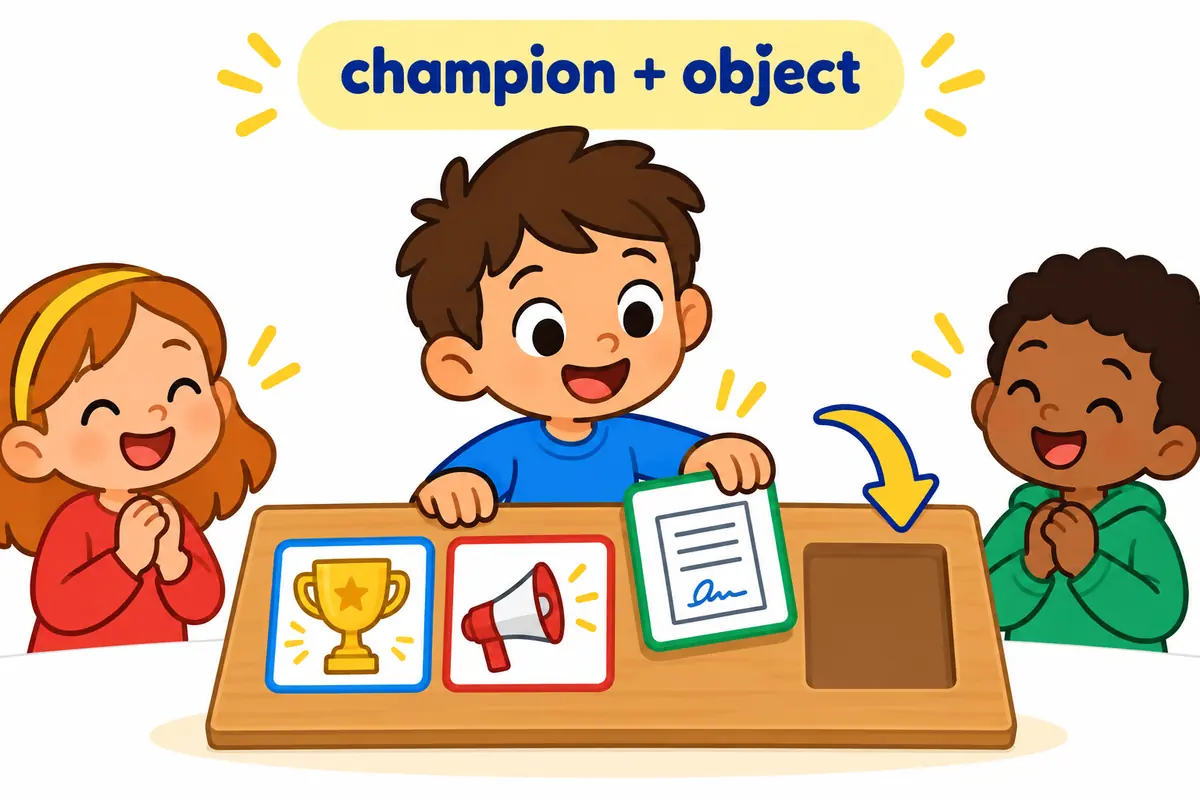
Champion in a sentence: examples across contexts
The word keeps one meaning but shifts register easily. The nine sentences below move from a sports hall to a policy report, and each one shows whether champion is doing the winner job or the advocacy job.
| Context | Example sentence | Why this works |
|---|---|---|
| Sports report | The champion defended the title in straight sets. | The noun marks a title holder with no need for a verb. |
| Workplace email | Our team championed the switch to flexible hours. | The verb shows public backing for a proposal. |
| News report | She was a champion of rural schools for thirty years. | The noun with of names a long public commitment. |
| Charity writing | The foundation champions children who cannot afford books. | A transitive verb with a human object. |
| Academic prose | The paper champions a simpler method of measuring risk. | Using the verb of an argument stresses advocacy. |
| Conversation | He is our champion at the quiz night. | Informal re-use of the winner sense for a group. |
| Political writing | The senator championed the bill through two committees. | The verb carries the sense of effort across obstacles. |
| History essay | She championed the cause of the displaced tenants. | A cause as object signals the advocacy sense. |
| Review writing | The report champions small farms but warns about costs. | The verb followed by but keeps the praise qualified. |
Only the sports and quiz sentences use the winner sense. Everything else treats champion as a form of advocacy, which is the sense that grows in modern writing. Where the cause is opposed by someone, the natural partner is defend, and where a formal body gives approval, endorse is closer.
Champion vs advocate
Champion and advocate both mean to back something, and the difference lies in how public that backing is.
| Attribute | champion | advocate |
|---|---|---|
| Core meaning | Fight publicly for a cause | Recommend or argue for something |
| Typical subject | A campaigner, a charity, a report | A professional, a doctor, a group |
| Usual object | A cause, a policy, a group of people | A method, a change, an approach |
| Register | Warm and committed | Neutral and slightly formal |
| Implies a fight | Usually, since others may oppose | Not necessarily |
Verdict: champion a cause when you are willing to fight for it in public, and advocate a measure when you are recommending it on the strength of reasons. The verb champion carries more heat, so it suits campaigns better than committee minutes.
Word forms and grammar of champion
Champion keeps the same spelling across its noun and verb uses, which is why the surrounding words must make its job clear. The table lists the forms and the related noun.
| Form | Part of speech | Example |
|---|---|---|
| champion | noun, singular | The champion smiled for the cameras. |
| champions | noun, plural | The champions toured the city. |
| champion | verb, base form | They champion fair pay. |
| championed | verb, past and past participle | She championed the reform for years. |
| championing | verb, present participle | championing a cause takes patience. |
| championship | noun | The team won the championship in May. |
The related noun championship is not simply the state of being a champion; it usually names the competition itself. Keep the verb transitive as well: you champion a policy, never champion for it.
Common mistakes with champion
- Incorrect:
She championed for the new library.Correct: She championed the new library. Rule: The verb is transitive and takes no for before its object. - Incorrect:
He was a champion for the reform.Correct: He was a champion of the reform. Rule: The noun takes of to name the cause it defends. - Incorrect:
The team was championed of the league.Correct: The team was the champion of the league. Rule: The winner sense is the noun, not the verb. - Incorrect:
They champion the race last year.Correct: They won the race last year. Rule: Champion never means to win; use the noun for the winner. - Incorrect:
Our group champion the idea quietly.Correct: Our group supported the idea quietly. Rule: The verb suggests public advocacy, so it clashes with quietly.
Practice using champion
Work through the six items, then check the reasoning so the noun and verb patterns stay distinct.
- Fill the gap: The boxer became world ______ at the age of twenty.
- Choose the better word: The nurse has long (championed / won) free clinics.
- Correct the error: The students championed for cheaper bus fares.
- Build a sentence: use champion as a verb about a teacher defending a school garden.
- Spot the register: which belongs in a policy note — the report champions the scheme, or the report is really into the scheme?
- Rewrite with the noun: She publicly defended the refugees. Use champion as a noun instead.
Answers
- champion — the winner sense is a singular countable noun.
- championed — the nurse gives public support, the verb sense of the word.
- The students championed cheaper bus fares — drop for, because the verb is transitive.
- Model answer: The teacher championed the school garden at every governors meeting.
- The report champions the scheme — a policy note prefers the single precise verb.
- She was a champion of the refugees — the noun takes of, and the verb would need a direct object.
The bottom line
Use champion in a sentence for a winner, or for someone who publicly fights for a cause, and let the object settle which sense is meant. The two nuances that decide most sentences are these: the noun takes of to name a cause, while the verb is transitive and takes none. Choose the verb when the support is active and visible.
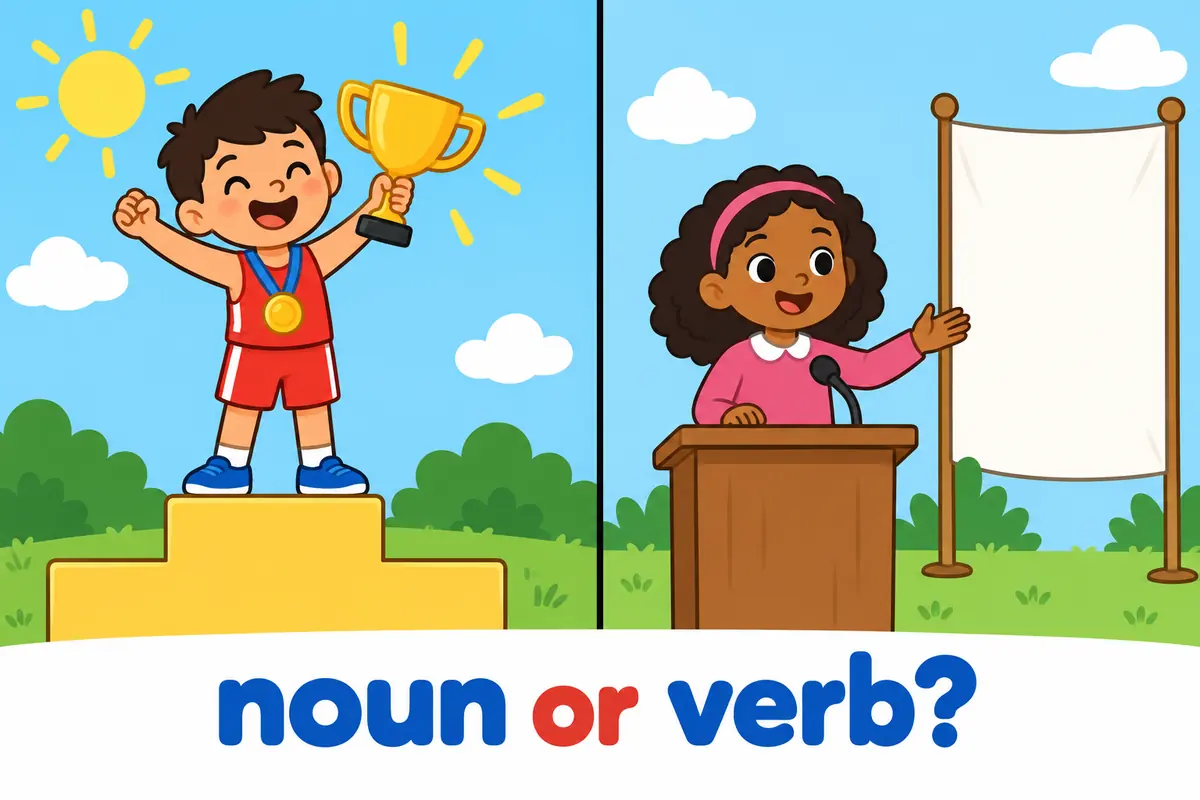
Frequently asked questions about champion
Is champion a noun or a verb?
Champion is both. As a noun it means a winner or a defender of a cause, as in she is the champion. As a verb it means to support something publicly, as in she championed the scheme. The spelling is identical, so the words around it must show which job it is doing.
Does champion take a preposition?
Only the noun does. The noun is followed by of, as in a champion of free speech. The verb is transitive and takes no preposition at all, so you champion a cause rather than champion for a cause. Adding for after the verb is one of the commonest learner errors.
What is the difference between champion and advocate?
Both mean to back something, but champion suggests visible, committed fighting for a cause, often against opposition. Advocate is cooler and more neutral, used for recommending a method or a policy on the strength of reasons. A campaigner champions; a professional body advocates.
Can champion mean to win?
No. Champion never means to win or to defeat. It either names a winner, as a noun, or means to support a cause, as a verb. A sentence such as they championed the final is a mistake; write they won the final or they were the champions instead.
Have you ever wondered what it takes to be a champion? A champion is someone who excels in a particular field or competition, representing the best of the best. They demonstrate exceptional skill, determination, and perseverance in achieving their goals.
In sports, academics, or any pursuit, champions inspire others with their dedication and achievements. They serve as role models for aspiring individuals, showing that success is possible through hard work and commitment.
7 Examples Of Champion Used In a Sentence For Kids
- Our school’s cricket team won the match and our team is the champion.
- The student who runs the fastest in the race will be the champion.
- The champion of the drawing competition drew a beautiful picture.
- When you work hard and never give up, you can be a champion too.
- Every year, we have a spelling bee to find the champion speller in our class.
- The team that wins the football tournament will be the champion team.
- We will all cheer for our classmates who become champions in their activities.
14 Sentences with Champion Examples
- College students in India aspire to become champions in academics and extracurricular activities.
- The debating society is always looking for the next champion speaker to represent the college.
- The sports club organized a tournament to find the ultimate champion in cricket.
- With dedication and hard work, anyone can transform into a champion in their chosen field of study.
- The coding competition attracted some of the brightest minds vying to be declared the champion programmer.
- The annual dance-off showcased the talents of students competing to be crowned the champion dancer.
- The environmental club aims to create champions for sustainability within the college community.
- Through teamwork and collaboration, students can become champions in various group projects.
- The quiz competition challenged participants to prove their knowledge and be recognized as the ultimate champion quizzer.
- The hackathon provided a platform for tech-savvy students to showcase their skills and be celebrated as champions of innovation.
- Despite facing setbacks and challenges, resilient students can emerge as champions in overcoming obstacles.
- The annual talent show highlighted the diverse talents of students, with the hope of discovering the next champion performer.
- By participating in leadership workshops and seminars, students can develop the skills needed to become champions in their future careers.
- The college aims to foster a culture of excellence where every student has the opportunity to become a champion in their own right.
How To Use Champion in Sentences?
Champion is used in a sentence as a noun to refer to a person who has defeated or surpassed all rivals in a competition. To use champion in a sentence, start by identifying a person or team who has achieved success or victory in a specific event.
For example, you could say, “She worked hard to become the champion of the swimming competition.” In this sentence, champion is used to describe the person who won the swimming competition.
When using champion in a sentence, it is important to consider the context and ensure that the word is used correctly. You can also use champion as a verb, meaning to support or fight for a cause. For instance, “She has always been quick to champion the rights of the underprivileged.”
Remember that champion can be used in both formal and informal contexts, so feel free to incorporate it into your writing or everyday conversations. Practice using champion in different sentences to become more comfortable with its usage and expand your vocabulary.
Overall, using champion in a sentence allows you to recognize and celebrate success, whether it’s in sports, competitions, or advocating for a cause.
Conclusion
In conclusion, champions are individuals who have achieved success, victory, or recognition in a particular field or endeavor. Whether it’s a sports champion, a champion of justice, or a champion in any other context, these individuals exemplify exceptional skill, determination, and excellence. They serve as sources of inspiration and motivation for others, setting high standards and pushing the boundaries of what is possible. The title of champion is earned through hard work, dedication, and relentless pursuit of a goal, making it a symbol of triumph and achievement.
Through their actions and accomplishments, champions demonstrate the power of perseverance, resilience, and passion. They inspire others to strive for greatness, to never give up, and to always believe in their abilities. Being a champion is not just about winning, but also about embodying qualities such as integrity, leadership, and sportsmanship. Therefore, champions are not only celebrated for their victories, but also for the positive impact they have on those around them, creating a legacy that transcends mere success.


