Summer adjectives describe different things: weather, daylight, landscapes, activities, or how a season feels to a particular person. Choose a word that fits the detail you can support. Summer is not equally hot, sunny, or relaxing everywhere, and its calendar dates depend on hemisphere and on whether you mean an astronomical or meteorological season.
Summer Changes by Place
For contrasting seasonal word choices, see our guides to adjectives for winter and autumn.
Quick guide
Scorching, humid, and breezy describe different weather conditions; use them only when they fit the place and day.
Sunlit, long, and golden can describe light or daylight, not temperature.
Lively, restful, and memorable express a mood or experience, which may vary from person to person.
In Northern Hemisphere meteorological convention, summer is June–August; in the Southern Hemisphere, those months are winter.
Pair a broad adjective with evidence: “a breezy evening by the lake” is clearer than “a perfect summer day.”
First decide what noun the adjective will describe. A humid afternoon says something about air; a leafy garden describes a setting; a lively festival describes an event; and a restful break describes an experience. This distinction helps prevent a word list from treating a subjective reaction as a universal feature of the season.
Use these four checks when writing:
Name the subject. Are you describing the weather, light, scenery, schedule, event, or feeling?
Check the evidence.Windy and rainy are observable conditions; carefree and idyllic are interpretations.
Add a place or time. “A cool coastal morning” gives readers more information than “a cool summer.”
Consider the reader. Heat, travel, school breaks, outdoor work, and seasonal customs affect people differently.
Seasons Flip by Hemisphere
Summer Depends on Hemisphere and Definition
The word summer does not point to the same months worldwide. In the Northern Hemisphere, astronomical summer begins at the June solstice and ends at the September equinox. The Southern Hemisphere experiences the opposite seasonal cycle, so its summer falls around December through March. Exact solstice and equinox dates can shift slightly from year to year. NASA explains that Earth’s axial tilt produces the opposite seasonal timing across hemispheres (NASA’s overview of seasons).
Weather services also use a meteorological calendar, grouping full months to simplify seasonal statistics. NOAA’s National Centers for Environmental Information describes Northern Hemisphere meteorological summer as June, July, and August; the corresponding Southern Hemisphere grouping is December, January, and February. State the convention when month boundaries matter. Tropical regions may also use wet and dry seasons that do not match a familiar four-season pattern. See NOAA’s explanation of meteorological and astronomical seasons.
These differences matter for adjective choice. A “summer heat wave” may fit one location and month but not another. An adjective such as seasonal should identify whose season or which climate context is meant.
Weather and Climate Words for Summer
Weather describes short-term atmospheric conditions; climate describes longer-term patterns in a region. A single cool day does not establish a cool climate, just as a hot afternoon does not define every summer. NOAA notes that weather varies over short time periods, while climate describes patterns over longer periods (NOAA’s weather and climate overview). Prefer precise combinations that make the time and place clear.
Word
Best fit
Example
Scorching
Intense heat, usually with a strong subjective emphasis
“The scorching pavement shimmered at midday.”
Humid
Moisture in the air; not a synonym for hot
“A humid morning left the garden leaves beaded with dew.”
Breezy
A noticeable, usually gentle wind
“A breezy evening cooled the open-air market.”
Dry
Little moisture in the air, soil, or recent weather, depending on context
“The dry hillside had pale grass after weeks without rain.”
Rain-soaked
A surface or place made wet by substantial rain
“Rain-soaked paths glistened after the storm.”
Mild
Moderate conditions relative to a stated place or expectation
“The coast had a mild afternoon while inland temperatures rose.”
Describe the Weather You See
Words for Summer Light, Scenery, and Activities
Summer writing often blends physical description with mood. Separate what can be seen from what a person feels: sunlit describes illumination; cheerful expresses a positive impression. This keeps the description vivid without claiming everyone experiences the season the same way.
Light and time:bright, sunlit, golden, and long work for sunlight, evenings, or daylight hours when the setting supports them.
Landscape:leafy, blooming, verdant, and dusty describe particular plants, grounds, or surfaces.
Activities:outdoor, festive, busy, and unhurried point to plans and events rather than the season’s weather.
Personal mood:joyful, restful, nostalgic, and overwhelming can describe an individual experience, not a universal summer mood.
Summer Can Feel Different
Examples of Summer Adjectives in Sentences
These new examples show how choosing a concrete subject makes a sentence more informative:
“A breezy ferry ride carried us across the bay at sunset.”
“The rain-soaked field smelled of grass after the afternoon shower.”
“We spent a restful week reading in the shaded courtyard.”
“A lively street festival filled the square with music.”
“The golden light made the hills glow just before dusk.”
“For the Southern Hemisphere, a summer holiday may take place in December.”
Using Subjective Summer Adjectives Carefully
Words such as perfect, carefree, lazy, boring, and magical reveal a viewpoint. They can work well in personal writing, fiction, or reviews when the perspective is clear. For informational writing, explain whose experience or preference the adjective reflects. A summer break can feel restorative to one person and stressful to another.
Some terms also depend on audience and setting. Exotic, for example, can frame a culture as unfamiliar from an outsider’s point of view; name the place, tradition, or feature instead. Regional labels such as Alaskan, Australian, or African are not interchangeable descriptions of weather or mood: specify the actual location or condition you mean.
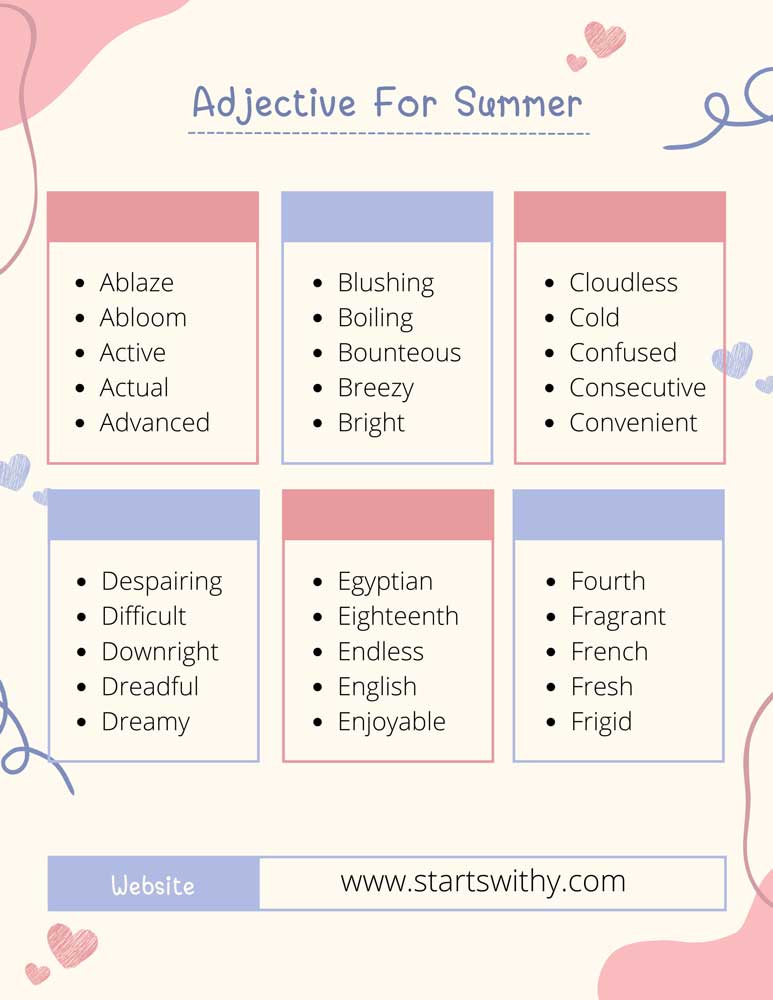
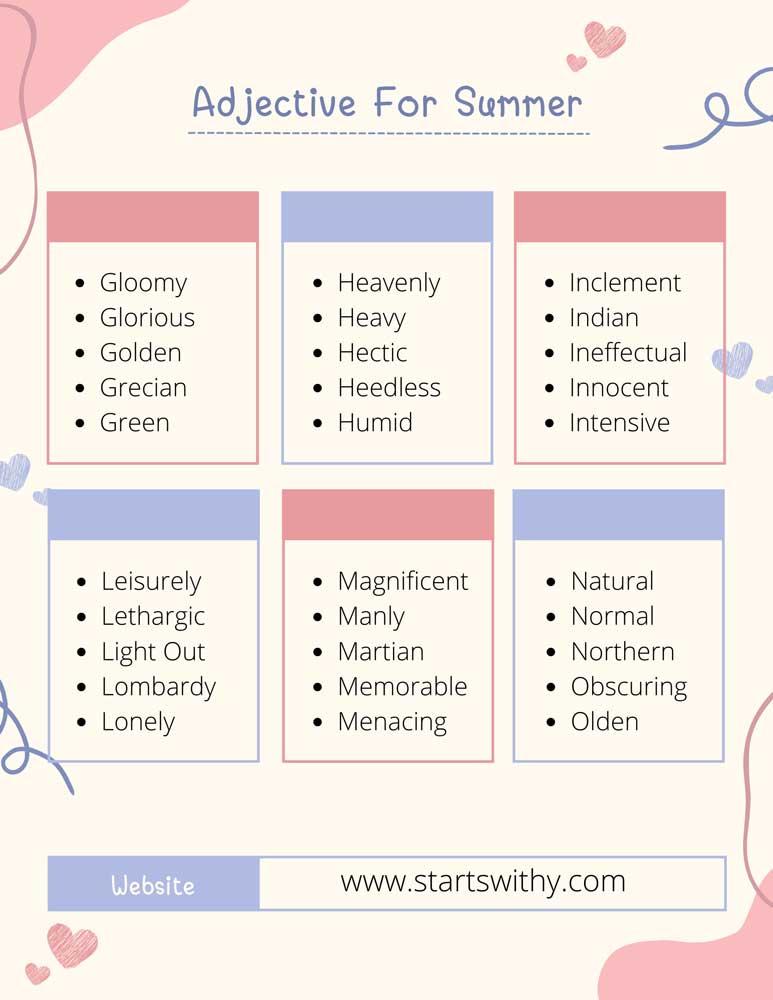
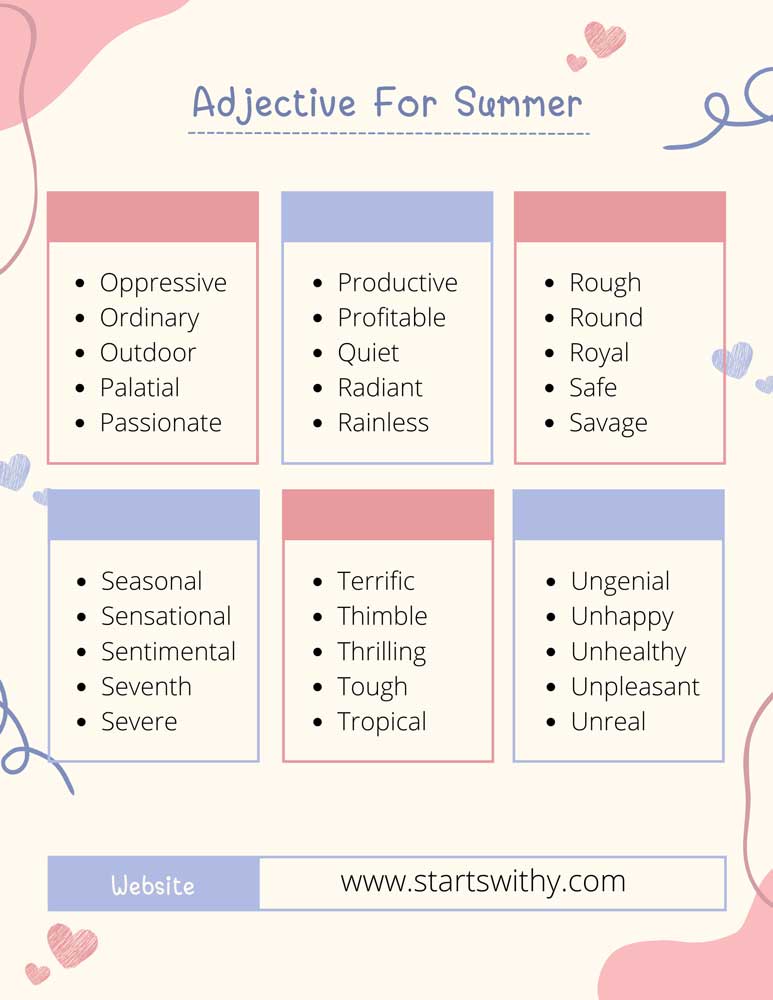
The original alphabetical collection below is retained in full, including its wording, list items, all table rows. It is a broad vocabulary directory rather than a claim that every entry is a literal or universally accurate summer description. Use context to select the words that fit your sentence.
We all have our favorite season, whether it be summer, winter, spring, or fall. Each season brings with it its own unique set of adjectives. For example, we might describe winter as being “cold,” “snowy,” or ” festive.” But what about summer? What adjectives come to mind when we think about this particular season?
In this article, we’ll take a look at some of the most common adjectives used to describe summer. From “fun” and “relaxing” to “hot” and “muggy,” these adjectives capture the essence of this time of year. So whether you’re looking to improve your vocabulary or simply want to find a new way to describe summer, this article is for you.
Adjective For Summer
As the weather gets warmer and the days get longer, many of us start to feel hopeful and excited for the summer months ahead. However, along with all the fun that summer brings, it can also be a challenging time of year, especially when it comes to finding the right adjectives to describe the season.
Whether you’re writing an essay or simply trying to impress your friends with your vocabulary, using adjectives is a great way to add depth and dimension to your writing. To help you get started, here are 15 adjectives that are perfect for describing summer:
Bright: The long days and warm weather make everything seem more vibrant and alive.
Cheerful: There’s something about summertime that just seems to put everyone in a good mood.
Hot: This one is pretty obvious, but it’s worth mentioning nonetheless!
Humid: Along with the heat comes increased humidity levels, which can be both good and bad depending on how you look at it.
Relaxing: For many people, summer is a time to kick back and relax after a busy year.
Joyful: There’s nothing like soaking up the sun and enjoying some quality time with family
A
Ablaze
Abloom
Active
Actual
Advanced
African
Air-Conditioned
Alaskan
Alive
Allergic
Alternate
Amazing
Americathis
Annual
Anomalous
Antarctic
Aquaholic
Arctic
Ardent
Australian
Average
Awesome
B
Backward
Backyard
Balmy
Barefoot
Beautiful
Bland
Blazing
Blistering
Blue
Blushing
Boiling
Bounteous
Breezy
Brief
Bright
Brilliant
Brisk
Burning
Busy
Bygone
C
Calm
Canadian
Careworn
Casual
Certain
Challenging
Chaotic
Charming
Cheerful
Chic
Chilly
Clammy
Classic
Clear
Cloudless
Cold
Concentrated
Confused
Consecutive
Convenient
Cool
Covid
Cruelest
D
Dark
Daysthese
De
Dead
Dear
Decent
Deep
Delightful
Despairing
Difficult
Dotimothy
Downright
Dreadful
Dreamy
Dreary
Dry
E
Earthly
Eastern
Easy
Egyptian
Eighteenth
Endless
English
Enjoyable
Entire
Ere
Eternal
European
Eventful
Exciting
Extraordinary
Extreme
F
Fair
Fantastic
Favourite
Fierce
Fifth
Final
Fine
Following
Fourth
Fragrant
Free
French
Fresh
Frigid
Fruitful
Future
G
Gay
Gentle
German
Glad
Gloomy
Glorious
Golden
Grecian
Green
Grilled
Grim
Growing
Grueling
H
Happy
Hard
Hated
Hazy
Heavenly
Heavy
Hectic
Heedless
Hot
Hotter
Humid
I
Ideal
Idle
Immediate
Immortal
Imperial
Inclement
Indian
Ineffectual
Innocent
Intended
Intense
Intensive
Interesting
International
Italian
L
Lakeside
Late
Later
Lazy
Leisurely
Lethargic
Light
Light Out
Lively
Lombardy
Lonely
Longtime
Lovely
Lucrative
Lusitanian
Luxuriant
M
Magical
Magnificent
Manly
Martian
Mellow
Memorable
Menacing
Mexican
Middle
Mild
Moderate
Moist
Moonlit
Mournful
Muggy
Murky
N | O
Natural
Nice
Normal
Northern
Obscuring
Olden
Oppressive
Ordinary
Outdoor
P
Palatial
Passionate
Past
Patriotic
Peaceful
Perfect
Perished
Perpetual
Pleasant
Polar
Poolside
Powerful
Present
Previous
Primary
Productive
Profitable
Q | R
Quiet
Radiant
Rainless
Rainy
Ramble
Raw
Real
Recorded
Red
Red Hot
Refreshing
Regular
Relaxing
Remarkable
Replete
Reposeful
Resinous
Restful
Rewarding
Rich
Ripe
Roasting
Roman
Rough
Round
Royal
S
Sad
Safe
Savage
Scandinavian
Scarce
Scorching
Scottish
Seasonal
Sensational
Sentimental
Seventh
Severe
Shaded
Shameless
Short
Showery
Sickly
Silken
Single
Sizzling
Slower
Smart
Soft
Softest
Solitary
Southern
Splendid
Starry
Steamy
Stifling
Stormy
Strange
Stunning
Subsequent
Subtle
Successful
Successive
Sudden
Sultry
Summery
Sun-Baked
Sun-Drenched
Sun-Filled
Sun-Kissed
Sun-Sational
Sunburnt
Sunny
Surprising
Sweating
Sweaty
Sweet
Sweeter
Sweltering
Syrian
T
Tan
Terrible
Terrific
Thimble
Thrilling
Tough
Tropical
Truant
Trying
Tumultuous
Twas
Twice
U
Ugly
Unclouded
Uncomfortable
Unexpected
Unforgettable
Ungarnered
Ungenial
Unhappy
Unhealthy
Unpleasant
Unreal
Unusual
Upcoming
Usall
V
Verdant
Virginian
Virtual
Vivid
Vulgar
W | Y
Warm
Welcome
Western
Wet
Wide
Wild
Winterin
Wonderful
Wondrous
Wretched
Youthful
Final verdict
In conclusion, the adjectives used to describe summer vary depending on the speaker’s culture and experiences. However, some common adjectives used to describe summer include hot, sunny, humid, and sticky. Summer is a time when many people enjoy spending time outdoors, and the adjectives used to describe it often reflect this.
Whether you’re looking for a way to describe the heat or the activities you enjoy during summertime, there’s an adjective out there for you. So go ahead and enjoy all that summer has to offer – just be sure to stay cool!
Robin founded StartsWithy in 2022 to make English words easier to understand and use. Robin oversees our 30,000+ guides, checks meanings and grammar against trusted dictionaries such as Cambridge, Oxford Learner’s and Collins, and is accountable for every correction we make.