Choose a star adjective by what you want to describe
A useful adjective for a star points to a feature a reader can picture: its light, apparent color, pattern in the sky, astronomical behavior, or the mood it creates in a scene. Luminous describes light; blue-white describes color; variable describes changing brightness; and solitary describes its setting. Choosing the feature first makes a description clearer than stacking several near-synonyms together.
The word star can mean a self-luminous object in space, a point of light as it appears to an observer, or a symbolic source of hope or attention. Those meanings call for different vocabulary. A science report benefits from precise terms such as apparent, intrinsic, or variable. A poem or story may instead use remote, watchful, or otherworldly to set a tone.
Adjectives for a star’s light and brightness
Use these words when the amount, quality, or visual effect of the light is the focus. They are not all interchangeable: some describe how much light reaches an observer, while others describe its look or impression.
- Bright: giving or appearing to give a strong amount of light. “A bright star stood above the rooftops.” In astronomy, apparent brightness depends on both the star’s light output and its distance from us.
- Luminous: producing light. “The luminous star was easy to spot in the dark field.” This is a good choice when you want to emphasize that the object shines.
- Brilliant: exceptionally bright or impressive. “A brilliant point of light appeared through the clouds.” It also works figuratively for a remarkable person or idea.
- Radiant: sending out light or seeming to glow with it. “A radiant star pierced the winter haze.” It often sounds warmer or more expressive than bright.
- Glowing: shining with steady, soft-looking light. “The glowing star gave the illustration a gentle focus.” The word can describe an appearance without stating how much energy the star emits.
- Faint: difficult to see because its light looks weak. “A faint star emerged as the sky grew darker.” Faintness to an observer does not by itself tell you that a star is physically small.
- Dim: giving little visible light, or appearing weak against its surroundings. “The dim star disappeared behind a thin veil of cloud.”
- Gleaming: shining clearly, often with a polished or sharp look. “One gleaming point marked the edge of the constellation.”
- Scintillating: sparkling or flashing with changing intensity. “The scintillating star seemed to flicker above the horizon.” It is vivid in descriptive writing; twinkling is the more familiar everyday choice.
- Twinkling: seeming to flicker as its light reaches the eye. “A twinkling star appeared between the branches.” For stars seen from Earth, this apparent change is mainly caused by shifting air in the atmosphere, rather than the star repeatedly switching on and off.
- Steady: appearing even or unchanging. “The planet looked steady beside the twinkling stars.” The comparison is useful in a scene, though a star’s actual brightness can vary over time.
- Overexposed: so bright in a photograph that detail is lost. “The overexposed star became a white flare in the long-exposure image.” This is a photographic description, not a physical type of star.

Adjectives for star color and appearance
Color words help readers picture what they see, especially in fiction, illustration, and observing notes. Astronomers also use a star’s color as evidence about its surface temperature. As a broad guide, hotter stars tend to look blue or blue-white, while cooler stars tend toward orange or red. The color labels below are useful descriptions, not a substitute for a measured spectrum.
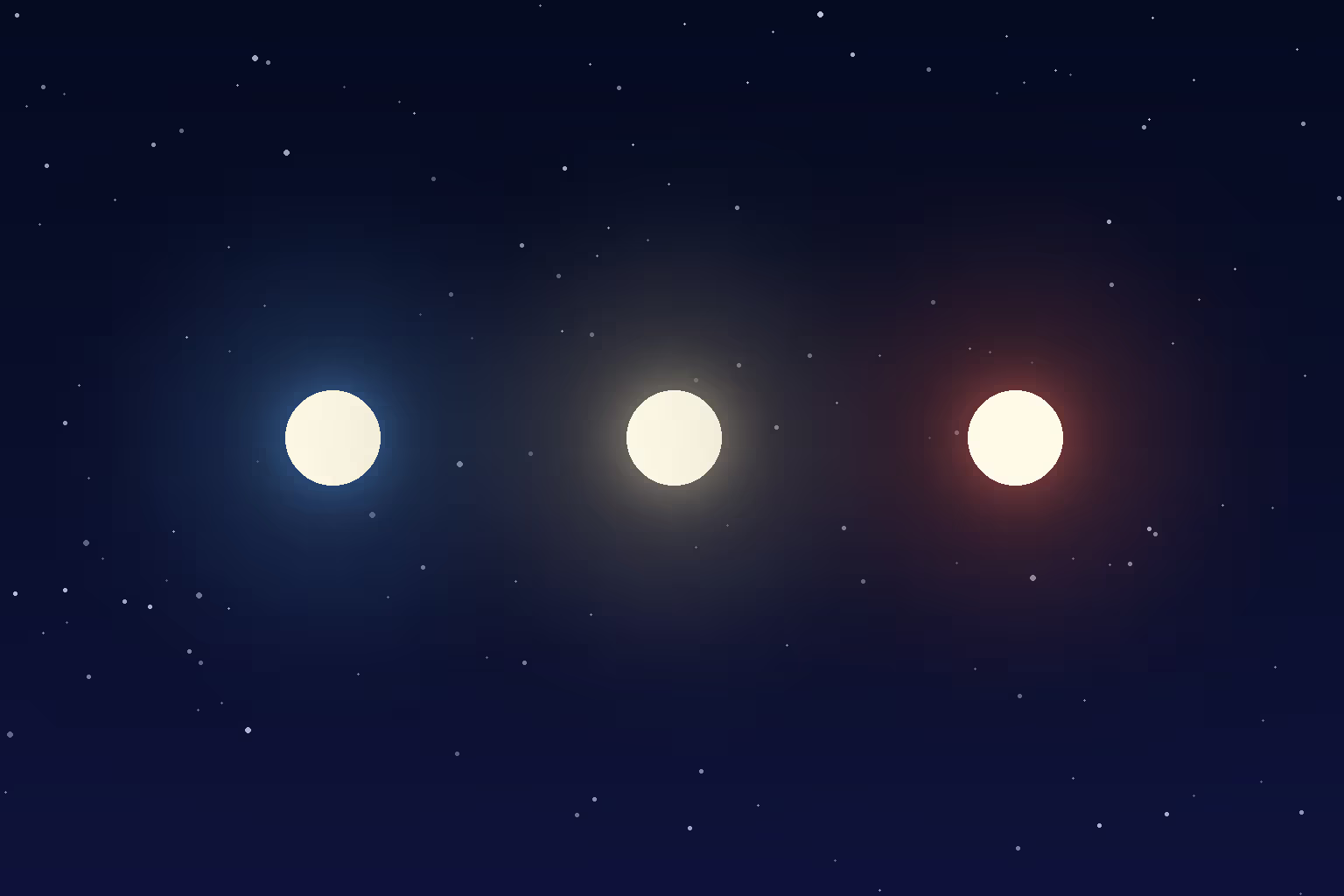
- Blue: visibly blue or associated with a hot-looking stellar color. “The blue star contrasted with the amber lights below.”
- Blue-white: pale white light with a cool blue cast. “A blue-white star marked the center of the sketch.”
- White: appearing neutral or pale rather than strongly tinted. “A white star shone above the cloud bank.”
- Yellow: having a warm yellow appearance, as people often describe the Sun. “The yellow star glimmered through the dusty atmosphere.”
- Golden: rich, warm yellow in appearance; especially useful in figurative prose. “A golden star hung above the quiet harbor.”
- Orange: showing a clear orange hue. “An orange star stood out in the binocular view.”
- Red: appearing red or reddish. “The red star looked coppery against the blue-black sky.” Many stars described as red look orange-red to the eye.
- Reddish: tinged with red without looking fully red. “A reddish point emerged near the horizon.”
- Silvery: pale, cool, and reflective-looking. It is a poetic impression rather than a standard astronomical color class.
- Multicolored: showing more than one apparent color, often in an illustration or a visual effect. “The multicolored star was a fantasy emblem, not a literal view through the telescope.”
Adjectives for a star’s position, pattern, or behavior
These choices describe how a star is situated or how its measured properties behave. They work best when you can identify the point of comparison: where it is, what it is near, or what changes.
- Distant: far away from the observer. “A distant star supplied the final point in the map.”
- Remote: far away or isolated from familiar surroundings. “The remote star seemed alone beyond the edge of the galaxy in the painting.”
- Solitary: alone or separated from nearby companions. “A solitary star shone above the ridge.” Use this for a scene or a known arrangement, not as a claim that most stars have no companions.
- Binary: describing a system of two stars that orbit a common center of mass. “The binary system appeared as one point to the unaided eye.” This is a scientific classification, not a visual synonym for double.
- Clustered: grouped close to other stars in the view. “Clustered stars filled the telescope’s field.”
- Circumpolar: appearing to circle a celestial pole without setting, for a given observing location. “The circumpolar stars traced a slow arc during the night.” The word depends on latitude.
- Variable: changing in brightness over time. “Astronomers monitored the variable star through repeated observations.” Different variable stars change for different physical reasons.
- Pulsating: rhythmically expanding and contracting, often with a corresponding change in brightness. “The pulsating star brightened and faded on a measurable cycle.”
- Eclipsing: used of a binary system whose brightness dips when one star passes in front of the other from our viewpoint. “The eclipsing binary grew fainter at regular intervals.”
- Flare-active: prone to sudden bursts of energy and light. “The flare-active star produced brief outbursts in the observing record.” In a casual description, say flaring only when that behavior is meant.
- Massive: having a large amount of mass. “The massive star used its nuclear fuel more rapidly than a lower-mass star.” Massive is more accurate than calling a star “heavy” in science writing.
- Ancient: extremely old. “The ancient star offered clues to the early history of its surroundings.” Age should be supported by context or evidence in factual writing.
Poetic adjectives for stars and starry scenes
In stories, poems, captions, or personal writing, an adjective can convey the feeling a star creates rather than a measurable property. These words are deliberately interpretive, so give the reader an image or situation that supports them.
- Enchanting: charming in a way that feels magical. “An enchanting star appeared over the glassy lake.”
- Dreamlike: resembling the uncertain or beautiful quality of a dream. “Dreamlike stars drifted above the mist.”
- Serene: calm and peaceful. “Serene stars watched over the empty field.”
- Lonely: suggesting isolation or sadness. “A lonely star lingered in the last strip of twilight.”
- Hopeful: suggesting possibility or comfort. “One hopeful star showed through the storm clouds.”
- Fleeting: lasting only briefly or seeming to pass quickly. “A fleeting star streaked across the sky.” A shooting star is a meteor burning in Earth’s atmosphere, not a star moving across space.
- Otherworldly: seeming strange, distant, or unlike ordinary earthly things. “An otherworldly glow surrounded the star in the science-fiction scene.”
- Watchful: seeming to observe or guard. “A watchful star hung over the sleeping village.” This is personification.
- Unfathomable: difficult to understand or imagine fully. “The unfathomable distance to the star dwarfed the travelers’ map.”
- Timeless: seeming to exist beyond ordinary measures of time. “The timeless stars gave the old observatory a quiet grandeur.”

How to choose the right adjective
When several words seem possible, start with the sentence’s purpose. A science description should state what was observed or measured. A story can use association and mood, provided the image makes the meaning clear.
- Name the feature. Is the star bright, colored, distant, variable, or emotionally symbolic?
- Choose the level of precision. Use reddish for a loose visual impression, but use a measured color or spectral classification in technical writing.
- Keep observation separate from explanation. “The star appeared to twinkle” describes what a viewer sees. A claim about a star’s physical pulsation needs observational evidence.
- Prefer one precise word to a pile of similar ones. “A faint blue star” gives color and visibility; “a bright, radiant, glowing, brilliant star” repeats the same idea.
- Add evidence or context. “A variable star dimmed between observations” is clearer than simply calling it “changeable.”
Compare these examples: “A beautiful star lit the sky” gives a personal reaction. “A pale blue-white star shone above the eastern ridge” lets the reader picture its color and position. “The variable star’s measured brightness decreased during the observation” tells the reader what changed. Each sentence is useful in a different setting.
Quick answers about describing stars
What is a good adjective for a bright star?
Luminous means producing light, brilliant emphasizes exceptional brightness, and radiant adds a warmer or more expressive tone. For a faint star, choose dim or faint.
What adjectives describe star colors?
Common choices include blue, blue-white, white, yellow, golden, orange, and red. For scientific work, describe the measurement or classification as precisely as your evidence allows.
Is “twinkling” the same as “variable”?
No. Twinkling usually describes apparent flicker caused by Earth’s atmosphere. A variable star changes its actual brightness over time, which astronomers can measure.
Can a star be called “lonely” or “watchful”?
Yes, in creative writing. These adjectives personify a star or describe the mood of a scene; they are not claims about a star’s physical behavior.
Sources for the astronomy details
- NASA Science: Stars in an Exoplanet World — overview of star color, temperature, and spectral groupings.
- NASA Science: Types of Stars — background on the range of stellar properties and behavior.
- NASA Science: Hubble Glossary — astronomy terms, including apparent brightness.

Adjectives for stars are used to describe the physical appearance of stars. adjectives for stars are also used to describe the behavior of stars. Adjectives for stars can be divided into two categories: adjectives that describe the physical appearance of stars and adjectives that describe the behavior of stars.
The first category includes adjectives such as bright, shining, and twinkling. The second category includes adjectives such as volatile, changeable, and dangerous. No matter what category they fall into, adjectives for stars are always used to help us understand and appreciate the complexities of these celestial bodies.
Adjective For Stars
It’s no secret that adjectives can add a lot of flavor to our language. They can help to describe the world around us in new and interesting ways. And when it comes to adjectives for stars, there are plenty to choose from.
Whether you’re looking for a word to describe a sparkling starry night or a burning star at midday, you’re sure to find the perfect adjective in this helpful list. So sparkle on, and let your adjectives shine!

A
| Absolute | Academic | Active |
| Actual | Admired | Adorable |
| Adrift | Advent | Adverse |
| Ancient | Angry | Argentine |
| Arsenal | Artificial | Asymptotic |
| Attendant | Atthe | Auspicious |
| Australian | Austrian | Average |
B
| Baahubali | Baked | Baleful |
| Banded | Bankable | Barcelona |
| Bare | Batwoman | Beaded |
| Beaming | Beauteous | Beautiful |
| Belgian | Beloved | Beneficent |
| Beta | Better | Bi |
| Big | Binary | Black |
| Blazing | Blissed | Blockbuster |
| Bloody | Blue | Bluish |
| Blurry | Brave | Brazilian |
| Breakout | Breathless | Brighest |
| Bright | Brilliant | Britest |
| British | Brittle | Broader |
| Broken | Brown | Burlesque |
| Burning | Burnished |
C
| Calm | Canadian | Cantonese |
| Captive | Caribbean | Celebrated |
| Central | Certain | Chief |
| Chinese | Circumpolar | Clear |
| Close | Clouded | Code |
| Cold | Colored | Coloured |
| Comic | Constant | Controversial |
| Cool | Countless | Cruel |
D
| Dark | Dead | Defensive |
| Difficult | Dim | Distant |
| Double | Dramatic |
E
| Earliest | Earthly | Eastern |
| Egyptian | English | Eternal |
| European | Evil | Exciting |
| Extra | Eyed |
F
| Fadeless | Faint | Fair |
| Fairest | Fallen | Falling |
| Familiar | Famous | Farthest |
| Fatal | Favorite | Favourite |
| Fellow | Female | Fiery |
| Fine | Fixed | Fixt |
| Flaming | Flare | Floating |
| Floral | Fluorescent | Fortunate |
| Fourth | Friendly | Fundamental |
| Future |
G
| Gentle | Genuine | Georgian |
| German | Giant | Gigantic |
| Gilded | Glamorous | Glittering |
| Globular | Glorious | Glow |
| Glowing | Gold | Golden |
| Good | Gorgeous | Gracious |
| Gray | Great | Green |
| Greenish | Guiding |
H
| Hairy | Happier | Happy |
| Hard | Hardy | Heavenly |
| Heavy | Heavyweight | Heraldic |
| Herded | Hidden | Hilarious |
| Holographic | Holy | Homely |
| Hospitable | Hostile | Hot |
| Huge | Hung | Hyper |
I
| Icelandic | Iconic | Ill |
| Imaginable | Immense | Immortal |
| Immovable | Indian | Indigenous |
| Individual | Inferior | Infinite |
| Inner | Innumerable | Insignificant |
| Inspiring | Instant | International |
| Inveterate | Invisible | Irish |
J | K
| Jewelled | Jewish | Joyous |
| Julian | Junior | Keen |
| Key | Kinder | Kindred |
| Kinski | Kleene | Kumawood |
L
| Large | Lasceevious | Latin |
| Lavender | Lead | Legendary |
| Legged | Lesser | Light |
| Lightweight | Lily | Literary |
| Loftiest | Lone | Loneliest |
| Lost | Lovely | Lower |
| Lucid | Lucky | Luminous |
| Lurid | Lustrous |

M
| Magic | Magnetized | Magnificent |
| Maidenliest | Mainstream | Major |
| Male | Malicious | Malign |
| Malignant | Manipulative | Marvellous |
| Massive | Meanest | Meaningful |
| Medicaean | Mega | Melancholy |
| Men | Mercurial | Mere |
| Metropolitan | Mexican | Mightiest |
| Mild | Milky | Mimic |
| Minded | Mini | Minor |
| Minute | Miraculous | Misty |
| Mixed | Mock | Modest |
| Momentary | Monstrous | Multi |
| Multiple | Multitudinous | Musical |
| Myriad | Mysterious | Mystic |
N
| Naked | Natal | Native |
| Natural | Nba | Near |
| Neighbouring | Nervous | Net |
| Neurotic | New | Newborn |
| Nigerian | Nocturnal | Nomad |
| Normal | North | Northern |
| Notable | Numberless | Numerous |
O
| Observed | Obvious | Occidental |
| Offensive | Olden | Ominous |
| Oneevery | Online | Opaque |
| Open | Operatic | Opposite |
| Orange | Ordinary | Original |
| Outer | Outlandish | Outlying |
| Overnight |
P
| Pale | Pallid | Panamanian |
| Particular | Passionless | Patient |
| Patriotic | Peaceful | Peculiar |
| Pensive | Perfect | Phantom |
| Phosphorescent | Photographed | Placid |
| Plain | Planetary | Plenty |
| Pointed | Polar | Pole |
| Polish | Poor | Pop |
| Popular | Portuguese | Potential |
| Pre | Principal | Professional |
| Prominent | Promising | Proper |
| Prophetic | Prospective | Prosperous |
| Punctual | Pure |
Q | R
| Quiet | Radiant | Rap |
| Rare | Raw | Rayed |
| Real | Rebel | Reclusive |
| Recognisable | Red | Reddish |
| Registered | Regular | Relativistic |
| Remarkable | Remote | Remotest |
| Renowned | Representative | Republican |
| Responsive | Restless | Retired |
| Revolving | Rican | Rising |
| Rival | Rolling | Round |
| Rugby | Russian |

S
| Sacred | Satiric | Scandinavian |
| Scottish | Seasoned | Secret |
| Seeveral | Senior | Sensuous |
| Separate | Separated | Serene |
| Shattered | Shellmore | Shining |
| Shivered | Shooting | Shy |
| Significant | Silent | Silver |
| Silvery | Single | Singular |
| Small | Social | Soft |
| Solemn | Solitary | Solo |
| South | Southern | Spangled |
| Spanish | Sparkling | Splendid |
| Sterile | Straggling | Strange |
| Successful | Super | Swedish |
| Sweet | Swiss | Syrian |
T
| Talented | Teen | Teenage |
| Temperate | Terrestrial | Thickest |
| Thoughtsno | Throbbing | Tiktok |
| Tiny | Titanic | Tremulous |
| Triple | Troubled | Twin |
| Twinkle | Twinkling |
U
| Ultra | Unbought | Uncertain |
| Undipsuted | Undiscernable | Undisputed |
| Unfaded | Unfamiliar | Unfortunate |
| Unlikely | Unlucky | Unmoved |
| Unpropitious | Untriangulated | Unusual |
| Unworthy | Upthe | Uttermost |
V
| Valuable | Variable | Vast |
| Vaunted | Veiled | Versatile |
| Vesper | Vigil | Visible |
W
| Wakeful | Wan | Wandering |
| Watery | Weak | Western |
| White | Wicked | Wide |
| Wildest | Windy | Winged |
| Wise | Wishing | Wistful |
| Wonderful | Wondrous | Woolly |
| Worldwide | Woven |
Y
| Yellow | Young | Youthful |
As an avid stargazer, I have always been captivated by the beauty and mystery of the night sky. The stars, with their twinkling brilliance, have a way of igniting our imagination and reminding us of the vastness of the universe. But have you ever wondered how to describe these celestial wonders? In this article, I’ll be sharing a variety of adjectives that can be used to describe stars, along with examples to help you envision their splendor.
When it comes to describing stars, there are countless adjectives that can be used to paint a vivid picture in our minds. From the shimmering “dazzling” stars that light up the night sky to the “mysterious” ones that seem to hide secrets of the cosmos, each star has its own unique qualities. Whether you’re an aspiring poet or simply want to expand your vocabulary, these adjectives will help you capture the essence of stars in all their glory.
So, join me on this celestial journey as we explore the enchanting world of adjectives for stars. From “glowing” and “radiant” to “twinkling” and “celestial,” we’ll uncover the perfect words to describe these celestial wonders. Let’s dive in and discover the beauty that lies beyond our earthly realm.
How to Describe stars? – Different Scenarios

When it comes to describing stars, the possibilities are endless. Stars are like little gems in the night sky, each possessing its own distinct qualities. Whether you’re teaching kids about the wonders of the universe or simply trying to find the perfect words to describe a starry night, here are some scenarios in which you can use different adjectives to bring the beauty of stars to life:
- Describing the Appearance of Stars
- Describing the Feelings Evoked by Stars
- Describing the Significance of Stars
Describing Words for stars in English
There are countless words to describe the beauty and wonder of stars. In this section, I’ll explore a variety of adjectives that can be used to describe stars in different ways. Let’s dive into the enchanting world of adjectives for stars!

1. Appearance of Stars
Stars in the night sky captivate us with their breathtaking beauty. Here are some adjectives that can be used to describe their appearance:
- Dazzling: Stars can be incredibly bright and shining, like diamonds in the sky.
- Mysterious: Stars often hold an air of mystery and intrigue, as they exist in a vast universe beyond our reach.
- Glowing: Stars emit a soft and gentle glow, illuminating the darkness of the night.
- Radiant: Stars emit a powerful and radiant light, illuminating the entire sky.
- Twinkling: Stars can appear to twinkle, creating a magical and mesmerizing effect.
- Celestial: Stars hold a celestial beauty, symbolizing the infinite expanse of the universe.
Read: Describing Words for Plants: Examples & Tips
2. Feelings Evoked by Stars
Stars evoke a wide range of emotions within us, leaving us feeling enchanted and inspired. Here are some adjectives to capture the feelings evoked by stars:
- Enchanting: Stars have a captivating and magical quality that enchants our hearts.
- Serene: Stargazing can evoke a sense of tranquility and peace, making us feel at ease.
- Magical: Stars have a mystical quality that sparks our imagination and makes us believe in the extraordinary.
- Mesmerizing: Stars have the power to captivate our attention and leave us in a state of wonder.
- Inspiring: Stars inspire us to dream big and reach for the stars, symbolizing limitless possibilities.
- Ancient: Stars have been a part of human history for thousands of years, connecting us to our ancestral past.
- Cosmic: Stars remind us of the vastness and grandeur of the cosmos, making us feel small yet connected to something greater.
- Guiding: Stars have long been used as guides for navigation, leading explorers and travelers on their journeys.
Adjectives for stars
When it comes to describing stars, there are a plethora of adjectives that can capture their beauty and magnificence. Let’s explore some positive and negative adjectives that can be used to describe stars.

Positive Adjectives for Stars
Stars have always fascinated us with their celestial glow and cosmic brilliance. Here are some positive adjectives that perfectly capture the wonder and beauty of stars:
- Dazzling – Stars are known for their dazzling radiance that lights up the night sky.
- Mysterious – Stars have an air of mystery surrounding them, making us wonder about their secrets.
- Glowing – Stars emit a gentle glow, filling the night with their ethereal light.
- Radiant – Stars shine with a radiant brilliance, illuminating the darkness.
- Twinkling – Stars appear to twinkle in the night sky, creating a magical and enchanting ambiance.
- Celestial – Stars are celestial objects that bring a sense of awe and wonder to our universe.
Here are some example sentences using these positive adjectives:
Read: Adjectives for Kiss: Describing Words & Examples
| Adjective | Example Sentence |
|---|---|
| Dazzling | The night sky was filled with dazzling stars. |
| Mysterious | The mysterious stars captivated my imagination. |
| Glowing | The glowing stars painted a beautiful picture in the sky. |
| Radiant | The radiant starlight shimmered through the darkness. |
| Twinkling | I marveled at the twinkling stars above me. |
| Celestial | The celestial bodies, like stars, are a marvel to behold. |
Now that we’ve explored positive adjectives for stars, let’s take a look at some negative adjectives that we can use to describe stars.
Negative Adjectives for Stars
While stars are often seen in a positive light, there are also negative adjectives that can be used to describe them. These adjectives evoke a different perspective and highlight contrasting aspects of stars:
- Dim – Some stars may appear dim, lacking the bright and radiant glow that we associate with stars.
- Fading – Some stars may be fading, losing their brilliance over time.
- Distant – Stars can seem distant and unreachable, reminding us of the vastness of the universe.
- Unremarkable – Some stars may appear unremarkable, blending into the night sky without drawing much attention.
- Obsolete – Stars do not last forever, and some may become obsolete over time.
Here are some example sentences using these negative adjectives:
| Adjective | Example Sentence |
|---|---|
| Dim | The dim stars were barely visible in the city’s bright lights. |
| Fading | The fading star signaled the end of an era. |
| Distant | The distant stars reminded me of our insignificance in the grand scheme of the universe. |
| Unremarkable | The unremarkable stars faded into the background of the magnificent sky. |
| Obsolete | The obsolete stars were once the center of attention but have now lost their luster. |
The adjectives we choose to describe stars can paint a picture of their beauty, mystery, and significance. From dazzling and radiant to dim and obsolete, these adjectives allow us to explore different aspects of stars. Whether positive or negative, each adjective adds depth and nuance to our understanding of these celestial objects. So let’s keep exploring the fascinating world of adjectives for stars and uncover the wonders that lie beyond our earthly realm.
Synonyms and Antonyms with Example Sentences

Synonyms for stars
When it comes to describing stars, there are numerous synonyms that can help paint a vivid picture. Here are some of the synonyms that capture the beauty and wonder of stars:
- Dazzling – Stars can be dazzling in the night sky, illuminating everything around them.
- Mysterious – There’s an air of mystery surrounding stars, as they twinkle and glow, leaving us in awe of their existence.
- Glowing – Stars emit a soft and radiant glow, adding a touch of magic to the celestial canvas.
- Radiant – The rays of stars can be radiant, casting a warm and comforting light in the darkness.
- Twinkling – The twinkle of stars adds a playful element to the night sky, as if they’re winking at us from afar.
- Celestial – Stars are often described as celestial beings, symbols of the vastness and majesty of the universe.
Read: Insect Adjectives: Examples of Describing Words
Here are some example sentences that demonstrate the use of these synonyms:
- The dazzling stars shone brightly in the clear night sky.
- The mysterious stars filled the dark expanse with their twinkling light.
- The glowing stars hung like lanterns, illuminating the world beneath.
- The radiant stars created a breathtaking spectacle against the backdrop of darkness.
- The twinkling stars seemed to dance and play hide-and-seek with each other.
- The celestial stars reminded me of how small we are in this vast universe.
Antonyms for stars
While it is easy to be captivated by the positive aspects of stars, it’s important to remember that there are antonyms that offer a different perspective. Here are some antonyms that provide contrasting viewpoints:
- Dim – Some stars may appear dim, lacking the brightness and luster usually associated with them.
- Fading – Stars can also fade over time, losing their brilliance and gradually disappearing from sight.
- Distant – Stars that are far away appear distant, making them seem unreachable and untouchable.
- Unremarkable – There are stars that, though still beautiful, may not have any particularly striking or noteworthy characteristics.
- Obsolete – Certain stars have become obsolete, no longer relevant or significant in our understanding of the universe.
Here are some example sentences that illustrate the use of these antonyms:
- The dim stars barely illuminated the night sky, casting a faint glow.
- The fading stars served as a reminder of the passage of time and the impermanence of beauty.
- The distant stars seemed like tiny specks in the vast expanse of the universe.
- The unremarkable stars blended into the background, barely catching anyone’s attention.
- The obsolete stars were once celebrated, but have now been replaced by newer discoveries.
Both synonyms and antonyms contribute to our understanding and appreciation of stars. They provide a range of adjectives that can be used to convey different qualities, helping us to paint a more complete picture of these celestial wonders.
Keep exploring the fascinating world of adjectives for stars, as there is so much more to discover and describe.
In this article, we have delved into the realm of adjectives that can be used to describe stars. By showcasing a variety of positive adjectives like “dazzling,” “mysterious,” and “celestial,” we have captured the sheer beauty and grandeur that stars possess. Additionally, we have introduced negative adjectives such as “dim,” “fading,” and “unremarkable” to offer a contrasting perspective and shed light on different aspects of stars.
It is important to remember that both synonyms and antonyms contribute to our understanding and appreciation of stars. By using a range of adjectives, we are able to convey various qualities and paint a more complete picture of these celestial wonders.
As we conclude our exploration of adjectives for stars, I invite you to continue your journey into the fascinating world of celestial objects. Discover new ways to describe stars and unlock the wonders of the universe. Let your imagination soar as you immerse yourself in the captivating language of the stars.
Final verdict
In conclusion, there are many adjectives that can be used to describe stars. They can be bright, twinkling, distant, and numerous. Each star has its own unique beauty, making them a fascinating subject of study. While we may not be able to reach them, adjectives help us to bring them a little closer to home.


