
Adjectives for a kiss describe its manner, mood, or effect: a kiss may be tender, playful, passionate, brief, or awkward. Choose a word that fits observable details and the narrator’s point of view; “lingering” describes duration, while “romantic” interprets the moment.
Adjectives for a Kiss at a Glance
- Tender and gentle describe softness or care; lingering describes a kiss that lasts.
- Passionate signals strong feeling, while playful signals a light, teasing tone.
- Brief, unexpected, and tentative describe duration, timing, and confidence—not the same quality.
- A concrete detail, such as a quick cheek peck or a pause before the kiss, makes a description more vivid.
- Words such as romantic express an interpretation; they do not establish what both people felt.

Which Adjectives Describe Different Kinds of Kisses?
The most useful adjective names one clear dimension of a kiss: its emotional tone, physical manner, duration, or the narrator’s reaction. These dimensions can combine—a brief kiss can also be tender, and a lingering kiss can feel awkward—so choose words for the detail you intend to emphasize.
| Adjective | What it emphasizes | Example |
|---|---|---|
| Affectionate | Warmth or fondness shown through the gesture. | “She left an affectionate kiss on his forehead.” |
| Tender | Gentleness and care rather than force or urgency. | “A tender kiss softened the goodbye.” |
| Gentle | Light pressure or an unhurried manner. | “He gave her a gentle kiss on the cheek.” |
| Playful | A lighthearted or teasing mood. | “They traded a playful kiss before the train arrived.” |
| Passionate | Strong emotion or intensity; the word is not a measure of duration. | “The scene ends with a passionate kiss.” |
| Lingering | A kiss that continues or seems to last. | “They shared a lingering kiss at the doorway.” |
| Fleeting | A very short moment that quickly passes. | “A fleeting kiss on the cheek brightened the reunion.” |
| Tentative | Hesitation or uncertainty in the approach. | “Their tentative first kiss left room for a pause.” |
| Spontaneous | A moment that seems unplanned; it does not explain whether it was welcome. | “A spontaneous kiss interrupted their laughter.” |
| Awkward | Self-consciousness, a mismatch in timing, or an uncomfortable impression. | “Their awkward first kiss ended with a laugh.” |
| Chaste | A restrained kiss, often described as modest or nonsexual. | “They exchanged a chaste kiss in front of their families.” |
| Sweet | A pleasant or endearing impression, usually from the narrator’s perspective. | “The note ended with a sweet kiss on the forehead.” |
Cambridge Dictionary uses long, lingering to describe a kiss, showing how adjectives can express duration as well as emotion. Its definition of passionate centers on strong feelings. Those distinctions help keep words precise: lingering answers “how long?”, while passionate answers “with what intensity?” See the Cambridge entry for kiss and its definition of passionate.
Cambridge Dictionary defines tender as gentle, loving, or kind and fleeting as short or quick. It also uses chaste kiss for a kiss that does not express sexual desire. Those dictionary meanings make useful distinctions between care, duration, and tone; they are more precise than treating every positive-sounding adjective as a synonym. See its entries for tender, fleeting, and chaste.
How Do You Choose the Right Word?
Choose an adjective by starting with the detail a reader can picture, then decide what that detail means in context. A pause may make a kiss seem tentative to one character and careful to another; the surrounding sentence should make the viewpoint clear.
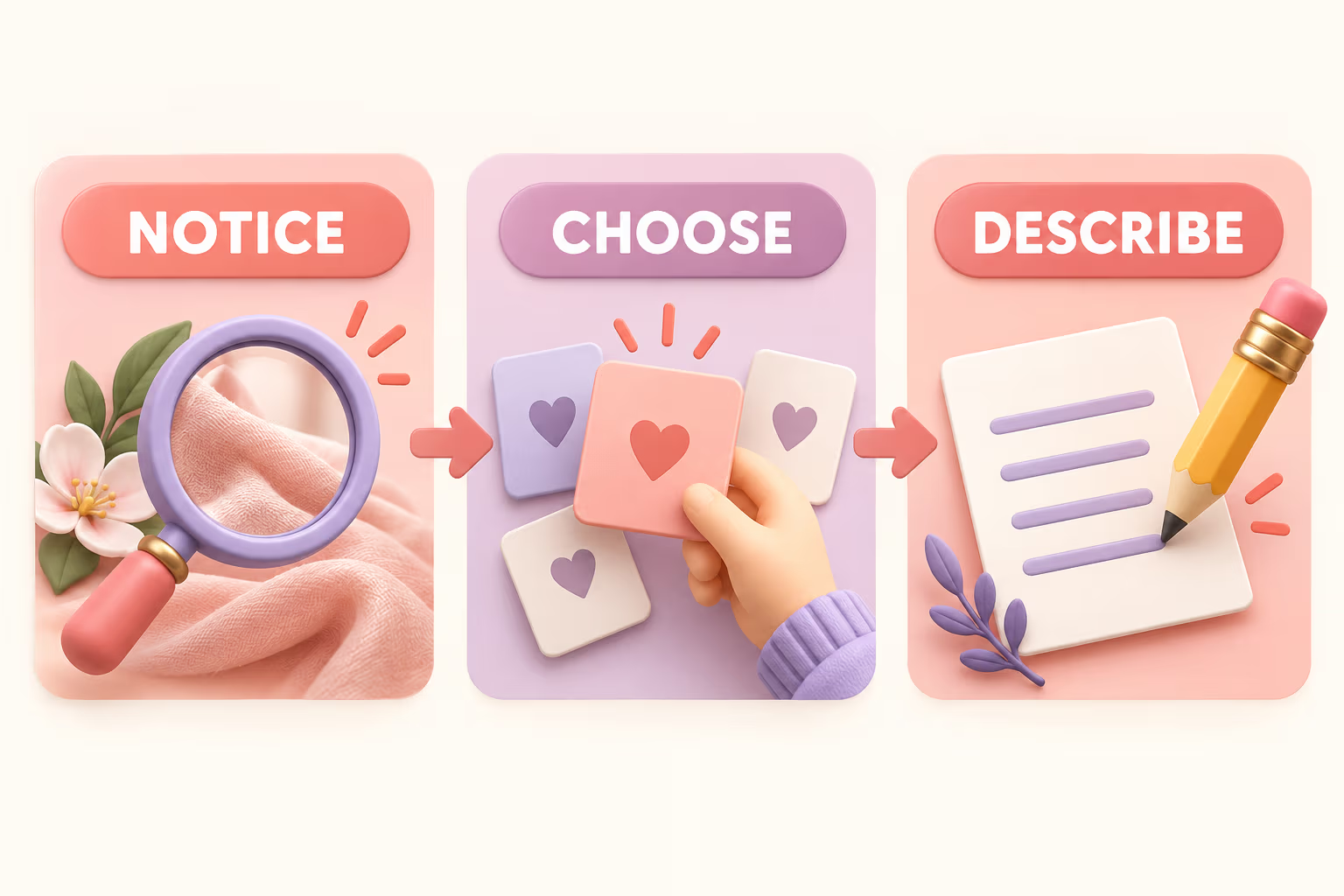
- Notice the detail: Was the kiss quick or lingering, gentle or forceful, expected or unplanned?
- Name one quality: Use brief for duration, tender for gentleness, or playful for a teasing mood.
- Add evidence: Pair the word with a concrete action or setting instead of stacking several near-synonyms.
| Observed detail | Possible adjective | Why it fits |
|---|---|---|
| A quick kiss before leaving | Brief or fleeting | Both emphasize short duration. |
| A careful pause and light touch | Tentative or gentle | The first suggests hesitation; the second emphasizes manner. |
| A grin and an exaggerated kiss on the cheek | Playful | The surrounding action establishes a teasing, lighthearted tone. |
| A goodbye described through fondness | Tender or affectionate | Both can convey care, but affectionate names fondness more directly. |
For instance, “They shared a passionate, fiery, electric, intense kiss” piles up four overlapping judgments. “Their kiss lingered as the station announcement called her train” gives the reader a concrete duration and scene, leaving room to infer the emotion. A second adjective helps only when it adds a different attribute.
How Do Adjectives for a Kiss Work in a Sentence?
An adjective can come before the noun it describes or after a linking verb. Purdue OWL gives the patterns the red house and the house is red; the same structure works with a tender kiss and the kiss was tender.
| Grammar pattern | Example | What the word modifies |
|---|---|---|
| Before the noun | “They shared a gentle kiss.” | Gentle describes the noun kiss. |
| After a linking verb | “Their first kiss felt awkward.” | Awkward describes the subject, kiss. |
| Adverb describing an action | “They kissed gently.” | Gently describes how they kissed; it is an adverb, not an adjective. |
One grammar distinction matters in the original word list below: peck, smooch, and snog are nouns for kinds of kisses, while woo and nuzzle are verbs. They may be useful vocabulary, but they do not function as adjectives in “a ___ kiss.” Purdue OWL’s parts-of-speech overview and adjective-versus-adverb guide explain the difference.
Do Positive or Negative Labels Depend on Context?
Yes. An adjective records a speaker’s interpretation, so the same word can sound affectionate, neutral, or critical depending on the scene and the people involved. Awkward may describe a funny first attempt or a genuinely uncomfortable moment; the surrounding details tell readers which meaning applies.
- Mostly warm: affectionate, tender, sweet, and loving generally express fondness, but should fit the point of view.
- Mostly descriptive: brief, lingering, unexpected, and gentle identify timing, duration, or manner without guaranteeing a positive reaction.
- Often critical or uneasy: sloppy, clumsy, unwanted, and awkward can describe a negative impression, though exact meaning still depends on context.
A “surprise” describes when something happens, not whether it is welcome. In a real-life situation, do not treat a romantic adjective, silence, or past affection as agreement. RAINN explains that consent should be clear, freely given, and ongoing; in fiction, naming a character’s uncertainty or boundary makes the scene more accurate than disguising it with a flattering label. See RAINN’s consent guidance.
How Can You Make a Kiss Description More Vivid?
Use one adjective with one specific detail instead of relying on a string of dramatic labels. For creative writing, the detail might be the setting, a brief pause, or how the moment changes the conversation; in a card or caption, a simple word such as sweet may be enough.
- “A fleeting kiss on the cheek, just before the elevator closed.”
- “Their tender goodbye lasted only a second, but neither rushed away.”
- “The playful kiss came between two lines of laughter.”
- “An awkward pause followed their first kiss, then both smiled.”
Do not assume that a kiss must be passionate or romantic. A greeting, family goodbye, stage direction, or moment in a novel can call for a different tone. For related vocabulary about a connection between people, explore adjectives for relationships, adjectives for love, and adjectives for romance.
When it comes to kisses, words can hardly do justice to the range of emotions they evoke. From sweet and tender to passionate and fiery, each kiss has its own unique flavor. That’s why I’ve compiled a list of adjectives that perfectly capture the essence of a kiss. Whether you’re a hopeless romantic or a fiery lover, these describing words will help you express the indescribable.
A gentle kiss, like a whisper on the lips, can be described as tender, delicate, or even soft. It’s the kind of kiss that makes your heart flutter and your knees weak. On the other hand, a passionate kiss is intense, fiery, and electrifying. It’s the kind of kiss that leaves you breathless and craving for more. And let’s not forget about the playful kiss, which is mischievous, teasing, and full of laughter. It’s the kind of kiss that brings out the childlike joy in both partners.
So, whether you’re looking to enhance your writing or simply want to find the perfect words to describe a memorable kiss, this list of adjectives will surely inspire you. From sweet and tender to passionate and playful, these words will help you paint a vivid picture of the magic that happens when lips meet. Get ready to dive into the world of adjectives for kiss and let your imagination run wild.
How to Describe kiss? – Different Scenarios
When it comes to describing a kiss, there are various scenarios and types of kisses that can be experienced. Each one has its own unique qualities and can elicit different emotions. Here are a few examples of how to describe kisses in different scenarios:
1. Sweet and Gentle Kiss:
- Affectionate
- Tender
- Delicate
- Soft
- Loving
- Heartwarming
In this scenario, the kiss is filled with tenderness and sweetness. It’s a gentle expression of love and affection, leaving you with a warm and fuzzy feeling.
2. Passionate and Fiery Kiss:
- Intense
- Fiery
- Electric
- Sensual
- Deep
- All-consuming
In this scenario, the kiss is passionate and intense, filled with desire and longing. It ignites a fire within you, leaving you craving more.
3. Playful and Teasing Kiss:
- Mischievous
- Teasing
- Flirtatious
- Fun-filled
- Laughter-inducing
- Light-hearted
In this scenario, the kiss is playful and full of laughter. It’s a teasing and flirtatious exchange, keeping the atmosphere light and enjoyable.
4. Romantic and Dreamy Kiss:
- Enchanting
- Magical
- Dreamy
- Mesmerizing
- Fairy-tale
- Blissful
In this scenario, the kiss is romantic and dreamy, sweeping you off your feet. It feels like a moment straight out of a fairy tale, leaving you in a state of pure bliss.
5. Surprise and Spontaneous Kiss:
- Unexpected
- Spontaneous
- Thrilling
- Exhilarating
- Exciting
- Nerve-wracking
In this scenario, the kiss takes you by surprise, catching you off guard. It’s a spontaneous and thrilling moment that leaves you with an exhilarating rush of emotions.
Remember, these words are just a starting point to describe a kiss. Feel free to mix and match them or come up with your own descriptors based on the unique qualities of the kiss you want to portray. The beauty of language is that it allows us to capture the essence of a kiss and convey it to others in a meaningful way. So, go ahead and explore the richness of words to describe the magic of a kiss in different scenarios.
Describing Words for kiss in English
When it comes to describing a kiss, finding the right words can be a challenging task. The beauty of language lies in its ability to capture the essence of a kiss and convey it to others in a meaningful way. In this section, I’ll provide you with a variety of adjectives that can help you paint a vivid picture of different types of kisses.
- Sweet and Gentle
- Passionate and Fiery
- Playful and Teasing
- Romantic and Dreamy
- Surprise and Spontaneous
These words are just a starting point. Feel free to mix and match, or come up with your own descriptors that reflect the unique qualities of the kiss you want to portray. Remember, the key is to choose words that create a sensory experience and evoke emotions in your readers.
Whether you are writing a romantic novel, a poem, or simply trying to express the feelings a kiss brings, a well-chosen adjective can make all the difference. Let your imagination run wild and allow your words to transport your readers to the world of kisses.
So go ahead, explore the vast array of words at your disposal and create a kiss that will leave a lasting impression in the hearts and minds of your readers. Happy writing!
| Adjective | Definition |
|---|---|
| Soft | Not hard or firm |
| Tender | Showing gentleness and concern or sympathy |
| Delicate | Very fine in texture or structure |
| Loving | Feeling or showing love |
| Adjective | Definition |
|---|---|
| Intense | Having or showing strong feelings or opinions |
| Burning | – |
Adjectives for kiss
Positive Adjectives for Kiss with Examples
When it comes to describing a kiss, there are numerous positive adjectives that can capture the essence of this intimate gesture. Here are twelve examples of positive adjectives for kiss, along with sentences that illustrate their usage:
| Adjective | Example Sentence |
|---|---|
| Sweet | She gave me a sweet kiss on the cheek. |
| Gentle | His gentle kiss made my heart skip a beat. |
| Passionate | Their passionate kiss left them breathless. |
| Fiery | The fiery kiss ignited a spark between them. |
| Playful | They shared a playful kiss under the mistletoe. |
| Teasing | His teasing kiss left her wanting more. |
| Romantic | The moonlit beach provided the perfect backdrop for their romantic kiss. |
| Dreamy | She sighed as she experienced the dreamy kiss. |
| Tender | His tender kiss was filled with love and affection. |
| Blissful | Their blissful kiss sealed their love forever. |
| Magical | The magical kiss transported them to a fairy tale world. |
| Enchanting | The enchanting kiss lingered in their hearts. |
Negative Adjectives for Kiss with Examples
While kisses are often associated with positivity and romance, there are also negative adjectives that can describe certain types of kisses. Here are five examples of negative adjectives for kiss, along with example sentences:
| Adjective | Example Sentence |
|---|---|
| Sloppy | His sloppy kiss was filled with saliva. |
| Awkward | They shared an awkward kiss on their first date. |
| Cold | She gave me a cold kiss that felt impersonal. |
| Clumsy | Their clumsy kiss bumped noses. |
| Disappointing | The disappointing kiss lacked passion and connection. |
Remember, these adjectives are just a starting point. Feel free to mix and match or even come up with your own unique adjectives to describe the type of kiss you want to convey. Let your imagination run wild and use words to transport your readers into the world of kisses.
Synonyms and Antonyms with Example Sentences
Synonyms for kiss
When it comes to describing different types of kisses, it’s helpful to have a diverse range of adjectives at your disposal. Here are some synonyms for “kiss” that can add variety and depth to your descriptions:
Soft and Tender
- Smooch: “She gave him a quick smooch on the cheek before heading out the door.”
- Peck: “As a sign of affection, they exchanged a gentle peck on the lips.”
Intense and Passionate
- Snog: “They couldn’t keep their hands off each other, indulging in a passionate snog.”
- Make-out: “Their hot and heavy make-out session took them to a whole new level of desire.”
Playful and Teasing
- Eskimo kiss: “They rubbed their noses together in a cute Eskimo kiss, giggling with delight.”
- Butterfly kiss: “She brushed her eyelashes against his cheek, giving him a light, butterfly kiss.”
Romantic and Dreamy
- Woo: “He spent the evening trying to woo her with romantic gestures and sweet kisses.”
- Nuzzle: “She nestled her head against his chest, enjoying the nuzzle of his lips on her forehead.”
Surprise and Spontaneous
- Smack: “Out of nowhere, he grabbed her and planted a smack on her lips, leaving her pleasantly surprised.”
- Pounce: “With a mischievous grin, he pounced on her, stealing a quick kiss before darting away.”
Antonyms for kiss
Sometimes, you may want to describe the absence of a kiss or a lack of physical affection. In such cases, these antonyms for “kiss” can come in handy:
- Snub: “She turned her head away, deliberately giving him the snub and avoiding his attempted kiss.”
- Reject: “He leaned in for a kiss, but she swiftly rejected his advances, leaving him crestfallen.”
Remember, these synonyms and antonyms are just starting points. Feel free to mix and match them or come up with your own descriptors to capture the unique qualities of the kiss you want to portray. Let your imagination run wild and let your words transport your readers into the world of kisses.
Conclusion
In this article, I have provided you with a comprehensive list of adjectives to describe different types of kisses. By incorporating these words into your descriptions, you can add depth and variety to your writing. I have also given you examples of how to use these adjectives in sentences, allowing you to create vivid and engaging descriptions.
I encourage you to mix and match these adjectives or even come up with your own descriptors based on the unique qualities of the kiss you want to portray. By using words that create a sensory experience and evoke emotions in your readers, you can truly transport them into the world of kisses.
Remember, the power of words lies in their ability to paint a picture and ignite the imagination. So, let your creativity flow and use these adjectives to craft captivating descriptions that will captivate your readers.
Armed with this knowledge, it’s time to unleash your inner wordsmith and bring your kisses to life on the page. Happy writing!
Choosing Adjectives for a Kiss
Adjectives for a kiss work best when the word matches a visible detail and the intended point of view. Use tender for gentleness, lingering for duration, playful for a teasing tone, or tentative for hesitation; then let one concrete detail support the description.
Frequently Asked Questions About Adjectives for a Kiss
What are good adjectives to describe a kiss?
Useful choices include tender, gentle, affectionate, playful, passionate, lingering, brief, tentative, and sweet. Pick according to the quality you mean: lingering describes duration, passionate suggests strong feeling, and tender emphasizes gentleness. A short detail from the scene will show why the adjective fits.
How do you describe a romantic kiss in writing?
Choose one word that fits the scene, such as tender, affectionate, or passionate, and support it with a concrete detail. A pause, a quiet goodbye, or a shared smile can create a clearer impression than several dramatic adjectives. Keep the description anchored to the narrator’s perspective rather than claiming both people feel the same way.
What words describe a first kiss?
A first kiss might be tentative, nervous, gentle, awkward, sweet, or unexpected, depending on the characters and setting. These words are not interchangeable: tentative suggests hesitation, awkward suggests self-consciousness, and unexpected describes timing. Add the characters’ actions or reactions so the reader understands the intended tone.
What is an adjective for a quick kiss?
Brief or fleeting can describe a kiss that lasts only a short time. “A brief kiss on the cheek” is straightforward, while “a fleeting kiss” sounds more literary. Peck is a noun for a short kiss, as in “a quick peck,” rather than an adjective in “a peck kiss.”
Is passionate the same as romantic or tender?
No. Passionate suggests strong feeling or intensity; romantic describes a love-related or idealized tone; tender emphasizes gentleness and care. A scene can be passionate without being tender, or tender without feeling dramatic. Choose the word that matches the particular quality you want readers to notice.


