Adjectives for Love: Words, Meanings, and Examples
Adjectives for love describe a relationship, feeling, action, or experience, and the best choice depends on what kind of love you mean. “Affectionate” describes showing warmth, “devoted” emphasizes loving loyalty, and “platonic” describes loving connection without sex. Name the relationship and the specific quality instead of treating every love word as interchangeable.
At a glance
Love can describe romantic, familial, friendship, compassionate, or spiritual bonds; it does not always mean romance.
Choose a word for the noun it modifies: an affectionate message, a devoted friendship, or a passionate romance.
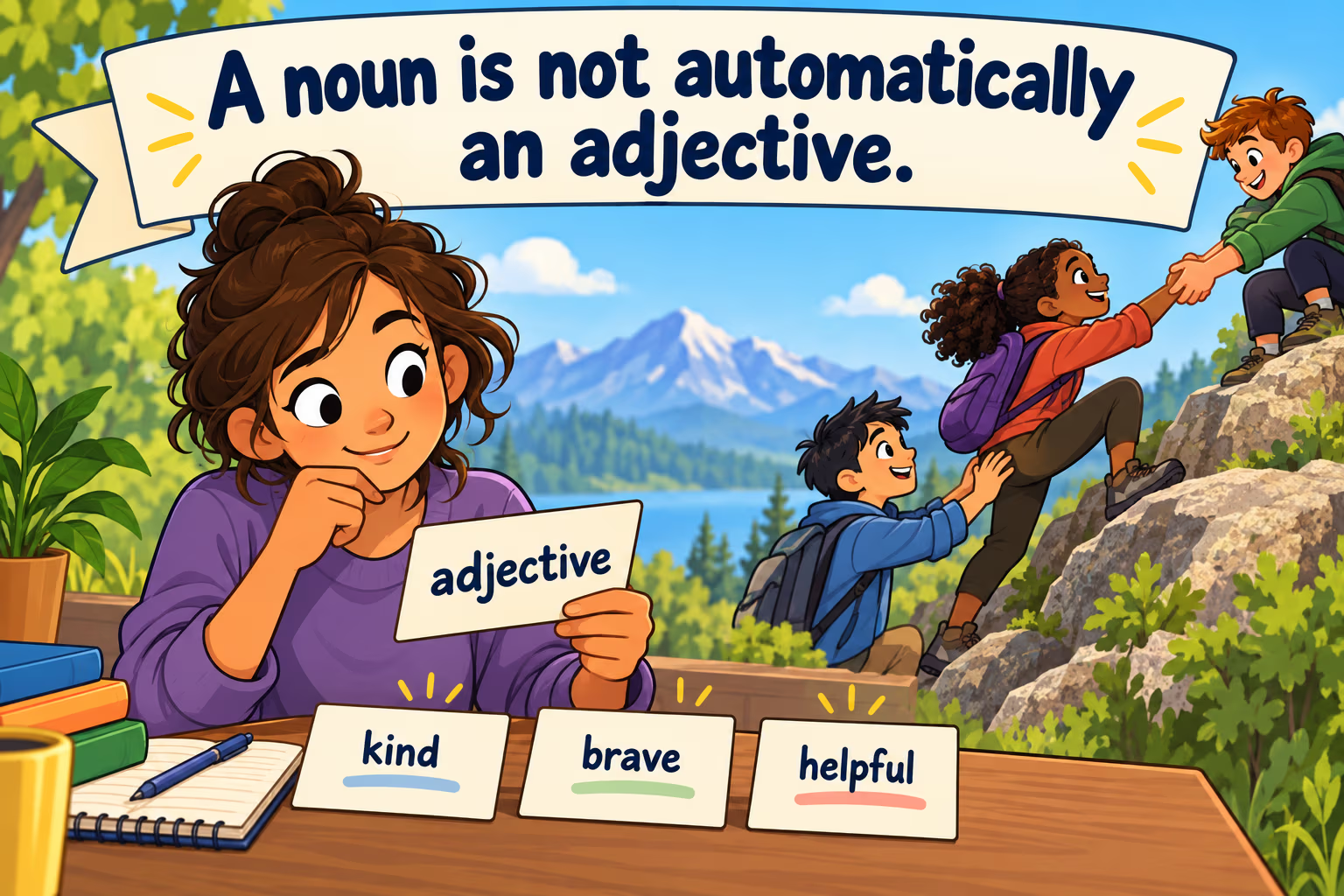
“Affection” is a noun; “affectionate” is an adjective. Related words can have different grammatical jobs.
Words such as possessive, jealous, and obsessive can describe difficult dynamics, not simply stronger love.
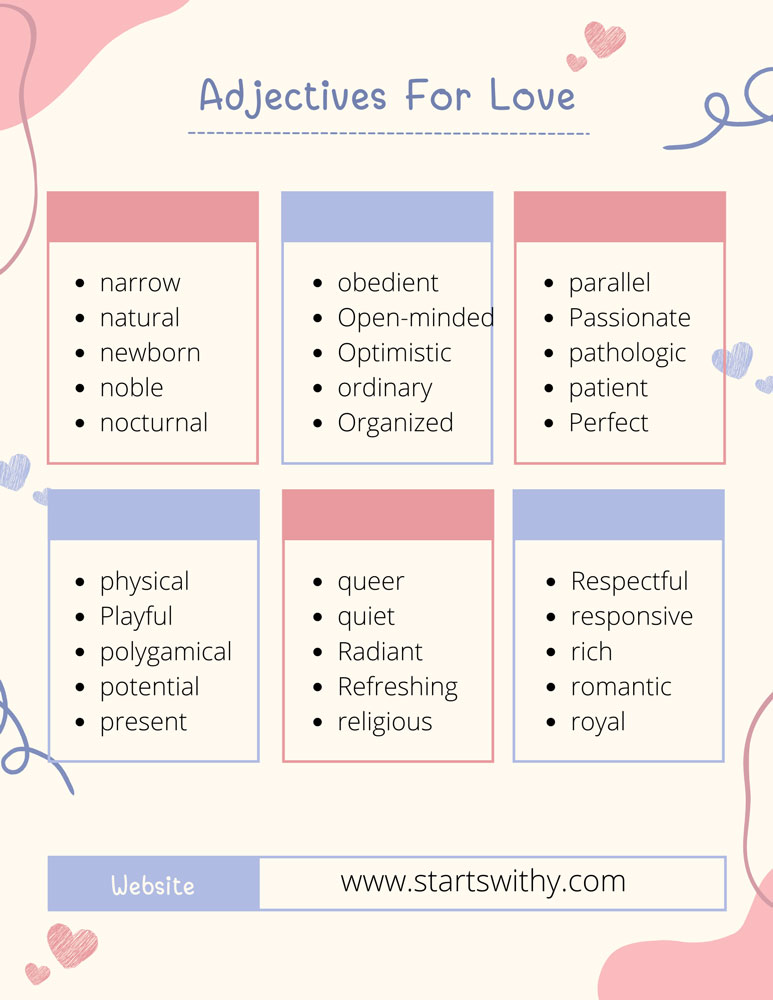
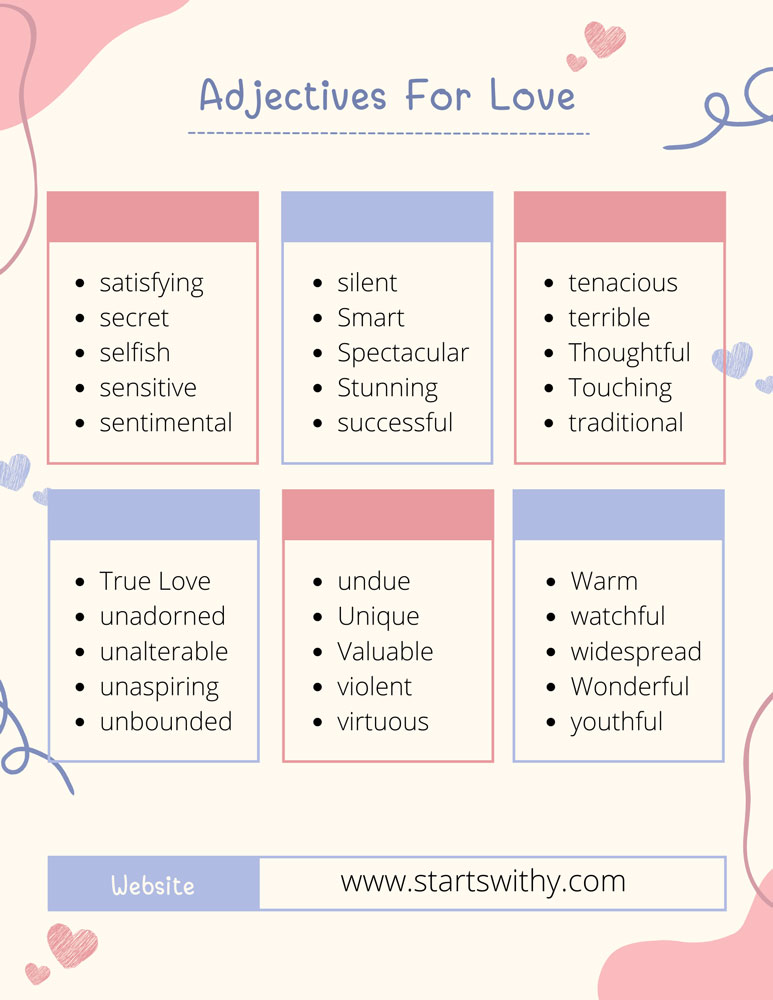
The alphabetized source list below is retained in full; some entries are phrases or other word classes, so check meaning and usage before adopting one.
Choose an adjective by first naming the relationship or experience, then the quality you want to convey. “A tender goodbye,” “a trusting friendship,” and “a passionate romance” describe different things more clearly than a string of broad praise words.
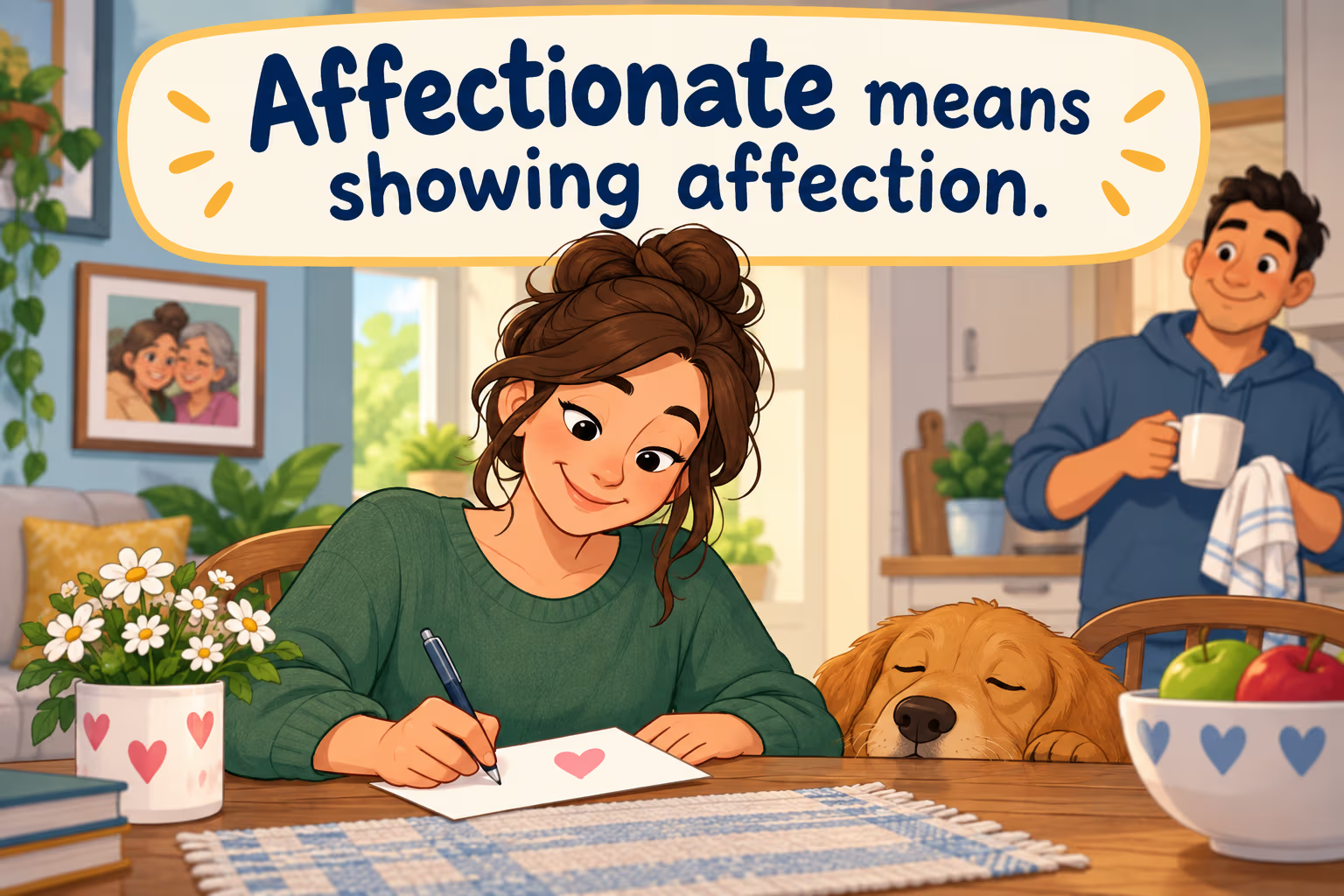
Affectionate describes how warmth or fondness is shown.
Identify the bond: Is the love romantic, familial, between friends, compassionate, or spiritual?
Name the quality: Do you mean warmth, loyalty, closeness, attraction, patience, or commitment?
Check the tone: Is the word affectionate, neutral, intense, critical, literary, or old-fashioned?
Match the grammar: Put the adjective before a noun or after a linking verb: “a caring relationship” or “their bond is enduring.”
Give evidence when describing a real person: “She is supportive; she checks in and listens” is more specific than a label alone.
Which Kind of Love Are You Describing?
The word love covers more than romantic attraction. Psychologists use different models rather than one universally agreed list: the American Psychological Association’s entry on Sternberg’s triangular theory describes intimacy, passion, and commitment as components, while UC Berkeley’s Greater Good overview discusses romantic, familial, companionate, and compassionate forms.
Devoted emphasizes steady loving loyalty.
Context
Useful adjectives
Example
What the word signals
Romantic relationship
Romantic, amorous, passionate, intimate
“They shared a passionate romance.”
Attraction, closeness, or intensity; the words are not exact synonyms.
Family bond
Familial, maternal, paternal, sisterly, brotherly
“His sisterly affection showed in practical help.”
A family connection or a quality associated with it; use a precise relationship noun where possible.
Friendship
Platonic, companionate, trusting, loyal
“Their platonic friendship is warm and trusting.”
Platonic identifies a loving, nonsexual relationship; other words describe its qualities.
Care for another person
Compassionate, caring, tender, supportive
“A compassionate response made room for her grief.”
Concern, kindness, or helpful action rather than romantic attraction.
Long-term bond
Committed, devoted, enduring, steadfast
“They described their bond as enduring.”
Continuity or dedication; these words do not guarantee that a relationship is healthy.
Spiritual or religious love
Spiritual, sacred, devotional
“The poem uses devotional language.”
A religious or transcendent frame, depending on the writer’s tradition and context.
These categories can overlap. A relationship may be romantic and companionate, familial and affectionate, or platonic and deeply committed. They are practical writing distinctions, not a diagnostic checklist or a ranking of which bond matters most.
Many useful adjectives describe one feature of a bond rather than defining the whole relationship. Check the distinction before substituting one word for another.
Adjective
Plain meaning
Example
Usage note
Affectionate
Showing feelings of liking or love
“He sent an affectionate message.”
Can describe behavior, expression, or a person; it does not specify romance.
Devoted
Extremely loving and loyal
“She is devoted to her family.”
Often emphasizes dedication and loyalty.
Platonic
Loving but not sexual
“They share a platonic bond.”
Describes the relationship or emotion, not just its intensity.
Passionate
Marked by strong feeling or enthusiasm
“They wrote passionate letters.”
Context determines whether it signals romance, energy, or a strong interest.
Compassionate
Showing concern and care for another
“Her compassionate response was patient.”
Focuses on care and concern; it need not be romantic or reciprocal.
Mutual
Shared by two or more people
“They described the affection as mutual.”
Names reciprocity, not whether the relationship is romantic or healthy.
Unrequited
Not returned by the person loved
“The novel follows an unrequited love.”
Usually modifies love or affection; it describes a painful mismatch.
Possessive
Showing a desire to control or claim another
“The story portrays possessive behavior as a source of conflict.”
Critical in many contexts; do not use it as uncomplicated praise for intensity.
Cambridge Dictionary defines affectionate as an adjective for showing liking or love, devoted as extremely loving and loyal, and platonic as describing loving but nonsexual relationships or emotions. Those meanings explain why the words are related but not interchangeable.
Are “Affection,” “Love,” and “Loving” the Same Part of Speech?
No. Affection is a noun, affectionate is an adjective, and affectionately is an adverb. Love can be a noun or a verb; loving commonly works as an adjective or verb form. Test the word in its sentence instead of relying on a vocabulary list’s label.
Check the grammatical role the word plays in its sentence.
Compare “She felt deep affection” (noun), “She wrote an affectionate note” (adjective), and “She spoke affectionately” (adverb). Cambridge lists affection as a noun, while its entry for affectionate identifies that form as an adjective. The source list below also contains non-adjectives and multiword expressions; keeping it intact does not make every entry grammatically suitable for every sentence.
Which Love Words Need Careful Context?
Some adjectives describe a narrator’s interpretation, an unhealthy dynamic, or a cultural ideal rather than a neutral fact. Words such as jealous, possessive, and obsessive may describe control or distress. They should not automatically be framed as proof that someone cares deeply.
Unconditional can describe a belief about love that is not dependent on conditions, but it does not establish that a relationship is safe, reciprocal, or free of boundaries. Selfless may praise generosity, yet it can obscure whether someone’s own needs are being ignored. In personal writing, describe observable actions and distinguish your interpretation: “I experienced the repeated messages as possessive” is more precise than presenting a label as objective fact.
Likewise, perfect, eternal, and unbreakable are often expressive or aspirational. They can suit poetry, vows, or fiction, but they make absolute claims if used as factual descriptions. A specific example—“they remained close through years of living in different cities”—lets the reader understand what enduring means in context.
How Can You Use an Adjective for Love in a Sentence?
Put the adjective next to the person, bond, message, action, or experience it describes, and add a concrete detail if readers need to understand the choice.
Describe a gesture: “He left an affectionate note beside her tea.”
Describe a relationship: “Their platonic friendship is close and supportive.”
Describe a quality over time: “A devoted daughter called every Sunday.”
Describe a difficult feeling: “The novel portrays unrequited love without suggesting it was returned.”
Make a subjective judgment clear: “To me, their quiet evening felt tender and intimate.”
A useful editing check is to ask whether the adjective names a visible quality, a type of bond, a level of intensity, or a judgment. If it is a judgment, add the detail or viewpoint that supports it. If it implies control, permanence, or reciprocity, make sure the surrounding sentence supports that implication.
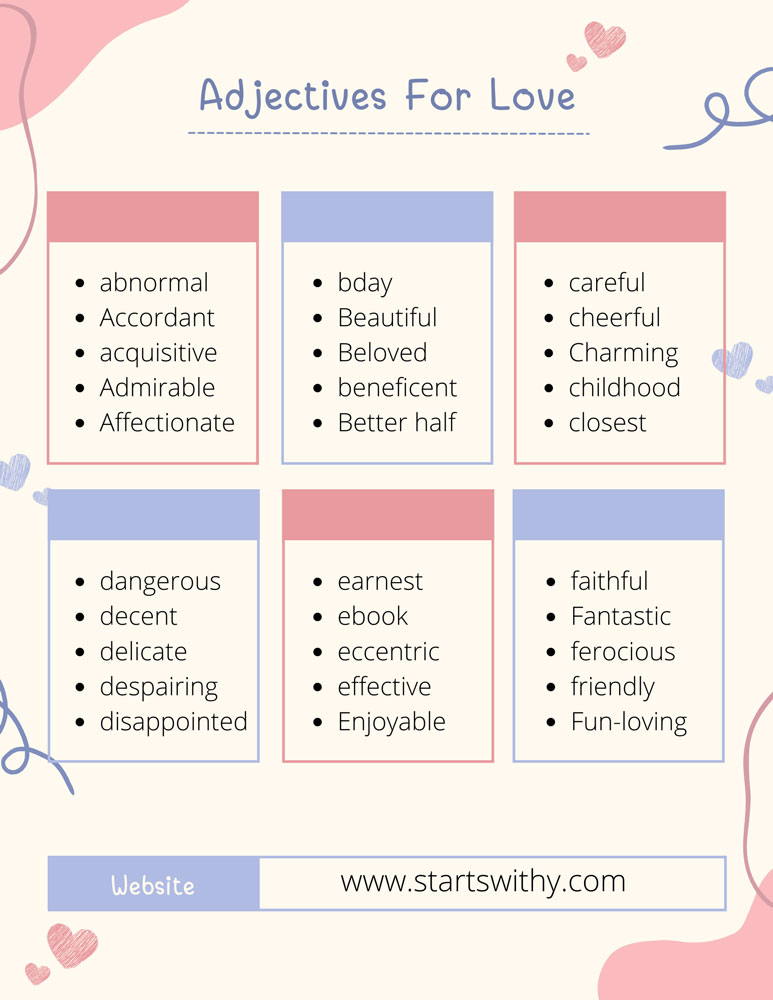
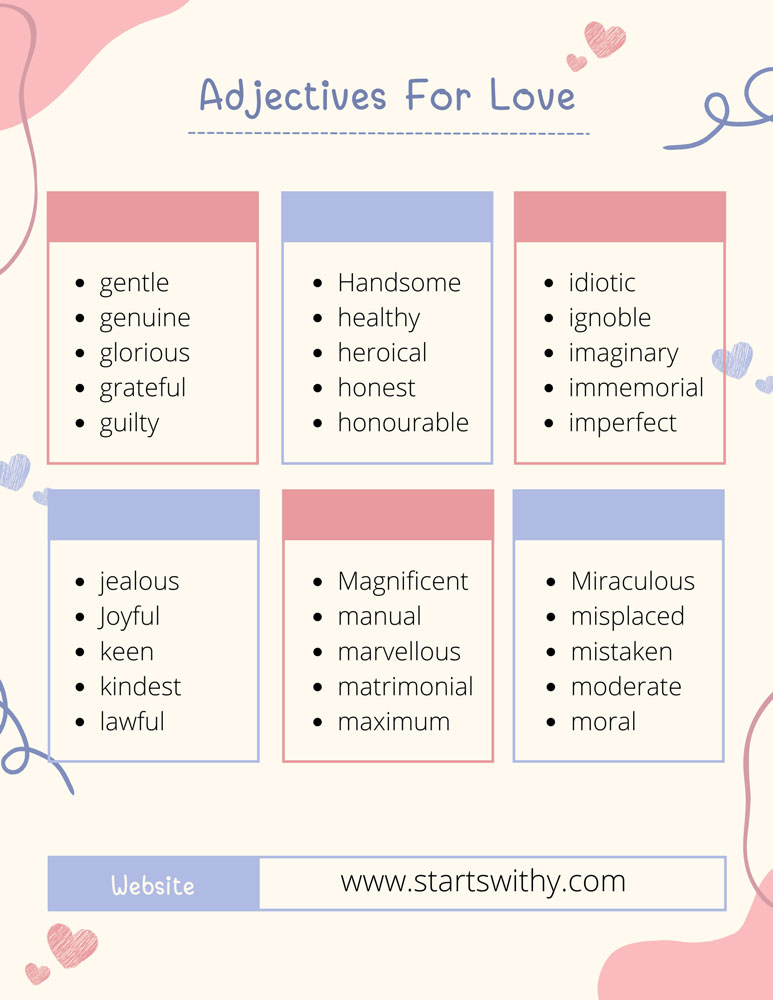
The complete original alphabetized source list follows unchanged. It contains 960 non-empty entries in 58 tables and 325 rows. Some entries are duplicates in meaning, phrases, nouns, verbs, labels, or unusual spellings; consult a current dictionary and check the word’s role before using it as an adjective.
Love is a feeling that is hard to describe in words. However, there are many adjectives that can be used to describe love. Some of these adjectives include: passionate, intense, beautiful, and perfect. Love is something that is felt deeply and passionately. It is an emotion that is intense and beautiful.
Love is perfect because it is something that is shared between two people. It is a feeling that is hard to put into words, but these adjectives give us a better understanding of what love is. Adjective are important because they help us to describe the world around us.
Adjectives For Love
When it comes to love, there are so many adjectives to choose from. You could say that love is beautiful, or passionate, or even life-changing. But no matter what words you use to describe it, one thing is for sure: love is wonderful.
No matter what form it comes in, love is always worth celebrating. Whether you’re in a new relationship or have been married for years, there’s nothing like feeling that connection with another person. And when you find yourself in love, all you can do is just enjoy the ride.
So if you’re feeling love today, take a moment to reflect on all the good things in your life. And if you’re not in a love relationship right now, don’t worry – love will find you when you least expect it. Adjective or not, love is always worth waiting for.
What are some of your favorite adjectives for love? Let us know in the comments below!
A
Abnormal
Aboriginal
Aboundant
Abounding
Absent
Absolute
Absorbing
Abstract
Accordant
Accustomed
Acquisitive
Active
Actual
Adieu
Admirable
Admiralyielding
Admiring
Adorable
Adulterous
Adventurous
Affectionate
African
Agile
Agreeable
Alien
Alleged
Alluring
Altruistic
Amazing
Ambitious
Amiable
Ample
Amusing
Anacreontic
Ancestral
Ancient
Andand
Angel
Angelic
Antique
Anxious
Apathy
Apparent
Appealing
Appreciative
Arcadian
Ardent
Arduous
Artificial
Artless
Asleep
Astounding
Attractive
Australian
Autumnal
Average
Awake
Awaken
Awakened
Awesome
B
Bacchanal
Ballad
Barbaric
Barbarous
Barren
Bashful
Batrachian
Bday
Beauteous
Beautiful
Beautious
Beauty
Befit
Beloved
Beneficent
Benign
Besotted
Best
Better Half
Bewitching
Bitter
Black
Blameless
Blessed
Blessing
Blighted
Blind
Blissful
Boasted
Boastful
Boonless
Boundless
Boyish
Breathtaking
Bright
Brightness
Brilliant
British
Broad
Broken
Brotherly
Brutal
Brutish
Burning
Burst
C
Calm
Canadian
Cannibal
Canst
Captivating
Careful
Careless
Caring
Carnal
Casual
Celestial
Celtiberic
Certain
Characterhis
Characteristic
Charitable
Charming
Chast
Chaste
Cheekèd
Cheerful
Cherishing
Chief
Childhood
Childish
Childlike
Childrenthe
Chinese
Chivalric
Chivalrous
Christian
Clandestine
Clasped
Classy
Clear
Closest
Clouded
Coarse
Cold
Cometh
Comforting
Commercial
Compassionate
Compatible
Complete
Conditional
Congenial
Conjugal
Conjugial
Connubial
Conscious
Consequent
Considerate
Constant
Constitutionalist
Contagious
Contemplative
Contented
Contrary
Cool
Cordial
Corporeal
Cosmopolitan
Courageous
Courteous
Cousinly
Crazy
Criminal
Cristés
Crooked
Crownèd
Cruel
Cuddly
Cunning
Curious
Cursed
Cute
D
Daily
Dainty
Dangerous
Dark
Daughteri
Dead
Deadly
Dear
Deatha
Deathless
Debased
Decent
Decided
Deciduous
Deeper
Defining
Delicate
Delicious
Deprive
Dere
Derivative
Desirous
Desolate
Despairing
Desperate
Despised
Desultory
Detestable
Devastating
Devoted
Devotional
Devouring
Devout
Diabolical
Didst
Difficult
Diligent
Dim
Direct
Disappointed
Disdainful
Diseased
Disguised
Disgusted
Dishonest
Dishonorable
Dishonourable
Disinterested
Disprised
Disprized
Distant
Distempered
Distinguished
Distrustful
Diverse
Divine
Divorcefree
Doglike
Doleful
Domestic
Dormant
Doting
Double
Doubted
Doubtful
Downright
Dramatic
Dramatised
Dreadful
Drowned
Drunken
Dull
Durable
Dutch
Duteous
Dutiful
E
Eager
Earnedthrough
Earnest
Earthborn
Earthly
Easygoing
Ebook
Eccentric
Ecclesiastical
Effective
Elegant
Empathetic
Enamoured
Enchanted
Enchanting
Endearing
Enduring
Engaging
English
Enjoyable
Enriching
Enthralling
Enticing
Entire
Epic
Erotic
Erotical
Esteemed
Etceetera
Eternal
Ethereal
Evangelical
Everlasting
Evident
Evil
Exalted
Exceeding
Exceptional
Excessive
Excite
Excited
Exciting
Exclusive
Exquisite
Extra
Extraordinary
Extravagant
Extreme
Eye-Catching
Eyed
F
Fabulous
Fair
Faithful
Faithfull
Familiar
Fancy
Fantastic
Fascinating
Fashioned
Fatal
Fatherly
Fathomless
Fearful
Female
Feminine
Ferocious
Fervent
Fierce
Fiery
Filial
Fine
Firm
Flaming
Fleshly
Fondest
Foolish
Forgiving
Forward
Frank
Fraternal
French
Fresh
Friendly
Fruitful
Fun-Loving
Fundamental
Funny
Furious
G
Gay
Generous
Genial
Gentle
Genuine
German
Girlish
Glad
Glorious
Godly
Gorgeous
Grateful
Greater
Greek
Guilty
H
Handsome
Hapless
Happy
Hasty
Healthy
Hearted
Heartfelt
Heartwarming
Hearty
Heavenly
Hebrew
Hellenic
Helpless
Heroic
Heroical
Hidden
Holy
Honest
Honey
Honorable
Honourable
Hopeless
Hospitable
Hot
Human
Humble
Hungry
I
Ideal
Idiotic
Idle
Idolatrous
Ignoble
Illicit
Illusive
Illustrated
Imaginary
Imaginative
Immeasurable
Immemorial
Immense
Immoderate
Impassioned
Impeccable
Imperfect
Impersonal
Impossible
Impressive
Impulsive
Inadequate
Inborn
Incarnate
Incensed
Incipient
Incorrigible
Inculcated
Indefatigable
Indian
Individual
Individualized
Ineffable
Inexhaustible
Inextinguishable
Infallible
Infatuated
Infernal
Infinite
Inflexible
Inherent
Inhuman
Innate
Innocent
Inordinate
Insane
Insatiable
Inseparable
Inspiring
Instant
Instinctive
Insurmountable
Intellectual
Intelligent
Intense
Interesting
Intoxicating
Invincible
Invisible
Involuntary
Irish
Irreplaceable
Irresistable
Irresistible
Irresponsible
Italian
J | K
Japanese
Jealous
Joyful
Keen
Kindest
Kindred
L
Laborious
Large
Lasting
Latent
Lavish
Lawful
Lawless
Lazy
Legal
Legged
Legitimate
Leprous
Lest
Lewd
Licentious
Lieth
Lifehis
Lifelong
Lighter
Limitless
Literary
Littleness
Lofty
Logical
Longtime
Loose
Lost
Lovable
Loveall
Lovedst
Lovedto
Loveless
Lovely
Lovemy
Lovesick
Lovest
Lovesuch
Lovetrue
Loveyour
Loyal
Lucid
Lustful
Lyric
M
Mad
Magical
Magnetic
Magnificent
Makinga
Male
Maniaa
Manly
Manual
Manywho
Marital
Married
Marvellous
Marvelous
Masterful
Material
Materialistic
Maternal
Matrimonial
Mature
Maturer
Maximum
Meane
Measureless
Mediaeval
Melancholy
Mere
Metaphysical
Middle
Mightest
Mightier
Mightst
Mild
Millet
Minded
Mindthey
Minethrough
Mingled
Miraculous
Mischievous
Miserable
Misguided
Misplaced
Mistaken
Mock
Moderate
Modern
Modest
Momentin
Monogamous
Moorish
Moral
Morbid
Mortal
Motherly
Mundane
Murmur
Murther
Mute
Mutual
Myselfmy
Mysterious
Mystical
N
Nagging
Naive
Narrow
Natural
Needless
Neglected
Neighborly
Newborn
Newfelt
Newfound
Nice
Noble
Nocturnal
Nonot
Notorious
Nuptial
O
Obedient
Obsequious
Obsessional
Obvious
Oft
Ofthis
Olden
Olympic
Omnipotent
Open
Open-Minded
Opposite
Optimistic
Ordinary
Organized
Oriental
Outspoken
Outstanding
Outweighed
Overdoating
Overmuch
Overweening
Overweighted
Overwhelming
P
Palled
Palmi
Parallel
Parental
Partial
Passionate
Passionsthe
Past
Pastoral
Paternal
Pathologic
Pathological
Patient
Patriotic
Peculiar
Pendant
Perennial
Perfect
Perfidious
Perilous
Permanent
Perpetual
Persistent
Personalized
Pervasive
Perverse
Perverted
Philanthropic
Philosophic
Physical
Pious
Placid
Platonic
Playful
Pleasing
Plighted
Poetic
Poetical
Poetryof
Polygamical
Poor
Popular
Positive
Potential
Practical
Preceding
Precious
Predominent
Preferred
Prematrimonial
Present
Preteen
Pretty
Previous
Primal
Primary
Primitive
Princely
Problematic
Profane
Profess
Professed
Proffered
Profound
Prolonged
Proper
Proud
Prudent
Prussian
Psychic
Puppy
Pure
Pure – Hearted
Q | R
Queer
Quick
Quiet
Racea
Racial
Radiant
Radical
Rancorous
Rapid
Rare
Rash
Rational
Real
Reckless
Redemptive
Refined
Refreshing
Rejoiceth
Relentless
Reliable
Religious
Remarkable
Remorseful
Reprehensible
Resourcefulness
Respectful
Respective
Responsive
Restless
Revealeth
Revengeful
Reverential
Rich
Ridiculous
Riotous
Rival
Roman
Romancesthe
Romantic
Rosevariable
Rough
Round
Royal
Runaway
Russian
S
Sacred
Sacrificial
Sacrilegious
Sad
Satanic
Satisfied
Satisfying
Savage
Seated
Secret
Seductive
Seest
Selfe
Selfish
Selfless
Semi
Senile
Sensible
Sensitive
Sensual
Sentimental
Separationhis
Seraphic
Serpent
Sexual
Shadowy
Sham
Sheer
Shepherd
Shineth
Short
Sicilian
Sided
Sidneian
Sighing
Silent
Silly
Simplest
Simultaneous
Sincere
Sinful
Single
Singular
Sisterly
Slavonic
Slighted
Smart
Smooth
Smothered
Soft
Solid
Sore
Sorrowful
Southern
Sovereign
Spare
Spectacular
Speedy
Spiritual
Spontaneous
Sportful
Spotless
Steadfast
Steady
Stern
Stoic
Stolen
Storyfather
Strange
Strong
Stunning
Stylish
Sublime
Submissive
Successful
Sudden
Sullen
Sunny
Sunshine
Superior
Supernal
Supersensual
Superstitious
Suppressed
Supreme
Sweet
Sweete
Sweetheart
Swiftest
Swiss
Sydnean
T
Talented
Tenacious
Tender
Tenderest
Tenderly
Tense
Terrible
Thati
Thee
Thorough
Thou
Thoughtful
Thy
Timid
Touching
Tough
Traditional
Tragic
Transplanted
Treacherous
Tremendous
Triple
Triumphant
Truant
True Love
Trustworthy
Truthfulness
Twas
Tyrannic
U
Unadorned
Unadulterated
Unalterable
Unappreciated
Unappropriated
Unaspiring
Unbounded
Unchangeable
Unchanging
Unconditional
Unconditionally Loving
Unconfined
Unconscious
Uncreate
Uncreated
Understanding
Undue
Undying
Unequalled
Unexampled
Unfeigned
Unfinished
Unfortunate
Unhappy
Unholy
Unique
Universal
Unknown
Unlawful
Unlimited
Unmerited
Unparalleled
Unpitied
Unprofitable
Unquenchable
Unreasoning
Unreciprocated
Unrecognized
Unrequited
Unruly
Unsatisfied
Unscrupulous
Unselfish
Unshakable
Unshaken
Unshriven
Unsought
Unspeakable
Unspoken
Unsubstantial
Untimely
Unutterable
Unwanted
Unwavering
Unwise
Upbeat
Usual
Usyour
Utmost
Utter
V
Vague
Vain
Valuable
Vast
Vehement
Veilher
Vertuous
Victorious
Vindictive
Violent
Virgin
Virtuous
Vital
Vulgar
W | Y
Wandering
Warm
Warm-Hearted
Warrantable
Watchful
Wealthy
Wedded
Welcoming
Well-Mannered
Wherefore
Whine
Whispered
Wholesome
Wicked
Wider
Widespread
Widest
Wifely
Wildest
Willed
Willing
Wilt
Winged
Wise
Wished
Wistful
Witty
Woful
Wolfish
Womanly
Wonderful
Wondrous
Wooly
Worldmust
Worshiping
Worthy
Wounded
Wretched
Wronged
Youi
Youin
Youthful
Final verdict
Love is a complex emotion that we experience in many different ways. The love we feel for our family is different from the love we feel for our friends, which is different from the love we feel for our romantic partners. And while we might use the same word to describe all of these different types of love, the reality is that each one is unique.
When it comes to describing love, then, the most important thing is to be specific. Which is why we’ve put together this list of adjectives for love. Whether you’re looking for a word to describe the love you feel for your partner, your child, your best friend, or even your pet, we’ve got you covered.
So, without further ado, here are 50 adjectives to describe love:
Frequently Asked Questions About Adjectives for Love
What is a good adjective to describe love?
Choose the adjective that names the feature you mean. Affectionate describes showing fondness or love, devoted emphasizes loving loyalty, and platonic describes a loving, nonsexual bond. A good sentence names the relationship or action too, such as “an affectionate friendship” or “a devoted partner.”
How do I describe love without making it sound romantic?
Name the relationship and choose a word that fits it: familial for family, platonic for loving connection without sex, or compassionate for concern and care. You can also describe actions—listening, helping, or keeping in touch—so readers understand the bond without assuming romance.
Is “love” an adjective?
Love is commonly a noun or verb, as in “their love” or “they love music.” Related forms have different jobs: loving can modify a noun (“a loving family”), while lovingly is an adverb. Check a dictionary and the sentence structure when a list includes multiple forms.
Is “unconditional love” always healthy?
The phrase expresses an ideal of love that is not dependent on conditions, but the adjective does not prove that a relationship is safe, mutual, or respectful. People can care deeply while maintaining boundaries. When describing a real relationship, explain the actions and limits you mean instead of treating “unconditional” as a guarantee.
What is the difference between passionate and devoted love?
Passionate emphasizes strong feeling or attraction, while devoted emphasizes loving loyalty and dedication. A relationship can be both, either, or neither. The American Psychological Association’s triangular theory entry treats passion, intimacy, and commitment as distinct components, offering one framework for describing those differences.
Robin founded StartsWithy in 2022 to make English words easier to understand and use. Robin oversees our 30,000+ guides, checks meanings and grammar against trusted dictionaries such as Cambridge, Oxford Learner’s and Collins, and is accountable for every correction we make.