Constitution in a Sentence: Meaning & Examples
In a sentence, constitution can mean the fundamental rules by which a country or organization is governed, a person’s general state of health, or the way something is formed. For example, “The club’s constitution sets out how officers are elected” uses the governing-rules sense, while “She has a strong constitution” refers to health.
At a glance
- Constitution is a countable noun when it means a governing system or a person’s general health.
- Use constitution of to name the country, organization, or thing being described.
- Constitutions may be codified in one main document or drawn from several laws, precedents, and conventions.
- Capitalize the formal name of a specific document, such as the U.S. Constitution; use lowercase for a generic constitution.
- Constitutional is an adjective, while constitute is a verb; neither replaces the noun in every sentence.
What does constitution mean?
Constitution has several related noun senses, so the surrounding words show which meaning is intended. Dictionaries define the political sense as the laws and basic principles governing a state or organization; the word can also describe health or the way something is made up.

| Meaning | Common pattern | Example sentence |
|---|---|---|
| Governing principles or laws | a country’s constitution; under the constitution | “The constitution defines the powers and duties of public institutions.” |
| Rules of an organization | the constitution of a club; amend a constitution | “The debate club revised its constitution before electing officers.” |
| General health or physical resilience | a strong, healthy, or delicate constitution | “Her strong constitution helped her tolerate the cold hike.” |
| Composition or structure | the constitution of a material or system | “The report describes the mineral constitution of the sample.” |
The legal meaning does not always refer to one bound document. The UK Parliament describes the United Kingdom’s constitution as uncodified: its rules are found across laws, precedents, customs, and texts. By contrast, the U.S. National Archives presents the U.S. Constitution as a specific document with a preamble and seven articles. The general noun applies to both systems, but their form differs.
How do you use constitution in a sentence?
Use constitution as a noun for a governing framework, an organization’s rules, a person’s health, or something’s makeup. The most useful sentence pattern names the relevant entity and says what its constitution does, contains, or affects.

| Pattern | Example | What it shows |
|---|---|---|
| the constitution of + group | “The constitution of the student council sets term limits.” | Identifies whose rules are meant. |
| under the constitution | “Under the constitution, members vote on major changes.” | Means according to its rules. |
| draft, adopt, or amend + a/the constitution | “The association adopted a new constitution.” | Describes creating or changing the rules. |
| have a strong/weak constitution | “He has a strong constitution and rarely catches colds.” | Uses the health sense; it is not about law. |
| the constitution of + material/system | “The analysis measured the chemical constitution of the alloy.” | Describes composition or structure. |
For a specific legal example, the National Archives explains that the U.S. Constitution organizes the federal government and includes an amendment process. Keep that jurisdiction clear: “Article V of the U.S. Constitution describes its amendment process” is more precise than using a U.S.-specific rule as if it applied to every constitution.
Should constitution be capitalized?
Capitalize Constitution when it is part of a formal title or when a style guide treats it as a shortened proper name for one specific document. Use lowercase for generic references such as “a written constitution” or “the constitution of the student club.” House styles vary, so follow the publication’s rule and identify the country or organization when context is unclear.
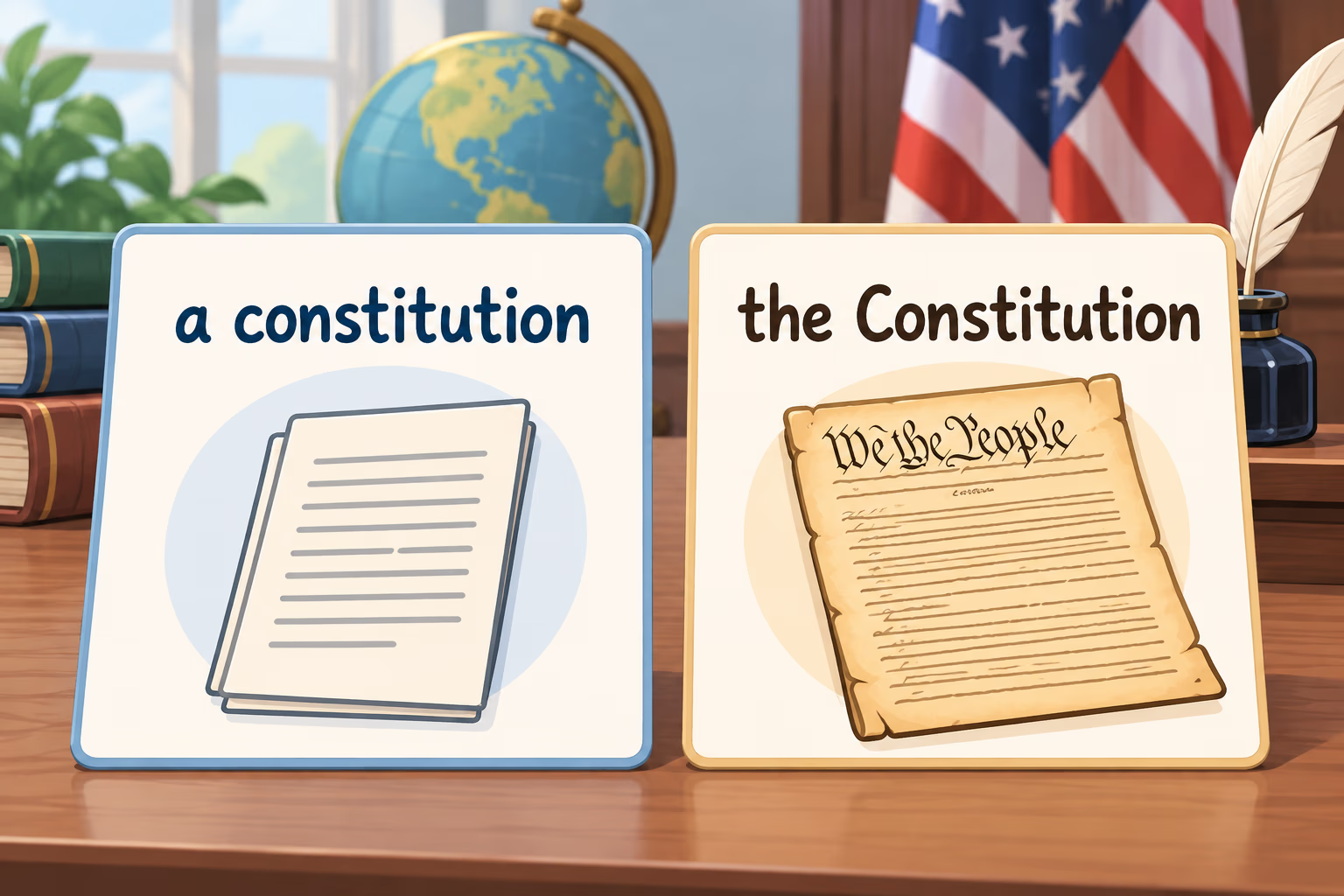
Compare “The country adopted a constitution” with “The U.S. Constitution was ratified in 1788.” In the first sentence, a signals a general document; in the second, U.S. Constitution names a particular historical document. Do not capitalize the word automatically just because a sentence discusses government.
What is the difference between constitution, constitutional, and constitute?
Constitution is a noun, constitutional is an adjective, and constitute is a verb. Their shared word family connects them, but their grammar and meanings differ.
- Constitution: “The constitution sets out the club’s voting rules.”
- Constitutional: “The court reviewed a constitutional question.”
- Constitute: “These elected members constitute the committee.”
Use constitutionality when you mean the quality or question of being constitutional: “The case raised questions about the constitutionality of the rule.” The word is longer and more technical, so use it only when that precise meaning is needed.
Common mistakes when writing constitution sentences
- Assuming every constitution is one written document: some systems draw on multiple legal sources and conventions.
- Using “supreme law” as a universal definition: that description depends on the legal system; name the jurisdiction if the claim is specific.
- Capitalizing every use: distinguish a formal title from a generic reference and check the relevant style guide.
- Missing the health meaning: “a strong constitution” usually concerns someone’s general health, not government rules.
- Confusing related word forms: use the noun constitution, adjective constitutional, or verb constitute according to the sentence structure.
Frequently asked questions about constitution
Is constitution a countable noun?
Yes, when it refers to a governing system or a person’s health: “a constitution,” “the constitution,” and “several constitutions” are all possible. In the formal sense of the way something is formed, it can also be uncountable, as in “the constitution of the material.”
Can an organization have a constitution?
Yes. A club, association, or student council can have a constitution that sets out its purpose, membership, officer roles, elections, and procedures. The exact contents depend on the organization; the word does not imply that the document has the same legal status as a country’s constitution.
Does a constitution have to be written in one document?
No. Some countries have a codified constitution centered on a single document, while others organize constitutional rules across statutes, court precedents, and conventions. “Written” and “unwritten” can oversimplify this distinction; “codified” and “uncodified” are often more precise.
What does “strong constitution” mean?
It usually means that someone seems generally healthy or resilient. In a sentence such as “He has a strong constitution,” the word refers to physical health, not the laws governing a country or organization.
Sources and further reading
- Oxford Learner’s Dictionaries: constitution — governing, health, and composition senses, plus common grammatical patterns.
- Cambridge Dictionary: constitution — political, health, and composition definitions.
- UK Parliament, How Parliament Works — explanation of an uncodified constitution and the distinction between one document and rules spread across sources.
- U.S. National Archives: The Constitution—What Does It Say? — structure and contents of the U.S. Constitution.
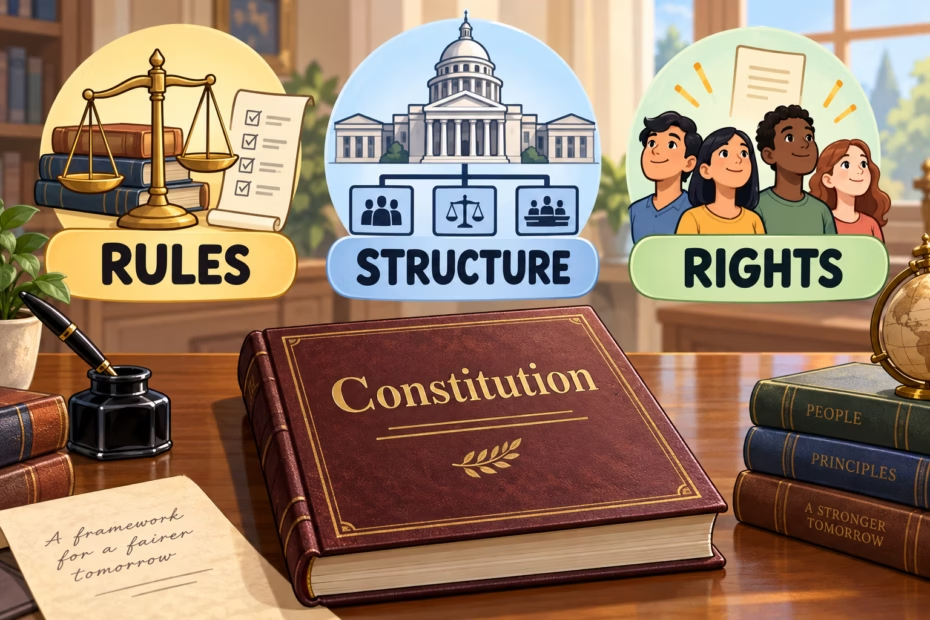
Have you ever wondered what a “constitution” actually is? In simple terms, a constitution is a set of fundamental principles and rules that outline the structure and powers of a government, as well as the rights and duties of its citizens.
Typically, a constitution serves as the supreme law of a country or organization, guiding decision-making processes and ensuring a balance of power. It is often seen as the foundation of a nation’s legal framework, providing a framework for governance and protection of individual rights.
7 Examples Of Constitution Used In a Sentence For Kids
- The constitution is like a rulebook for our country.
- We must respect the constitution of India.
- The constitution tells us our rights and duties.
- Our leaders follow the constitution to make fair decisions.
- We should learn about the constitution in school.
- The constitution protects our freedom and equality.
- Everyone must obey the constitution to live peacefully.
14 Sentences with Constitution Examples
- Have you read the constitution of the student council in our college?
- It’s essential to know the constitution of the college clubs before joining them.
- Understanding the constitution of our college is crucial for every student.
- The constitution of the college ensures equality and fairness among students.
- As responsible citizens, we should abide by the constitution of our college.
- The provisions in the constitution of our college protect the rights of all students.
- Before organizing any event on campus, you must check the constitution for guidelines.
- Familiarizing oneself with the constitution of the college is a sign of a proactive student.
- The constitution establishes the framework for student government elections.
- The constitution outlines the duties and responsibilities of student representatives.
- Violating the constitution of the college can lead to disciplinary action.
- Students should be aware of their rights as per the constitution of the college.
- By upholding the constitution, students contribute to a harmonious campus environment.
- Following the constitution demonstrates respect for the rules and principles of the college.
How To Use Constitution in Sentences?
Constitution is a noun that refers to a written set of fundamental principles and rules by which a country or organization is governed. To use Constitution in a sentence, you can follow these steps:
-
Identify the appropriate context: Consider whether you are referring to a country’s Constitution or an organization’s Constitution. This will help you frame your sentence correctly.
-
Choose the subject: Decide what you want to talk about in relation to the Constitution. It could be a specific article, amendment, or provision.
-
Construct the sentence: Once you have the context and subject in mind, you can create a sentence using Constitution. For example, “The US Constitution is the supreme law of the land.”
-
Check for grammar and accuracy: Ensure that your sentence is grammatically correct and accurately reflects the usage of Constitution in the context you have chosen.
-
Expand your knowledge: To gain a better understanding of how Constitution is used in various contexts, read more about constitutional law, historical documents, or legal cases involving constitutional issues.
By following these steps and practicing using Constitution in different sentences, you can improve your vocabulary and understanding of this important term.
Conclusion
In conclusion, the constitution is the foundation of a country’s legal system and outlines the basic principles upon which a government is established. It serves as a guiding document that sets out the rights and responsibilities of citizens, as well as the framework for the government’s structure and operations. Sentences using the keyword “constitution” demonstrate the significance of this document in shaping a nation’s laws, policies, and political processes.
Understanding the constitution is crucial for maintaining a functioning democracy and upholding the rule of law. It provides a framework for resolving conflicts, protecting individual liberties, and promoting the common good. By examining various sentences with the keyword “constitution,” we can gain insight into the pivotal role this document plays in governing societies and ensuring a just and fair system for all citizens.