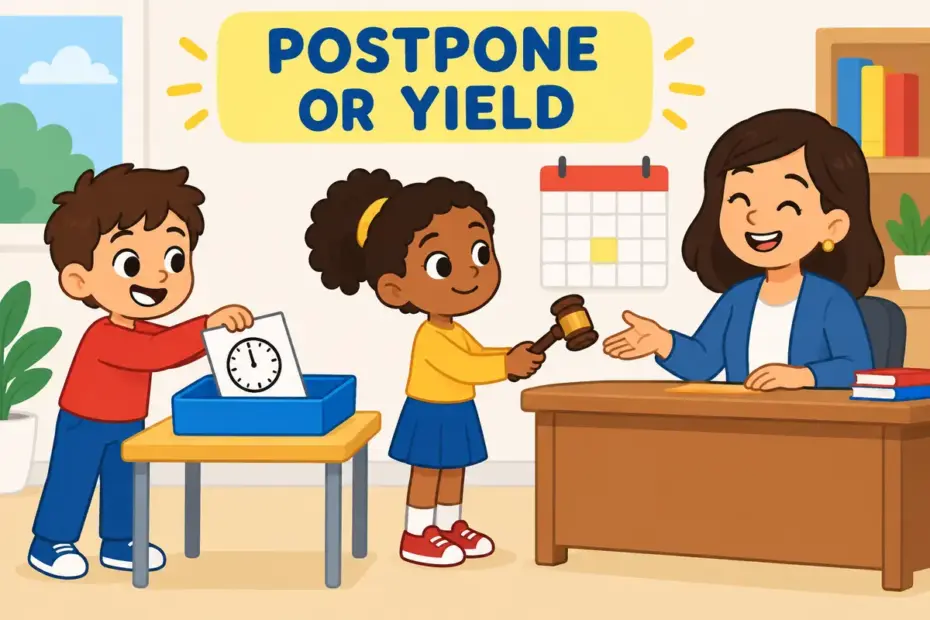
Defer means either to postpone something to a later time or to yield politely to another person’s judgement. To use defer in a sentence, choose the sense first, then the pattern: defer a decision until Friday, or defer to the chair. The preposition to marks the yielding sense and keeps the two meanings apart.
Defer at a glance
- Defer is a verb with two senses: to postpone and to yield to someone.
- Its forms are defers, deferred and deferring, with the nouns deferral and deferment.
- The postponing sense takes a thing as its object (defer a decision); the yielding sense takes to plus a person (defer to the chair).
- Defer is more formal than put off and appears in schedules, law and polite disagreement.
- The commonest error is dropping to in the yielding sense or confusing defer with demur.
What does defer mean?
Defer is a verb with two senses: to postpone an event or decision to a later time, and to yield to another person’s judgement or preference. The Cambridge entry for defer keeps those senses separate, and the pattern in the sentence tells a reader which one is in play. The postponing sense always names the thing delayed; the yielding sense always names the person respected. Writers showing respect for an authority often use the noun, as when a junior lawyer shows deference to a senior judge.
| Sense | Plain meaning | Example sentence |
|---|---|---|
| Postpone | Move an event or decision to a later time | We deferred the launch until testing finished. |
| Yield | Accept another person’s judgement or wish | I defer to your experience on this point. |
For the postponing sense, postpone a meeting and put off work in almost every register, and both words avoid the ambiguity that defer can carry.
How do you use defer in a sentence?
Defer changes its pattern with its sense, and the preposition is the signal a reader uses.
| Pattern | Example | What it signals |
|---|---|---|
| defer + object | The board deferred the vote. | Moves a decision to a later time. |
| defer + object + until, for or by | They deferred payment for ninety days. | Names when the delay or obligation ends. |
| defer to + person | The intern deferred to the senior editor. | Yields to another person’s judgement. |
| defer to + thing (custom or rule) | The club deferred to its own constitution. | Accepts an established authority. |
| be deferred | The hearing was deferred to October. | Passive, common in schedules and law. |
The verb itself seldom takes a person as its direct object, so a sentence such as defer the manager usually means the writer wanted defer to the manager. For the yielding sense, yield to advice is the closest everyday synonym.
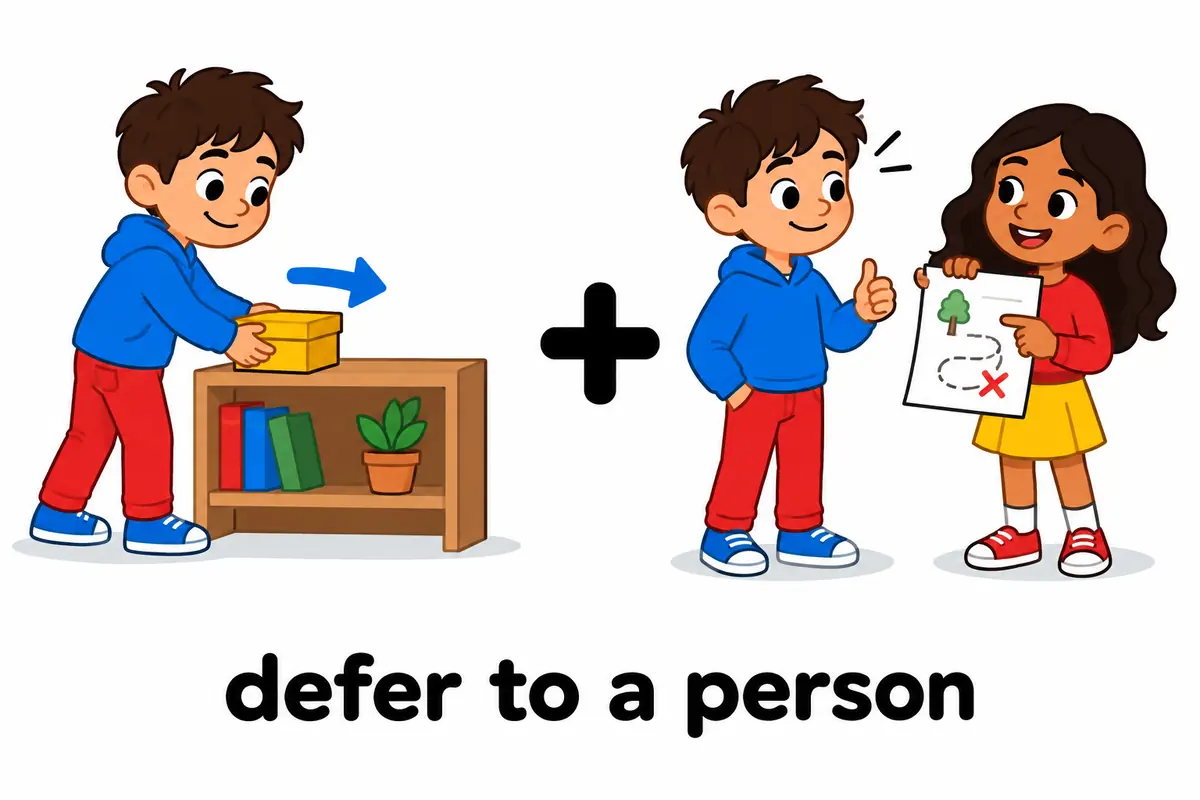
Defer in a sentence: examples across contexts
Defer keeps its form while the setting around it changes, and the examples below show how the two senses separate themselves by pattern rather than by spelling.
| Context | Example sentence | Why this works |
|---|---|---|
| Meeting agenda | The board deferred the vote until its next session. | A formal body delaying its own decision needs the bare object. |
| Workplace email | We have deferred the launch by two weeks to finish testing. | by plus a period states the length of the delay. |
| Legal writing | The court deferred the hearing to October. | Courts adjourn a hearing, so the passive is standard here. |
| Academic writing | The panel deferred to the chair on procedural questions. | The to pattern marks respect for an authority. |
| Conversation | I will defer to your experience here. | The yielding sense is the one that survives in speech. |
| News report | The agency deferred its ruling on the licence. | The object is an official decision, not a person. |
| HR policy | Staff may defer their pension contributions for a year. | for plus a period names how long the obligation is paused. |
| Customer service | The airline deferred our flight until the next morning. | The thing delayed is a service, and the new time is fixed. |
| Sports report | The club deferred contract talks until the season ended. | A bare object plus a time phrase keeps the sentence short. |
Only the last three examples name an end point, and each does it with a different preposition.
Defer vs delay and postpone
Defer overlaps with two common verbs, and the difference is intent rather than length of time.
| Attribute | defer | delay | postpone |
|---|---|---|---|
| Core meaning | Postpone to a chosen time, or yield to a person | Make something late, often unintentionally | Move an event to a fixed later time |
| Intent | Deliberate arrangement, or respect | Often accidental or caused by events | Deliberate rescheduling |
| Typical object | A decision, payment or vote; a person after to | A train, reply or process | A meeting, launch or trip |
| Register | Formal | Neutral | Neutral to formal |
| Extra sense | Yielding to a person | None | None |
Use defer for a chosen or formal delay, and also for yielding to someone; use delay a flight when something is late and possibly unwanted; use postpone a meeting when a new time is fixed.
Word forms and grammar of defer
Defer doubles its final r in the past and participle, which is where most spelling errors begin.
| Form | Part of speech | Example |
|---|---|---|
| defer | verb, base form | We will defer the decision. |
| defers | verb, third person singular | The chair defers to the treasurer. |
| deferred | verb, past and past participle | Payment was deferred for a month. |
| deferring | verb, present participle | They are deferring the final vote. |
| deferral | noun | A short deferral kept the project alive. |
| deferment | noun | He applied for a deferment of his loan. |
| deference | noun | She spoke with deference to the panel. |
| deferred | adjective | A deferred payment falls due in June. |
Deferred and deferring carry two r’s; defered and defering are misspellings. Deferral and deferment both name a delay, but deferment is the usual word for official permission to delay an obligation such as a loan or service, while deferral is the general term.
Common mistakes with defer
- Incorrect:
The junior deferred the senior editor.Correct: The junior deferred to the senior editor. Rule: the yielding sense needs to before the person. - Incorrect:
The court defered the hearing.Correct: The court deferred the hearing. Rule: defer doubles the r before -ed. - Incorrect:
She deferred at the unfair proposal when she meant to object.Correct: She demurred at the proposal. Rule: defer means postpone or yield; demur means to raise an objection. - Incorrect:
From the note we deferred that the manager was unhappy.Correct: From the note we inferred a conclusion that the manager was unhappy. Rule: infer means to draw a conclusion, and defer never has that sense. - Incorrect:
He deferred his decision to the weather.Correct: He delayed his decision because of the weather. Rule: defer is chosen, not caused; use delay when circumstances make something late.
Practice using defer
Work through the six items, then check the reason alongside the answer.
- Fill the gap: The committee agreed to ______ the final vote until March.
- Choose the better word: Heavy snow (deferred / delayed) our flight by three hours.
- Correct the error: The clerk defered the file without a reason.
- Build a sentence: use defer to about a junior colleague accepting a senior colleague’s plan.
- Spot the register: which suits a formal policy document — we’ll push the launch back, or the launch is deferred pending safety checks?
- Fill the gap: On matters of spelling, I ______ to the dictionary.
Answers
- defer — a body choosing a later date takes the bare object.
- delayed — snow is a cause rather than a choice, so the neutral delay fits.
- The clerk deferred the file without a reason — the past tense doubles the r.
- Model answer: The junior deferred to the senior colleague and adopted the plan — to marks the person whose judgement is accepted.
- The launch is deferred pending safety checks — it keeps the passive and avoids the contraction.
- defer — the to pattern signals the yielding sense.
The bottom line
Use defer in a sentence for a deliberate delay or for politely accepting another person’s judgement, and let the pattern tell the reader which: defer a decision takes a thing, while defer to a person takes to. The past tense is spelled deferred with two r’s, and deferral, deferment and deference are the three nouns that grow from the verb. Keep demur for objection and delay for unintentional lateness.
Frequently asked questions about defer
Is defer always about time?
No. Defer has a second sense that has nothing to do with schedules. When someone defers to a colleague, they accept that person’s judgement out of respect, as in she deferred to the senior surgeon. In that pattern the verb is about authority and politeness, not delay, and the preposition to is the signal.
What preposition follows defer?
The preposition depends on the sense. The yielding sense always takes to, as in defer to the chair. The postponing sense takes until, for or by, as in defer the vote until Friday or defer payment for ninety days. A bare object with no preposition simply names the thing delayed.
Does defer mean refuse?
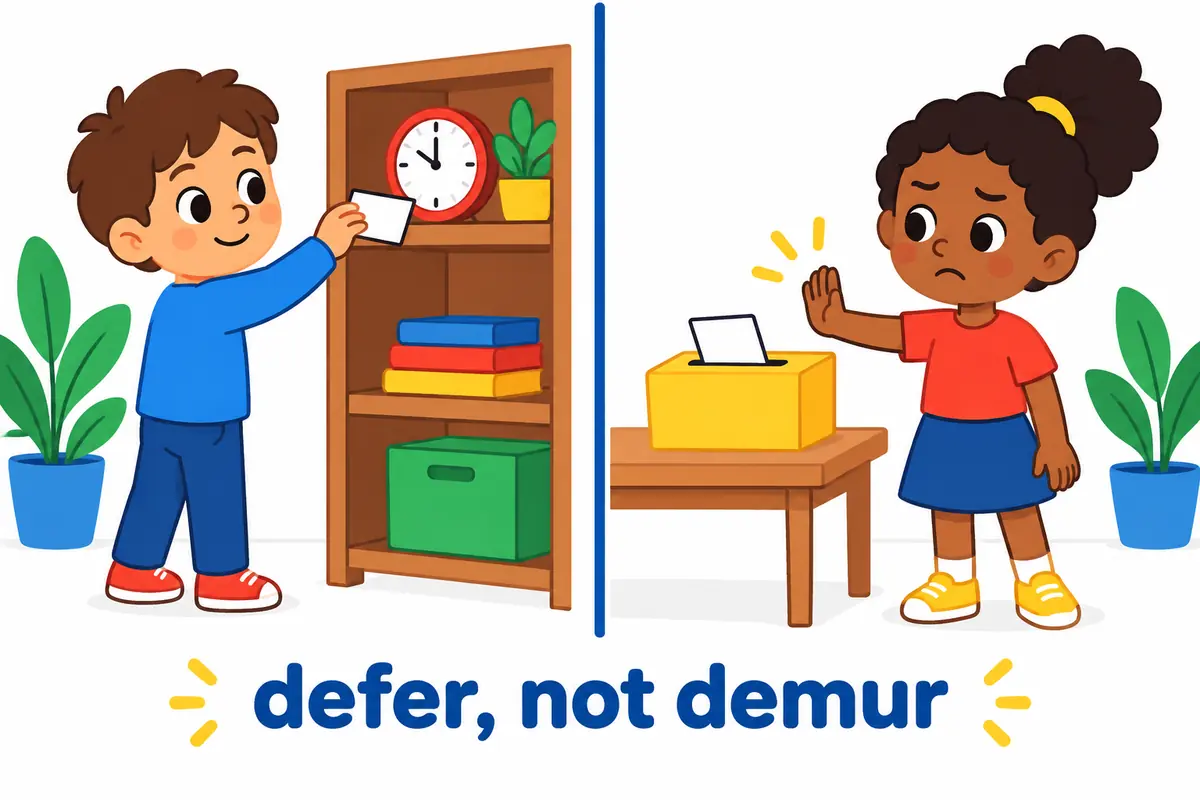
No. Defer means postpone or yield, never refuse. The word that means to object politely is demur, and the two are easily confused because they differ by one letter and both appear in formal writing. If you are raising an objection, choose demur; if you are delaying or yielding, choose defer.
Can defer mean to give in?
It can, in the narrow sense of accepting another person’s judgement or preference. Defer to the chair means to let the chair decide, which is a kind of giving in, but the motive is respect rather than defeat. The verb never means to surrender after a fight or to lose an argument.
Defer in a Sentence: Postpone or Yield to Someone
Defer has two important patterns: defer something means postpone it, while defer to someone means accept or yield to that person’s judgment. “We deferred the meeting until Friday” delays an event. “I defer to the editor on this wording” gives the editor’s judgment priority.
Correction to the older introduction: postponing something is deferral or deferment, not ordinarily deference. Deference concerns respect or yielding to judgment. Also, “defer responsibilities to your study group” does not normally mean assign work; use “delegate responsibilities” for that meaning. “Defer your procrastination habits” is awkward; say “change your procrastination habits” if improvement is intended.
- Defer + object identifies what is postponed.
- Defer to + person or judgment identifies whose view is accepted.
- Until identifies the later time: defer the decision until Monday.
- The forms are defer, defers, deferred, and deferring.

How do you use defer to mean postpone?
Name the decision, event, payment, or action that will happen later. “The committee deferred the vote” tells the reader what was delayed. Adding “until the next meeting” gives a clear time point. A sentence can be grammatical without that time point, but practical notices are more useful when they explain when the matter will return.
| Pattern | Original example | Meaning |
|---|---|---|
| Defer + noun | We deferred the discussion. | We postponed discussing the matter. |
| Defer + gerund | She deferred choosing a topic. | She delayed the action of choosing. |
| Defer + object + until | They deferred the meeting until Friday. | Friday is the new time. |
| Passive construction | The vote was deferred until next week. | The focus is on the postponed vote. |
After defer, an action can take the ing form: “defer making a decision” or “defer buying the tickets.” Avoid “defer to make a decision” when you mean postpone making it. The word to has a different role in defer to someone, so copying that pattern into the postponement sense creates confusion.

How do you use defer to someone?
Use defer to when another person’s view, authority, or preference guides the choice. “I defer to your judgment about the layout” means I accept your judgment in that matter. It does not say I am postponing the layout until a later time. Name the issue when you want to limit the scope of the deference.
Compare “We deferred the decision” with “We deferred to the chair’s decision.” The first delays a choice; the second accepts a choice or judgment. A single preposition changes the relationship. You can combine the senses in a context: “We deferred the vote until Friday and deferred to the chair on the meeting format.”
Defer to does not mean transfer a task. “I delegated the editing to Jo” assigns work; “I deferred to Jo on the final wording” gives Jo’s judgment priority. “I referred the question to Jo” sends the question to Jo for consideration. These three verbs express different actions even when the same person is involved.

What are deferral, deferment, and deference?
Deferral and deferment name postponement. Deference names respectful yielding or consideration for someone’s judgment or position. “The deferral moved the vote to Friday” concerns timing. “The committee showed deference to the specialist’s assessment” concerns whose expertise it respected.
For ordinary writing, postponement is often the simplest noun when no specialized terminology is needed. In an administrative setting, use the institution’s actual term for an approved delay. A request to defer an event is not proof that the delay has been granted; distinguish “requested a deferral” from “received a deferral.”
Frequently asked questions
How do you spell deferred and deferring?
Double the final r: deferred and deferring. “The organizers deferred the event” uses the past tense. “They are deferring the event” uses the ing form. Defers has only one r because it adds s rather than ed or ing. Practice the complete forms instead of assuming every suffix produces the same spelling change.
Is defer more formal than put off?
Defer commonly appears in formal or administrative writing. Put off is a familiar alternative for postponement: “We put off the meeting.” Both can describe delay, but put off has other meanings, such as discouraging someone. In a notice, postpone or defer can make the timing meaning clearer when context is limited.
Can you defer to a preference?
Yes. “I’ll defer to your preference about the restaurant” means the other person’s preference will guide the choice. That use is about yielding rather than timing. If you merely want to ask what someone prefers, “Which restaurant would you like?” is more direct and does not imply that a decision has already been made.
What is a short defer sentence?
“We will defer the vote” is a simple postponement example. “I defer to your judgment” is a simple yielding example. Ask learners to explain whether the sentence delays something or accepts a view. Then add context: “We will defer the vote until Monday” and “I defer to your judgment on the wording.”
Sources: Cambridge Dictionary’s defer entry and its defer to entry. Examples and editing comparisons above are original.

Have you ever wanted to postpone a decision or action for a later time? This act of delaying or putting off something is what we call deference. Deference involves showing respect or yielding to another’s opinion, allowing for a delay or postponement.
When you defer a decision, you are choosing to hold off on making a choice until a later point. This can be done for various reasons, such as needing more information, considering other options, or giving someone else the opportunity to weigh in. Throughout different aspects of life, the concept of deference plays a significant role in how we navigate decisions and interactions with others.
7 Examples Of Defer Used In a Sentence For Kids
- Defer your turn to speak patiently.
- Can you defer your playtime for a few minutes?
- Let’s defer the snack time until after the activity.
- Remember to defer to the teacher’s instructions.
- It’s polite to defer to your elders.
- Sometimes it’s necessary to defer a fun activity for later.
- Please defer your questions until the end of the story.
14 Sentences with Defer Examples
- Defer your social plans until after you finish studying for your exams.
- Remember to defer any unnecessary expenses until you have a clearer picture of your budget.
- It’s best to defer taking up that part-time job until your final exams are over.
- If you’re feeling overwhelmed, don’t hesitate to defer some of your responsibilities to your study group.
- Defer your elective courses until you have completed all your core subjects.
- It’s wise to defer making any major decisions until you’ve consulted with your academic advisor.
- Try to defer your procrastination habits and stay on top of your assignments.
- Don’t forget to defer your travel plans until you have attended all your classes.
- Remember to defer joining any extracurricular clubs until you have settled into your new routine.
- Defer your late-night gaming sessions until after you’ve completed your assignments.
- It might be a good idea to defer purchasing that expensive textbook until you’ve checked if it’s available at the library.
- Make sure to defer any personal errands until you’ve finished your group project.
- It’s important to defer any non-academic commitments until after your exams are over.
- Defer picking your specialization until you’ve explored all your options.
How To Use Defer in Sentences?
Defer means to delay or postpone something. When you defer something, you are choosing to put it off until a later time.
You can use the word defer in a sentence like this: “I will defer my decision on which college to attend until after I have visited all of my top choices.”
When using defer, remember to identify what it is that you are delaying or postponing. This can be a decision, action, or task. Make sure the context of your sentence clearly conveys that you are choosing to wait before proceeding with something.
It’s helpful to use defer in situations where you need more time to think or gather information before making a choice. By deferring a decision, you give yourself the opportunity to weigh your options and make a more informed choice in the future.
In conversations or writing, you can signal that you are deferring something by using phrases like “I will defer to your expertise” or “Let’s defer the meeting until next week.”
Overall, using defer is about taking control of your timeline and deciding when it is best to address something. It’s a useful way to manage your priorities and ensure that you are making well-thought-out decisions.
Conclusion
In conclusion, the concept of deference in sentences is evident when individuals show respect or yield to another’s opinions, judgments, or requests. Throughout the examples provided, deference can be seen in phrases like “I will defer to your expertise” or “Please defer your decision to a later time.” This practice of deferring highlights the importance of acknowledging and respecting the authority, knowledge, or judgment of others in communication and decision-making processes.
By incorporating deference into sentences, individuals can maintain harmonious relationships, demonstrate humility, and foster a sense of collaboration and mutual respect. Whether it’s deferring to someone’s expertise in a professional setting or yielding to a loved one’s preferences in personal matters, using deference in sentences can contribute to effective communication and positive interactions in various aspects of life.


