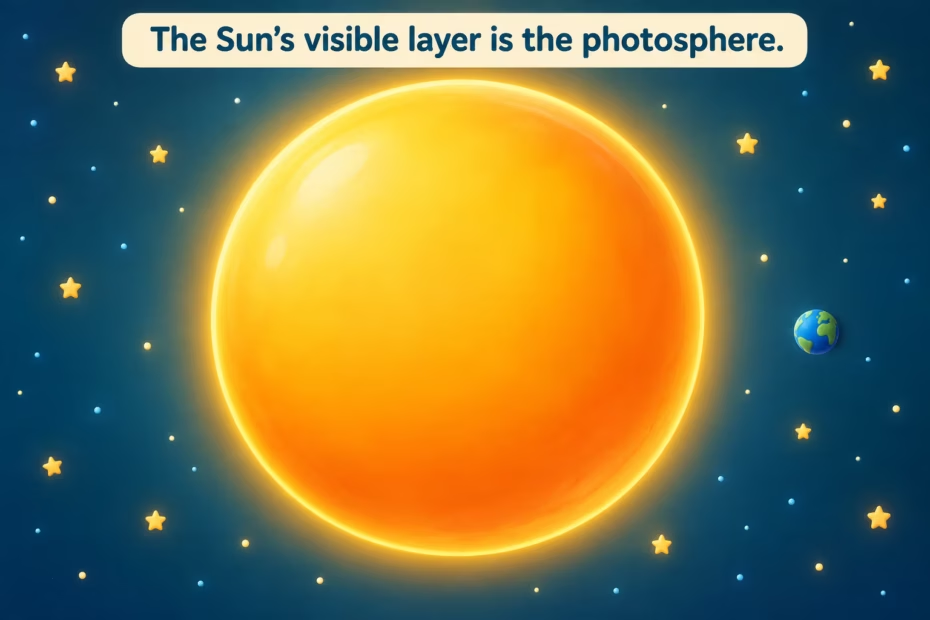
Adjectives for the Sun can describe light, heat, apparent color, solar activity, or a figurative impression. Use bright for light, hot for temperature, golden for a scene or perceived color, and sunlit for a place receiving sunlight. The Sun’s visible layer is the photosphere, while G2 V is its stellar classification.
Quick guide
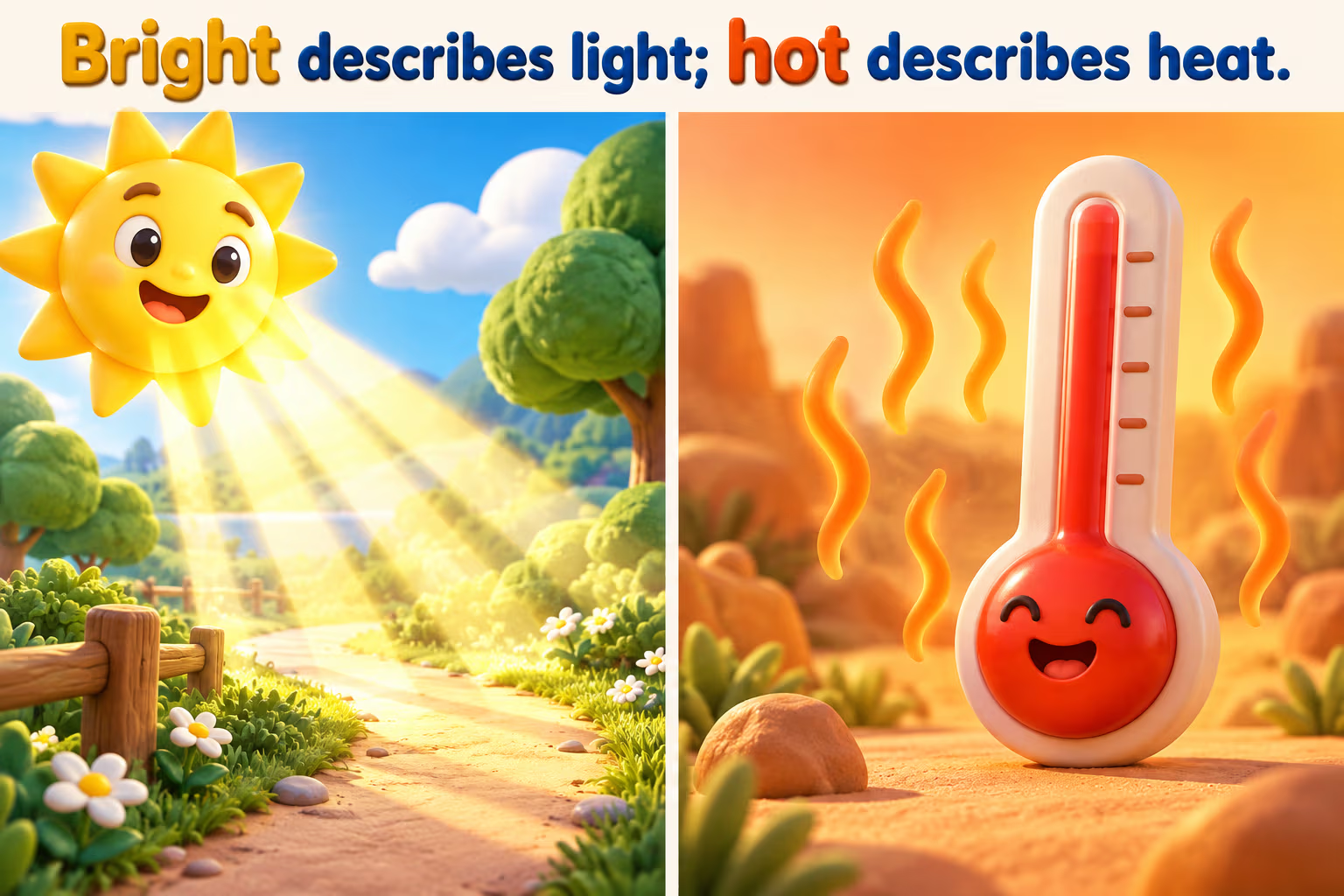
- Bright describes visible light; hot describes high temperature.
- Sunlit describes a place receiving sunlight; sunny often describes weather and can also describe a cheerful mood.
- Golden, yellow, and orange can describe an illustration, scene, or observed color; they are not fixed descriptions of every view of the Sun.
- The Sun has no solid surface; its visible layer is called the photosphere.
- The Sun’s G2 V classification is an astronomy label, not a color or mood adjective.
What Do Adjectives for the Sun Describe?
Adjectives for the Sun and sunlight can describe several different things: the star itself, visible light, heat, a weather condition, a place illuminated by the Sun, or a figurative mood. Before choosing a word, check which noun it modifies. “Bright sunlight” describes light; “a sunlit courtyard” describes a place; “sunny weather” describes conditions.
The Sun is a star. NASA identifies it as a G2 V, yellow-dwarf main-sequence star in its Sun facts guide. That classification is a useful factual description, while many other words in a broad A–Z list are poetic, subjective, or better suited to sunlight, a landscape, or a person’s mood.

What Is the Sun’s Visible Layer Called?
The Sun does not have a solid surface like Earth. NASA’s description of the Sun’s surface calls the visible layer we see from Earth the photosphere; this part of the solar atmosphere emits most of the visible light that reaches our eyes. “The Sun’s visible photosphere” is more precise than wording that suggests a rocky surface or crust.
NASA gives the photosphere’s temperature as about 5,500°C. That is a temperature of a solar layer, not the temperature of sunlight itself or of the air at a reader’s location. In everyday writing, hot day usually describes local weather, while a scientific sentence can call the photosphere hot and state the relevant layer or measurement.
Which Adjective Fits the Meaning You Want?
The same word can have more than one sense, and near-synonyms do not always make the same claim. Use these distinctions to select a word before drawing from the complete original list below.
| Meaning | Possible adjectives | Clear example | Usage check |
|---|---|---|---|
| Visible light | Bright, brilliant, luminous | “Bright sunlight crossed the path after the clouds cleared.” | Bright can describe light intensity; it does not by itself state how warm the air feels. |
| Heat or temperature | Hot, warm, scorching, radiant | “The photosphere is extremely hot.” | Name what is hot: the photosphere, the ground, the air, or a day. Radiant can refer to heat or light. |
| Color or visual scene | Golden, yellow, orange, white | “The sunset painted the clouds with golden light.” | These words can describe a viewpoint, filtered light, a painting, or a scene; avoid presenting one everyday color as universal. |
| Weather or a place | Sunny, sunlit | “It was sunny, and the studio was sunlit.” | Sunny often describes weather; sunlit describes a place receiving sunlight. |
| Solar activity | Active, eruptive | “The report described an active period of solar activity.” | Use activity words only when a source or specific observation supports them; the Sun’s activity changes over time. |
| Figurative mood or appearance | Cheerful, welcoming, radiant | “The poet called the morning radiant.” | This is a figurative or aesthetic impression, not a scientific property of the star. |
Do “Yellow,” “Golden,” and “White” Mean the Same Thing?
Not exactly. A color adjective may describe emitted light, how an observer sees the Sun under particular conditions, or the color of a scene or illustration. NASA’s color explainer discusses how viewing conditions, including Earth’s atmosphere, affect apparent color. NASA’s visible-light guide also connects stellar color descriptions with temperature.
For a sunset, golden or orange can describe the visible scene. In an astronomy sentence, use the specific classification or explain the observing conditions. NASA’s color explainer discusses the Sun’s appearance through a filtered visor above the atmosphere; never look directly at the Sun without appropriate eye protection.
How Do “Sunny” and “Sunlit” Differ?
Sunny can describe weather that is bright because of sunlight, and it can describe a cheerful or relaxed person. Sunlit describes a place or object receiving sunlight. Cambridge’s entry for “sunny” includes the weather and figurative senses, while its entry for “sunlit” gives examples such as a sunlit room or courtyard.

| Adjective | Common placement | Example sentence |
|---|---|---|
| Bright | Before a noun such as sunlight or sky | “Bright sunlight filled the room.” |
| Hot | Before a noun for a hot layer, surface, or weather condition | “The photosphere is hot; the afternoon air is a separate measurement.” |
| Sunny | Before a noun for weather or after a linking verb | “The forecast called for a sunny afternoon.” |
| Sunlit | Before a place or object receiving sunlight | “They ate lunch in a sunlit courtyard.” |
| Radiant | Before a noun for heat/light or for a person’s expression | “The radiant heater warmed the room”; “She had a radiant smile.” |
Cambridge defines bright with light, color, and other senses; hot can describe high temperature; and radiant can refer to producing heat or light or to a happy, beautiful appearance. The context and noun make the intended meaning clear. For more light-related vocabulary, see our adjectives for light guide.
How Can You Choose an Accurate Sun Adjective?
- Name the thing: are you describing the star, sunlight, temperature, weather, a location, or a person’s mood?
- Choose the matching sense: use bright for light, hot for temperature, sunlit for a place, and sunny for weather or its figurative sense.
- Add the context: identify the scene, time, observer, or source when color and intensity may vary.
- Check the grammar: make sure the adjective modifies the intended noun; label nouns, verbs, or poetic phrases as related vocabulary rather than adjectives.
The A–Z tables, examples, and links below form a broad word bank: some entries describe a related scene, a person, or a particular literary use rather than the Sun itself. Check a word’s meaning and fit instead of assuming every table entry is a precise astronomical adjective. The source’s positive and negative groupings are also editorial categories, not scientific properties of the Sun.
Adjectives are words that describe or modify another person or thing in a sentence. For example, the word “red” is an adjective that describes the color of something. The word “sunny” is an adjective that describes the weather. When it comes to adjectives for sun, there are many different options to choose from. Here are just a few of the most commonly used adjectives: sunny, bright, warm, hot, and beautiful.
Each of these adjectives can be used to describe the sun in a different way. For example, you might say that the sun is “sunny” on a clear day, or that it is “bright” when it first comes out in the morning. If it is a particularly hot day, you might say that the sun is “hot.”
And if you’re admiring a sunset, you might say that the sun is “beautiful.” These are just a few examples of how adjectives can be used to describe the sun. With so many different options to choose from, there’s sure to be an adjective that perfectly captures your experience of this amazing star.
Adjectives For Sun
The sun is one of the most important objects in our solar system. It provides warmth, light, and energy to everything on Earth. As such, it’s no surprise that the sun has been the subject of countless poems, songs, and stories throughout history. And while all of these artistic works are different, they all have one thing in common: they all use adjectives to describe the sun.
Some of the most common adjectives used to describe the sun include “bright,” “warm,” “sunny,” and “shining.” However, there are many other adjectives that can be used to capture the unique qualities of this celestial body. For example, the sun can also be described as “energetic,” ” powerful,” and “vital.” In addition, its color can be described as “golden,” “yellow,” or “orange.” Ultimately, the adjectives used to describe the sun will depend on the specific qualities that the artist wants to highlight.

A
| Abominable | Abundant | Active |
| Actual | Adequate | Affrighted |
| African | Afternoon | Airly |
| Alcyonic | Alternate | Angelic |
| Angry | Arabian | Arctic |
| Ardent | Artificial | Asleep |
| Australian | Autumnal | Awful |
B
| Balkan | Beaming | Beautiful |
| Behin | Beloved | Beneficent |
| Benevolent | Benignant | Black |
| Blessed | Blistering | Blue |
| Bounteous | Brave | Brief |
| Bright | Brilliant | Broad |
| Broken | Burnished |
C
| Canadian | Central | Certain |
| Cheap | Cheerful | Clad |
| Clean | Clear | Clouded |
| Cloudless | Cold | Colonial |
| Comfortable | Concentrated | Conservative |
| Constant | Covetous | Creamy |
| Crimson | Cruel | Curious |
D
| Daily | Dark | Day |
| Dayby | Dazzling | Dead |
| Deadly | Dear | Deep |
| Delicate | Devouring | Dim |
| Diminished | Direct | Distant |
| Diurnal | Divine | Double |
| Dry | Dull |
E
| Earthly | Eastern | Effulgent |
| Egyptian | Enlarged | Entire |
| Equatorial | Eternal | Etheric |
| European | Everlasting | Exhausting |
| Extinct | Extinguished | Extraordinary |
| Extreme | Eyed |
F
| Faint | Fair | Faithful |
| Fallen | Fantastic | Farewell |
| Fashionable | Feeble | Female |
| Feverish | Fierce | Fiery |
| Fifth | Fine | Finer |
| Fitful | Flaming | Foreign |
| Forgotten | Fourth | Fresh |
| Friendly | Frightful | Frosted |
| Future |
G
| Gay | Generous | Genial |
| Gentler | Glad | Glaring |
| Glorious | Glowing | Golden |
| Gone | Gorgeous | Grateful |
| Gray | Grecian | Green |
| Grieve | Grievous |
H
| Haloed | Happy | Hard |
| Harsh | Hazy | Heaventhe |
| Hidden | Hopetwo | Horizontal |
| Hot | Huge | Human |
| Hung | Hungry |
I
| Ignorant | Imitative | Immense |
| Immortal | Implacable | Incoming |
| Incomparable | Indian | Indirect |
| Ineffectual | Inexorable | Infinite |
| Innumerable | Inquisitivethe | Insufficient |
| Intense | Intolerable | Invisible |
| Inward | Irrepressible | Italian |
J | K
| Jealous | Joyous | Keen |
| Kind | Kindly |

L
| Languid | Larger | Lavish |
| Leaping | Lighthalf | Lightningthe |
| Liquid | Livid | Lost |
| Lovely | Lybian |
M
| Magic | Magical | Malaysian |
| Matured | Mellow | Melted |
| Mental | Meridian | Mighty |
| Mild | Mimic | Miniature |
| Miraculous | Mischievous | Misty |
| Mock | Modern | Molten |
| Moted | Mottled | Mournful |
| Myriad | Mythical |
N
| Nasty | Natural | Nice |
| Nimble | Nitrate | Noontide |
| Normal | Norwegian | Numberless |
O
| Oblique | Odorous | Open |
| Oppressive | Optimum | Orbed |
| Ordinary | Oriental | Outer |
| Outthe | Overhead |
P
| Pale | Pallid | Peaceful |
| Penetrative | Perfect | Perpendicular |
| Perpetual | Peruvian | Physical |
| Pitiful | Plain | Pleasant |
| Poor | Potent | Powerful |
| Practical | Precious | Previous |
| Proper | Proud | Pure |
| Purple |
R
| Radiant | Rare | Rayed |
| Rayful | Real | Red |
| Reduced | Relentless | Reminiscent |
| Remote | Resplendent | Retractable |
| Revealing | Rich | Rolling |
| Roman | Rosy | Round |
| Royal | Ruthless |
S
| Scarce | Scarlet | Secret |
| Semi | Set | Shaded |
| Shaketh | Sharp | Shiny |
| Sickly | Silent | Silver |
| Silvery | Simulated | Single |
| Slant | Sleepy | Slow |
| Smoky | Soft | Softest |
| Solid | Southern | Spanish |
| Spiritual | Splendid | Sportive |
| Starry | Stationary | Steady |
| Stonethe | Stormy | Straighter |
| Strange | Streaming | Sub |
| Sudden | Summer | Sunken |
| Sunlike | Sweet | Swift |

T
| Tenth | Terrible | Ther |
| Thin | Thirst | Thirsty |
| Threefold | Tiny | Tired |
| Torrid | Tremendous | Tropic |
| Tropical | Twentieth | Twin |
U
| Unbounded | Unchanged | Unchanging |
| Unclouded | Unconquered | Undimmed |
| Unfiltered | Universal | Unseen |
| Unsetting | Untempered | Unvanquished |
| Unveiled | Unwearied | Unwilling |
| Upper |
V
| Valencian | Vast | Veiled |
| Venetian | Vernal | Vertical |
| Victorious | Visible | Vital |
| Vivid |
W | Y
| Warm | Watery | Weak |
| Weary | Welcome | Westering |
| Western | Wild | Windy |
| Wiser | Yellow |
How to Describe Sun? – Different Scenarios
When it comes to describing the sun, there are various adjectives that can paint a vivid picture in our minds. The sun is a magnificent celestial body that holds immense significance in our daily lives. In different scenarios, the sun can elicit different feelings and evoke different emotions. Let’s explore how we can describe the sun in various situations:
- Bright and Radiant: On a clear day, the sun shines brightly, casting its warm and radiant light upon us. Its golden rays illuminate everything around, filling the world with brightness and warmth.
- Blazing and Intense: During the scorching summer months, the sun’s rays can feel intensely hot. The heat can be so intense that it can make you seek shade or crave a refreshing dip in a cool pool.
- Vibrant and Majestic: During sunrise and sunset, the sun paints the sky with a breathtaking palette of colors. Shades of orange, pink, and purple blend together, creating a vibrant and majestic display that never fails to captivate our hearts.
- Golden and Serene: On a peaceful day at the beach, the sun shines down, casting a golden glow on the sand and the waves. The gentle breeze and the rhythmic sound of the ocean create a serene atmosphere, making it the perfect setting for relaxation.
- Dazzling and Sparkling: In winter, when the sun’s rays reflect off a fresh blanket of snow, the world becomes dazzling and sparkling. The sun’s reflection creates a magical scene, making everything glisten and gleam with beauty.
- Invigorating and Energizing: When the sun shines through after a bout of rain, it brings a feeling of freshness and renewal. Its rays give us a burst of energy and a sense of vitality, making us ready to take on the day.
Each of these descriptions captures a different aspect of the sun, highlighting its diverse nature and the impact it has on our surroundings. Whether it’s the brightness and radiance, the intensity, the vibrancy, or the serenity, the sun is a powerful force that adds beauty and energy to our lives.
In the next section, I will provide you with a comprehensive list of adjectives that can be used to describe the sun in different scenarios.
Read: 550+ Adjective Words To Describe Technology
Describing Words for Sun in English
As an expert blogger with years of experience writing high-quality articles, I’ve compiled a comprehensive list of adjectives to describe the sun in different scenarios. These words will help you teach young children about the sun and its various characteristics.
- Bright – The sun is bright on a clear day, illuminating everything around us.
- Radiant – Its radiant rays bring warmth and light to our Earth.
- Blazing – During the summer months, the sun can be particularly blazing, making us seek shade to cool off.
- Intense – Its intense heat can make us feel the need to protect ourselves with hats and sunscreen.
- Vibrant – Witnessing a sunrise or sunset, the colors become vibrant as the sun makes its way above or below the horizon.
- Majestic – The sun can create a majestic view as it casts its golden glow across the sky.
- Golden – At the beach, the sun’s reflection on the water creates a golden and serene atmosphere.
- Dazzling – In winter, the sun’s rays can be dazzling as they reflect off the snow-covered ground.
- Sparkling – The sun’s rays can give off a sparkling effect on a dewy morning after rain, making everything glisten and shine.
- Invigorating – After a rainy day, the sun’s appearance can be invigorating and energizing, revitalizing our surroundings.
| Adjective | Description |
|---|---|
| Bright | Illuminating, full of light |
| Radiant | Emitting warmth and light |
| Blazing | Extremely hot, scorching |
| Intense | Powerful, focused heat |
| Vibrant | Full of life and color |
| Majestic | Impressive, grand |
| Golden | Having a rich, golden hue |
| Dazzling | Brilliant, shining brightly |
| Sparkling | Giving off small flashes of light |
Adjectives for Sun
Positive Adjectives for Sun with Example Sentences
The sun is a magnificent celestial body that brings warmth, light, and life to our planet. Here are some positive adjectives to describe the sun in different scenarios:
- Bright: The sun shines brightly on a clear day, illuminating everything around me.
- Radiant: As I looked up, the sun’s radiant rays danced through the leaves of the trees.
- Blazing: During the summer months, the sun is blazing and fills the air with its intense heat.
- Intense: The sun’s intense heat made me seek shade to find relief.
- Vibrant: The colors of the sky turned vibrant as the sun began to set.
- Majestic: Watching the sunrise, the sun looked majestic as it emerged from the horizon.
- Golden: At the beach, the sun casts a golden hue on the sparkling waves.
- Serene: Sitting on the sand, I felt at peace as the sun’s serenity enveloped me.
- Dazzling: In winter, the sun’s rays reflect off the snow, creating a dazzling spectacle.
- Sparkling: The sun’s rays hit the icicles, causing them to sparkle like diamonds.
- Invigorating: Stepping outside after rain, the sun’s warmth felt invigorating on my skin.
- Energizing: The sun’s energy fills me with renewed vigor and vitality.
Read: Beautiful Eyes: Describing Adjectives & Examples
Negative Adjectives for Sun with Example Sentences
While the sun is a source of light and life, there are times when it can be described with negative adjectives:
- Scorching: The sun can be scorching, making it uncomfortable to be outside for long.
- Blinding: The sun’s bright rays can be blinding, making it difficult to see.
- Unrelenting: In the midst of a heatwave, the sun’s unrelenting heat can be overwhelming.
- Harsh: The sun’s harsh rays can cause sunburn if proper precautions aren’t taken.
- Oppressive: In certain climates, the sun’s unyielding heat can create an oppressive environment.
Overall, the sun creates a wide range of experiences and emotions, from the positive and invigorating to the negative and challenging. It is a powerful force that impacts our everyday lives in numerous ways.
Synonyms and Antonyms with Example Sentences
Synonyms for Sun
When talking about the sun, there are several synonyms that can be used to add variety and depth to our descriptions. Here are some common synonyms for the sun:
| Word | Example Sentence |
|---|---|
| Sun | The sun is shining brightly today. |
| Sunlight | The warm sunlight streamed through the window. |
| Daystar | The daystar illuminated the sky. |
| Solar orb | The golden hues of the solar orb filled the horizon. |
| Star | The bright star in the sky is actually the sun. |
| Daytime | I love spending time outdoors during daytime. |
Antonyms for Sun
On the other hand, when discussing the opposite of the sun or times when it’s not visible, we can use antonyms. Here are some antonyms for the sun:
| Word | Example Sentence |
|---|---|
| Night | The moon shines during the night, while the sun rests. |
| Darkness | The city was engulfed in darkness when the sun set. |
| Clouds | The clouds blocked the sun, casting a shadow over the beach. |
| Rain | The heavy rain obscured the sun’s presence. |
| Winter | The days become shorter and the sun is less intense during winter. |
Read: Describing Words for Service: Examples and Adjectives
As we explore different adjectives to describe the sun and its various scenarios, it’s important to consider the synonyms and antonyms that can enhance our descriptions. Adding variety to our language not only makes our writing more engaging but also helps us to paint a vivid picture for our readers.
Describing the sun can add depth and vividness to our writing. In this article, I have provided a comprehensive list of adjectives that can be used to describe the sun in various situations. From synonyms like “sunlight” and “daystar” to antonyms like “night” and “darkness,” these adjectives help us paint a more detailed picture of the sun.
By incorporating these adjectives into our writing, we can create engaging and captivating descriptions. Whether we want to convey the warmth and brightness of a sunny day or the contrast between the sun and the night sky, these adjectives allow us to express our thoughts more effectively.
Remember, using synonyms and antonyms not only enriches our descriptions but also adds variety and interest to our writing. So, next time you find yourself in need of words to describe the sun, refer back to this list and choose the adjective that best captures the essence of this celestial body.
With these adjectives at your disposal, your writing will shine as bright as the sun itself.
Final verdict
In conclusion, adjectives for sun can be very useful when describing someone or something. They can be used to describe the physical appearance of the sun, its position in the sky, or its effects on people and things. Adjectives for sun can also be used to describe the emotional effects of the sun, such as its warmth, light, and energy. When used correctly, adjectives for sun can help to create a more vivid and accurate description of the subject.
Frequently Asked Questions About Adjectives for the Sun
What are adjectives for the Sun?
Adjectives for the Sun describe light, heat, apparent color, activity, or a figurative impression. Examples include bright, hot, golden, luminous, and radiant. Use each word for the meaning it supports: “bright sunlight” describes light, while “a sunlit room” describes a place receiving sunlight.
What is the Sun’s visible surface called?
The visible layer commonly called the Sun’s surface is the photosphere. NASA explains that the Sun has no solid surface like Earth; the photosphere is the layer visible from Earth and emits most visible light. “Visible photosphere” is more precise than a phrase suggesting a solid crust.
Is the Sun yellow, white, or golden?
Those words describe different classifications, perceptions, or scenes. NASA classifies the Sun as a G2 V yellow-dwarf main-sequence star and explains that viewing conditions affect apparent color; above the atmosphere through a filtered visor it appears white. A golden sunset is a scene description. Never look directly at the Sun without proper protection.
What is the difference between bright and hot?
Bright describes visible light or strong illumination. Hot describes high temperature. Bright sunshine may occur in cool weather, and a hot place may be shaded; the words do not measure the same quality. State whether you mean the photosphere, sunlight, ground, or local air.
Does “sunlit” describe the Sun?
Usually, no. Sunlit describes a room, courtyard, object, or other place receiving light from the Sun, as in “a sunlit garden.” To describe the star, choose a word for its light, heat, classification, or a specific appearance; to describe weather, sunny may fit.


