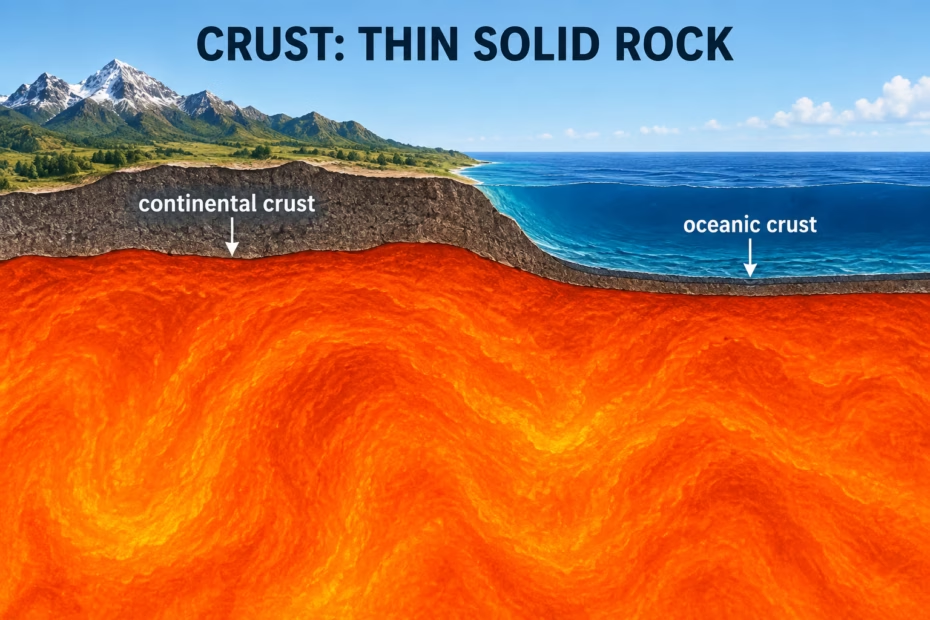
Earth’s crust is the thin, solid outer rocky layer of the planet, beneath the continents and ocean floors. In a sentence, use Earth’s crust as a singular noun for that layer; it is not the same thing as soil or a tectonic plate.
Earth’s Crust at a Glance
- Earth’s crust is the planet’s outermost solid rocky layer.
- Oceanic crust is generally thinner than continental crust.
- The crust–mantle boundary is called the Mohorovičić discontinuity, or Moho.
- A tectonic plate includes crust and rigid uppermost mantle, so a plate is not just crust.
- Geologists infer much of the deep crust’s structure using seismic waves.
What Does “Earth’s Crust” Mean?
Earth’s crust is the planet’s outermost solid layer, made mostly of rocks and minerals. It includes the continental rock beneath land and the oceanic rock beneath the seafloor. The crust’s lower boundary is the Moho, where seismic-wave behavior marks a transition into the mantle.
The crust is only one part of Earth’s outer shell. The lithosphere includes the crust plus the stiff uppermost mantle; tectonic plates are pieces of this larger shell. Soil, by contrast, is a thin, variable surface material formed from minerals, organic matter, water, and air. A beach, field, or city street sits above crust, but the visible ground is not all crust.
Thickness varies with location and how it is measured. NASA describes average land crust as about 30 kilometers (19 miles) thick and crust below the ocean floor as roughly 5 kilometers (3 miles). A USGS global review reports deep-ocean crust commonly around 6–7 kilometers and continental crust from about 16 to 80 kilometers, with a weighted mean near 41 kilometers. These values describe different averages and regions, rather than one universal thickness.
How Do Continental and Oceanic Crust Differ?
Continental crust is usually thicker and less dense than oceanic crust, while oceanic crust is typically thinner and denser. Their different properties help explain why continents stand higher than ocean basins and why many oceanic plates sink beneath continental plates at subduction zones.
| Feature | Continental crust | Oceanic crust |
|---|---|---|
| Where it occurs | Under continents and much of their submerged margins | Under most deep ocean basins |
| Typical thickness | Often tens of kilometers; varies widely | Usually around 5–7 kilometers in broad summaries |
| Common rock character | Composition varies; granitic rocks are common in upper continental crust | Basalt and gabbro are characteristic of much oceanic crust |
| Relative density | Generally less dense | Generally denser |
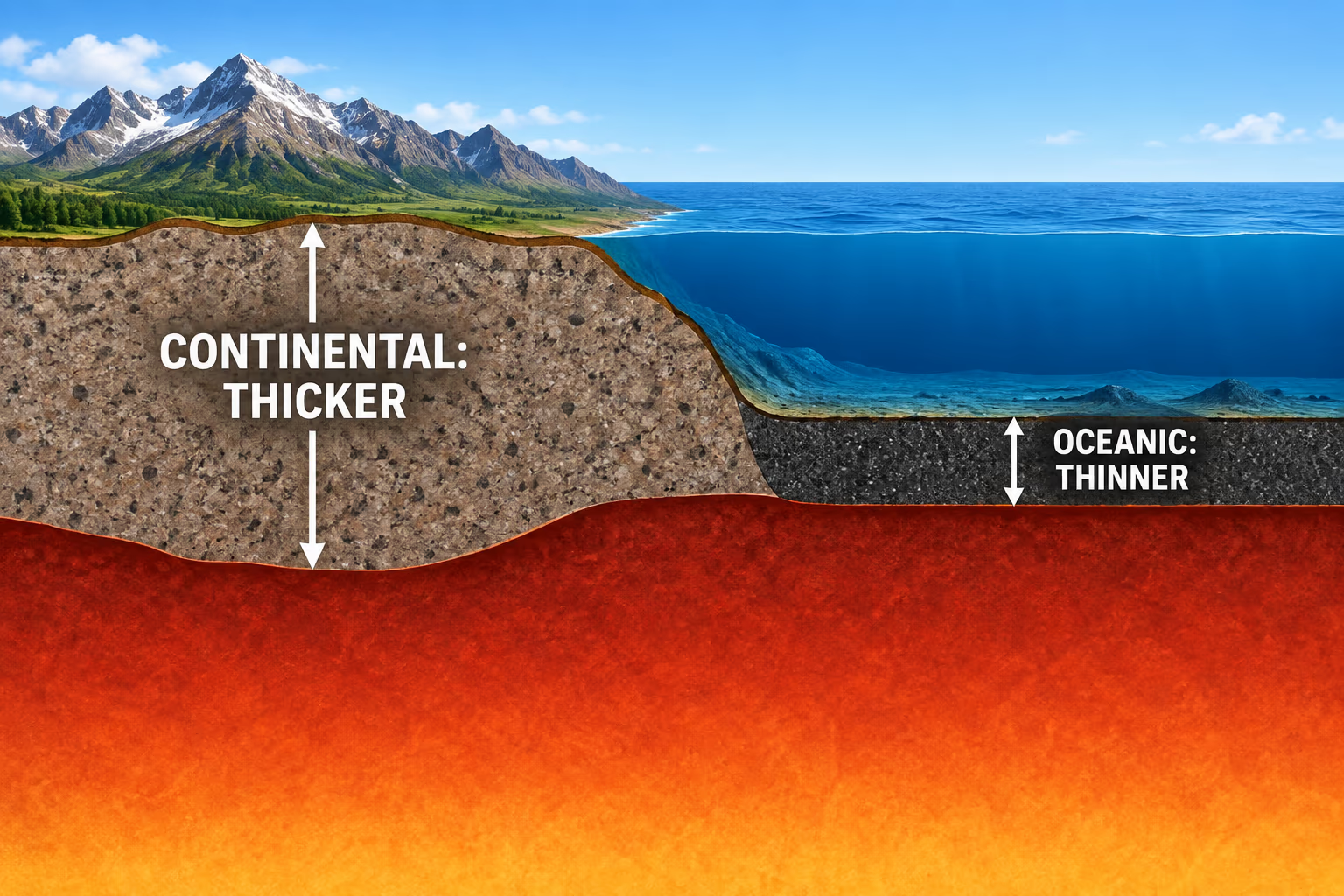
These are broad patterns, not strict rules for every place. Mountain belts can have unusually thick continental crust, while ridges, trenches, volcanic islands, and oceanic plateaus can depart from typical ocean-basin structure. When writing a sentence about thickness, specify which kind of crust and use a source-appropriate range.
How Is the Crust Related to Tectonic Plates?
Earth’s crust moves with tectonic plates because the crust is part of the lithosphere. The plates shift slowly over the softer, deformable mantle beneath them; stress builds where they interact and can be released as earthquakes, while melting and magma movement can feed some volcanoes.
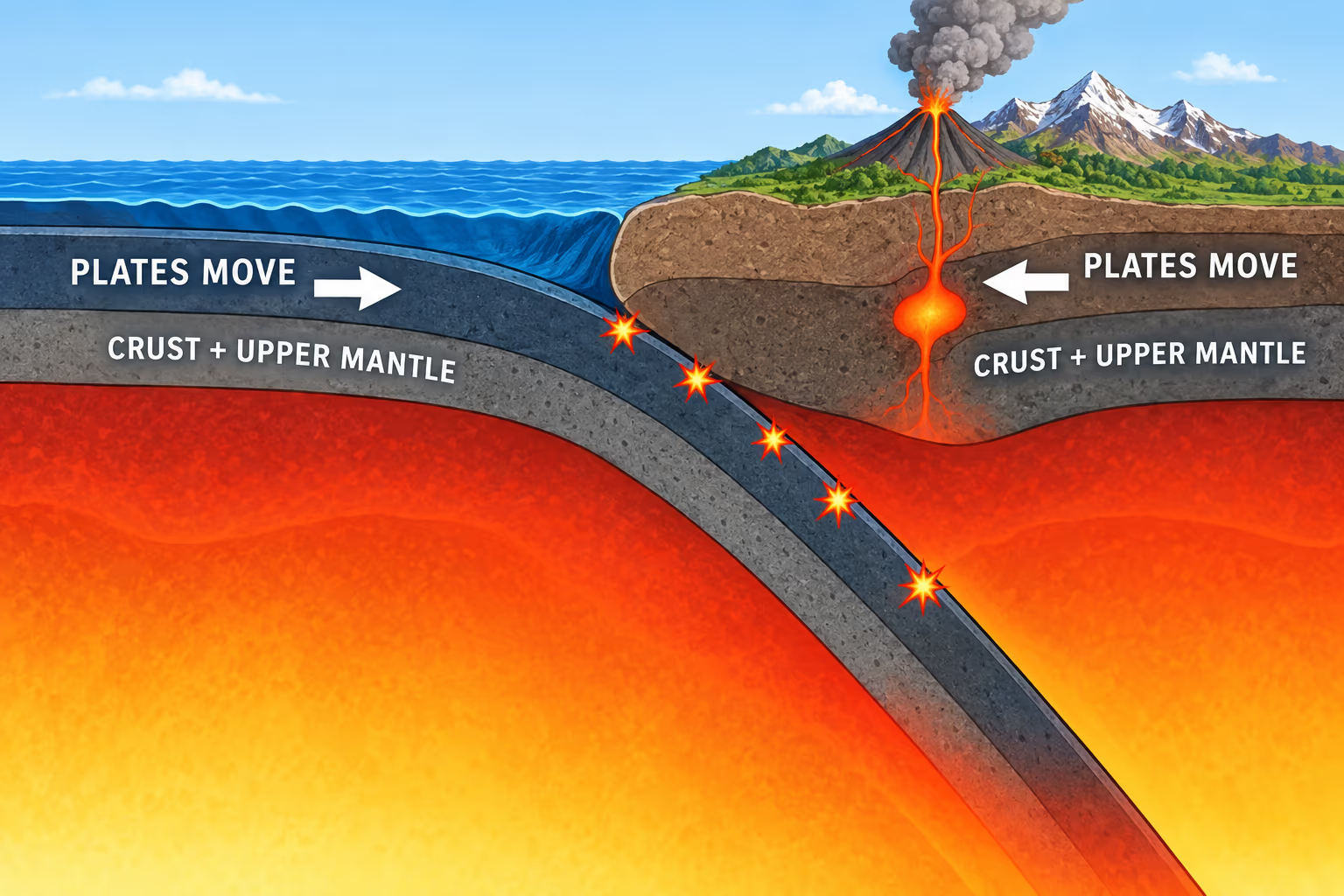
A useful distinction is that earthquakes occur within or along plates, but plates are not thin flakes of crust alone. In the diagram, the oceanic plate bends beneath the continent as one example of a convergent boundary. Other boundaries pull apart or slide sideways, so avoid writing that every plate boundary produces the same landform or hazard.
How Do Scientists Identify the Crust’s Lower Boundary?
Scientists map the crust and mantle boundary indirectly, chiefly by measuring how seismic waves travel through Earth. The Moho is the seismic discontinuity that marks the transition from crust to mantle; it is a boundary, not a separate rock layer.
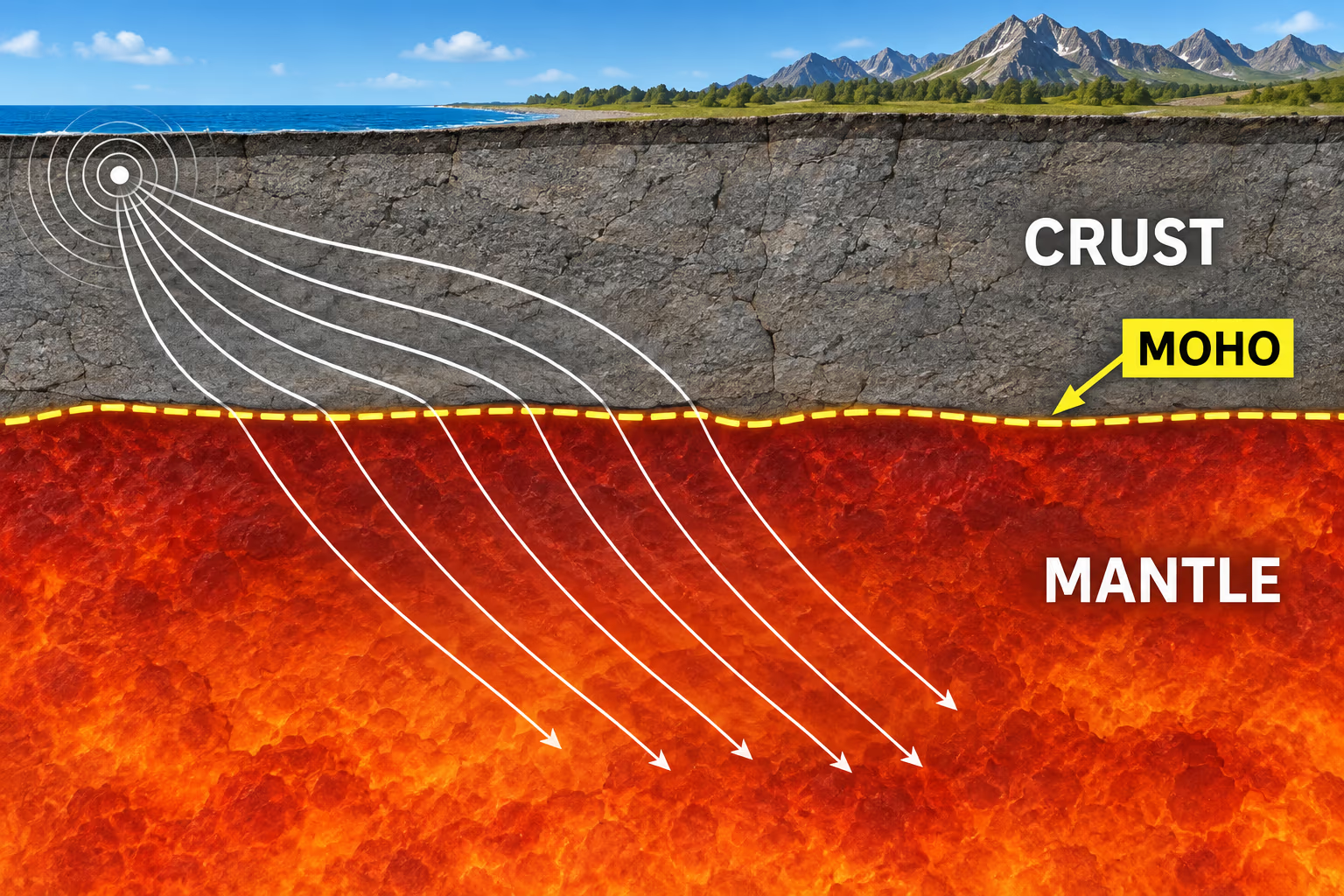
Earth’s deepest crust has not been sampled directly across most of the planet. Seismic reflection and refraction, earthquake recordings, gravity, magnetic measurements, and laboratory tests help scientists estimate its thickness and properties. This is why a textbook cross-section is a simplified model, rather than a direct photograph of the whole crust.
How Can You Use “Earth’s Crust” in a Sentence?
Use Earth’s crust as a singular noun when your sentence refers to the planet’s rocky outer layer. The possessive apostrophe belongs to Earth; in ordinary sentence case, write lowercase crust unless it begins a sentence or appears in a title.
- Define it: “Earth’s crust is the planet’s outermost solid rocky layer.”
- Compare its types: “Oceanic crust is generally thinner than continental crust.”
- Connect it to a process: “Scientists study earthquakes to learn how stress affects Earth’s crust.”
- Name a boundary carefully: “The Moho marks the transition between Earth’s crust and mantle.”
- Keep the subject precise: “The lithosphere includes Earth’s crust and the rigid uppermost mantle.”
Prefer observable, specific claims. “The earthquake ruptured a fault in Earth’s crust” identifies a geological feature; “the crust caused the earthquake” is vague because it hides the fault, stress, and plate setting. Likewise, say “soil covers the crust” when you mean surface soil, rather than treating soil and crust as synonyms.
Common Mistakes When Writing About Earth’s Crust
- Confusing crust with lithosphere: The crust is a compositional layer; the lithosphere is a rigid mechanical shell that also includes uppermost mantle.
- Calling the Moho a layer: It is the boundary between crust and mantle, recognized through changes in seismic-wave behavior.
- Giving one thickness as universal: State whether your example concerns continental crust, oceanic crust, a regional measurement, or an average.
- Equating crust with soil: Soil is a surface material; the rocky crust extends far below it and also lies beneath the oceans.
- Overstating effects: Weather and erosion shape the surface, while earthquakes and volcanic processes involve deeper geological forces; avoid implying that any one surface condition directly determines crustal stability.
Frequently Asked Questions About Earth’s Crust
Is Earth’s crust solid?
Yes. Earth’s crust is solid rock overall, although it can fracture, fold, deform, melt locally, or be covered by loose sediment and soil. “Solid” describes the crust as a layer; it does not mean every surface outcrop is unbroken bedrock.
Is the ocean floor part of Earth’s crust?
The seafloor includes oceanic crust at its base, often covered by sediments and seawater. Ocean water is not crust, and the visible sediment layer is not the whole crust. The rocky oceanic crust continues beneath the seafloor to the Moho.
Does Earth’s crust include tectonic plates?
Earth’s crust is included in tectonic plates, but plates also contain rigid uppermost mantle. For a scientifically precise sentence, say that crust is part of the lithosphere and that lithosphere is divided into moving plates.
How do you capitalize Earth’s crust?
Capitalize Earth when referring to the planet as a proper name, and keep crust lowercase except at the beginning of a sentence or in title case. The standard phrase is “Earth’s crust,” with an apostrophe before the s.
Sources: NASA, Facts About Earth; U.S. Geological Survey, The Interior of the Earth; U.S. Geological Survey, What Is a Tectonic Plate?; USGS, Global Crustal Structure.
Have you ever wondered about the Earth’s crust? The Earth’s crust is the outermost layer of our planet, composed of solid rock that forms the continents and ocean floors.
This thin layer ranges in thickness from around 3 to 44 miles and plays a crucial role in supporting life on Earth. It is where we stand, build our homes, and witness the dynamic forces of nature.
7 Examples Of Earth’S Crust Used In a Sentence For Kids
- Earth’s crust is the outer layer of our planet.
- We walk and play on earth’s crust every day.
- Rocks and soil are found on earth’s crust.
- Earth’s crust is where plants and animals live.
- Sometimes, earth’s crust can shake and cause earthquakes.
- We should take care of earth’s crust by not littering.
- Earth’s crust is also known as the ground we stand on.
14 Sentences with Earth’S Crust Examples
- Earth’s crust is made up of various types of rocks, minerals, and sediments.
- College students studying geology often learn about the composition and structure of Earth’s crust.
- Understanding the movement of tectonic plates is crucial in understanding the dynamic nature of Earth’s crust.
- Researching the history of Earth’s crust has helped scientists uncover important clues about the planet’s past.
- The study of earthquakes and volcanoes provides valuable insights into the behavior of Earth’s crust.
- Field trips to areas with exposed Earth’s crust allow students to observe different rock formations up close.
- The layers of Earth’s crust vary in thickness and composition, creating a complex geological landscape.
- Climate change can have a significant impact on the stability and health of Earth’s crust.
- Studying the interaction between Earth’s crust and the atmosphere is essential for understanding environmental processes.
- Mining operations can disrupt the natural balance of Earth’s crust and lead to environmental degradation.
- Conservation efforts aim to protect natural resources and ensure the long-term sustainability of Earth’s crust.
- By examining fossils and sedimentary layers in Earth’s crust, scientists can reconstruct past climates and ecosystems.
- The movement of magma beneath Earth’s crust is responsible for the formation of volcanic islands.
- College students can conduct experiments to simulate the processes that shape Earth’s crust over time.
How To Use Earth’S Crust in Sentences?
Earth’s Crust refers to the outermost layer of the Earth, where all landforms, continents, and ocean basins are located. To properly use this term in a sentence, one must identify it as a noun and capitalize the first letter of each word for correctness.
Here is how Earth’s Crust can be used in a sentence:
– “Scientists study the composition of Earth’s Crust to understand the geological processes that shape our planet.”
When using Earth’s Crust in a sentence, it is important to remember that it is a specific term referring to a particular part of the Earth. To avoid confusion, make sure the context of the sentence aligns with the geological meaning of Earth’s Crust.
Additionally, it is recommended to provide a brief explanation or context for beginners to understand the significance of Earth’s Crust in a sentence. By doing so, learners can deepen their understanding of the Earth’s structure and its importance in various scientific fields.
In conclusion, using Earth’s Crust in a sentence involves recognizing its importance as the outer layer of the Earth and applying it correctly within the context of geology and Earth sciences. Practice using this term in different sentences to become more familiar with its usage.
Conclusion
In summary, the Earth’s crust is the thin outer layer of the planet where we live. It is made up of solid rock and is home to various geological features like mountains, valleys, and plate boundaries. The Earth’s crust plays a crucial role in supporting life on our planet by providing a stable surface for us to live on and serving as a source of resources such as minerals and water.
Understanding the Earth’s crust is important for geologists and scientists studying the planet’s history, structure, and processes. By analyzing the composition and behavior of the Earth’s crust, we can gain insights into the formation of mountains, earthquakes, volcanic activity, and other natural phenomena that shape our world. Ultimately, the study of the Earth’s crust allows us to better comprehend the dynamic and ever-changing nature of our planet.