Adjectives for Experience: Meaning, Examples & Usage
Adjectives for experience describe what an event is like, how a participant responds, how they took part, or what effect it had. Use thrilling for a ride, exhilarated for a rider, firsthand for direct knowledge, and vicarious for an experience through another person. Name the evidence and perspective before choosing a label.
At a glance
Thrilling or tranquil describes the event or setting; identify which one your sentence means.
Exhilarated, frustrated, or unsettled describes a participant’s response.
Firsthand and hands-on describe direct access or practical participation; vicarious describes experience through others.
Educational points to learning; memorable points to recall; neither guarantees that everyone enjoyed the event.
Reserve strong claims such as life-changing for a specific person’s reported effect.
An adjective can evaluate an event, describe its setting, name a participant’s feeling, show how someone learned about it, or summarize a longer-term effect. These are different jobs. In “the exhilarating trip left me exhilarated,” exhilarating describes what caused excitement and exhilarated describes the speaker’s feeling. Cambridge defines exhilarating as causing strong excitement and happiness and exhilarated as feeling excited and happy.
“Experience” can also mean accumulated knowledge or skill, rather than a single event. A useful description therefore starts by asking whether the sentence means a particular encounter, a person’s response, or know-how gained over time. Cambridge’s entry for experience covers both event and knowledge/skill senses.
How Do Firsthand, Hands-On, and Vicarious Differ?
When is an account firsthand?
Firsthand means direct knowledge: someone may have experienced the event themselves or report it as a person who was involved. It does not mean that every firsthand account comes from the writer; name whose direct experience the sentence uses. See Cambridge’s definition of firsthand.
Firsthand identifies direct experience or an account from someone involved.
When is an experience hands-on?
Hands-on usually means practical involvement—doing or using something rather than only reading about it or watching someone else do it. A workshop can offer hands-on experience; a demonstration someone only watches is not hands-on for that viewer. In another context, “hands-on manager” means closely involved in decisions and work. Cambridge describes hands-on experience as knowledge or skill gained by doing.
Hands-on describes learning through practical activity.
What does vicarious experience mean?
Vicarious describes an experience or feeling gained by watching, listening to, or reading about another person’s activity instead of doing it oneself. It can be emotionally vivid without being direct participation. Cambridge’s definition of vicarious makes that distinction explicit.
A reader or viewer can experience a story vicariously without taking part in the event.
The complete original article follows, including its A–Z tables, example tables, links, and three original images. The source is preserved without editing; guidance after it explains how to check an entry’s meaning and fit.
Adjectives are words that describe or modify another person or thing in a sentence. They are often used to describe how someone feels about an experience. For example, you might use the adjective “amazing” to describe a particularly fun or memorable experience. Adjectives can also be used to describe the intensity of an experience.
For example, you might use the adjective “intense” to describe a very challenging or difficult experience. Adjectives can also be used to describe the emotional tone of an experience. For example, you might use the adjective “happy” to describe a pleasant experience, or the adjective “sad” to describe a negative experience.
Adjectives are a powerful tool for describing experiences, and there are many different adjectives that can be used to capture the nuances of an experience. In this article, we will explore some of the most common adjectives for describing experiences.
Adjectives For Experience
Adjectives are words that describe, clarify or modify a noun or pronoun, and there are Adjectives for all sorts of different experiences. In this article, we’ll take a look at some Adjectives For Experience that will help you to describe your own personal experiences more effectively.
If you’ve ever had an unpleasant experience, you might describe it as ‘awful‘, ‘terrible‘, or ‘horrible‘. Or if you want to be a little more specific, you might use adjectives like ‘miserable‘, ‘disgusting‘, or ‘appalling‘.
On the other hand, if you’ve had a really great experience, you might describe it as ‘wonderful’, ‘fantastic’, or ‘amazing’. You could also go for something more specific, like ‘brilliant‘, ‘superb‘, or even ‘extraordinary‘.
Whatever your experience, there’s an adjective out there to help you describe it more clearly. So next time you need to find the perfect word to describe your experiences, remember this list of Adjectives For Experience.
A
Adjectives are a great way to describe your experiences, and there are many adjectives that start with the letter A. Adventuresome, for instance, is a great word to describe someone who loves to try new things.
If you’re looking for a word to describe a breathtaking experience, try “awe-inspiring.” Or if you want to describe an experience that was both challenging and fun, try “amusing.” Whatever your experience, there’s an adjective out there to describe it.
So next time you’re struggling to find the right words, try browsing through a list of adjectives that start with the letter A. You’re sure to find the perfect word for your experience.
Aagreat
Abnormal
Absolute
Absorbing
Absurd
Abundant
Academic
Acadian
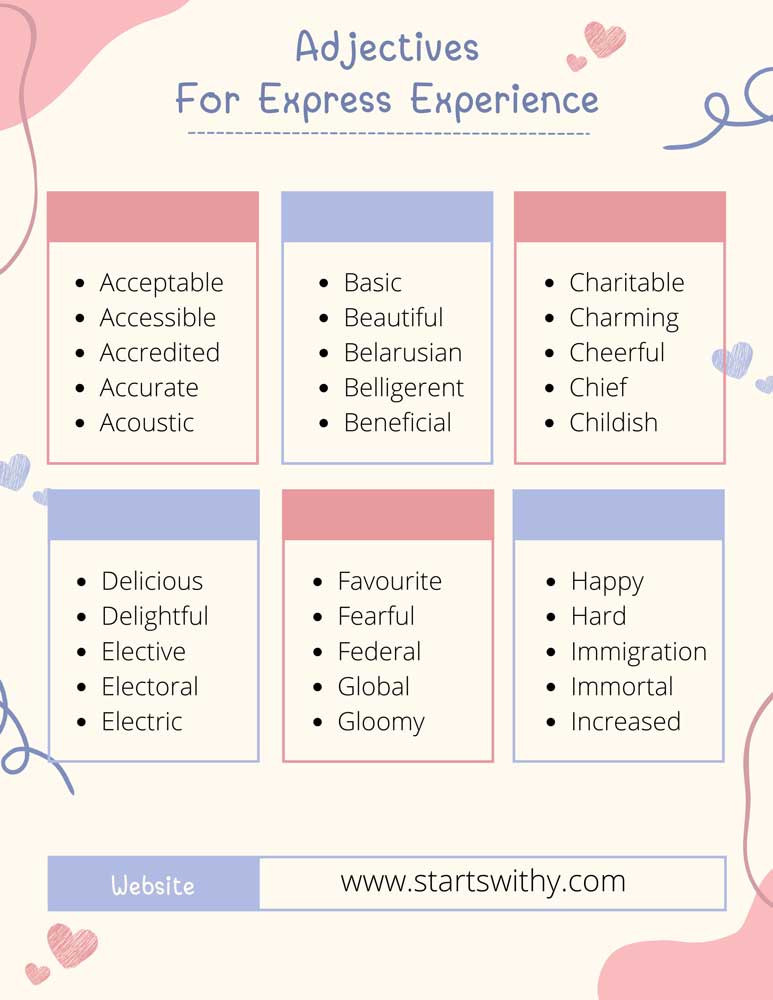
Acceptable
Accessible
Accredited
Accurate
Acoustic
Active
Actual
Adequate
Administrative
Adolescent
Advanced
Advantageous
Adventurous
Adverse
Advisory
Aesthetic
Affective
Affordable
African
Agile
Agreeable
Agricultural
Akin
Alleged
Amazing
Amorous
Ample
Amusing
Analogous
Ancestral
Ancient
Anecdotal
Annoying
Annual
Antecedent
Anti
Anxious
Appalling
Appellate
Applicable
Arcadian
Arctic
Arduous
Artificial
Artistic
Ascent
Asian
Assistant
Astonishing
Astounding
Astronomical
Athletic
Atmospheric
Audio
Auditory
Augmented
Australian
Austrian
Authentic
Authoritative
Autobiographical
Automotive
Awesome
Awful
Awkward
B
Bahamian
Bare
Barren
Basic
Beautiful
Belarusian
Belligerent
Beneficial
Bewildering
Bitterest
Bizarre
Black
Bleak
Blessed
Bloody
Bodily
Border
Bored
Boring
Boundless
Boyish
Breakthrough
Brief
Brilliant
Broader
Broken
Browsing
Brutal
Bsw
Burnout
Business
C
Adjectives are words that describe or modify other words in a sentence. They can be used to describe the physical appearance of a person or thing, as well as the personality of a person. Adjectives that start with the letter C are listed in this article.
These C adjectives can be used to describe people, places, things, or experiences. Many of these adjectives have both positive and negative connotations. For example, a “crowded” place can be seen as both busy and vibrant, or it can be seen as cramped and chaotic. It is up to the user of the adjective to decide which meaning is intended.
Some of the other C adjectives in this list include “cold,” “calm,” and “cheap.” Adjectives are a great way to add more detail and Description to your writing. By using descriptive language, you can paint a picture for your readers and help them experience your story in a more vivid way. Whether you are writing fiction or non-fiction, Adjectives are a powerful tool that should be in every writer’s toolbox.
Calamitous
Canadian
Cannabis
Capable
Cardiac
Caribbean
Caring
Casual
Cathartic
Catholic
Celebrated
Certain
Certified
Challenging
Channel
Channeling
Chaotic
Characteristic
Charitable
Charming
Cheerful
Chic
Chief
Childish
Childless
Chilling
Chinese
Choicest
Christian
Chronic
Cinematic
City
Civilian
Civilised
Classic
Claustrophobic
Cleaner
Clicky
Clinical
Close
Co
Cognate
Cognitive
Cohesive
Cold
Collaborative
Collectible
Collective
Collegiate
Colloquial
Colonial
Coloured
Combined
Comfortable
Comical
Commercial
Commonest
Commonplace
Communal
Comparable
Compelling
Competitive
Complementary
Complete
Complex
Complicated
Comprehensible
Comprehensive
Conceivable
Concentrated
Concrete
Concurrent
Confused
Connected
Conscious
Considerable
Consistent
Constant
Contactless
Contemporary
Contemptible
Continent
Continental
Continual
Continued
Continuous
Contradict
Contradictory
Contrary
Contrasting
Convenient
Conventional
Cool
Corporate
Corresponding
Cosmic
Costly
Counsellorswhose
Counterfeit
Countless
Country
Coveted
Covid
Crazy
Creative
Credentialed
Credible
Criminal
Critical
Cross
Crosscultural
Crucial
Cruel
Cuban
Culinary
Cultural
Culture
Cumulative
Curious
Curricular
Customizable
D
Daily
Damaging
Dangerous
Dark
Dating
Daunting
Dear
Decadent
Decent
Decisive
Dedicated
Deep
Definite
Degraded
Delicious
Delightful
Demonstrate
Dental
Deplorable
Depressing
Despotic
Detailed
Devastating
Developed
Devoid
Devotional
Diasporic
Didactic
Differential
Differentiated
Difficult
Diffused
Digital
Dimensional
Diplomatic
Direct
Disagreeable
Disappointing
Disastrous
Disciplinary
Disconnected
Disembodied
Disgraceful
Disheartening
Disillusioning
Dismal
Disparate
Disquieting
Distant
Distinct
Distinctive
Distressing
Distributive
Divergent
Diverse
Diversified
Divine
Diving
Dizzying
Doggoned
Doleful
Domestic
Dosing
Double
Doubtful
Downstream
Dramatic
Dreadful
Dreary
Dynamic
E
Eager
Earthly
Eastern
Easy
Ecstatic
Editorial
Educational
Educative
Eerie
Effective
Efficient
Elective
Electoral
Electric
Electrictrician
Electrifying
Elemental
Elementary
Elevated
Elusive
Embarrassing
Embodied
Embryonic
Emotional
Endearing
Endocannabinoid
Engaging
Engender
English
Enhanced
Enjoyable
Enlarged
Enlightened
Enormous
Enriched
Enriching
Ensemble
Entertaining
Enticing
Entire
Entrepreneurial
Environmental
Epic
Epidemic
Epsom
Equine
Equitable
Equivalent
Ere
Erroneous
Essential
Established
Ethiopian
Etymological
European
Eventful
Everyday
Evil
Exact
Exalted
Examinationpersonal
Excellent
Exceptional
Exciting
Exclusive
Executive
Exhausting
Exhilarating
Expansive
Expensive
Experienceof
Experiential
Experimental
Exquisite
Extended
Extensive
External
Extra
Extracurricular
Extraordinary
F
Fabulous
Fair
Familiar
Fantastic
Fascinating
Fast
Fatal
Fateful
Fatuous
Favorite
Favourite
Fearful
Federal
Fellow
Female
Fierce
Filming
Final
Financial
Fine
Finite
Firsthand
Fitting
Flattering
Flavourful
Flexible
Fluid
Following
Fond
Foreign
Forlorn
Formal
Formative
Fortunate
Foundational
Fractured
Fragmentary
Fragmented
Freeing
Freezing
French
Frequent
Fresh
Friendly
Frightening
Frightful
Frustrated
Frustrating
Fun
Funny
Furious
Future
G
Garnered
Gastronomical
Gay
Generalist
Gentle
Genuine
German
Ghastly
Ghostly
Glacier
Glamorous
Global
Gloomy
Glorious
Graduation
Grand
Gratifying
Grave
Gray
Greata
Greater
Greek
Grievous
Grim
Grueling
Gruelling
Guerrilla
Guilty
H
Hacking
Hackneyed
Hallucinatory
Hant
Happy
Hard
Harrowing
Harsh
Havergal
Heady
Healthful
Healthy
Heartfelt
Hectic
Heightened
Hellish
Hemp
Hereditary
Heroic
Heterogeneous
Hideous
Hilarious
Historic
Historical
Hoary
Holistic
Holy
Horrendous
Horrible
Horrific
Horrifying
Hosting
Hot
Hourly
Huge
Human
Humbeling
Humble
Humiliating
Humorous
I
Adjectives are words that modify, or describe, other words. They can be used to describe feelings or states of being, as well as physical attributes. Adjectives that start with the letter “I” can be useful for describing personal experience.
For example, an “intense” experience is one that is felt very deeply and strongly. An “interesting” experience is one that is compelling and draws your attention. Meanwhile, an “invaluable” experience is one that is extremely valuable or important. By using adjectives, we can add precision and detail to our writing, making it more vivid and engaging.
Iconic
Ideal
Ideational
Identical
Illustrious
Imaginable
Imaginary
Imaginative
Immediate
Immense
Immersive
Immigrant
Immigration
Immortal
Impactful
Imperfect
Imperishable
Impressive
Improved
Inaugural
Inclusive
Incoming
Incommunicable
Incomparable
Inconsiderable
Inconvenient
Increased
Incredible
Indebted
Indefinite
Independent
Indian
Indigenous
Indirect
Indispensable
Individual
Individualistic
Individualized
Indoor
Indulgent
Industrial
Inept
Inevitable
Inexplicable
Inexpressible
Infernal
Inflight
Influential
Informative
Initial
Initiatory
Inland
Innate
Inner
Innermost
Innocent
Innovative
Inquisitorial
Insightful
Inspirational
Inspiring
Instructional
Integral
Integrated
Intellectual
Intelligent
Intelligible
Intense
Intensive
Interactive
Interdisciplinary
Interesting
Internal
International
Interprofessional
Interventional
Intimate
Intimidating
Introductory
Introverted
Intuitive
Invaluable
Invariable
Inward
Irish
Ironical
Irrelevant
Irretrievable
Islamic
Isolated
Italian
J | K
Jaded
Japanese
Jewish
Joint
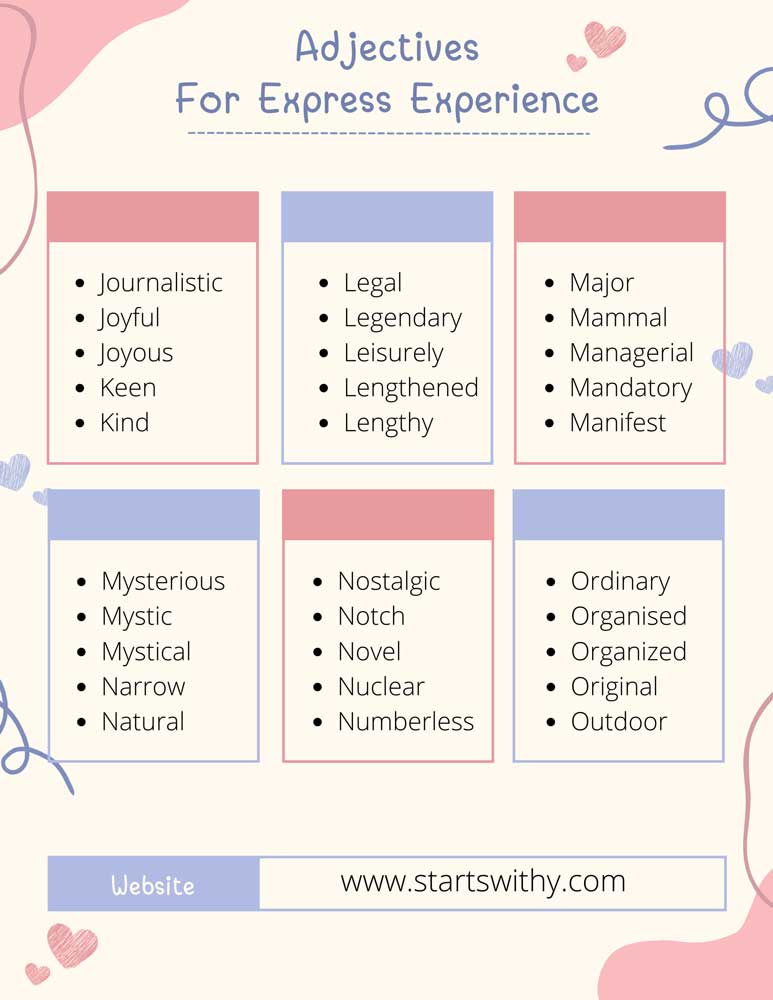
Journalistic
Joyful
Joyous
Judicial
Jurisdictional
Juvenile
Keen
Kind
Korean
L
Lacked
Larger
Latest
Latino
Lead
Leading
Leaning
Legal
Legendary
Leisurely
Lengthened
Lengthy
Lesse
Leveraged
Liberating
Lifelike
Lifelong
Lightweight
Linear
Linguistic
Literal
Literary
Live
Lived
Lively
Lofty
Longstanding
Lovely
Loving
Lucian
Ludicrous
Luminous
Luxe
Luxurious
M
Adjectives are words that describe or modify another person or thing in a sentence. Adjectives for experience can range from the simple and straightforward (“happy”) to the more complicated and flowery (“overjoyed”).
If you’re looking to add some variety to your describing words, consider using an adjective that starts with the letter M. “Mystical,” “magical,” and “miraculous” are all excellent choices for describing an experience that was particularly wonderful or life-changing. For something more low-key, try “mellow,” “moderate,” or “mundane.” No matter what word you choose, adjectives are a great way to add detail and depth to your writing.
Macroeconomic
Magic
Magical
Maiden
Major
Makan
Male
Maltreatment
Mammal
Management
Managerial
Mandatory
Manifest
Manifold
Marine
Marital
Maritime
Marvellous
Marvelous
Massive
Mastery
Mathematical
Mathematician
Matric
Matrimonial
Mature
Matured
Maturer
Mayoral
Meaningful
Meccan
Mechanical
Media
Medical
Mediocre
Meditative
Mediterranean
Melancholy
Memorable
Memorial
Mental
Mentored
Mere
Mesmerizing
Messy
Meta
Metaphysical
Middling
Mighty
Military
Mini
Minimal
Minimum
Ministerial
Minor
Miraculous
Miserable
Mistaken
Mobile
Moderate
Modern
Monetary
Moral
Moralistic
Motivational
Mournful
Moving
Multi
Multicultural
Multilingual
Multiple
Multisensory
Mundane
Municipal
Muscular
Musical
Muslim
Mutual
Myriad
Mysterious
Mystic
Mystical
N
Narrow
Native
Natural
Naturalistic
Nautical
Naval
Near
Negative
Negligible
Net
Neutral
Newfound
Nice
Nigerian
Nightmarish
Nomadic
Noncomparative
Nordespite
Normal
Northern
Nosed
Nostalgic
Notch
Novel
Nuclear
Numberless
Numerous
Nutritional
O
Oasys
Objective
Occasional
Odd
Official
Offline
Oflight
Ofthe
Olympic
Omnipresent
Onboard
Onboarding
Online
Op
Operational
Operative
Oppo
Opposite
Optimal
Optimum
Ordinary
Organised
Organized
Original
Outdoor
Outer
Outrageous
Outside
Outstanding
Overall
Overnight
Overpacked
Overseas
Overwhelming
P
Paediatric
Painful
Pampered
Pandemic
Parallel
Paranormal
Parental
Parisian
Parliamentary
Parochial
Partial
Participant
Participatory
Passionate
Passive
Past
Pastoral
Pathogenic
Pathological
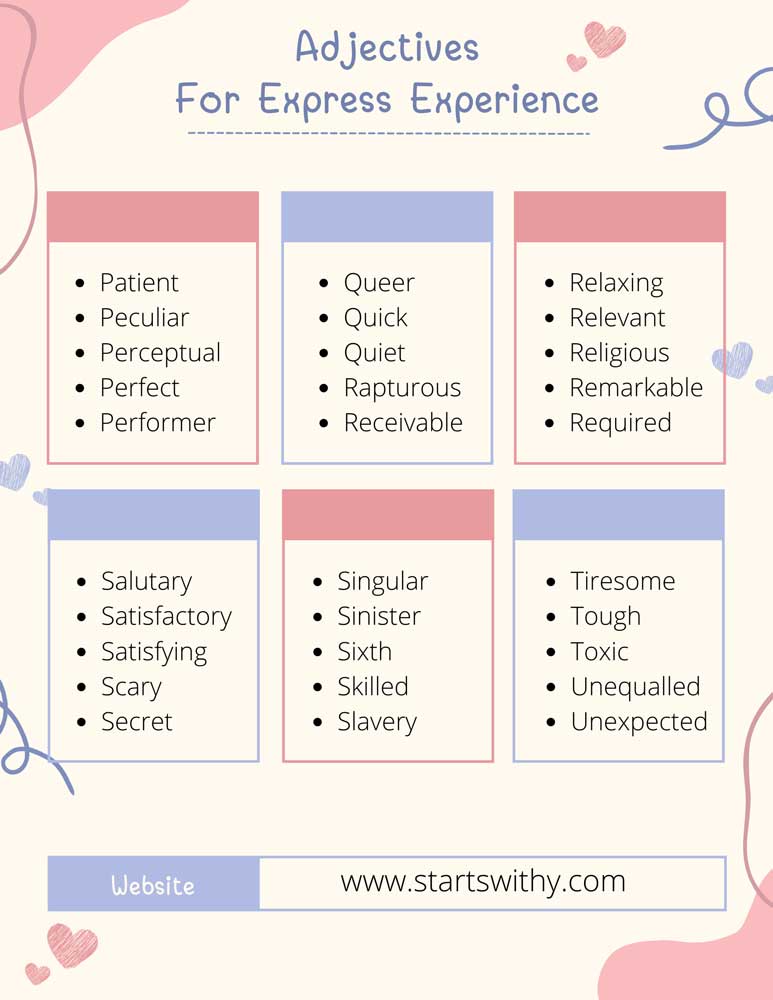
Patient
Peculiar
Pentecostal
Pepperdine
Perceptual
Perfect
Performer
Perilous
Peripheral
Perpetual
Persistent
Personalised
Personalized
Pertinent
Petty
Phenomenal
Phenomenological
Philosophic
Philosophical
Phlegmatic
Photographic
Physical
Pioneering
Pitiful
Pleasant
Pleasing
Pleasurable
Poetic
Poetical
Poignant
Poor
Popular
Portentous
Positive
Post
Postdoc
Postdoctoral
Potent
Powerful
Practical
Pre
Precious
Precocious
Preferable
Preferred
Prefigurative
Preliminary
Premier
Premium
Prep
Present
Presidential
Previous
Priceless
Primitive
Primordial
Prior
Pro
Productive
Professional
Profoundest
Progressive
Prolonged
Promising
Proper
Prophetic
Prosecutorial
Proven
Pruning
Prussian
Psychedelic
Psychic
Psychical
Psychological
Psychosocial
Pure
Purple
Q
Qualitative
Queer
Quick
Quiet
Quintessential
R
Radical
Rapturous
Rare
Raw
Real
Realistic
Receivable
Recommendatory
Recorded
Recreational
Red
Redoubled
Refreshing
Regional
Regular
Regulatory
Relatable
Related
Relational
Relative
Relaxing
Relevant
Religious
Remarkable
Remembered
Remote
Renowned
Rental
Replenishing
Reproductive
Repulsive
Required
Resident
Residential
Respective
Responsive
Retail
Retrospective
Revolution
Revolutionary
Rewarding
Rich
Rightful
Rigid
Ripe
Ritual
Robust
Romantic
Rough
Round
Rounded
Rpg
Rude
Rugged
Runaway
Rural
Russian
Rustic
S
This article provides a helpful list of adjectives for experiences that start with the letter S. The list includes a range of positive and negative adjectives, from “serene” and “satisfying” to “stressful” and “scary.”
The list is sure to be useful for anyone looking to improve their writing skills. In addition to being a helpful resource for writers, the list could also be used by anyone seeking to better understand the English language. After all, adjectives are an important part of speech, and understanding how to use them correctly can help improve communication in both written and spoken English.
Sacred
Sad
Safari
Safe
Salutary
Satisfactory
Satisfying
Scant
Scanty
Scary
Scented
Scientific
Seamless
Searing
Secondhand
Secret
Sectoral
Secure
Selfish
Semi
Senior
Sensational
Sensible
Sensitive
Sensory
Sensuous
Sentimental
Separate
Seraphic
Serie
Severe
Sexual
Shallow
Shamanic
Shambolic
Shameful
Shared
Sharp
Shattered
Shocking
Shoppable
Short
Siberian
Sick
Significant
Silent
Silly
Simple
Simplified
Single
Singular
Sinister
Sixth
Skilled
Slavery
Slight
Slow
Slush
Smart
Smoother
Sober
Sobering
Sole
Solemn
Solid
Solitary
Solo
Somatic
Sombre
Sonic
Sophisticated
Sore
Sorrowful
Sorry
Sound
Soundproof
Spatial
Specialist
Spellbinding
Spirited
Spiritual
Spiritualistic
Splendid
Spooky
Staggering
Standard
Startling
Static
Steady
Stellar
Sterile
Stern
Stimulating
Stirring
Stormy
Storytelling
Straight
Strange
Streaming
Streamlined
Strenuous
Stressful
Striking
Strong
Structural
Structured
Stubborn
Stunning
Subjective
Sublime
Subsequent
Substantial
Subtle
Successful
Sudden
Suggestive
Sunny
Super
Superb
Superconnective
Superficial
Superior
Supernatural
Supernormal
Supervised
Supervisory
Supportive
Supposed
Supreme
Surgical
Surprising
Surreal
Sustainable
Sweet
Symptomatic
Synthetic
T
Tame
Tangible
Technical
Technological
Telephonic
Temporal
Terrestrial
Terrible
Terrific
Terrifying
Theatrical
Themed
Theological
Therapeutic
Thingsby
Thirsty
Tho
Thorough
Thoughtful
Thrilling
Tighter
Tiresome
Tormented
Touching
Touchless
Tough
Toxic
Traditional
Tragic
Tragical
Trans
Transcendent
Transformative
Transgendered
Transparent
Traumatic
Traveled
Treasured
Tremendous
Trivial
Tropical
Trustworthy
Trying
Turbulent
Typical
U
Ukrainian
Ultimate
Ultra
Unaided
Unavailable
Unbeatable
Uncanny
Uncomfortable
Uncommon
Uncondensed
Unconscious
Uncontrollable
Undergraduate
Underwater
Undirected
Undisturbed
Unequalled
Unexpected
Unexplained
Unfailing
Unfamiliar
Unforgettable
Unfortunate
Unhappy
Unified
Uniform
Unifying
Unimagined
Unimportant
Uninterrupted
Unintrusive
Unique
United
Universal
Unknown
Unmatched
Unmissable
Unmistakable
Unnamed
Unnerving
Unparalleled
Unpleasant
Unpleasurable
Unrecorded
Unrivalled
Unsatisfactory
Unsettling
Unshared
Untold
Unusual
Unwritten
Upbeat
Upcoming
Upsetting
Urban
Urbane
Useful
Usher
Usual
Uttermost
V
Valid
Validate
Valuable
Variant
Varied
Variegated
Vast
Vaunted
Verifiable
Veterinary
Vexatious
Vibrant
Vicarious
Victorian
Viewer
Violent
Virtual
Virtuous
Visceral
Visionary
Visual
Vital
Vivacious
Vivid
Vivo
Vulgar
Vulnerable
W | Y
Waitsian
Wartime
Weightless
Weird
Welcome
Western
Wholesale
Wholesome
Widened
Wider
Wild
Windmill
Wise
Woeful
Woful
Wonderful
Wondrous
Woodland
Work
Workplace
Worldly
Worldwide
Worthwhile
Worthy
Wretched
Yea
Youthful
When it comes to describing our experiences, finding the right adjectives can make all the difference. From thrilling adventures to transformative moments, our experiences shape who we are and how we view the world. In this article, I’ll be exploring a range of adjectives that can help us vividly express the depth and richness of our experiences. Whether it’s a heart-pounding adventure or a peaceful retreat, these adjectives will allow you to paint a picture with words and truly bring your experiences to life.
From exhilarating to awe-inspiring, there are countless adjectives that can capture the essence of our experiences. Each adjective carries its own unique flavor, allowing us to convey the emotions, sensations, and impact of a particular moment. Whether you’re trying to describe a breathtaking sunset, a life-changing journey, or a profound encounter, having a diverse repertoire of adjectives at your disposal can elevate your storytelling and engage your readers. So, let’s dive into the world of adjectives for experience and discover the perfect words to encapsulate the magic and significance of our most cherished moments.
How to Describe Experience? – Different Scenarios
When it comes to describing experiences, there are a variety of scenarios and situations that call for different adjectives. Whether you’re trying to capture the excitement of an adventure or convey the tranquility of a peaceful retreat, choosing the right words can enhance your storytelling and engage your readers. Let’s explore some common scenarios and the adjectives that can help vividly describe them:
1. Thrilling Adventures
When recounting thrilling adventures, it’s important to use adjectives that convey the exhilaration and adrenaline rush of the experience. Here are some examples:
Heart-pounding: The heart-pounding experience of skydiving left me breathless.
Nerve-wracking: It was a nerve-wracking experience to bungee jump off a tall bridge.
Exhilarating: I felt exhilarated as I zipped through the treetops on the zipline.
2. Peaceful Retreats
Describing peaceful retreats requires choosing adjectives that evoke calmness, serenity, and relaxation. Consider using words like:
Tranquil: The tranquil lake provided a soothing backdrop for meditation.
Serene: I was surrounded by the serene beauty of the mountains during my hiking trip.
Blissful: Relaxing on the hammock, I felt a blissful sense of peace and contentment.
3. Cultural Experiences
When sharing cultural experiences, it’s important to use adjectives that capture the unique customs, traditions, and atmosphere of the place. Use words like:
Vibrant: The vibrant streets of New Orleans were alive with music and colors.
Enchanting: I was enchanted by the enchanting beauty of the ancient temples in Kyoto.
Immersive: The immersive experience of living with a host family in another country broadened my perspective.
For memorable events, you want to choose adjectives that convey the significance and impact of the experience. Consider using words like:
Unforgettable: It was an unforgettable experience to witness a stunning sunset over the Grand Canyon.
Life-changing: The marathon I ran was a life-changing experience that taught me perseverance and determination.
Profound: Attending the graduation ceremony was a profound experience, marking the end of an important chapter in my life.
Describing Words for Experience in English
When it comes to describing experiences, finding the right adjectives can make all the difference. Whether you want to capture the excitement of a thrilling adventure or the serenity of a peaceful retreat, choosing the right words can enhance storytelling and engage readers. In this section, I will provide you with a variety of adjectives that can vividly describe different types of experiences.
Thrilling Adventures
Exhilarating: The fast-paced roller coaster ride was absolutely exhilarating.
Adventurous: Exploring the deep jungle was a truly adventurous experience.
Breathtaking: The view from the mountain peak was simply breathtaking.
Peaceful Retreats
Tranquil: The sound of gentle waves crashing on the shore created a tranquil atmosphere.
Serene: The peaceful garden was a serene escape from the hustle and bustle of the city.
Calming: The soothing music and candlelight created a calming ambiance in the spa.
Cultural Experiences
Enriching: Visiting the art museum was an enriching experience that broadened my horizons.
Immersive: The cultural festival provided an immersive experience that allowed me to fully embrace the traditions.
Eye-opening: The documentary film revealed an eye-opening perspective on a different culture.
Unforgettable: The wedding ceremony was an unforgettable celebration of love and commitment.
Remarkable: The grand fireworks display left a remarkable impression on everyone’s minds.
Magical: The enchanting theater performance created a magical atmosphere that transported the audience into a different world.
By using these descriptive adjectives, you can bring your experiences to life and create a more engaging narrative. Remember to choose adjectives that accurately capture the essence of the moment and elicit the desired emotions in your readers.
Adjectives for Experience
When it comes to describing experiences, finding the right adjectives can truly bring them to life. As someone who has had the privilege of exploring various scenarios and situations, I have learned the power of carefully chosen words to capture the essence of an experience. In this section, I will share some positive and negative adjectives that can help you express different types of experiences. Let’s dive in!
Positive Adjectives for Experience with 12 Example Sentences
Electrifying: The concert was electrifying, with the crowd buzzing and the music pulsating through the air.
Breathtaking: Standing on top of the mountain, I was in awe of the breathtaking view that stretched out before me.
Enchanting: The enchanting aroma of freshly baked cookies filled the kitchen, instantly bringing a smile to my face.
Exhilarating: As I soared through the sky in a hot air balloon, I felt an exhilarating sense of freedom and adventure.
Serene: Walking along the peaceful beach at sunset, I could feel the serene tranquility enveloping my being.
Captivating: The play’s captivating storyline and talented actors held the audience spellbound from start to finish.
Delightful: Exploring the bustling markets of Marrakech was a delightful sensory experience, filled with vibrant colors and enticing aromas.
Inspiring: The art exhibition showcased a range of thought-provoking and inspiring works that left a lasting impression on me.
Magical: Celebrating New Year’s Eve in Times Square was a magical experience, with the shimmering lights and festive atmosphere.
Thrilling: Riding the roller coaster elicited thrilling screams of excitement as it twisted and turned at breakneck speeds.
Joyful: I couldn’t help but feel joyful as I watched my favorite team win the championship in a nail-biting game.
Memorable: The road trip with my friends was filled with laughter, adventures, and memorable moments that I will cherish forever.
Frustrating: Trying to solve the complex puzzle was a frustrating experience that tested my patience.
Disappointing: The movie didn’t live up to the hype and turned out to be a disappointing experience.
Unsettling: Walking alone in the dark woods can be an unsettling experience, as every rustle of leaves sends shivers down your spine.
Dull: The lecture was delivered in a monotone voice and lacked any dull moments, leaving the audience bored and uninterested.
Regretful: Making the wrong decision and missing out on an amazing opportunity can be a regretful experience that lingers in your mind.
Synonyms and Antonyms with Example Sentences
Synonyms for Experience
When it comes to describing different experiences, choosing the right words is crucial. Here are some synonymous adjectives that can help bring your storytelling to life:
Adjective
Definition
Example Sentence
Electrifying
causing excitement or thrill
The roller coaster ride was an electrifying experience.
Breathtaking
extremely impressive or awe-inspiring
The view from the top of the mountain was breathtaking.
Enchanting
captivating or charming
The ballet performance was enchanting, with its graceful movements and beautiful music.
Exhilarating
invigorating or thrilling
Skydiving was an exhilarating experience, as I soared through the sky with adrenaline rushing through my veins.
Serene
peaceful, calm, and untroubled
Waking up to the sound of waves crashing on the beach was a serene experience.
Captivating
holding one’s attention and interest
The storyteller had a captivating way of drawing in the audience with his vivid descriptions.
Delightful
highly pleasing or enjoyable
We had a delightful time exploring the charming streets of the small town.
Inspiring
filling with motivation or encouragement
The speech by the motivational speaker was incredibly inspiring, leaving the audience inspired to chase their dreams.
Magical
extraordinary or enchanting
Stepping into the ancient castle felt like entering a magical world from a fairy tale.
Thrilling
exciting and full of suspense
The suspenseful plot twists in the movie kept me on the edge of my seat, making it a thrilling experience.
Joyful
filled with happiness and joy
Celebrating my birthday with friends and family was a joyful experience that I will always cherish.
Memorable
worth remembering or unforgettable
The trip to Paris was a memorable experience, as we explored iconic landmarks and immersed ourselves in the city’s culture.
Sometimes, our experiences may not always be positive. Here are some antonyms to describe negative experiences:
Adjective
Definition
Example Sentence
Frustrating
causing feelings of irritation or disappointment
Trying to solve the puzzle was a frustrating experience, as I couldn’t figure out the solution.
Disappointing
falling short of expectations or not fulfilling
The movie was highly anticipated, but it turned out to be quite disappointing in terms of its storyline.
Unsettling
causing a feeling of uneasiness or discomfort
The strange noises coming from the old house were unsettling, making me feel on edge.
Dull
lacking interest or excitement
The lecture on historical facts was dull, as the presenter read from slides without any enthusiasm.
Regretful
causing or feeling regret or remorse
Skipping the concert was a regretful decision, as I missed out on an amazing musical experience.
By using these adjectives to describe your experiences, you can bring your storytelling to life and engage your readers. Whether your experiences are electrifying, breathtaking, or even frustrating, the use of descriptive adjectives adds depth and emotion to your narrative without relying on exaggeration or exclamation points.
Choosing the right adjectives to describe experiences is essential for engaging storytelling. Throughout this article, we have explored the significance of finding the perfect words to vividly portray thrilling adventures, peaceful retreats, cultural experiences, and memorable events. By using descriptive adjectives, we can bring these experiences to life and create a more captivating narrative.
In this blog post, we have provided a comprehensive list of positive adjectives that can enhance the storytelling process. Words such as electrifying, breathtaking, enchanting, exhilarating, serene, captivating, delightful, inspiring, magical, thrilling, joyful, and memorable can add depth and emotion to our narratives. Additionally, we have also explored negative adjectives like frustrating, disappointing, unsettling, dull, and regretful that can be used to describe negative experiences.
By incorporating these adjectives into our writing, we can engage readers on a deeper level, making our stories more immersive and relatable. So, the next time you embark on a writing journey, remember the power of adjectives in bringing experiences to life. Choose your words wisely, and watch as your storytelling flourishes.
Final verdict
Adjectives are an important part of language, allowing us to describe the world around us in greater detail. They can also be used to express our experiences and emotions, making them an essential tool for communication. When it comes to describing our experiences, there are a wide range of adjectives to choose from.
Whether we’re talking about a positive or negative experience, there’s sure to be an adjective that accurately describes how we feel. With so many options available, it’s easy to find the perfect word to describe our experiences. Adjectives are an important part of language, and they can help us to better communicate our experiences to others.
How Should You Choose an Adjective for an Experience?
Match the word to the detail you can support. A word may describe the activity, a place around it, a participant’s response, the route by which someone learned about it, or an outcome. The table separates these dimensions so a reader can tell what each adjective claims.
Focus
Useful adjectives
Example
Event or activity
thrilling, nerve-wracking, challenging
“The steep climb was challenging, with a marked route and rest stops.”
Setting or atmosphere
tranquil, vibrant, captivating
“The garden was tranquil in the early morning.”
Participant’s reaction
exhilarated, calm, unsettled
“I felt unsettled by the film’s sudden ending.”
Participation or source
firsthand, hands-on, vicarious, lived
“The mechanic gave a firsthand account of the repair.”
Learning or application
educational, enriching, practical, experiential
“The workshop offered practical experience with the equipment.”
Memory or longer-term effect
memorable, unforgettable, life-changing
“I found the move life-changing because it reshaped my daily routine.”
Evaluation or service context
helpful, frustrating, confusing, rewarding
“The application process was confusing because its instructions contradicted one another.”
In work experience and customer experience, the first word names the domain. “Work experience” may mean job-related knowledge or a student placement; “customer experience” refers to how a customer feels across interactions with an organization. Add an adjective such as valuable, practical, or frustrating to express an evaluation. Cambridge explains these domain phrases in its entries for work experience and customer experience.
Which Words Need a Clear Point of View?
Some adjectives express a personal judgment rather than a guaranteed feature. Memorable means likely to be remembered; a memorable event can be joyful, difficult, or mixed. Educational means that something teaches or relates to education. An event can be educational without being enjoyable, and enjoyable without teaching a lesson. See Cambridge’s entries for educational and life-changing.
Life-changing is stronger: it claims that an event had a major enough effect to change someone’s life. Attribute that judgment (“I found the course life-changing”) or identify the change (“the move changed where she lived and worked”). Do not assume a marathon, trip, ceremony, or festival has the same effect on all participants. Similarly, unforgettable, blissful, frustrating, and profound should reflect a speaker’s perspective or evidence in the surrounding sentence.
Immersive describes a setting, performance, game, or activity designed to surround participants and involve them. It describes the format or effect the setting aims for; it does not guarantee every person will feel absorbed. Cambridge defines immersive as seeming to surround an audience or player so they feel involved.
Lived experience refers to things someone has personally experienced and the understanding gained from them. It often appears in health, social-policy, and community contexts, where replacing a person’s account with an outsider’s summary can erase the point of the term. Cambridge’s entry for lived experience gives examples of that usage.
What Should You Know About the Original A–Z Tables?
The 74 alphabetic tables are a preserved, unfiltered source word bank, not a verified list of interchangeable adjectives for an experience. Their entries mix adjectives with nouns, verbs, acronyms, fragments, specialized terms, and spelling errors. Keep the source intact, but check a word’s part of speech, spelling, meaning, and fit before using it.
Preserved source entry
What to check
Clearer handling
Demonstrate
It is a verb, not an adjective.
Use a real adjective that matches the intended experience, or describe what someone demonstrates.
Ascent and Immigration
These are nouns. They may name a topic or event, but do not directly modify “experience” as adjectives.
Use a relevant adjective such as steep for an ascent or new for an immigration process, if that is what the sentence means.
Electrictrician
This is a misspelling of the noun electrician.
Correct the spelling when referring to a worker; choose an adjective like practical only if describing hands-on learning.
Experienceof
This appears to be two words accidentally joined together.
Separate it only in new writing when the intended phrase is known; the original table remains unchanged.
Identity, group, and specialist labels
These require a relevant context and respectful, accurate wording; they are not generic descriptions of a person’s character or an event.
Use identity terms only when they are relevant and accurate, and describe the actual experience separately.
Repeated or overlapping words can also be useful in different sentences, but a long table does not make every entry equally natural. For example, thrilling and exhilarating overlap in some contexts; choose the one that fits the sentence’s tone and evidence. Use the adjectives for sad guide when the point is specifically a person’s sadness rather than the event that prompted it.
How Can You Clarify Some Original Examples?
The examples and section headings below remain in their original form above. These fresh alternatives make their intended meaning clearer without replacing or editing the source.
Source wording to review
Clearer alternative
Reason
A lecture “lacked any dull moments,” followed by “bored and uninterested” listeners
“The lecture had several dull moments, and the audience seemed bored.”
The original clauses conflict: dull means uninteresting, so a dull lecture does not lack dull moments. Cambridge defines dull as not interesting or exciting.
“A regretful experience”
“A regrettable experience” or “an experience I regret”
Regretful commonly describes a person or expression showing regret; regrettable evaluates the event. Choose by intended meaning. See Cambridge on regretful.
A “remarkable impression on everyone’s minds”
“The fireworks display left a lasting impression on the crowd.”
Remarkable and impression repeat the evaluation, while “everyone” claims a reaction from every person.
A “life-changing” marathon that “taught me perseverance”
“I found the marathon life-changing because training taught me to keep a steady routine.”
First-person wording keeps a strong impact claim tied to the writer’s reported change.
Living with a host family “fully embrac[ing] the traditions”
“Living with one host family introduced me to that household’s routines and traditions.”
One visit offers a particular person’s experience; it should not be framed as representing an entire culture.
A heading promises 12 positive example sentences before 17 list items
Read the block as 12 positive examples followed by 5 negative examples.
The five negative items are useful vocabulary too, but the heading does not describe the full list as displayed.
Are the “Synonyms and Antonyms” Tables About Experience?
The source section with that heading groups positive and negative adjectives used with experience; its tables do not give synonyms and antonyms for the noun itself. A sentence can describe the same event as memorable, disappointing, or nerve-wracking depending on the speaker and context. Treat the categories as one writer’s grouping, not a rule that every event has one fixed emotional value.
Examples of Adjectives for Experience in Sentences
“The hands-on workshop let each visitor assemble a small radio.”
“I felt exhilarated after the ride, although my friend found it nerve-wracking.”
“The documentary offered a vicarious glimpse of the expedition.”
“The museum’s immersive audio tour made the room feel close and vivid.”
“The job placement gave her practical work experience with customer records.”
“For me, the quiet morning was memorable because I finished my first sketch.”
Before settling on a word, identify the event or setting, whose response you are describing, whether the experience was direct or indirect, and what specific evidence supports a claimed outcome. That check helps an adjective add information instead of implying that everyone felt the same way.
Frequently Asked Questions About Adjectives for Experience
What adjectives describe an experience?
Words such as thrilling, tranquil, educational, memorable, and frustrating can describe an experience, but each highlights something different. Choose an adjective for the event, its setting, the participant’s response, or its effect, and give context when the word expresses a personal judgment.
What is the difference between exhilarating and exhilarated?
Exhilarating describes something that causes strong excitement and happiness, such as an exhilarating ride. Exhilarated describes the person feeling that response: “I felt exhilarated after the ride.” Use the first for the event or activity and the second for the participant’s state.
What is the difference between firsthand and vicarious?
Firsthand means direct knowledge from doing something yourself or from a person who was involved. Vicarious means experiencing an event or feeling through another person’s activity, such as by watching or reading about it. A vivid response can still be vicarious rather than direct participation.
Does hands-on mean the same thing as firsthand?
They overlap, but they emphasize different things. Hands-on highlights practical involvement—doing or using something instead of only reading or watching. Firsthand highlights direct knowledge or an account from someone involved. A participant may have hands-on experience, while a witness may give a firsthand account.
Does memorable mean pleasant or life-changing?
No. Memorable means likely to be remembered; an event can be remembered for many reasons, including difficulty or surprise. Life-changing makes a much stronger claim about lasting impact. Attribute it to a particular person or describe the change rather than assuming every participant had the same result.
Is every entry in the original A–Z tables a good adjective?
No. The preserved A–Z tables are an unfiltered word bank that includes nouns, verbs, fragments, spelling errors, and context-specific terms alongside adjectives. Check part of speech, spelling, meaning, and fit before using an entry. The original source remains intact so readers can see its full list.
Robin founded StartsWithy in 2022 to make English words easier to understand and use. Robin oversees our 30,000+ guides, checks meanings and grammar against trusted dictionaries such as Cambridge, Oxford Learner’s and Collins, and is accountable for every correction we make.