
Adjectives for sadness describe a person, expression, voice, mood, memory, or event as unhappy or sorrowful. Choose disappointed for unmet hopes, dejected for low spirits, mournful for grief, and wistful for gentle longing; these words overlap, so context and register determine which sounds natural.
Adjectives for Sadness at a Glance
- Sad is the broad, neutral choice; add a more specific adjective when the cause or tone matters.
- Disappointed points to an unmet expectation; heartbroken conveys much stronger emotional pain.
- Mournful and sorrowful often suit serious loss or formal writing; glum is informal.
- Wistful suggests tender longing, which can mix sadness with affection or a pleasant memory.
- Several entries in the original alphabetical list are nouns, related feelings, positive contrasts, or context-dependent terms rather than direct synonyms.

How Do You Choose the Right Word for Sad?
Start with what caused the feeling, then choose a word that matches its intensity and tone. Disappointed points to hopes that were not met, mournful is closely associated with grief, and wistful adds longing; sad remains the clearest neutral option.
| Situation or tone | Adjectives to consider | Example |
|---|---|---|
| An expectation fell short | disappointed, let down, crestfallen | “I felt disappointed when the event was canceled.” |
| A setback lowered confidence | dejected, disheartened, discouraged | “After the rejection, he felt dejected but kept applying.” |
| A serious loss or memorial | mournful, sorrowful, grief-stricken, bereaved | “Her mournful voice softened as she remembered her friend.” |
| Quiet longing or memory | wistful, melancholy, pensive | “He gave a wistful smile while looking at the old photograph.” |
| A low or subdued mood | glum, gloomy, downcast, low | “The team looked glum after the match.” |
| Strong general unhappiness | miserable, distressed, heartbroken, inconsolable | “She was heartbroken when the relationship ended.” |
The distinctions are tendencies, not a fixed scale. Gloomy can describe a person, outlook, room, or weather; melancholy can describe a mood, artwork, or person and also functions as a noun. The Cambridge Dictionary’s entry for “sad” lists several overlapping alternatives, while its definitions of “disappointed” and “gloomy” show why a little context makes a choice more precise.
Which Adjectives Describe Different Kinds of Sadness?
Use an adjective that names the particular shade of feeling rather than treating every synonym as interchangeable. The examples below show how the cause, strength, and formality of a word change the sentence.
- Disappointed: unhappy because an outcome did not meet a hope or expectation. “We were disappointed that the concert was postponed.”
- Dejected: low in spirits, often after a discouraging event. “He felt dejected after missing the final shot.”
- Heartbroken: intensely distressed by a loss, separation, or rejection. “They were heartbroken when their longtime home was sold.”
- Mournful: expressing or marked by grief; it is more formal or literary than sad. “A mournful melody played during the ceremony.”
- Melancholy: quietly or reflectively sad; it may describe a person, mood, scene, or piece of music. “The film ends on a melancholy note.”
- Wistful: gently sad while thinking about something absent or past, often with affection. “She felt wistful when she found her childhood sketchbook.”
- Glum: visibly or informally gloomy. “The glum students perked up when the bus arrived.”
- Miserable: very unhappy or uncomfortable, so it can describe physical discomfort as well as sadness. “I felt miserable after the long, rainy commute.”
Are Sad, Sadness, and Depression the Same Part of Speech?
No. Sad is an adjective, sadness is a noun, and sadly is an adverb; depressed is an adjective, while depression is a noun. Melancholy can be either an adjective or a noun, depending on its sentence.
| Word form | Examples | Sentence |
|---|---|---|
| Adjective | sad, sorrowful, dejected, melancholy | “The character seems sad.” |
| Noun | sadness, sorrow, grief, melancholy | “The story carries a note of sadness.” |
| Adverb | sadly, mournfully, gloomily | “She spoke sadly about the farewell.” |
| Related verb | grieve, mourn | “They continue to grieve for their friend.” |
For example, write “a sorrowful letter” when an adjective describes the letter, but “the sorrow in the letter” when a noun names the feeling. The Cambridge entry labels “sadness” a noun; its entries for “sorrowful” and “melancholy” show how word class and register differ.
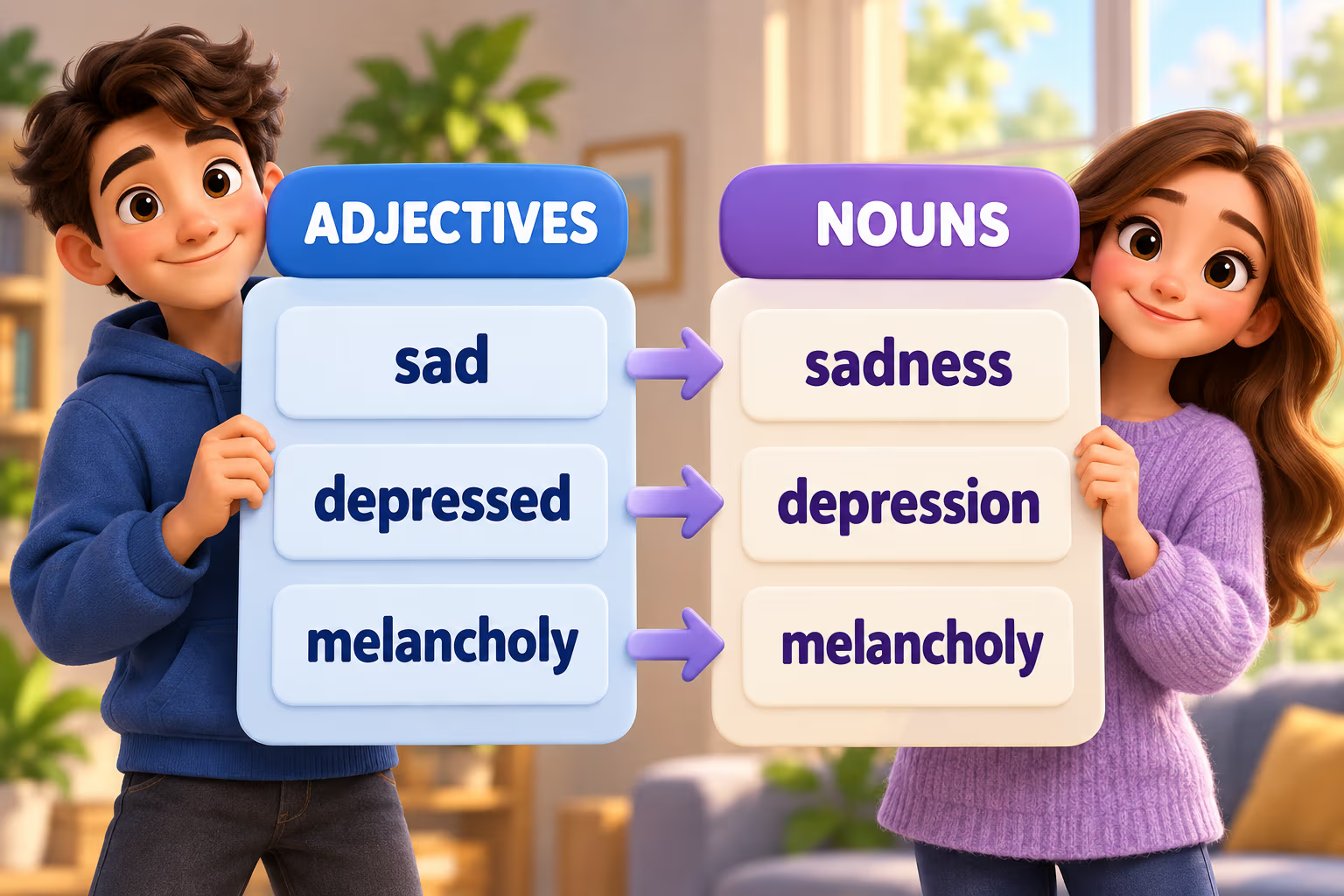
Depressed can describe feeling unhappy in everyday speech, but it can also refer to a mental-health condition in another context. An adjective by itself cannot diagnose anyone. Use the word that accurately communicates the intended meaning, and choose a neutral description when you do not know how another person feels.
Which Words in the Original List Need Context?
The original alphabetical collection below is preserved in full, but not every entry is a direct, current synonym for feeling sad. Some name related emotions or causes, some are nouns rather than adjectives, and some usually express a contrasting or positive meaning.
| Original-list examples | How to read them | More precise use |
|---|---|---|
| sadness, depression, dejection, gloominess | Nouns that name a feeling, state, or concept | Use an adjective such as sad, depressed, dejected, or gloomy to describe a person or scene. |
| cheerful, glad, happy, joyful, lucky, fortunate | Usually positive or contrasting, not direct synonyms for sad | Use when the context is happy or fortunate; use disappointed or unhappy for a negative feeling. |
| amusing, funny | Usually describe what causes laughter or entertainment | “The joke was funny” does not mean “the joke was sad.” |
| anxious, apprehensive, worried | Describe worry or expectation of a problem, which may occur alongside sadness | Name the emotion that is most relevant: “worried about the result” or “sad about the loss.” |
| moving, touching, poignant | Describe an experience that strongly affects someone; it can evoke mixed feelings | Explain the response: “a touching farewell that made her sad and grateful.” |
The word depression is a noun and is not an adjective for someone; depressed is its adjectival form. Likewise, grief and sorrow are nouns, while grieving and sorrowful can describe a person or expression. The Cambridge entry for “sorrow” identifies it as a noun, and the American Psychological Association explains that grief varies from person to person; the words here are descriptions, not a required sequence or diagnosis.
How Can You Use Sadness Adjectives in Writing?
Use one specific adjective, then support it with an action, detail, or cause. Instead of stacking near-synonyms—“sad, sorrowful, miserable, gloomy”—show what the character notices or does: “She folded the unused invitation and felt disappointed.”
- Name the source: an unmet hope may call for disappointed; a death may call for grief-stricken or mournful.
- Choose the register: glum is conversational, while sorrowful and dolorous sound more formal or literary.
- Check the grammar: use an adjective before a noun (“a melancholy song”), after a linking verb (“the song sounds melancholy”), or a noun after a determiner (“a feeling of melancholy”).
- Read the sentence aloud: if the word sounds too dramatic, clinical, or old-fashioned for the situation, use sad, upset, or disappointed instead.
Sadness can coexist with affection, relief, anger, or hope. The American Psychological Association notes that grief is individual and cautions against expecting everyone to pass through fixed stages in order. A precise adjective describes the moment; it does not define the whole person or prescribe what they should feel.
For broader emotion words, see our guides to adjectives for feelings and emotions and adjectives for feelings. If you need words for emotional hurt, explore adjectives for emotional pain.
The Original Alphabetical Collection
The full pre-existing list and its examples follow unchanged. It is a broad word bank; use the usage notes above to select direct synonyms and distinguish adjectives from related nouns and expressions.
When we think of adjectives for sad, a few words may come to mind, such as blue, down, and low. However, there are many other adjectives that can be used to describe sadness. In this article, we will explore a wide range of adjectives that can be used to describe this emotion. It is our hope that by the end of this article, you will have a better understanding of how to express your sadness through words.
Adjectives are a powerful tool that can help us to communicate our emotions more effectively. Some of the adjectives on this list may be more familiar to you than others. However, we hope that you will find all of them useful in different situations.
Adjectives For Sad
When we think of adjectives to describe someone who is sad, a few common ones come to mind: blue, down, and depressed. But there are many other words that can be used to capture different shades of sadness.
Here are some other adjectives for sad:
- Disappointed
When you feel sad because things didn’t turn out the way you wanted them to, you can say you’re disappointed. This word often describes a more mild form of sadness.
- Disheartened
To be disheartened is to be discouraged or sad because of a setback or failure. This word is often used to describe how we feel after something negative happens.
- Heartbroken
If you’re heartbroken, you’re devastated or extremely sad because of a loss or rejection. This word is often used to describe the intense sadness we feel after a romantic relationship ends.
- Miserable
When you’re miserable, you’re very unhappy or uncomfortable. This word is often used to describe how we feel when we’re sick or in pain.
- Pained
To be pained is to be emotionally hurt or distressed. This word is often used to describe the sadness we feel when we’re thinking about someone we’ve lost.
- Regretful
If you’re regretful, you feel sad, repentant, or ashamed about something you’ve done. This word is often used to describe the way we feel when we make a mistake.
- Sad
Of course, the word “sad” itself can be used to describe a wide range of emotions, from mild disappointment to intense grief.
- Sorrowful
To be sorrowful is to be deeply sad or regretful. This word is often used to describe the way we feel after someone close to us dies.
- Troubled
When you’re troubled, you’re worried or upset about something. This word is often used to describe the way we feel when we’re facing a difficult situation.
- Upset
To be upset is to be disturbed or agitated. This word is often used to describe the way we feel when something negative happens.

A
| Afflicted | Afflictive | Amusing |
| Anguished | Anxious | Apprehensive |
| Atrabilious |
B
| Bad | Baleful | Bereaved |
| Bilious | Bitter | Bleak |
| Blighted | Blue | Brokenhearted |
C
| Calamitous | Careworn | Cast Down |
| Cheap | Cheerful | Cheerless |
| Common | Crestfallen | Crushed |
| Cut Up |
D
| Dark | Dejected | Dejecting |
| Dejection | Deplorable | Depressed |
| Depressing | Depression | Desolate |
| Despairing | Despondent | Dimming |
| Dire | Discomposing | Disconsolate |
| Discouraged | Discouraging | Disheartened |
| Disheartening | Dismal | Dispirited |
| Dispiriting | Disquieting | Distressed |
| Distressing | Disturbing | Doldrums |
| Doleful | Dolorous | Down |
| Down In Dumps | Down In The Mouth | Down-In-The-Mouth |
| Downcast | Downhearted | Dreadful |
| Dreary | Dull | Dysphoric |
E | F
| Elegiac | Foreboding | Forlorn |
| Fortunate | Frightening | Funereal |
| Funny |
G
| Gay | Glad | Gloominess |
| Gloomy | Glum | Grave |
| Great | Grief-Stricken | Grieved |
| Grieving | Grievous | Grim |
H
| Hapless | Happy | Harassed |
| Heart-Rending | Heartbreaking | Heartbroken |
| Heartsick | Heavy | Heavy-Hearted |
| Heavyhearted | Homesick | Hopeless |
| Horrible | Horrified | Hurting |
I | J
| In Doldrums | In Grief | In The Dumps |
| Inconsolable | Jaundiced | Joyful |
| Joyless |

L
| Lachrymal | Lachrymose | Lamentable |
| Lamenting | Languishing | Lovelorn |
| Low | Low-Spirited | Lucky |
| Lugubrious |
M
| Megrims | Melancholia | Melancholic |
| Melancholy | Mischievous | Miserable |
| Moody | Morbid | Morose |
| Mournful | Mourning | Moving |
N | O
| Naughty | Not Happy | Oppressed |
| Oppressive | Out Of Sorts | Out-Of-Sorts |
P
| Pathetic | Pensive | Pessimistic |
| Piteous | Pitiable | Pitiful |
| Plaintive | Poignant | Poor |
R | S
| Regrettable | Rueful | Sad |
| Saddening | Sadness | Saturnine |
| Scary | Second-Class | Sepulchral |
| Shocking | Sick At Heart | Sober |
| Solemn | Somber | Sombre |
| Sorrowful | Sorry | Spiritless |
| Strange | Subdued | Sullen |
T
| Tearful | Terrible | Touching |
| Tragic | Tristful | Troubled |
| Troublesome |

U | V | W
| Unfortunate | Unhappy | Vexatious |
| Weeping | Wistful | Woebegone |
| Woeful | Worried | Wretched |
Final verdict
It is clear that there are many different adjectives that can be used to describe sadness. While some of these words may be more commonly used than others, all of them can be used to accurately describe the feeling of sadness.
In conclusion, if you are ever feeling sad, remember that you are not alone in your emotions and that there are many different words that can be used to describe what you are feeling.
Frequently Asked Questions About Adjectives for Sad
What is a stronger word for sad?
There is no single strongest word for every situation. Heartbroken suggests intense pain after loss or separation, inconsolable means difficult to comfort, and devastated is emphatic. Choose the word that fits the event and voice; a stronger-sounding synonym is not automatically more accurate.
What is a gentle word for sad?
Wistful suggests tender longing, often connected with a memory or something absent. Melancholy can sound quiet and reflective, while pensive emphasizes thoughtfulness more than sadness. These words suit reflective writing better than a plain report of acute distress.
Is melancholy an adjective or a noun?
Melancholy can be both. In “a melancholy song,” it is an adjective describing the song; in “a sense of melancholy,” it is a noun naming a feeling. The surrounding grammar, rather than the spelling alone, tells you which role the word has.
Can I use depressed as a synonym for sad?
In everyday language, depressed can describe feeling unhappy or low. It also has a mental-health meaning, so use it thoughtfully when describing another person. If you only mean an ordinary disappointment, sad, down, or disappointed may be clearer.
What is the difference between sad and sorrowful?
Sad is a common, broad adjective for unhappiness. Sorrowful is more formal or literary and often suggests deeper sadness or loss. For everyday conversation, “I felt sad” is natural; for a solemn scene, “a sorrowful expression” may better match the tone.


