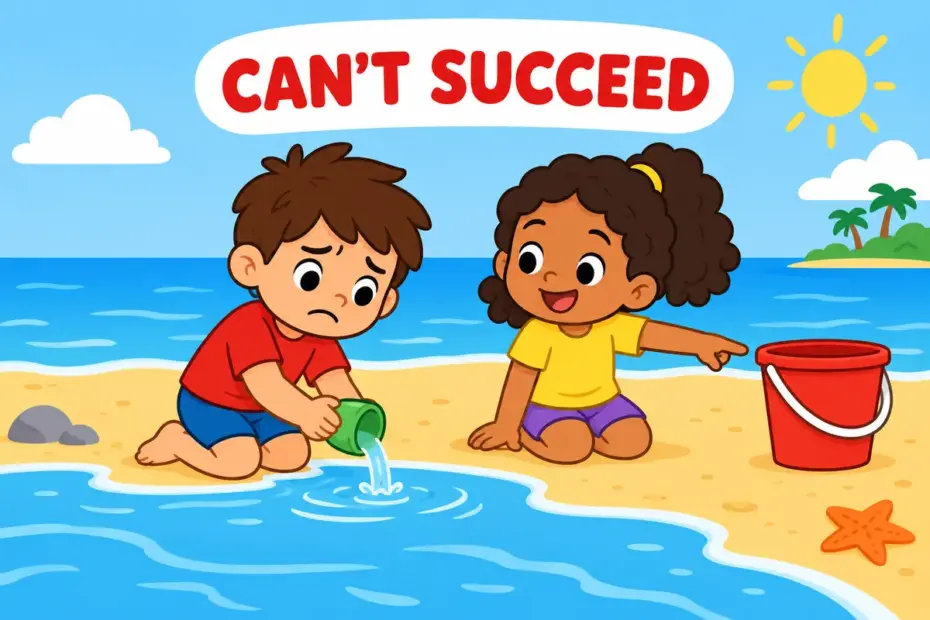
Futile means having no chance of succeeding, so a futile effort is wasted before it begins. To use futile in a sentence, attach it to the attempt rather than the person, as in “Their appeals proved futile.” The adjective describes an action that cannot produce a useful result.
Futile at a glance
- Futile is an adjective meaning having no chance of a useful result.
- Its adverb is futilely and its noun is futility.
- Futile normally follows linking verbs such as was, seemed and proved.
- The usual collocations are futile attempt, futile effort and futile gesture.
- The comparative is more futile; futiler and futilest are not standard.
- The commonest error is confusing futile with fertile, its near opposite.
What does futile mean?
Futile is an adjective meaning having no chance of producing a useful result, so an action described as futile cannot succeed. The Cambridge entry for futile records that sense of pointless effort, and it shapes three related uses: an attempt bound to fail, a gesture that changes nothing, and a hope certain to be disappointed. For a formal alternative, abortive describes an attempt that fails early.
| Sense | Plain meaning | Example sentence |
|---|---|---|
| Bound to fail | An effort with no chance of success | Their appeal to the referee was futile. |
| Pointless gesture | An action that cannot change events | She waved, a futile gesture in the dark. |
| Vain hope | An expectation certain to be disappointed | It was futile to hope for a reprieve. |
One limitation deserves stating plainly. Futile judges the action, not the person: it does not mean lazy, weak or worthless, and it says nothing about how hard someone tried. A futile effort may be brave and well organised, so use the word of attempts that cannot succeed rather than of people you wish to criticise.
How do you use futile in a sentence?
Futile sits after a linking verb and before the noun it judges. Most sentences use either the pattern it is futile to do something, or an attributive phrase such as a futile attempt. The adjective describes the attempt, so the person stays outside the structure.
| Pattern | Example | What it signals |
|---|---|---|
| be, seem or prove + futile | The rescue proved futile. | A linking verb plus the adjective. |
| a futile attempt, effort or gesture | A futile attempt to clear the drain. | The adjective before the noun it judges. |
| it + be + futile + to + verb | It is futile to argue. | An impersonal judgement of an action. |
| futile + opposition or resistance | Futile resistance delayed the outcome. | The adjective before an abstract noun. |
| futile + for + person + to + verb | It was futile for us to wait. | Names who the wasted effort belongs to. |
The infinitive pattern is the commonest in speech, while the attributive pattern dominates headlines. For a milder everyday judgement, hopeless covers the same ground without the finality.
Futile in a sentence: examples across contexts
Futile keeps its finality in every register; the nine sentences below move from a classroom to a literary scene, and each keeps the judgement on the action rather than the actor.
| Context | Example sentence | Why this works |
|---|---|---|
| Classroom | Their attempt to finish the model before the bell proved futile. | The effort cannot meet the deadline. |
| Workplace email | Further appeals were futile once the contract had been signed. | A formal statement that no remedy remains. |
| News report | Rescuers called the search futile after the third day. | Reports an official judgement. |
| Sports report | A late rally was futile against a defence that never slipped. | The effort arrives too late to matter. |
| Legal writing | The court found the objection futile and dismissed it. | A procedural step with no prospect. |
| Academic prose | Early claims that the theory was futile were quietly dropped. | Records a reversed judgement. |
| Historical writing | Resistance proved futile against the advancing army. | The standard collocation proved futile. |
| Conversation | It is futile to argue with the referee. | An everyday pattern with an infinitive. |
| Literary prose | She made one futile gesture toward the closing door. | A gesture that cannot change events. |
The sports and legal examples both keep the word on the action: the rally and the objection are futile, not the players or the lawyer. That habit is what makes the adjective sound native rather than harsh.
Futile vs useless and vain
Futile overlaps with two adjectives and matches neither. useless judges the value of a thing, vain judges effort that fails, and futile judges an action that never had a chance. The noun each modifies decides the choice.
| Attribute | futile | useless | vain |
|---|---|---|---|
| Core idea | Cannot succeed | Has no value | Fails to achieve its aim |
| Typical noun | attempt, effort, gesture | object, tool, advice | attempt, hope, promise |
| What it judges | The prospect of success | Practical worth | The result of effort |
| Strength | Strong and final | Blunt and dismissive | Literary and mild |
| Register | Neutral to formal | Everyday | Formal, slightly old-fashioned |
| Common collocation | a futile attempt | a useless umbrella | a vain hope |
Verdict: choose useless for things, vain for effort in literary prose, and futile when success was never possible. Formal writing often prefers unavailing for the same sense of effort that achieves nothing.
Word forms and grammar of futile
Futile inflects with more and most, and its adverb futilely describes how an effort is made. The noun futility is uncountable, and the form futilety, built by analogy with other nouns, is not a word.
| Form | Part of speech | Example |
|---|---|---|
| futile | adjective | The protest was futile. |
| more futile | comparative | Waiting longer seemed more futile than leaving. |
| most futile | superlative | It was the most futile gesture of the day. |
| futilely | adverb | They argued futilely for an hour. |
| futility | noun | The futility of the plan became clear. |
| futiler | non-standard comparative | Use more futile, never futiler or futilest. |
The adverb futilely describes the manner of an action, so it modifies a verb rather than a noun. Keep futile for the thing judged and futilely for the way it is done, and the two will rarely be confused.
Common mistakes with futile
- Incorrect:
The soil here is too futile for crops.Correct: The soil here is too fertile for weeds. Rule: Fertile means able to produce; futile means unable to succeed. One letter separates opposite ideas. - Incorrect:
It is futile to trying again.Correct: It is futile to try again. Rule: The pattern takes to plus the base verb, never to plus an -ing form. - Incorrect:
She made a futilely attempt to explain.Correct: She made a futile attempt to explain. Rule: Use the adjective futile before a noun; use the adverb futilely only to modify a verb. - Incorrect:
This is the most futilest plan yet.Correct: This is the most futile plan yet. Rule: Futile takes more and most, so it never adds -er or -est. - Incorrect:
He was a futile worker.Correct: His efforts were futile. Rule: Futile judges an action, not a person’s worth.
Practice using futile
Work through the six items, then check the reasoning rather than only the key.
- Fill the gap: The second vote was ______, because the first had already settled the matter.
- Choose the better word: The cracked torch was (futile / useless) in the dark.
- Correct the error: It is futile to trying to change the referee’s mind.
- Build a sentence: use proved futile about an attempt to repair a kite in high wind.
- Spot the register: which belongs in a formal report — further objections were futile, or it was pointless even trying?
- Rewrite with the noun: Trying to stop the tide was futile. Use futility.
Answers
- futile — the vote could not change a question that had already been decided.
- useless — the torch is a thing with no practical value, not an effort.
- It is futile to try to change the referee’s mind — the pattern takes to plus the base verb.
- Model answer: The attempt to repair the kite in high wind proved futile.
- Further objections were futile — a formal report keeps the adjective on the objections.
- The futility of trying to stop the tide was clear — the noun names the quality of the effort.
The bottom line
Use futile in a sentence when an effort cannot produce a useful result, and attach the adjective to the attempt rather than the person. The two details that decide most sentences are these: futile describes an action bound to fail, while useless describes a thing with no value, and the comparative is more futile, never futiler. Where the sense is everyday, hopeless or pointless fits better.
Frequently asked questions about futile
Does futile mean impossible?
Futile is stronger than unlikely and narrower than impossible. An impossible task cannot be done at all, while a futile attempt can be made but cannot achieve anything useful. Rescuing a boat that has already sunk is futile because the effort changes nothing, whatever the rescuers hope.
What is the difference between futile and useless?
Futile describes an action that cannot succeed, while useless describes a thing that has no practical value. A useless umbrella leaks, but carrying it in a storm is futile. The first judges what something is worth, the second judges what an effort can achieve.
Is futile an adjective or a noun?
Futile is an adjective, and its noun is futility. Writers say the search was futile and the futility of the search became clear. The adverb is futilely, as in they protested futilely. Building the noun from the adjective is regular, but futile itself never becomes a noun.
Can a person be described as futile?
Futile describes actions, efforts and gestures, not people. Calling a colleague futile sounds like an insult about their worth, which the word does not mean. If you mean that someone’s efforts failed, write their efforts were futile or their attempts proved futile, keeping the adjective on the attempt.
Ever experienced the frustration of putting in effort without achieving any meaningful results? That’s the essence of a situation described as “futile.”
When something is described as futile, it means that despite one’s best attempts, it is unlikely to succeed or be effective. This word is often used to convey a sense of hopelessness or wasted effort in various contexts.
7 Examples Of Futile Used In a Sentence For Kids
- The little ant tried to lift the big leaf, but it was futile.
- The bird kept pecking at the window, but it was futile.
- I tried to catch the butterfly with my hands, but it was futile.
- The squirrel tried to climb the smooth tree trunk, but it was futile.
- The fish tried to jump out of the bowl, but it was futile.
- The caterpillar tried to reach the top of the plant, but it was futile.
- The dog chased its own tail in circles, but it was futile.
14 Sentences with Futile Examples
- Futile attempts were made by the students to cram the night before exams, hoping to score well.
- Many students found it futile to argue with the university administration over the strict attendance policy.
- Group study sessions often turned futile when everyone got distracted by social media.
- Trying to finish a semester’s worth of assignments in one night proved to be futile for the overwhelmed students.
- It was futile to expect the college canteen to have any healthy food options for the health-conscious students.
- Requesting deadline extensions for assignments at the last minute was considered futile by the strict professors.
- The students’ attempts to get the syllabus reduced were seen as futile by the unyielding academic department.
- Attending a lecture without taking notes proved to be futile when it came time to revise for exams.
- Trying to navigate the complex college campus without a map turned out to be futile for the lost students.
- Procrastinating on studying until the day before the exam was a futile strategy for the unprepared students.
- Negotiating with the college bookstore for lower prices on textbooks felt futile as the prices remained fixed.
- It seemed futile to expect the slow internet connection in the hostel to support online classes smoothly.
- Students found it futile to complain about the lack of resources in the overcrowded college library.
- Attempting to please all the professors with equally good assignments proved to be futile for the perfectionist students.
How To Use Futile in Sentences?
Futile is used to describe something as pointless or ineffective. When forming a sentence with the word futile, it is essential to ensure it is utilized correctly to convey the intended meaning.
Here are some tips on how to use futile in a sentence effectively:
- Identify a situation where something is not likely to succeed or produce any desired outcome.
- Use futile to describe efforts, actions, or attempts that are in vain or have little chance of success.
- Ensure the sentence context clearly demonstrates the lack of effectiveness or success.
Example sentences using futile:
- “Despite his repeated attempts, his efforts to repair the old and worn-out machine were futile.”
- “Fighting against the powerful hurricane with just a small umbrella proved to be a futile endeavor.”
- “The detective knew that pursuing the false lead would be futile and a waste of precious time.”
By following these guidelines and examples, you can effectively use futile in a sentence to express the idea of something being pointless, ineffective, or without success.
Conclusion
In conclusion, futile sentences are those that are ultimately pointless or ineffective in delivering a clear message or achieving a specific goal. Examples of futile sentences include those that are overly complex, lack coherence, or are redundant. By understanding what constitutes a futile sentence, writers can strive to communicate more efficiently and effectively.
To avoid writing futile sentences, it is important to be clear and concise in your communication, avoid unnecessary repetition or wordiness, and ensure that each sentence adds value to the overall message. By practicing good writing habits and continually refining your skills, you can create more impactful and meaningful sentences that effectively convey your ideas to your audience.