Gambol is a verb meaning to run and skip about playfully, and it can also name one such playful jump. To use gambol in a sentence, put a lively subject in front and a place after: “The lambs gambolled across the meadow.” The verb is intransitive, so it never takes an object.
Gambol at a glance
- Gambol is a verb, and less often a noun; its forms are gambols, gambolled and gambolling.
- The dominant pattern is a person or animal gambolling in, across or through a place.
- Gambol is literary and affectionate; plain speech usually prefers skip or romp.
- It nearly always describes animals or young children at play.
- The commonest error is confusing gambol with gamble, a near homophone meaning to bet.
What does gambol mean?
Gambol is a verb meaning to run about with lively, playful skipping and jumping. The Cambridge entry for gambol records both the verb and a noun for one such skip, and the two are easy to keep apart: the verb is the activity, the noun is a single bound. The word carries no sense of purpose or speed, only light-hearted movement.
| Sense | Plain meaning | Example sentence |
|---|---|---|
| Skip about (verb) | Move with playful jumps | The puppies gambolled on the lawn. |
| A playful jump (noun) | One light, skipping movement | The foal gave a sudden gambol. |
| At play (participle) | Describing lively movement | We watched the gambolling lambs. |
One limitation matters here. Gambol does not mean ordinary walking, and it does not fit a serious or hurried journey. A commuter does not gambol to the station. For heavy, weary movement the right word is plod, and gambol keeps to animals, children and a gentle, playful mood.
How do you use gambol in a sentence?
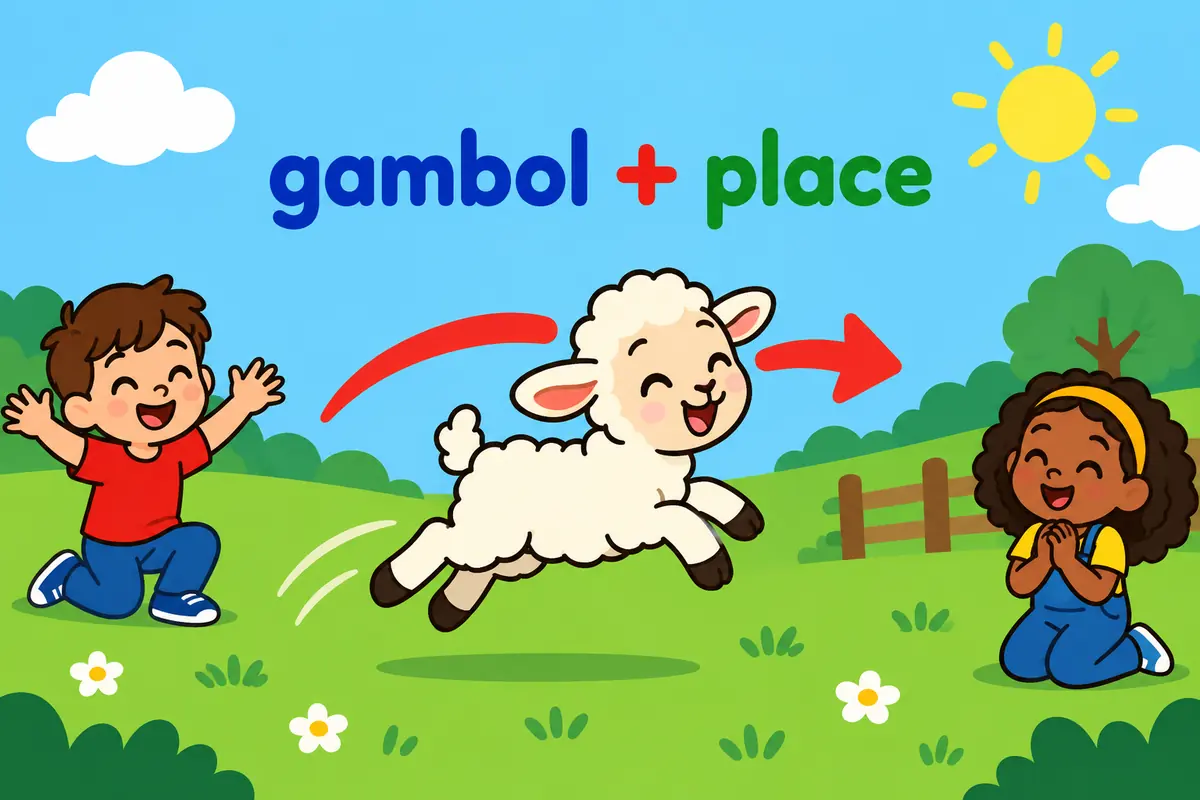
Gambol is intransitive, so it never takes a direct object; the place is added with a preposition. Five patterns cover almost every real sentence.
| Pattern | Example | What it signals |
|---|---|---|
| subject + gambol | The kids gambolled all afternoon. | Pure playful movement, no object. |
| gambol + in/across + place | The deer gambolled across the clearing. | Where the playful movement happens. |
| gambol + with + companion | The cubs gambolled with one another. | Shared, social play. |
| gambolling + noun (participle) | The gambolling goats woke the farm. | Describes a scene rather than an action. |
| give + a + gambol (noun) | The lamb gave a gambol and stopped. | One countable, finished jump. |
Gambol in a sentence: examples across contexts
Gambol is a literary word, so its home is narration rather than business writing. Each sentence below keeps the same playful movement while moving through different reading contexts.
| Context | Example sentence | Why this works |
|---|---|---|
| Classroom | The story ends with the lambs gambolling in the sunrise. | A gentle, visual image suits a read-aloud book. |
| Children’s fiction | The children gambolled through the fallen leaves. | Playful movement matched to a happy scene. |
| Nature writing | Young deer gambolled at the edge of the wood. | Animal play is the word’s most natural subject. |
| Poetry | They gambolled, and the meadow seemed to laugh. | The rhythm and light mood fit verse. |
| Review | The film lets its young cast gambol through a long summer. | Metaphor for carefree screen action. |
| Letter | Our puppy gambolled round the garden all morning. | Warm, informal narration to a friend. |
| Sports feature | The winger gambolled past two defenders with a grin. | Uses the skip to suggest joy, not speed alone. |
| Travel essay | Goats gambolled on the terraces above the village. | Paints a lively rural scene in few words. |
Gambol vs gamble
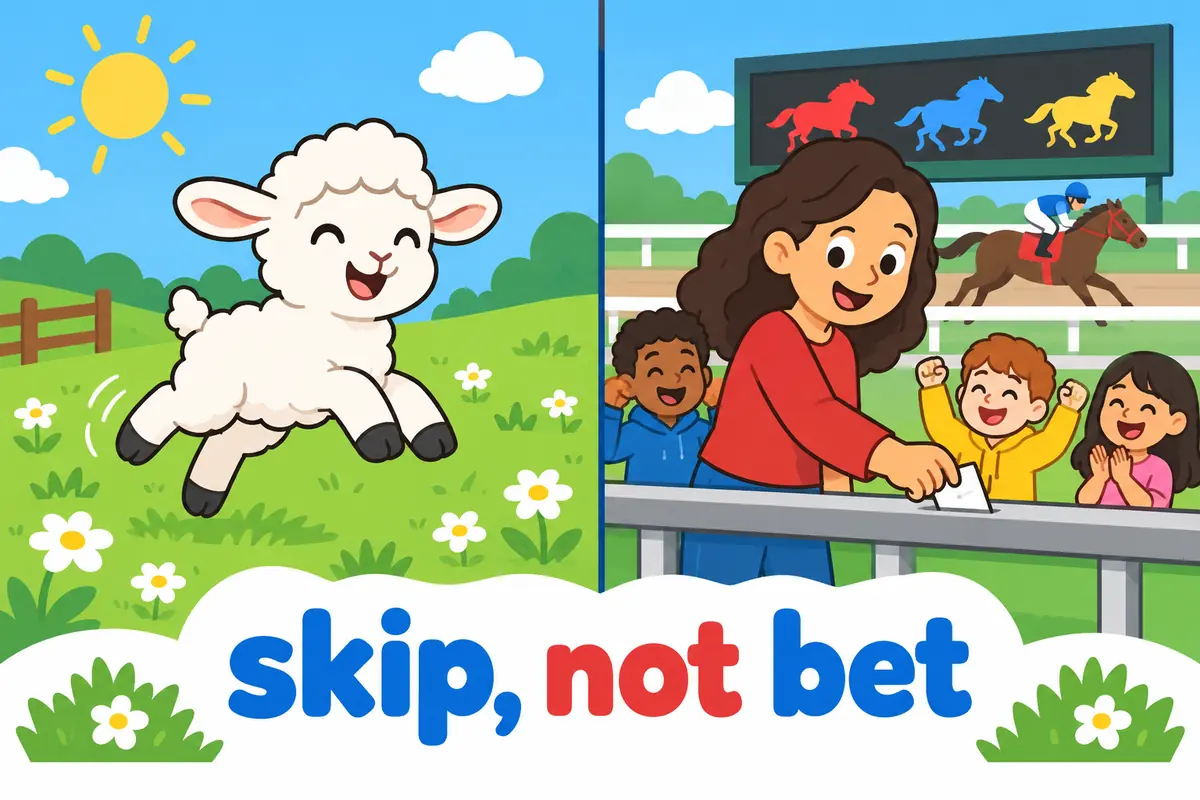
Gambol and gamble are pronounced almost identically, so they are routinely confused in writing. Their meanings could hardly be further apart, and only the spelling keeps them separate.
| Attribute | gambol | gamble |
|---|---|---|
| Core meaning | Skip about playfully | Bet money or take a risk |
| Part of speech | Verb, sometimes a noun | Verb and noun |
| Typical subject | Lambs, puppies, children | A person, a company, an investor |
| Feeling | Light, joyful, harmless | Risk, chance, possible loss |
| Register | Literary and affectionate | Neutral, common in finance and speech |
Verdict: if something is skipping for joy, the word is frolic or gambol; when the play turns rough and noisy it becomes a romp, and one frisky leap is a caper. If someone is staking money on an outcome, the word is gamble.
Word forms and grammar of gambol
Gambol inflects regularly, and the doubled L is the form learners most often misspell. British writing keeps the double L before a vowel ending, while American writing uses a single one.
| Form | Part of speech | Example |
|---|---|---|
| gambol | verb, base form | The pups will gambol in the yard. |
| gambols | verb, third person singular | The foal gambols beside its mother. |
| gambolled | verb, past, British spelling | The lambs gambolled until dusk. |
| gamboled | verb, past, American spelling | The lambs gamboled until dusk. |
| gambolling | verb, present participle | A gambolling puppy crossed the path. |
| gambolment | noun — non-standard | Avoid this invented form; the noun is simply gambol. |
Common mistakes with gambol
- Incorrect:
The children gambolled the ball.Correct: The children gambolled across the field. Rule: Gambol is intransitive, so it takes a place phrase, never a direct object. - Incorrect:
He gambolled his savings on a horse.Correct: He gambled his savings on a horse. Rule: Gambol means to skip playfully; risking money is gamble. - Incorrect:
The tired hikers gambolled up the mountain.Correct: The tired hikers trudged up the mountain. Rule: Gambol implies light, joyful movement, not weary effort. - Incorrect:
The office staff gambolled to the meeting.Correct: The office staff hurried to the meeting. Rule: Keep gambol for playful animals or children, not routine work.
Practice using gambol
Work through the six items, then read the reasoning rather than only the answers.
- Fill the gap: The lambs ______ across the spring meadow.
- Choose the better word: The puppy (gambolled / gambled) around the garden.
- Correct the error: The kittens gambolled the wool.
- Build a sentence: use gambol in about young goats on a hillside.
- Spot the register: which belongs in a bedtime story — the fawns gambolled in the moonlight, or the fawns moved playfully about?
- Rewrite with the noun: The calf skipped about. Use a gambol instead.
Answers
- gambolled — the lambs are the subject and the meadow follows the preposition across.
- gambolled — the puppy is skipping for joy; gambled would mean money was at stake.
- The kittens gambolled in the wool — gambol needs a place phrase, not a direct object.
- Model answer: The young goats gambolled in the sunshine on the hillside.
- The fawns gambolled in the moonlight — the vivid literary verb suits a bedtime story.
- The calf gave a gambol — the noun is countable and needs a determiner.
The bottom line
Use gambol in a sentence when animals or children move about in light, joyful skipping, and add the place with a preposition. The two details that decide most sentences are these: gambol is intransitive, so it never takes an object, and it stays in literary narration, where a plain word like skip would be the everyday choice.
Frequently asked questions about gambol
Is gambol a real word?
Yes. Gambol is a standard English verb recorded in major dictionaries and used in fiction, poetry and nature writing. It is uncommon in ordinary speech, which is why it can look unfamiliar, but it is entirely real and correctly spelled with two Ls in British usage.
How do you spell the past tense of gambol?
British writing doubles the final L, giving gambolled and gambolling. American writing keeps a single L, giving gamboled and gamboling. Both are accepted; choose one variety and stay consistent within a document, as you would with travelled and traveled across a whole text.
Can gambol be a noun?
Yes. A gambol is one playful skip or frolic, as in the foal gave a sudden gambol. It is countable, so it needs a determiner. The verb is far more common, so most sentences use gambol as an action rather than a thing.
Is gambol a common word?
No. Gambol belongs to literary and affectionate writing rather than everyday speech. Most people would simply say the lambs were skipping. Use gambol when you want a warm, vivid picture of playful movement, and keep it away from technical or business prose.
Have you ever seen a playful puppy bounding around a field, tossing and turning with sheer joy? That exuberant, carefree movement is what is known as “gambol.” This dynamic verb signifies playful or spirited jumping or skipping, often with lightness and happiness.
In essence, when someone or something gambols, it is engaged in a lively and uninhibited frolic. The term encapsulates a sense of freedom, spontaneity, and merriment, making it a delightful word to describe moments of unbridled fun and joy.
7 Examples Of Gambol Used In a Sentence For Kids
- Let’s gambol like happy little lambs!
- The bunny loves to gambol around the garden.
- We can gambol and play in the park.
- The kittens like to gambol in the sun.
- The children like to gambol on the grass.
- The puppies gambol in the field.
- Let’s all gambol together and have fun!
14 Sentences with Gambol Examples
- College students often gambol around the campus during breaks.
- After finishing their exams, a group of friends decided to gambol in the park to celebrate.
- The fresh monsoon rain invited the students to gambol in the puddles outside their hostels.
- During sports day, the students were seen to gambol on the field in excitement.
- To relieve stress, many students choose to gambol and have a good time in the common areas.
- During the annual fest, the students gathered to gambol and enjoy various musical performances.
- With their hectic schedules, college students often find solace in taking a break to gambol freely.
- The college authorities encouraged the students to gambol during the cultural event to showcase their talents.
- During the trekking trip, the students took a moment to gambol on the lush green hills.
- After a long day of lectures, the students felt the urge to gambol and release some pent-up energy.
- Witnessing a successful event, the students could not resist the urge to gambol and celebrate.
- The college courtyard filled with laughter as students began to gambol during the annual picnic.
- The end of semester party saw students gambol around the bonfire, enjoying the music and dance.
- The college’s open amphitheater provided the perfect space for students to gambol and relax after a day of classes.
How To Use Gambol in Sentences?
To use the word “Gambol” in a sentence, simply follow these steps:
-
Understand the meaning: The word gambol means to run or jump about playfully. It often implies a sense of joy and carefree movement.
-
Identify the context: Think of a scenario where someone or something is moving around in a playful or lively manner.
-
Form a sentence: Once you have the context in mind, you can easily construct a sentence using the word gambol. For example, “The children gambolled in the park, laughing and chasing each other.”
-
Check the sentence: Make sure the sentence you have created makes sense and effectively conveys the playful nature of the word gambol.
-
Practice: To become more comfortable using the word gambol, try incorporating it into different sentences and contexts. This will help you remember and use it appropriately in the future.
By following these steps, you can effectively incorporate the word gambol into your vocabulary and communicate more vividly and accurately.
Conclusion
In conclusion, the word “gambol” is used to describe the playful and lively movements of animals or people. It typically conveys a sense of joy, freedom, and spontaneity in its usage. For instance, “The lambs gleefully gambolled in the meadow” paints a vivid picture of carefree frolicking. Similarly, “Children love to gambol in the park on sunny days” captures the infectious energy and delight associated with playful activities. Overall, “gambol” is a versatile word that evokes a sense of fun and light-heartedness, making it a valuable addition to descriptive writing or storytelling.


