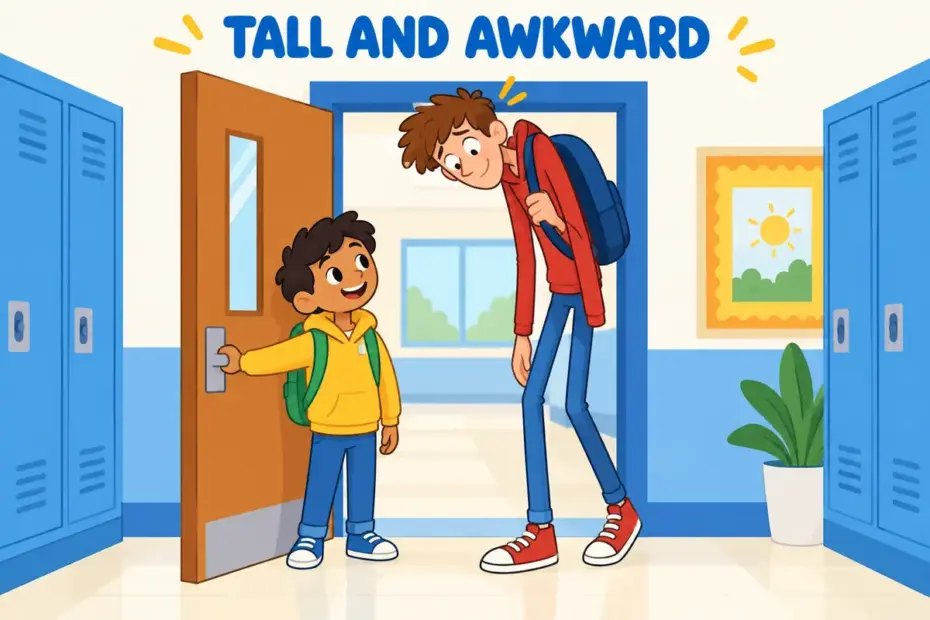
Gawky is an adjective meaning awkward and ungainly in movement or build, usually because someone is tall, thin and still growing. In a sentence it most often describes a person or their walk: “A gawky teenager unfolded from the small desk.” The word carries a mild, often fond tone rather than open criticism.
Gawky at a glance
- Gawky is an adjective; the related forms are gawkily and gawkiness.
- It describes a person, a limb or a way of moving, not usually an object.
- Gawky is commonest of adolescents whose height has outrun their coordination.
- Common collocations are a gawky teenager, gawky limbs and a gawky walk.
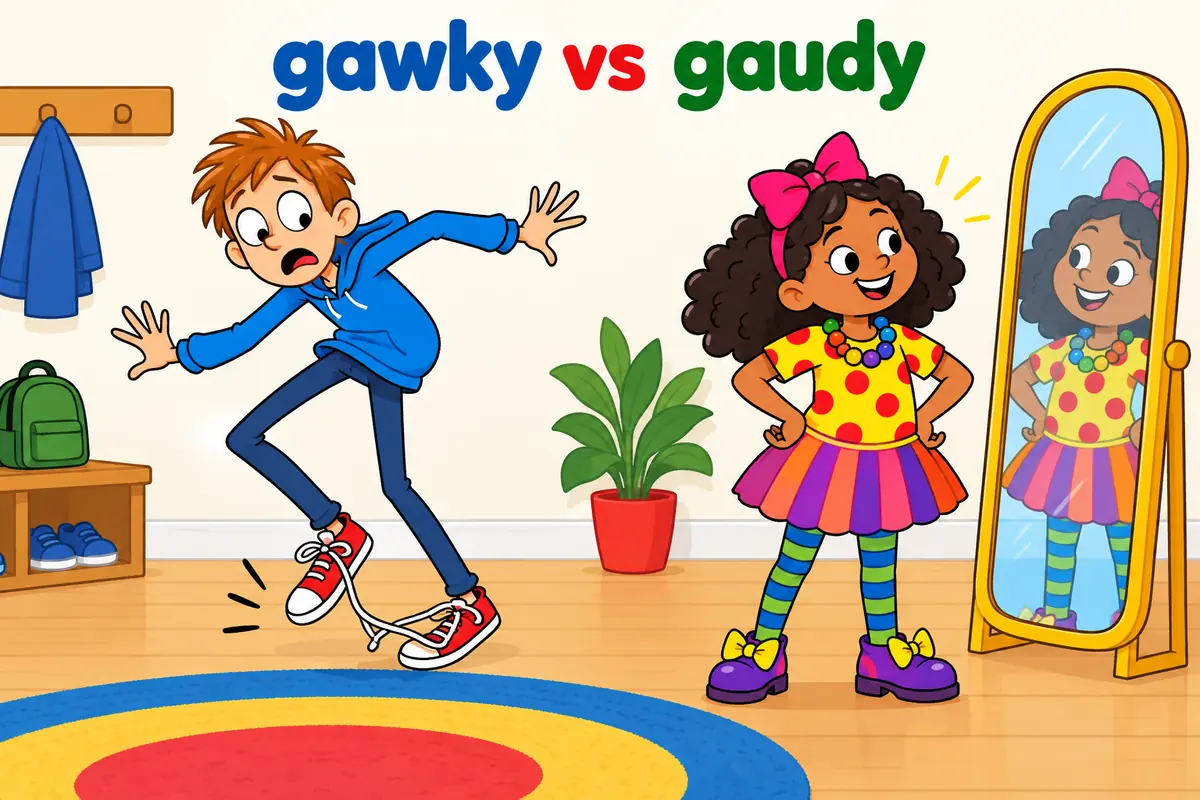
- The commonest error is confusing gawky with gaudy, which means showily colourful.
What does gawky mean?
Gawky is an adjective meaning awkward, ungainly or graceless in movement or appearance, especially when a person is tall and thin. The Cambridge entry for gawky records that sense. Its near neighbours differ in subtle ways: lanky means tall and thin without any judgment of grace, and gangling adds unusually long, loose limbs. Gawky keeps a hint of discomfort, as though the body has not yet caught up with its owner.
| Sense | Plain meaning | Example sentence |
|---|---|---|
| Awkward in movement | Moving clumsily or without grace | The gawky colt stumbled across the field. |
| Tall and thin | Long-limbed and awkward-looking | His gawky frame filled the doorway. |
One limitation matters. Gawky can sting if it is aimed at an adult’s body, because it suggests clumsiness rather than charm. It is safest about a passing stage of youth, and it does not suit furniture or machines, where clumsy or clunky is the right word.
How do you use gawky in a sentence?
Gawky is an attributive or predicative adjective, so it goes before a noun or after a linking verb such as be, look or seem. The five patterns below cover nearly every natural use.
| Pattern | Example | What it signals |
|---|---|---|
| gawky + person | a gawky teenager | Describes the whole person as awkward. |
| gawky + body part | his gawky arms | Applies the quality to a limb. |
| be / look gawky | He looked gawky in the suit. | Links the quality to an occasion. |
| gawky + movement noun | a gawky walk | Names the awkward action itself. |
| grow out of being gawky | She grew out of being gawky. | Hints that it is a passing stage. |
Gawky in a sentence: examples across contexts
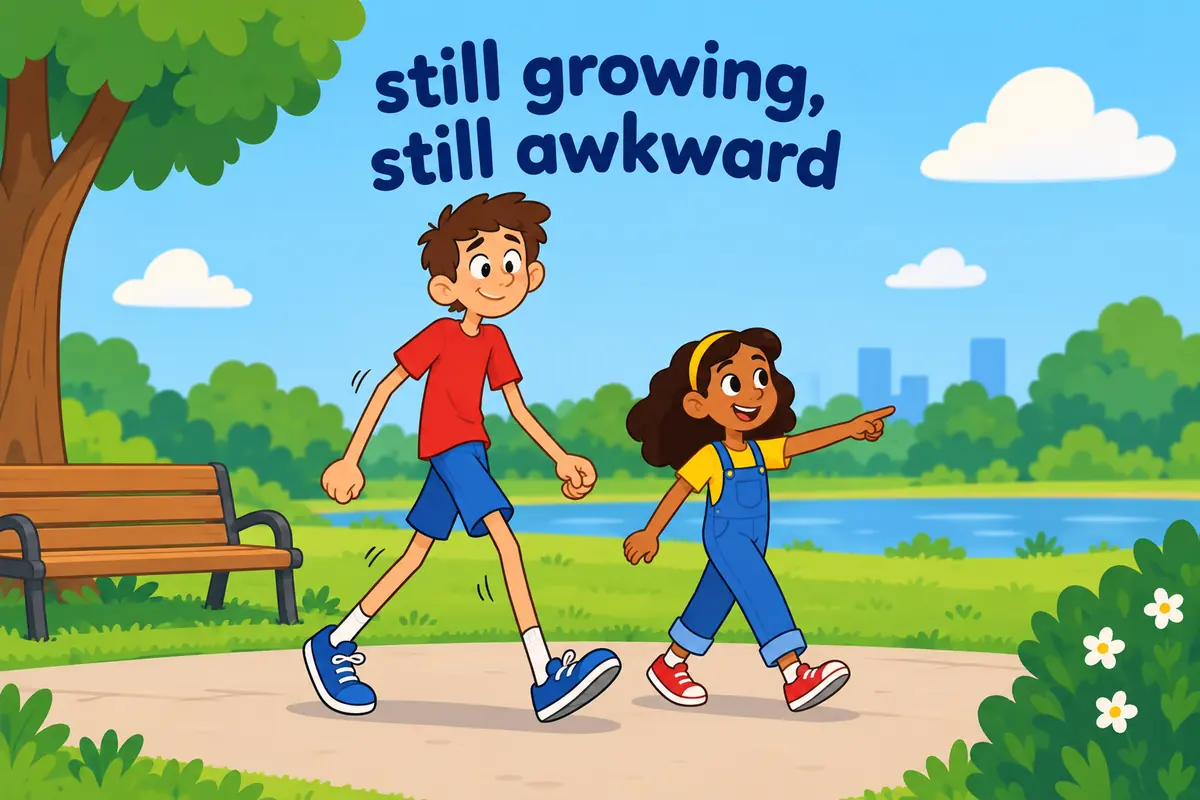
Gawky changes its company more than its meaning. These sentences move from home to sport, and each one shows the awkwardness the adjective names.
| Context | Example sentence | Why this works |
|---|---|---|
| Home | My gawky brother tripped over his own feet at the door. | The concrete mishap shows the awkwardness rather than naming it twice. |
| Classroom | The gawky new boy folded himself into a chair meant for children. | The size contrast makes the discomfort visible. |
| Sports report | A gawky young striker scored twice in his first match. | Sets the awkward frame against unexpected skill. |
| Fiction | She was all gawky elbows and apologies. | The noun phrase turns the adjective into a whole impression. |
| Diary | I feel gawky whenever I stand next to her. | The linking verb reports a present, personal feeling. |
| Review | The puppy was gawky now but promised to grow into its paws. | Extension to an animal keeps the growing-stage sense. |
| Advice column | Most people stop being gawky once their frame fills out. | The phrase being gawky shows it as a temporary state. |
| History | The portrait shows a gawky prince on the edge of adulthood. | Describes a known awkward stage in a public life. |
Notice that no sentence calls a chair or a machine gawky. The adjective stays with bodies and the people attached to them.
Gawky vs awkward and ungainly
Gawky overlaps with awkward and ungainly but is the narrowest of the three. Awkward covers social discomfort and bad design; gawky almost always means an ungainly body or walk.
| Attribute | gawky | awkward | ungainly |
|---|---|---|---|
| Core meaning | Tall and awkward-looking | Lacking skill or ease | Clumsy and hard to move |
| What it describes | A growing body or walk | People, moments, designs | Bodies, movements, machines |
| Source of the awkwardness | Fast growth in youth | Any lack of skill | Sheer shape and weight |
| Tone | Mild, often fond | Neutral to critical | Neutral, sometimes comic |
| Example | a gawky teenager | an awkward silence | an ungainly leap |
Verdict: choose gawky for a tall, still-growing awkwardness, awkward for a lack of skill, and ungainly for something that moves with visible effort.
Word forms and grammar of gawky
Gawky forms its adverb and noun regularly, but the verb gawk is a different word with a different meaning. The table separates the forms learners most often mix up.
| Form | Part of speech | Example |
|---|---|---|
| gawky | adjective | He was a gawky, cheerful boy. |
| gawkily | adverb | She gawkily climbed the ladder. |
| gawkiness | noun | His gawkiness faded by eighteen. |
| gawk | verb, to stare | The tourists gawked at the tower. |
| gangly | adjective, near-synonym | Her gangly legs crossed the room. |
Common mistakes with gawky
- Incorrect:
She wore a gawky necklace.Correct: She wore a gaudy necklace. Rule: Gaudy means showily colourful; gawky describes an awkward body or walk. - Incorrect:
He gawky at the screen.Correct: He gawked at the screen. Rule: The verb is gawk, meaning to stare; gawky is only an adjective. - Incorrect:
The gawky table wobbled.Correct: The wobbly table rocked. Rule: Gawky describes people and limbs, not furniture. - Incorrect:
He was gawky of his height.Correct: He was gawky because of his height. Rule: Gawky takes no phrase with of; give the cause with because of. - Incorrect:
She moved gawky across the room.Correct: She moved gawkily across the room. Rule: Use the adverb gawkily to modify a verb.
Practice using gawky
Work through the six items, then read the reasons rather than only the answers.
- Fill the gap: The ______ puppy loped after the ball on legs too long for its body.
- Choose the better word: His shirt was loud and (gawky / gaudy).
- Correct the error: The tourists gawky at the palace gates.
- Build a sentence: use look gawky about a boy in a borrowed suit.
- Spot the register: which fits a kind note — she was a gawky but warm classmate, or she was a gawky, ugly girl?
- Rewrite as an adverb: He was gawky as he danced. Use gawkily instead.
Answers
- gawky — the adjective describes the puppy in its long-legged, growing stage.
- gaudy — loud colours call for gaudy; gawky is about bodies and movement.
- The tourists gawked at the palace gates — the verb meaning to stare is gawk.
- Model answer: In the borrowed suit he looked gawky and young.
- She was a gawky but warm classmate — the kind version keeps gawky mild and adds warmth.
- He danced gawkily — the adverb modifies the verb danced.
The bottom line
Use gawky in a sentence to describe a tall, thin, still-growing awkwardness, usually in a young person or their walk. Two nuances decide the choice: gawky carries a mild, even fond tone about youth, so it is unkind about an adult’s body, and it belongs to people rather than objects. For something that moves with visible effort, ungainly is often the better fit.
Frequently asked questions about gawky
What does gawky mean?
Gawky means awkward and ungainly in build or movement, especially when someone is tall and thin. It is often used of adolescents whose limbs have grown quickly, as in a gawky teenager. The word suggests awkwardness rather than plain height, so it carries more judgment than lanky.
Is gawky an insult?
It can be, but it is usually mild. Said of a growing teenager, gawky often sounds fond rather than cruel, because the awkwardness is understood to be temporary. Applied to an adult, though, it suggests clumsiness, so a kinder writer chooses tall or graceful instead.
What is the difference between gawky and gangly?
Both describe a tall, thin build. Gangly stresses the long, loose limbs and is nearly neutral, while gawky stresses the awkwardness those limbs produce. A gangly dancer may move beautifully, but a gawky one moves without grace. The choice depends on whether you mean to judge the movement or merely the build.
What is the adverb of gawky?
The adverb is gawkily, as in she gawkily climbed the ladder. Do not confuse it with the verb gawk, which means to stare open-mouthed, as in the crowd gawked at the parade. The adjective gawky and the verb gawk look alike but describe different things.
Have you ever felt awkward or clumsy in your movements, like a “gawky” adolescent deer trying to find its footing? The term “gawky” describes a person who is awkward, ungainly, or lacking in grace and coordination.
This word can be used to describe someone who appears uncoordinated, socially inept, or uncomfortable in their own skin. Whether it’s their physical movements or their social interactions, a gawky person may come across as awkward or out of place in various situations.
7 Examples Of Gawky Used In a Sentence For Kids
- The gawky baby giraffe wobbled around the zoo.
- The gawky puppy had trouble walking in a straight line.
- The gawky scarecrow stood tall in the field.
- The gawky flamingo stumbled while learning to stand on one leg.
- The gawky turtle moved slowly across the sand.
- The gawky foal struggled to keep up with the herd.
- The gawky duckling tripped over its own feet while learning to walk.
14 Sentences with Gawky Examples
- Gawky freshmen often struggle to navigate the busy college campus.
- She felt gawky trying to parallel park her car in front of the hostel.
- His gawky attempts at flirting with classmates always ended in awkward silence.
- The gawky first-year students stood out in the crowd during orientation week.
- She felt gawky and out of place at the fancy college socials.
- Gawky dancers stumbled through the routine during the cultural fest.
- The gawky new debate team member struggled to make her point effectively.
- Gawky freshmen often got lost in the labyrinth of halls and corridors.
- He felt gawky asking senior students for help with his assignments.
- The gawky group of friends tried to pose for a picture in front of the college sign.
- The gawky volunteer stumbled over her words during the campus event.
- She felt gawky trying to fit in with the trendy fashion choices of her classmates.
- The gawky basketball player struggled to keep up with the fast-paced game.
- Gawky musicians nervously took the stage for the college talent show.
How To Use Gawky in Sentences?
To use the word Gawky in a sentence, follow these simple steps:
-
Understanding the meaning: The word Gawky means looking or moving awkwardly due to being tall, thin, and clumsy.
-
Placement in a sentence: When using Gawky in a sentence, it is important to place it where it fits naturally. Typically, Gawky is used to describe a person’s appearance or mannerisms.
-
Example sentence: “Despite his intelligence, he moved in a Gawky manner that often drew attention.”
-
Context: Consider the context in which you are using the word. Ensure that it accurately conveys the intended meaning and does not come across as disrespectful or offensive.
-
Practice: To become more comfortable with using Gawky in sentences, practice incorporating it into different scenarios. This will help you gain confidence in your usage.
-
Variation: Experiment with using Gawky in combination with other words to create more detailed descriptions. For example, “Her Gawky frame stood out in the crowd.”
-
Feedback: Seek feedback from others on your usage of Gawky in sentences. This can help you refine your skills and become more proficient in incorporating the word into your vocabulary.
Remember, the key to mastering the use of Gawky in a sentence is practice and understanding its meaning and appropriate usage in various contexts.
Conclusion
In conclusion, sentences with the keyword “gawky” describe individuals who appear awkward, clumsy, or lacking in grace. These sentences often highlight someone’s physical appearance or behavior in a particular situation. For instance, “Sarah’s gawky movements made her stand out during the ballet class,” emphasizes her awkwardness compared to the other dancers. Along similar lines, “The gawky teenager tripped over his own feet while trying to impress his crush,” exemplifies a situation where clumsiness leads to embarrassment. Overall, sentences with “gawky” paint a vivid picture of individuals struggling with coordination or social skills, inviting readers to empathize with or chuckle at the portrayed awkwardness.