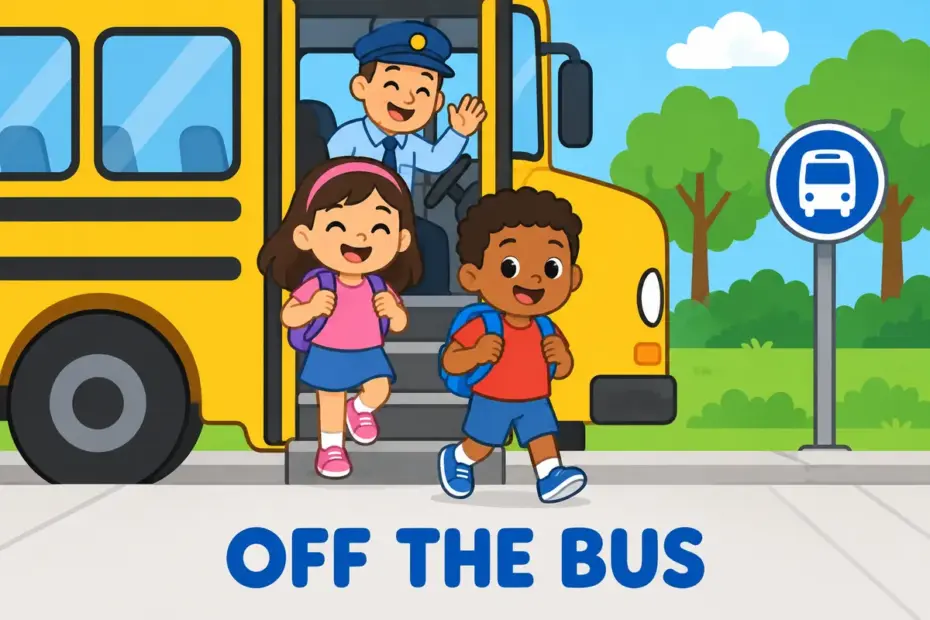
Get off is one of the busiest phrasal verbs in English: it can mean to leave a bus or train, to escape punishment, to remove something, to finish a shift, or to send a message. Which sense applies depends on the words that follow, so the object does most of the work.
Get off at a glance
- Get off is a phrasal verb; its forms are gets off, got off and getting off.
- The particle may move when the meaning is to remove something: get your coat off.
- The commonest sense is to leave a large passenger vehicle, so it is the opposite of get on.
- The verb also covers escape from punishment, finishing work and sending a letter.
- The commonest error is saying get off a car, where English requires get out of a car.
What does get off mean?
Get off is a phrasal verb meaning to leave a vehicle or surface, to escape or soften a punishment, to remove something, to finish work, or to send a message. The Cambridge entry for get off lists these senses separately, and the context decides which one a reader will choose. The verb is highly productive, so a single word covers ground that other languages spread across half a dozen.
| Sense | Plain meaning | Example sentence |
|---|---|---|
| Leave a vehicle or surface | Step down from a bus, bike or table | We got off the train at the last stop. |
| Escape or soften punishment | Receive a light penalty | The driver got off with a warning. |
| Remove something | Take off clothing, a mark or a load | Get your muddy boots off before you come in. |
| Finish work | End a shift or leave the workplace | I get off at five on Fridays. |
| Send something | Post a letter or dispatch a message | She got the parcel off before noon. |
One limitation is worth stating. Get off is informal and has several slang senses about pleasure that a school report or a formal letter should avoid; in those settings, leave, remove, finish and send are the safer verbs. The verb also never takes the preposition from before a place, which is a frequent learner slip.
How do you use get off in a sentence?
The sense is chosen by what follows the verb. Six patterns cover almost every real sentence, and only the removal sense lets the object sit between get and off.
| Pattern | Example | What it signals |
|---|---|---|
| get off + vehicle | We got off the bus outside the library. | Leaving a large passenger vehicle, the opposite of get on. |
| get off + place | Get off the sofa and help me. | An order to leave a surface or a piece of furniture. |
| get + object + off | Get your shoes off at the door. | The removal sense is separable, so the object may split the phrase. |
| get off + lightly or with | The firm got off with a small fine. | Degree of punishment, from mild to lucky. |
| get off at or in + place | Get off at the next stop. | Travel directions, with the verb standing alone before the place. |
| get off + work | What time do you get off work? | Finishing a shift, with the noun left bare, not after from. |
Get off in a sentence: examples across contexts
Get off shifts its sense more than its form. The eight sentences below move from a bus stop to a workshop, and each one makes the intended meaning clear from context alone.
| Context | Example sentence | Why this works |
|---|---|---|
| Travel directions | Get off at the third stop and walk two blocks. | The at phrase fixes the travel sense with no object needed. |
| Student excuse | We got off lightly because the teacher forgot the deadline. | The lightly pattern shows a punishment that could have been worse. |
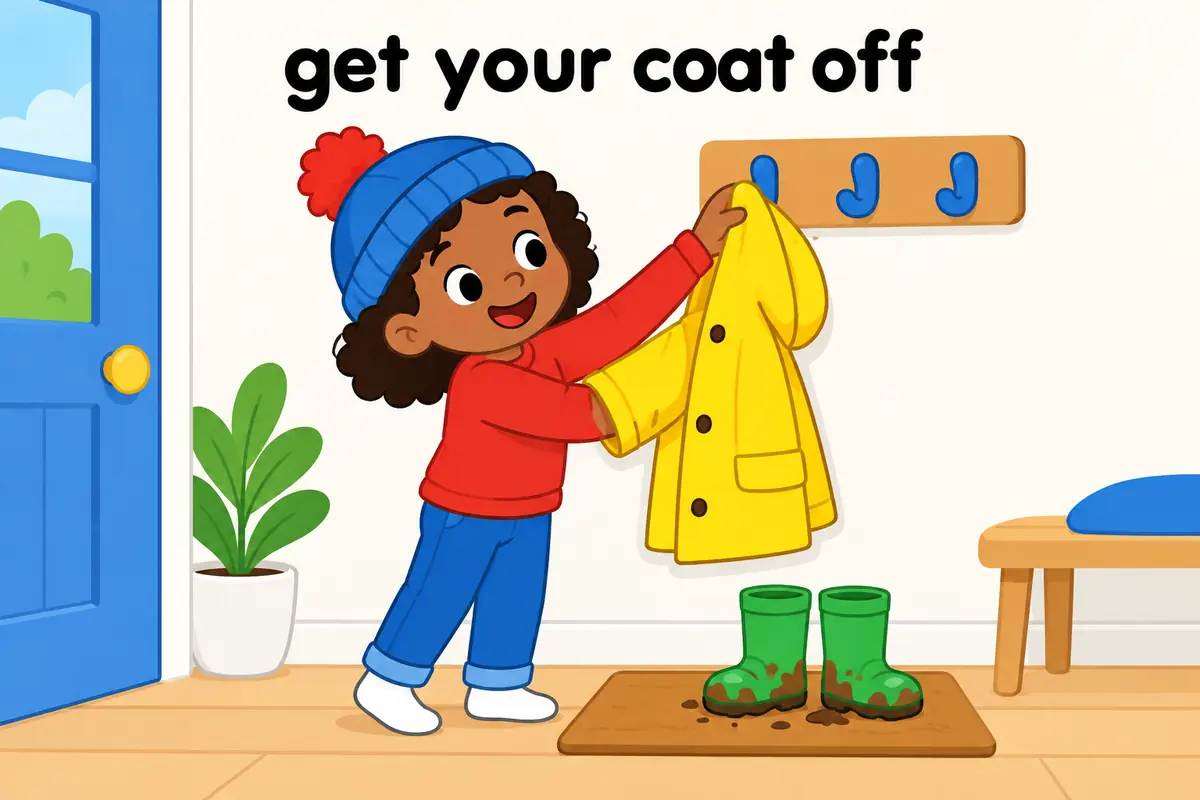
| Home routine | Get your wet coat off and hang it by the door. | The object splits the phrase, which only the removal sense allows. |
| Workplace chat | She gets off work at six, so call her after that. | Bare work after get off marks the end of a shift. |
| News report | The company got off with a reprimand and no penalty. | The with pattern reports a lenient official outcome. |
| Customer email | I got the replacement part off to you this morning. | The send sense speeds up a routine dispatch note. |
| Sports report | The defender got off the bench and changed the game. | Leaving a seat is the surface sense in a sporting context. |
| Safety notice | Do not get off the moving walkway before it stops. | The vehicle sense in a clear public instruction. |
Only the third sentence lets the object split the verb, which is the clearest grammatical signal that removal, not departure, is meant.
Get off vs get out of and get down
The words readers mix up are other get phrases. Use alight for the formal register of leaving a vehicle, and note the vehicle rule that separates get off from get out of. A passenger gets off a bus, a train or a plane and out of a car or a taxi.
| Attribute | get off | get out of | get down |
|---|---|---|---|
| Core job | Leave a large vehicle or surface | Leave a car or avoid a duty | Descend from a height |
| Typical object | A bus, train, bike, sofa | A car, taxi, an obligation | A ladder, tree, horse |
| Opposite | get on | get into | climb up |
| Separable | Yes for removal only | No | No |
| Register | Neutral and very common | Neutral and common | Neutral |
Verdict: choose get off for buses, trains and planes, get out of for cars and taxis, and get down for climbing down. When the meaning is formal travel, disembark fits an airport notice better than either phrase.
Word forms and grammar of get off
Get off follows the irregular verb get, whose past is got and whose past participle is got in British English and gotten in American English. Get is also a machine for new meanings: get around means to travel or to avoid, and get back means to return.
| Form | Part of speech | Example |
|---|---|---|
| get off | base phrasal verb | Do not get off yet. |
| gets off | third person singular | He gets off the bus here. |
| got off | past tense | She got off lightly. |
| gotten off | past participle, American | They have gotten off at the wrong stop. |
| getting off | present participle | We are getting off at the next stop. |
| get-off | not a standard noun | Writers wrongly treat get-off as a noun. |
One more particle worth knowing is back off, which means to retreat or to stop pressuring somebody, and it shares the off that gives get off its sense of separation.
Common mistakes with get off
- Incorrect:
We got off the taxi at the corner.Correct: We got out of the taxi at the corner. Rule: Small vehicles you sit in take get out of, not get off. - Incorrect:
Get off from the table right now.Correct: Get off the table right now. Rule: Get off takes a direct place without from. - Incorrect:
I get off from work at six.Correct: I get off work at six. Rule: The shift sense leaves work bare, with no preposition. - Incorrect:
Please get off your shoes.Correct: Please get your shoes off. Rule: To remove something, the object sits between get and off.
Practice using get off
Work through the six items, then read the reasons, because the sense is decided by the words after the verb.
- Fill the gap: We ______ the ferry and walked into the old town.
- Choose the better word: Please (get off / get out of) the car and stretch your legs.
- Correct the error: She got off from the bus at the wrong stop.
- Build a sentence: use get off in its removal sense about wet boots at a door.
- Spot the register: which belongs in a formal travel notice, Passengers should disembark at the final stop, or Passengers should get off at the final stop?
- Rewrite with the object inside: She got off her gloves.
Answers
- got off – a ferry is a large passenger vessel, so get off is the correct phrase and the past marks a finished trip.
- get out of – a car is small and you sit inside it, so the phrase is get out of.
- She got off the bus at the wrong stop – get off takes the place directly, with no from.
- Model answer: Get your wet boots off before you cross the kitchen.
- Passengers should disembark at the final stop – a formal notice prefers the single verb to the phrasal one.
- She got her gloves off – the removal sense allows the object to split the phrase.
The bottom line
Use get off in a sentence for leaving a bus, train or plane, for escaping a harsh punishment, for removing something, for finishing work, or for sending a message. The two details that decide most sentences are that only the removal sense is separable and that a car takes get out of instead. When the register is formal, choose leave, remove, disembark or send.
Frequently asked questions about get off
What does get off mean?
Get off has several connected meanings: to leave a large vehicle such as a bus or train, to escape or soften a punishment, to remove clothing or a mark, to finish a work shift, and to send a letter or message. The words around the verb tell a reader which sense is active.
Is it get off or get out of a car?
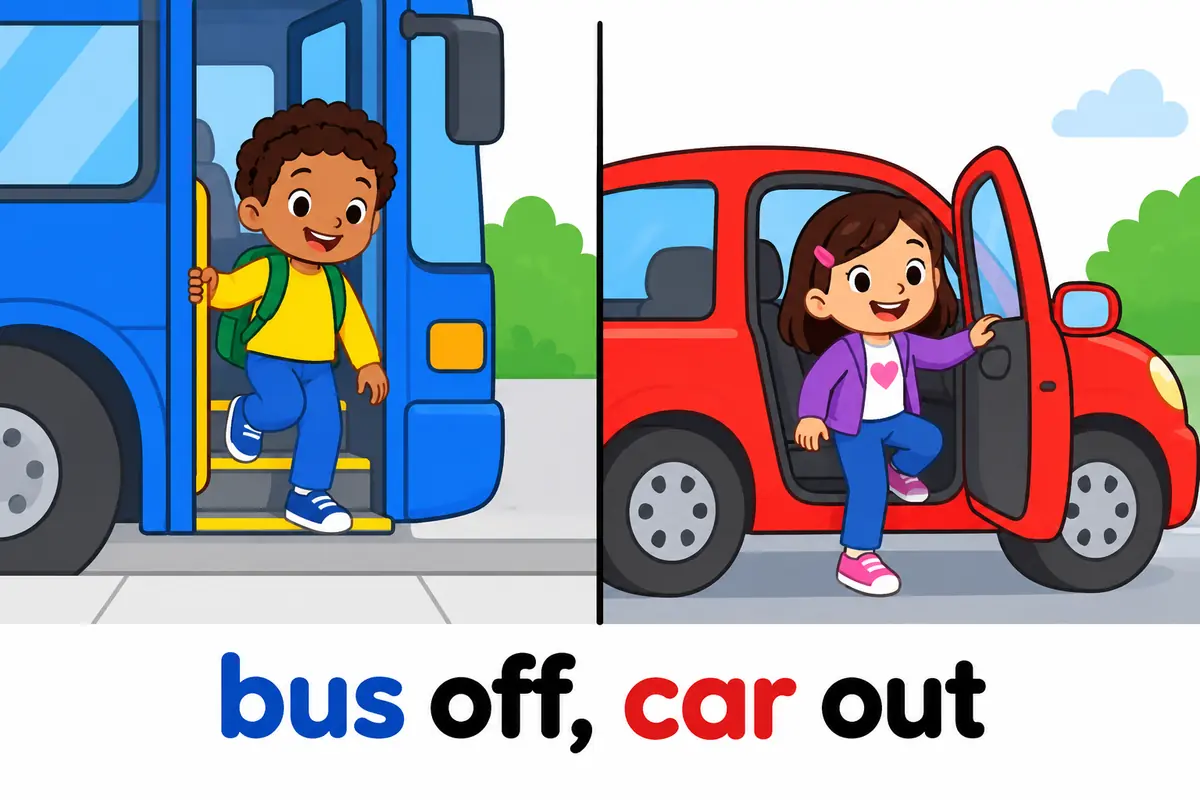
A car takes get out of, because you sit inside a small vehicle. A bus, train, plane or ferry takes get off, because you stand and step down from a larger one. So you get out of a taxi but get off a coach, and the same rule covers get on and get into.
Can you say get off work?
Yes, and the noun work follows the verb directly, as in I get off work at six. Adding from, as in get off from work, is a common learner error and is not used by native speakers. The same pattern appears in what time do you get off tonight.
How do you use get off in the removal sense?
To remove something, put the object between get and off: get your coat off, get your boots off. This is the one sense where the phrase separates, and it makes the sentence sound natural. The object may also follow off, as in get off your boots, but the split form is far more common.
Do you often find yourself puzzled by the phrasal verb “get off”? Well, you’re not alone. In English, “get off” is a versatile phrasal verb that can have various meanings depending on the context in which it is used.
“Get off” can mean to physically move from a place, to escape punishment, or even to experience the feeling of euphoria from a drug. With its different usages, understanding the nuances of how to correctly use “get off” in a sentence can greatly enhance your command of the English language.
7 Examples Of Get Off Used In a Sentence For Kids
- Get off the swing when I say so.
- Please get off the slide so others can play.
- Let’s all get off the merry-go-round and take turns.
- Time to get off the see-saw and switch partners.
- Hold on tight as we get off the monkey bars.
- Remember to get off the jungle gym carefully.
- It’s important to always get off the equipment before running off.
14 Sentences with Get Off Examples
- Get off your phone and pay attention in class.
- Can you get off at the next bus stop? I need to get off too.
- Get off social media and start studying for your exams.
- It’s important to get off campus and explore the city during your college years.
- Get off the wifi and connect with your friends in person.
- Don’t forget to get off the waiting list for that popular elective course.
- You should get off the bed early and make the most of your day.
- Get off your lazy chair and join us for a game of football.
- Make sure to get off at the right metro station or you’ll be late for your lecture.
- Get off the fence and choose a major that truly interests you.
- It’s time to get off the campus and unwind at a nearby café.
- Don’t wait until the last minute to get off your assignments; start working on them now.
- Get off your high horse and collaborate with your classmates on the group project.
- Remember to get off the campus shuttle at the main gate, not the back entrance.
How To Use Get Off in Sentences?
To use Get Off in a sentence, you need to remember a few key points.
First, get off can have multiple meanings depending on the context. It can mean to physically move from a higher position to a lower one, as in “She got off the chair.” It can also mean to descend from a vehicle or form of transportation, as in “We get off the bus at the next stop.” Additionally, get off can be used informally to express excitement or approval, as in “I got off on that new movie.”
When constructing a sentence with get off, make sure to identify which meaning you intend to convey to avoid confusion. Remember to pair get off with a subject, like “I,” “you,” or “they,” and use the correct verb tense (e.g. get off, gets off, got off).
Here are a few example sentences using get off:
– “She gets off work at 5 p.m.”
– “We need to get off the train at the next station.”
– “He got off with just a warning for his speeding ticket.”
By keeping these tips in mind and practicing with different examples, you’ll be able to confidently use get off in a sentence in no time.
Conclusion
In conclusion, finding the right time and way to get off a train, bus, or any means of transport is essential for a smooth and safe journey. Remembering to wait for the vehicle to come to a complete stop before attempting to get off, as well as being mindful of other passengers, is crucial in ensuring a pleasant travel experience for everyone. Additionally, following any instructions given by the driver or conductor regarding getting off at specific stops can help avoid confusion and delays.
Overall, knowing the proper etiquette and procedures for getting off transportation can make the process quick and effortless, allowing you to arrive at your destination comfortably and on time. By being courteous, patient, and observant, you can navigate the process of getting off any mode of transport with ease and efficiency.


