
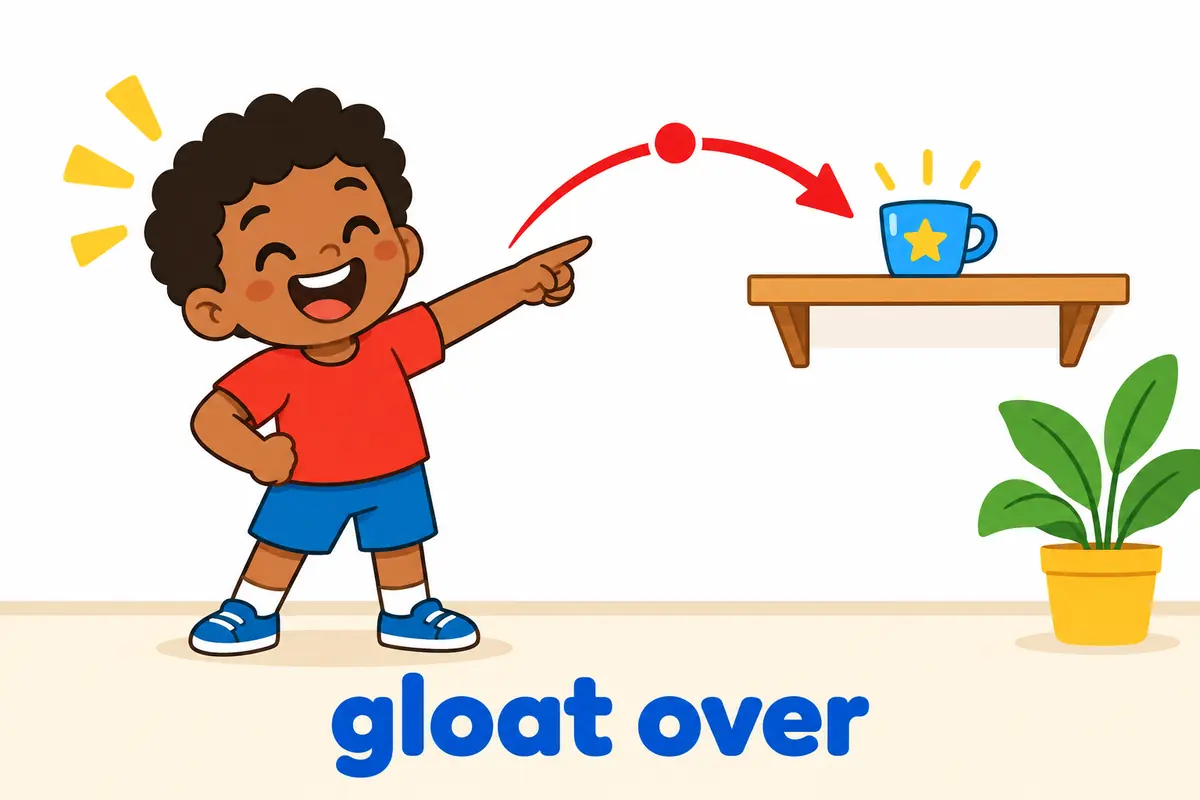
Gloat is a verb meaning to show smug pleasure at your own success or at another person’s bad luck. To use gloat in a sentence, link it with over, at or about: “He gloated over his rival’s defeat.” The verb is usually intransitive and carries a critical edge, so writers use it when the joy depends on someone else losing.
Gloat at a glance
- Gloat is a verb; its forms are gloats, gloated and gloating.
- It is usually intransitive and links with over, at or about.
- It suits storytelling and comment writing more than neutral reporting.
- Common collocates are gloat over, gloat at and a gloating smile.
- The commonest learner error is using gloat for ordinary pride in your own success.
What does gloat mean?
Gloat is a verb meaning to show great, smug pleasure at your own success or at another person’s misfortune. The Cambridge entry for gloat emphasises that self-satisfied joy, and the word almost always involves someone else’s loss. To exult in a victory is to feel open delight, while to gloat is to enjoy the contrast with a rival who is down.
| Sense | Plain meaning | Example sentence |
|---|---|---|
| Triumph over a rival | Show smug pleasure when someone else loses | He gloated over his rival’s defeat. |
| Self-satisfied delight | Enjoy your own win in a showy way | She gloated about topping the class. |
| Dwell on advantage | Keep returning to another’s mistake | The team gloated over the dropped catch for weeks. |
How do you use gloat in a sentence?
| Pattern | Example | What it signals |
|---|---|---|
| gloat + over | They gloated over the result. | names what the winner enjoys |
| gloat + at | He gloated at his opponent. | points at the person being watched |
| gloat + about | She kept gloating about the prize. | shows the topic of the boasting |
| gloating + noun | a gloating smile | leads an image as a participle |
| there is no + gloating | There was no gloating in the camp. | turns the verb into its noun form |
Gloat in a sentence: examples across contexts
| Context | Example sentence | Why this works |
|---|---|---|
| Fiction | He gloated over the letter that ended his rival’s hopes. | reveals character through a small triumph |
| Sports writing | The champions refused to gloat after the final whistle. | sporting restraint in clear register |
| Workplace | Nobody likes a colleague who gloats when a project fails. | shows the social cost of the behaviour |
| Classroom | The winner was told not to gloat about the score. | a concrete school example |
| News comment | Critics said the party gloated while families struggled. | argumentative, public tone |
| Conversation | Do not gloat; you might lose the rematch. | spoken warning with a playful edge |
| Review writing | The villain gloats before the hero returns. | a familiar narrative beat |
| Parent talk | She gloated a little when her brother missed the bus. | gentle, everyday observation |
Gloat vs boast
| Attribute | Gloat | Boast |
|---|---|---|
| Core meaning | smug joy at a win or a rival’s loss | proud talk about your own achievements |
| Whose downfall | usually someone else’s | nobody’s; the focus is the speaker |
| Feeling it shows | revenge-like satisfaction | pride or vanity |
| Typical object | over, at or about a defeat | about a skill, prize or record |
| Register | critical; the word rarely flatters | neutral; the word can be mild |
| What it implies | the pleasure depends on a loser | the pleasure depends on the speaker |
Use gloat when the pleasure feeds on someone else’s loss, and use boast about a record when the pride is all the speaker’s own.
Word forms and grammar of gloat
| Form | Part of speech | Example |
|---|---|---|
| gloat | base verb | Winners should not gloat. |
| gloats | third-person singular | She gloats whenever he is late. |
| gloated | past tense | He gloated after the vote. |
| gloating | present participle | They were gloating all evening. |
| gloating | noun (gerund) | There was little gloating in the dressing room. |
| gloat | noun (informal, rare) | It was a quiet gloat, not a celebration. |
A player may triumph over a rival without gloating, and a winner who is smug after a win is close to it. Fans revel in the win, while the gloom in the rival camp is what a gloat feeds on. Gloat has no common adjective of its own, so a writer says a gloaty look rather than a gloating one, or reaches for smug or triumphant instead.
Common mistakes with gloat
Incorrect: He gloated his trophy to the crowd.Correct: He gloated over his trophy to the crowd. Gloat is intransitive and needs over, at or about.Incorrect: She gloated her own hard work.Correct: She boasted about her own hard work. Gloat needs a rival’s loss, so boast fits plain pride.Incorrect: The team gloated to the defeat of the rivals.Correct: The team gloated over the defeat of the rivals. Link the verb with over, not to.Incorrect: He was gloaty after the win.Correct: He was smug after the win. English has no adjective form of gloat.Incorrect: Do not gloat for me.Correct: Do not gloat at me. Use at before the person being watched.
Practice using gloat
- Fill in the blank: The winner tried not to ___ over the easy victory.
- Choose the better word: She ___ about her new record. (gloated / boasted)
- Correct the error: He gloated his rival at the final.
- Build a sentence: use gloat over about a rival team’s loss.
- Spot the register: which sentence belongs in a sports report? (a) We crushed them and laughed. (b) The champions chose not to gloat after the win.
- Fill in the blank: There was no ___ in the winning dressing room.
Answers
- gloat – the verb follows the infinitive marker to.
- boasted – the pride is in her own record, with no rival involved.
- He gloated over his rival at the final – the verb links with over, not a direct object.
- The captain gloated over the rival team’s loss – over introduces the other side’s defeat.
- Sentence (b) – chose not to gloat suits a measured sports report.
- gloating – the gerund acts as a noun after no.

The bottom line
To use gloat in a sentence, link it with over, at or about rather than a direct object, as in the rivals gloated over the missed penalty. The verb means smug pleasure at a win or at someone else’s setback, so it carries a critical edge. Choose boast instead when the pride is in your own success and no rival is involved.
Frequently asked questions about gloat
Is gloat always a bad thing?
Gloat is almost always critical, because it describes pleasure that depends on someone else losing. Even when the winner has earned the victory, gloating suggests a lack of grace. If you want to describe honest pride without that edge, choose rejoice, celebrate or boast, depending on whether a rival appears.
What preposition follows gloat?
Gloat links with over, at or about. Use over before the event or defeat, as in gloated over the result; use at before the person being watched, as in gloated at his rival; and use about before the topic, as in gloated about the prize. It never takes a plain direct object.
Can gloat be a noun?
Gloat works as a noun mainly in the gerund form gloating, as in there was no gloating in the camp. A bare noun gloat exists but is rare and informal, as in it was a quiet gloat. For ordinary writing, keep gloat as a verb or use the gerund gloating as a noun.
What is the adjective form of gloat?
English has no established adjective from gloat, so gloaty is not standard. Writers use the participle gloating as an adjective, as in a gloating smile, or borrow smug, triumphant or gleeful. The participle is the safest choice because it keeps the meaning of enjoying another person’s setback.
Have you ever experienced the sweet satisfaction of gloating over a triumph or success? To gloat means to take great pleasure or delight in one’s own success or another’s misfortune.
This emotion typically involves a sense of superiority or smugness and can manifest in various ways, such as boasting, bragging, or flaunting one’s achievements.
7 Examples Of Gloat Used In a Sentence For Kids
- Gloat when you do something good!
- Do not gloat when others fail.
- It is not nice to gloat over someone else’s mistake.
- Let’s all celebrate together and not gloat alone.
- Remember to be kind and not gloat about how smart you are.
- It’s better to share your success than to gloat about it.
- Friends should support each other, not gloat when one falls.
14 Sentences with Gloat Examples
- After acing the final exam, Ravi couldn’t help but gloat about his high score to his classmates.
- When Anita got an internship at a prestigious company, she made sure to subtly gloat about it on social media.
- Gloating about their project presentation going smoothly, the group of students celebrated with a round of lassis.
- Unable to contain his excitement, Akash couldn’t resist gloating about getting selected for the competitive study abroad program.
- Priya’s parents couldn’t help but gloat about their daughter’s academic achievements at the family gathering.
- Ram felt a surge of satisfaction as he watched his classmates gloat over his winning entry in the photography competition.
- Anjali couldn’t resist gloating after receiving praise from the professor for her well-researched thesis.
- The engineering students couldn’t help but gloat as they showcased their innovative project at the college exhibition.
- Amit felt a sense of pride as he listened to his hostel mates gloat about his impressive performance in the college cricket match.
- Despite his modest nature, Deepak couldn’t resist gloating about the scholarship he received for his academic achievements.
- As the results were announced, the air was filled with tension and the occasional sound of students trying to gloat discreetly.
- The winning debate team couldn’t help but gloat as they walked back to their college dorms, basking in their victory.
- Neha’s friends didn’t mind her gloating about getting the highest score in the class, as they were proud of her hard work paying off.
- Suraj found himself in an awkward position of having to gloat about his internship offer without coming off as arrogant to his peers.
How To Use Gloat in Sentences?
Gloat can be used in a sentence to express excessive pride or satisfaction over one’s own achievements or someone else’s misfortune. Here’s a simple guide on how to use gloat effectively in a sentence:
-
Identify the situation where someone is expressing excessive pride or satisfaction.
- Example: Gloat can be used when someone is bragging about their success at work.
-
Choose the appropriate tense for the sentence – past, present, or future.
- Example: She will likely gloat about her promotion at the meeting tomorrow.
-
Make sure to use the word gloat in the correct context to convey the feeling of smugness or satisfaction.
- Example: He couldn’t resist the urge to gloat about winning the competition.
-
Check the sentence for clarity and proper grammar before using it in written or spoken communication.
- Example: It’s not polite to gloat over someone else’s mistakes.
By following these simple steps, you can effectively incorporate gloat into your vocabulary to accurately convey feelings of excessive pride or satisfaction. Remember to use it thoughtfully and consider the context in which it is being used to ensure clear communication.
Conclusion
In different contexts, sentences with “gloat” demonstrate satisfaction or delight derived from someone else’s misfortune or one’s own success. These sentences often convey a sense of arrogance or gloating over a triumph or perceived victory. In negative instances, they may reflect an unkind or boastful attitude that aims to belittle others.
It is important to be mindful of the tone and intention behind sentences containing “gloat,” as they can easily come across as insensitive or hurtful. Whether used in a playful or malicious manner, understanding the impact of such statements is essential in maintaining positive and respectful communication with others.


