Goof up is an informal phrasal verb meaning to make a careless mistake or to spoil a task. To use goof up in a sentence, name what went wrong: “He goofed up the address on the parcel.” The verb works with an object when it means spoil, and stands alone when it simply means slip.
Goof up at a glance
- Goof up is an informal phrasal verb; its forms are goofs up, goofed up and goofing up.
- The two senses are to make a careless mistake and to spoil a plan or task.
- It is separable, so the object may follow the verb or sit between goof and up.
- A pronoun object must take the middle slot: goof it up, never goof up it.
- The verb is chiefly American and belongs in speech rather than in reports.
- The commonest error is confusing goof up with goof off, which means to waste time.
What does goof up mean?
Goof up is an informal phrasal verb meaning to make a careless mistake or to ruin a task through clumsiness. The Cambridge entry for goof up treats it as a synonym of mess up, and to blunder through a task is the plainer one-word alternative. Both senses share the idea that the damage was avoidable and small rather than tragic.
| Sense | Plain meaning | Example sentence |
|---|---|---|
| Make a mistake | Blunder through carelessness | I goofed up and sent the invoice twice. |
| Spoil something | Ruin a plan or arrangement | One wrong number goofed up the whole booking. |
One limitation is worth stating plainly. Goof up is too light for a serious failure: a surgeon does not goof up an operation, and a report does not describe a disaster that way. It also never means to act on purpose, so it cannot replace sabotage or cheat.
Where the mistake ruins a job completely, botch a repair carries more weight than goof up and suits a written account.
How do you use goof up in a sentence?
Goof up is separable and can be transitive or intransitive. The object may follow the whole phrase or slot between goof and up, but a pronoun must sit in the middle. The table shows where the particle can move.
| Pattern | Example | What it signals |
|---|---|---|
| goof up (no object) | Everyone goofs up sometimes. | An intransitive use that states a simple fact. |
| goof up + object | She goofed up the seating plan. | The object follows the full verb. |
| goof + object + up | She goofed the seating plan up. | The separable form, equally correct. |
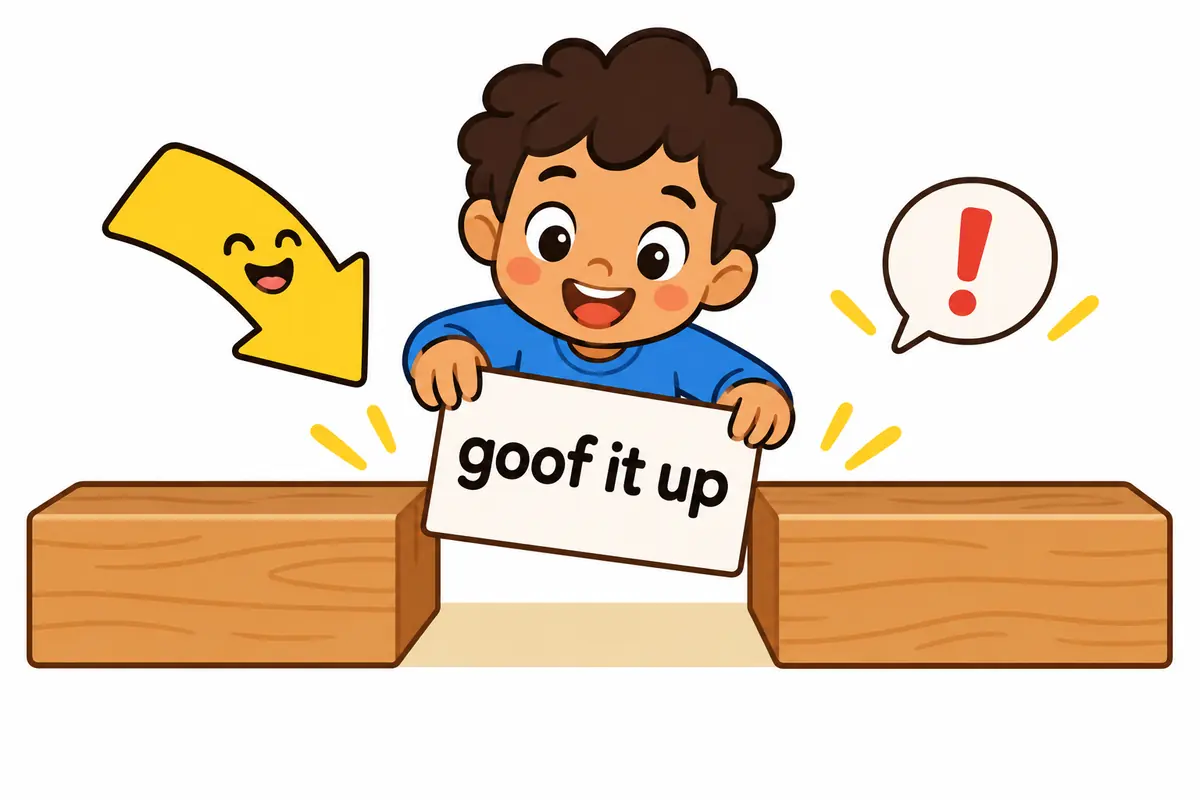
| goof + pronoun + up | I goofed it up on purpose. | A pronoun must sit between the parts. |
| be goofed up | The timetable was goofed up by the storm. | Passive voice puts the damaged thing first. |
The particle keeps a natural position beside its verb, so a reader expects goof and up to stay near each other. The particle alone tells a reader nothing, because the same up sits inside verbs that mean something else entirely.
Goof up in a sentence: examples across contexts
Goof up keeps its light, spoken feel while the setting changes. The nine sentences below each name the mistake, and the last row shows the same particle up inside a different verb.
| Context | Example sentence | Why this works |
|---|---|---|
| Classroom | Maya goofed up the spelling of her own street. | A small, familiar slip suits the informal verb. |
| Workplace email | I goofed up the meeting link, so please use the new one. | An everyday apology stays friendly, not dramatic. |
| News report | The clerk goofed up the delivery address, the supervisor said. | Reported speech lets a casual verb appear inside quotation. |
| Customer service | We goofed up your order and will refund the postage. | The transitive sense names exactly what was spoiled. |
| Sports report | The keeper goofed up a routine catch in the closing minutes. | The intransitive sense explains a single error. |
| Informal note | Do not goof up the recipe while I am out. | An imperative warns against a careless slip. |
| Conversation | I really goofed it up when I called her by the wrong name. | The pronoun sits between goof and up, as required. |
| Children’s story | The puppy goofed up the picnic by chasing the sandwiches. | A comic failure keeps the tone warm and gentle. |
| Shared particle | Please back up the files before you go home. | Same particle up, but back up means to make a copy. |
The final row is the useful warning: up appears in countless phrasal verbs, and its meaning shifts with the verb, so goof up must be learned as a whole.
Goof up vs goof off
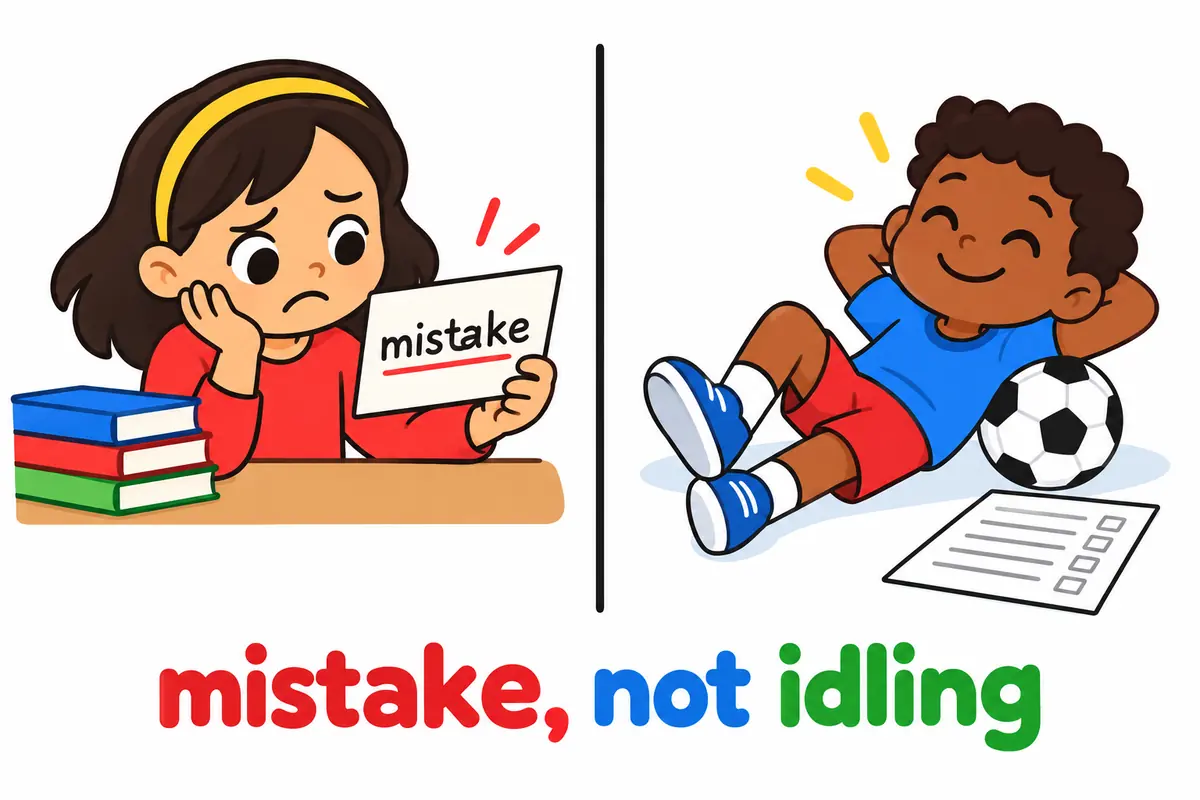
Goof up and goof off share the base verb goof, yet they describe opposite failures. Goof up is about a mistake; goof off is about wasted time.
| Attribute | goof up | goof off |
|---|---|---|
| Meaning | Make a mistake or spoil something | Waste time instead of working |
| Focus | The error and its result | The idleness itself |
| Object | Often takes an object | Usually stands alone |
| Typical result | Something is spoiled or wrong | Work is simply not done |
| Register | Informal, chiefly American | Informal, chiefly American |
Verdict: choose goof up when something went wrong, and goof off when someone avoided the work, because the two verbs answer different questions.
Word forms and grammar of goof up
Goof up inflects on the verb goof, and the particle up stays fixed. The table also lists the word orders learners get wrong.
| Form | Part of speech | Example |
|---|---|---|
| goof up | phrasal verb, base | Try not to goof up today. |
| goofs up | third person singular | He goofs up whenever he rushes. |
| goofed up | past and past participle | We goofed up the order. |
| goofing up | present participle | Stop goofing up the figures. |
| goof it up | correct pronoun order | Do not goof it up again. |
| goof up it | non-standard order | Write goof it up, never goof up it. |
Keep goof up apart from fumble a simple pass in tone, even though both describe clumsiness; fumble works in neutral writing, while goof up stays in speech.
Common mistakes with goof up
- Incorrect:
I goofed up it completely.Correct: I goofed it up completely. Rule: A pronoun object must sit between goof and up. - Incorrect:
She goofed up on the address.Correct: She goofed up the address. Rule: The verb takes a direct object with no preposition. - Incorrect:
The surgeon goofed up the operation.Correct: The surgeon made a serious error during the operation. Rule: Goof up is too light for a grave failure. - Incorrect:
He goofed off the report.Correct: He goofed up the report. Rule: Goof off means waste time and takes no such object. - Incorrect:
Do not goof up in the figures.Correct: Do not goof up the figures. Rule: Drop the extra preposition before the object.
Practice using goof up
Work through the six items, then read the reason beside each answer rather than only the key.
- Fill the gap: I ______ the invitation and left off the date.
- Choose the better word: The pilot (goofed up / made an error) during the emergency landing.
- Correct the error: She goofed up it at the last minute.
- Build a sentence: use goof up about a cook spoiling a simple cake.
- Spot the register: which suits a friendly work email — I goofed up the link, or I erred in the transmission of the link?
- Rewrite with the pronoun: Do not goof up the plans. Use them instead of the plans.
Answers
- goofed up — the past form follows the subject and takes the invitation as its object.
- made an error — a grave event needs a neutral phrase, not the informal verb.
- She goofed it up at the last minute — the pronoun goes between goof and up.
- Model answer: The cook goofed up a simple cake by adding salt twice.
- I goofed up the link — a friendly email keeps the informal verb and the active voice.
- Do not goof them up — the pronoun must sit between the two parts.
The bottom line
Use goof up in a sentence when a small, avoidable mistake spoils something or when someone slips through carelessness. Two nuances decide most sentences: the verb is separable, so a pronoun must sit between goof and up, and it stays informal, so serious writing prefers slip up over a detail or botch. Where no error occurred and time was merely wasted, goof off is the verb you want.
Frequently asked questions about goof up
Is goof up one word or two?
It is two words, because goof is the verb and up is its particle. The pair never takes a hyphen and never becomes a single word, even in the past tense, where it appears as goofed up. Only goof changes form; up stays fixed in every sentence.
Is goof up the same as mess up?
They are close synonyms, and both mean to make a careless mistake or spoil something. Mess up is a little more common in British writing, while goof up sounds distinctly American and casual. Choose mess up for neutral conversation and goof up when the tone is light and familiar.
Does goof up have to be negative?
The verb almost always reports a failure, yet it can be gentle and even comic, as when a puppy goofs up a picnic. It seldom describes real harm, so a reader expects a small, forgiveable slip rather than a disaster. Serious losses need a stronger verb such as botch.
Can goof up be used without an object?
Yes. Goof up works intransitively in sentences such as everyone goofs up sometimes, where no thing is named. When an object is present, it names what was spoiled, as in she goofed up the seating plan. Both patterns are standard.
Have you ever made a mistake or error in a task? That’s what we call a “goof up.” A “goof up” is a casual way of saying that something didn’t go as planned or a mistake was made.
People often use the term “goof up” when they want to acknowledge their error in a lighthearted or humorous manner. It’s a common phrase that many use to describe those small slip-ups we all make from time to time.
7 Examples Of Goof Up Used In a Sentence For Kids
- Oh no, I made a goof up with my spelling!
- Let’s help each other so we don’t goof up our work.
- It’s okay to goof up, just try again and do your best.
- I don’t want to goof up my artwork, so I will be careful.
- Remember to double-check so you don’t goof up your math problems.
- Sometimes we all goof up, it’s how we learn and grow.
- When we work together, we can help each other not goof up.
14 Sentences with Goof Up Examples
- Goof up : forgetting to submit an assignment on time.
- Goof up : registering for the wrong course and realizing it after the add/drop deadline.
- Goof up : missing a group project meeting without informing your teammates.
- Goof up : citing the wrong sources in your research paper.
- Goof up : mixing up the dates for two important exams.
- Goof up : wearing slippers to a formal presentation instead of proper shoes.
- Goof up : forgetting to bring necessary materials for a practical lab session.
- Goof up : accidentally emailing the wrong professor about an urgent academic matter.
- Goof up : mispronouncing a key term during a class presentation.
- Goof up : falling asleep in a lecture and missing important information.
- Goof up : submitting a draft of your thesis with multiple typos and grammatical errors.
- Goof up : printing assignments on the wrong paper size and format.
- Goof up : losing important notes or study materials right before an exam.
- Goof up : using outdated information for a current affairs quiz in class.
How To Use Goof Up in Sentences?
To use Goof Up in a sentence, simply follow these steps:
-
Understand the meaning: Goof Up means to make a mistake or an error. It is a more informal way of saying “mess up” or “blunder”.
-
Choose the right context: Goof Up is usually used in casual conversations or informal writing. It is not typically used in formal or professional settings.
-
Construct your sentence: For example, you could say “I accidentally goofed up my presentation by forgetting to include the crucial information.”
-
Ensure clarity: Make sure your sentence clearly conveys that a mistake was made. You can also use Goof Up to describe the mistake made by someone else, such as “She really goofed up the project by missing the deadline.”
-
Practice using it: Incorporate Goof Up in your conversations or writing to become more comfortable with the term. Experiment with different sentence structures to see how it fits naturally.
By following these steps, you can confidently incorporate Goof Up into your vocabulary and express errors or mistakes in a more informal and lighthearted way.
Conclusion
In conclusion, making a goof up can happen to anyone, as seen in various examples of sentences with this keyword. It is important to acknowledge these mistakes, learn from them, and strive to do better next time. From forgetting an important meeting to mixing up important details, goof ups are a part of life that allow us to grow and improve our skills. By taking responsibility for our errors and seeking ways to prevent them in the future, we can avoid repeating the same mistakes and show our willingness to learn and adapt.
Ultimately, embracing our goof ups with a positive attitude can lead to personal development and help us navigate through challenges more effectively. It’s essential to remember that making mistakes is a natural part of the learning process, and by approaching them constructively, we can turn setbacks into opportunities for growth and self-improvement.


