Grapple means to struggle with a hard problem, or to seize and hold an opponent in a close fight. To use grapple in a sentence, name the difficulty and usually add with: “The council is grappling with a housing shortage.” The verb is intransitive in the problem sense and transitive only in the physical sense.
Grapple at a glance
- Grapple is a verb; its forms are grapples, grappled and grappling, and its agent noun is grappler.
- The dominant pattern is grapple with + problem, where with introduces the difficulty.
- The physical sense means to grip and hold an opponent, and only there is it transitive.
- Typical subjects are people and institutions facing something hard: a committee, a city, a family, a team.
- The commonest error is dropping with and writing grapple the problem instead of grapple with the problem.
What does grapple mean?
Grapple is a verb meaning to work hard at a difficult problem, or to seize and hold an opponent in a close struggle. The Cambridge entry for grapple records both the intellectual and the physical sense, and the two take different grammar. A sentence that names a topic needs with; a sentence that describes two people fighting does not.
| Sense | Plain meaning | Example sentence |
|---|---|---|
| Struggle mentally | Work hard to deal with a difficult matter | The team grappled with the new rules for weeks. |
| Wrestle physically | Seize and hold an opponent in a struggle | The two players grappled near the try line. |
| Contend with | Fight or compete against a force | Towns grapple with flooding every spring. |
One limitation is worth stating plainly. Grapple does not mean solve. A committee that grapples with a problem may still fail to fix it, and the verb covers the effort rather than the outcome. Where a result is certain, the neutral word struggle or a plain solve describes the act more directly.
How do you use grapple in a sentence?
The problem sense nearly always takes the preposition with, so the difficulty arrives after the verb rather than as a direct object. The physical sense behaves differently and can take a person as its object. Five patterns cover almost every real sentence.
| Pattern | Example | What it signals |
|---|---|---|
| grapple with + noun | She grappled with the decision for days. | The problem follows with, not the verb. |
| be grappling with + noun | The city is grappling with rising rents. | Progressive form shows an ongoing struggle. |
| grapple (no object) | The wrestlers grappled on the mat. | Physical sense; no preposition is needed. |
| grapple for + noun | The heirs grappled for control of the firm. | Names what the fight is over. |
| grapple + noun (physical) | He grappled his opponent to the ground. | Transitive only in the physical sense. |
Grapple in a sentence: examples across contexts
Grapple moves easily from a classroom to a council chamber because difficulty is everywhere. Each example below names the problem and, in the physical cases, the person held.
| Context | Example sentence | Why this works |
|---|---|---|
| Classroom | The class grappled with a puzzle that had no obvious answer. | A difficult task shows the mental sense clearly. |
| Workplace email | We are still grappling with the shortfall in the budget. | The progressive form signals work in progress. |
| News report | Hospitals are grappling with a surge in winter cases. | An institution plus an ongoing pressure suits reporting. |
| Legal writing | The court grappled with two conflicting statutes. | Names the difficulty precisely and impersonally. |
| Science writing | Researchers grapple with the limits of their instruments. | The abstract object keeps the tone technical. |
| Sports reporting | The forwards grappled for the ball near the corner flag. | The physical sense, with for naming the prize. |
| City planning | Every coastal town must grapple with the same tide data. | Shows a shared, recurring problem. |
| Academic writing | The thesis grapples with how memory shapes identity. | A clause-like topic after with is common in essays. |
| Conversation | I am grappling with whether to move or stay. | The first person suits an everyday dilemma. |
Grapple vs wrestle
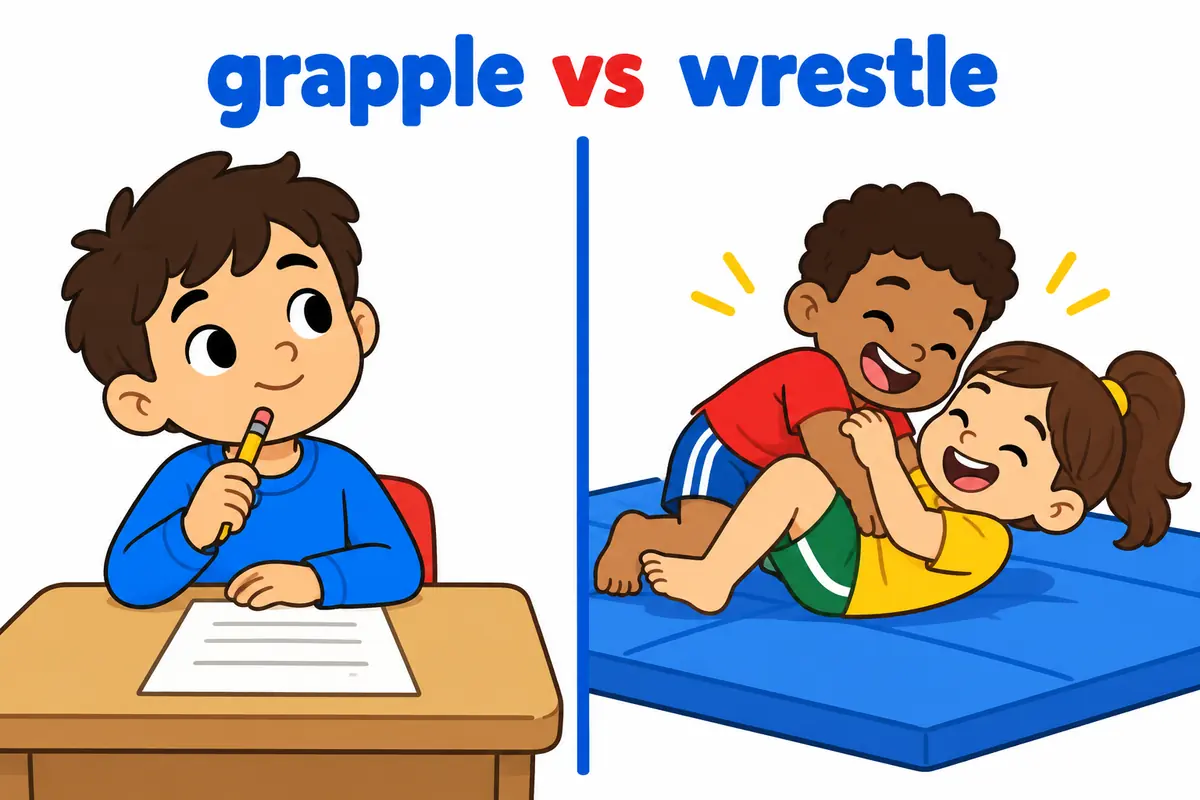
wrestle is the nearest rival and the word writers substitute most often. Both describe a close struggle, but grapple usually concerns a problem one faces, while wrestle usually concerns an opponent or a conscience one holds onto. To tackle a task is the plain business alternative when no struggle is meant.
| Attribute | grapple | wrestle |
|---|---|---|
| Core meaning | Struggle to deal with something hard | Struggle by holding and twisting |
| Typical object | A problem, issue or decision | An opponent, animal or conscience |
| Usual preposition | with | with, or none in the sport |
| Register | Formal and journalistic | Physical and everyday |
| What it implies | Effort against difficulty | A close contest or inner conflict |
Verdict: choose grapple when the thing faced is an abstract problem, and wrestle when the thing faced has a grip you are trying to break.
Word forms and grammar of grapple
Grapple inflects regularly, and the same -ing form doubles as a noun for the combat sport. The agent noun grappler names a person, while contend is a near synonym that usually takes with as well.
| Form | Part of speech | Example |
|---|---|---|
| grapple | verb, base | The committee will grapple with the budget next week. |
| grapples | verb, third person singular | The city grapples with traffic every year. |
| grappled | verb, past and past participle | They grappled with the same question in 2010. |
| grappling | verb, present participle | Schools are grappling with staff shortages. |
| grappling | noun | Grappling is a recognised wrestling sport. |
| grappler | noun | The grappler pinned his opponent in seconds. |
Common mistakes with grapple
- Incorrect:
The team grappled the problem all week.Correct: The team grappled with the problem all week. Rule: The problem sense needs the preposition with. - Incorrect:
She is grappling at the decision.Correct: She is grappling with the decision. Rule: The fixed preposition is with, not at. - Incorrect:
They grappled to solve the issue.Correct: They grappled with the issue. Rule: Grapple takes a noun after with, not a to-infinitive. - Incorrect:
The council grappled about housing.Correct: The council grappled with housing. Rule: About is not used with grapple. - Incorrect:
He was grabbling with the question.Correct: He was grappling with the question. Rule: Grapple has a double p and no b.
Practice using grapple
Work through the six items, then read the reasoning rather than only the answer.
- Fill the gap: The school is still ______ with the loss of its sports field.
- Choose the better word: The two climbers (grappled / solved) for a hold on the icy ledge.
- Correct the error: The committee grappled the new rules for a month.
- Build a sentence: use grappling with about a difficult choice.
- Spot the register: which belongs in a news report — families are grappling with higher prices, or I am totally grappling with this?
- Rewrite without the struggle: The town grappled with flooding for years. Replace the verb with a neutral word that names the effort.
Answers
- grappling — the progressive form after is, and with introduces the loss.
- grappled — the climbers are holding on physically, which is the transitive sense.
- The committee grappled with the new rules for a month — the problem sense requires with.
- Model answer: She is grappling with whether to accept the offer.
- Families are grappling with higher prices — a report avoids the casual intensifier and the first person.
- The town coped with flooding for years — coped names the effort without implying a losing struggle.
The bottom line
Use grapple in a sentence when somebody is struggling hard with a problem, and remember the preposition that carries the difficulty: grapple with. The two details that settle most sentences are these: the problem sense is intransitive and needs with, while the physical sense can grip a person directly as its object.
Frequently asked questions about grapple
What does it mean to grapple with something?
To grapple with something is to struggle hard to deal with it, usually over time and without a guaranteed answer. A council grapples with a shortage, and a student grapples with a hard text. The phrase names the effort, so it fits whenever the difficulty is real and the solution is still uncertain.
Is grapple a formal word?
Grapple sits comfortably in news, business and academic writing, where problems are faced at length. It also survives in everyday speech in its physical sense, as in the wrestlers grappled. Its formal tone comes from the abstract problems it usually takes, not from the word itself.
What is the difference between grapple and wrestle?
Both describe a close struggle, but grapple usually takes an abstract problem after with, while wrestle usually takes an opponent or a conscience. You grapple with a budget and wrestle with doubt. Choose grapple for a difficulty you are trying to understand, and wrestle for something that seems to grip you back.
Can grapple be used without the word with?
Yes, but only in the physical sense, where two people or animals grip each other and no preposition follows, as in they grappled on the mat. In the problem sense, dropping with makes the sentence ungrammatical, so always write grapple with a difficulty rather than grapple the difficulty.
If you’ve ever found yourself wrestling with a concept or idea, trying to fully comprehend or overcome it, then you’ve likely experienced what it means to grapple. In simpler terms, to grapple is to engage in a mental or physical struggle with something challenging or unfamiliar.
Much like a wrestler in a match, when we grapple with difficult situations or complex ideas, we are actively trying to gain control and understanding. From navigating tricky dilemmas to processing intricate theories, the act of grappling is a common human experience that can lead to growth and deeper insights.
7 Examples Of Grapple Used In a Sentence For Kids
- Grapple with the rope and climb up the tree.
- Let’s see who can grapple the ball first.
- Can you help me grapple the big box?
- The wrestler will grapple with his opponent in the ring.
- Use both hands to grapple the monkey bars.
- The cat likes to grapple with the toy mouse.
- We can grapple the puzzle pieces together to solve it.
14 Sentences with Grapple Examples
- Grapple with difficult assignments and seek help from professors or classmates.
- It is common for college students to grapple with time management, especially during the exam season.
- Many students grapple with the decision of choosing the right major.
- College life often requires students to grapple with balancing academics and extracurricular activities.
- It’s important to grapple with stress and find healthy ways to cope with it.
- Students may grapple with homesickness, especially if they are studying far from home.
- Some students grapple with financial challenges and need to find part-time jobs to support themselves.
- It’s common for students to grapple with peer pressure and make choices that align with their values.
- College students often grapple with finding a good work-life balance.
- Many students grapple with imposter syndrome and doubt their abilities.
- It’s essential for students to grapple with their academic weaknesses and work on improving them.
- Students may grapple with finding their passion and career path during their college years.
- Some students grapple with mental health issues and seek counseling services for support.
- College students often grapple with the pressure to perform well in their academics and secure a bright future.
How To Use Grapple in Sentences?
To * Grapple* in a sentence, start by identifying a concept, idea, or issue that you want to discuss. Next, determine how you want to engage with that subject – do you want to challenge it, explore it, or provide examples of it? Once you have a clear idea of what you want to achieve, you can begin constructing your sentence.
When constructing your sentence, make sure to place the * Grapple* word where it fits best within the sentence structure. This will ensure that your sentence is clear and concise. For example, “I had to grapple with my fear of public speaking before giving the presentation.”
Remember to use proper punctuation and grammar to ensure that your sentence is well-written and easy to understand. Pay attention to the context in which you are using the word Grapple to ensure that it aligns with the meaning you intend.
Experiment with different sentence structures and variations to see how the word * Grapple* can be used in various contexts. By practicing with different sentences, you will become more comfortable integrating this word into your writing.
Conclusion
In conclusion, the sentences with “grapple” demonstrate a struggle or effort to overcome something challenging or complex. Each sentence showcased different contexts where individuals were engaging in a physical, mental, or emotional battle to come to terms with difficult circumstances. From wrestling with tough decisions to trying to understand confusing emotions, the word “grapple” captures the essence of the internal and external conflicts we face in our everyday lives.
By exploring various examples of sentences containing the keyword “grapple,” we can see how it is used to convey the idea of confronting obstacles, dilemmas, or uncertainties. These sentences highlight the human experience of grappling with adversities and striving to find solutions or resolutions, reflecting the universal theme of resilience and perseverance in the face of adversity.


