Grateful means feeling thankful for something you have received. To use grateful in a sentence, pair it with for before the benefit and to before the person: “I am grateful for your patience.” The adjective describes a person, so it normally follows be or feel.
Grateful at a glance
- Grateful is an adjective; its forms are grateful, gratefully and gratefulness.
- The two fixed patterns are grateful for + benefit and grateful to + person.
- Grateful describes the person who feels thanks, never the thing that caused it.
- Common collocations include deeply grateful, grateful for your help and grateful to be here.
- The commonest error is writing grateful of, as in grateful of your help.
What does grateful mean?
Grateful is an adjective meaning feeling or showing thanks because somebody has done something kind for you. The Cambridge entry for grateful records the core sense, and most sentences split it three ways. Grateful also expresses relief that something unwanted did not happen. Where you only want to say somebody was pleased, glad is plainer and grateful becomes too warm, so show appreciation openly is the better phrase when thanks must be expressed rather than felt.
| Sense | Plain meaning | Example sentence |
|---|---|---|
| Thankful for a benefit | Feeling thanks for something received | She was grateful for the extra week. |
| Showing thanks openly | Expressing that feeling in words or gesture | He sent a grateful note to the nurse. |
| Relieved about an outcome | Glad that something worse did not happen | They were grateful that the storm missed the coast. |
One limitation is worth stating plainly. Grateful does not mean indebted, which adds the idea that you owe something back, and it does not mean glad, which reports pleasure with no sense of a benefactor. Grateful names a benefit and, usually, the person who supplied it.
How do you use grateful in a sentence?
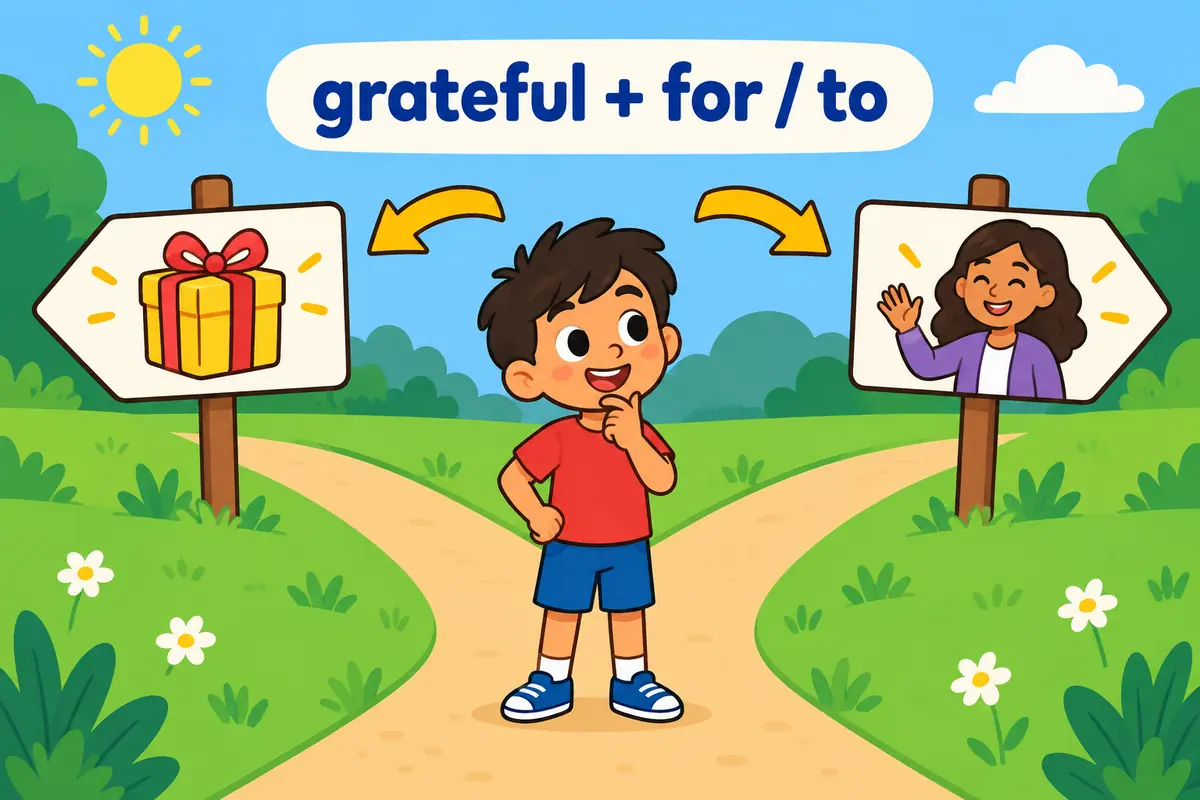
Put for before the benefit and to before the person. Five patterns cover almost every real sentence, and the combined form grateful to someone for something is the one that carries both pieces of information at once.
| Pattern | Example | What it signals |
|---|---|---|
| grateful + for + noun | I am grateful for your advice. | Names the benefit that prompted the thanks. |
| grateful + to + person | We are grateful to the whole team. | Names who provided the help. |
| grateful + to + person + for + noun | She was grateful to her tutor for the extension. | Combines the helper and the benefit in one sentence. |
| grateful + that + clause | He was grateful that nobody noticed the error. | Thanks an outcome rather than a gift or a person. |
| would be grateful if + clause | I would be grateful if you could reply by Friday. | The polite formal request, standard in email. |
The preposition pair is the whole grammar of the word. Writers who put the person first, as in I am grateful to you for the lift, sound natural; writers who write grateful of or grateful from mark themselves as learners in a single word.
Grateful in a sentence: examples across contexts
Grateful changes its company far more than its meaning. The ten sentences below keep the same adjective while moving from a classroom to a thank-you note, and each one names what prompted the thanks.
| Context | Example sentence | Why this works |
|---|---|---|
| Classroom | The class was grateful for the extra week to finish the project. | Names the benefit with for, the pattern children learn first. |
| Thank-you note | I am grateful to you for covering my shift at short notice. | Pairs helper and benefit, the standard polite formula. |
| Workplace email | We would be grateful if the invoices could be sent by the fifth. | Uses the formal request pattern, softer than a bare instruction. |
| News report | Residents were grateful that the bridge reopened before winter. | Thanks an outcome with a that-clause rather than a person. |
| Customer service | The customer was grateful for the prompt refund. | Keeps the adjective on the person, not on the refund. |
| Academic writing | The researchers were grateful to the archive staff for access to the letters. | Credits a named helper for a specific benefit. |
| Conversation | I am so grateful for you. | Colloquial, with a person after for; warm in speech, loose in formal writing. |
| Health setting | The family felt grateful to the surgeon for the clear explanation. | Keeps the relative as subject and thanks a professional. |
| Personal writing | She felt grateful for small routines after the move. | Uses a general noun as the benefit. |
| Formal speech | We are deeply grateful for the support of our volunteers. | Adds the intensifier deeply, a frequent collocation. |
Grateful vs thankful
Grateful and thankful overlap, and choosing between them is a matter of what you are pointing at. Unlike beholden, which implies that something is owed back, grateful only reports the feeling, so it never suggests a debt.
| Attribute | grateful | thankful |
|---|---|---|
| Main focus | A benefit and the person who gave it | A benefit or a fortunate outcome |
| Usual construction | grateful for, grateful to | thankful for, thankful that |
| Tone | Warm and personal | Broader, sometimes solemn |
| Common subject | I, we, the family | I, we |
| Fits best when | Thanking a named helper for something specific | Expressing relief after a narrow escape |
Verdict: choose grateful when you thank a named person for something specific, and choose thankful when you are mainly relieved that events turned out well.
Word forms and grammar of grateful
Grateful inflects with more and most rather than with endings, and its adverb gratefully keeps the same for and to patterns. The related noun gratitude is the one most people reach for, while gratefulness is rarer and warmer.
| Form | Part of speech | Example |
|---|---|---|
| grateful | adjective | She was grateful for the help. |
| gratefully | adverb | He gratefully accepted the offer. |
| gratefulness | noun | Her gratefulness showed in every message. |
| gratitude | noun, different form | He expressed his gratitude in person. |
| more grateful | comparative phrase | She felt more grateful after the call. |
| gratefuller | non-standard | Use more grateful instead of gratefuller. |
Common mistakes with grateful
- Incorrect:
I am grateful of your help.Correct: I am grateful for your help. Rule: Grateful takes for before the benefit, never of. - Incorrect:
I am grateful for you helped me.Correct: I am grateful for your help. Rule: After for comes a noun phrase, not a clause. - Incorrect:
She is grateful to the weather.Correct: She is grateful for the weather. Rule: To introduces people and institutions that act, not things. - Incorrect:
He is very appreciating your support.Correct: He is very grateful for your support. Rule: The adjective is grateful; appreciating is not used as a state adjective. - Incorrect:
We are grateful for to welcome you.Correct: We are grateful to welcome you. Rule: Before a verb, use the bare infinitive with no preposition.
Practice using grateful
Work through the six items, then check the reasoning rather than only the answer.
- Fill the gap: The students were ______ for the sunny afternoon.
- Choose the better word: I am (grateful / indebted) for the loan, which I will repay next month.
- Correct the error: We are grateful of your patience.
- Build a sentence: use be grateful to about a teacher who stayed late to help.
- Spot the register: which belongs in a formal email, We would be grateful if you could confirm, or Thanks a bunch?
- Rewrite with the noun: The team was grateful for the support. Use gratitude instead.
Answers
- grateful — the sunny afternoon is the benefit, so for introduces it.
- indebted — the promise to repay means something is owed, which is the extra idea indebted adds.
- We are grateful for your patience — grateful never takes of.
- Model answer: We were grateful to the teacher for staying late to explain the problem.
- We would be grateful if you could confirm — email avoids the casual Thanks a bunch.
- The team felt deep gratitude for the support — the noun takes for and usually an article.
The bottom line
Use grateful in a sentence to thank a person for a specific benefit, keeping for before the benefit and to before the helper. The two details that decide most sentences are that preposition pair and the fact that grateful describes the person, not the gift. When you only want to express relief, thankful is often the better fit.

Frequently asked questions about grateful
Is grateful an adjective or a verb?
Grateful is an adjective, so it describes a person or a group, as in the family was grateful. The verb you want is thank, as in I thank you, and the noun is gratitude or gratefulness. Writing I grateful you mixes the adjective with a verb and is the commonest slip.
Do you say grateful for or grateful to?
Use grateful for before the benefit and grateful to before the person or organisation that provided it. The combined form grateful to someone for something names both, as in I am grateful to the nurse for her patience. The form grateful of is never correct.
What is the difference between grateful and thankful?
Both words describe feeling thanks, but grateful usually names a specific benefit and the person behind it, while thankful is broader and often expresses relief. You are grateful to a neighbour for a lift, and thankful that the roads were quiet. Grateful is the more personal choice.
How do you use grateful in a formal email?
Formal email usually uses the fixed phrase I would be grateful if, followed by could and a verb, as in I would be grateful if you could confirm the date. It is politer and softer than a direct request, and it keeps the sentence in the first person without sounding demanding.
Do you know what it means to be truly grateful? Being grateful is the act of appreciating and acknowledging the kindness, blessings, or favors received from others or even from life itself.
Expressing gratitude can be a powerful practice that not only uplifts our own spirits but also strengthens relationships and fosters a sense of connection with those around us. A simple “thank you” or a heartfelt gesture of appreciation can go a long way in spreading positivity and cultivating a sense of joy in our daily interactions.
7 Examples Of Grateful Used In a Sentence For Kids
- I am grateful for my family who loves me.
- We are grateful for the delicious food we eat.
- I am grateful for the colorful flowers in the garden.
- We are grateful for the bright sun that shines on us.
- I am grateful for the rain that waters the plants.
- We are grateful for the teachers who help us learn.
- I am grateful for the sweet friends I have.

14 Sentences with Grateful Examples
- I am grateful for the opportunity to pursue higher education at a prestigious college in India.
- Grateful for the supportive professors who are always willing to help me with my studies.
- I am grateful for the resources available at the library that aid in my research projects.
- Grateful for the scholarship that has helped ease the financial burden of my education.
- I am grateful for the friendships I have made with my classmates during my time at college.
- Grateful for the extracurricular activities that have helped me develop new skills and interests.
- I am grateful for the career guidance sessions provided by the college to help me plan for the future.
- Grateful for the opportunity to participate in study abroad programs and expand my horizons.
- I am grateful for the campus facilities that make student life more comfortable and convenient.
- Grateful for the mentorship programs that have helped me navigate my academic journey.
- I am grateful for the online resources that have made remote learning more accessible during challenging times.
- Grateful for the cultural events and festivals organized by the college that celebrate diversity.
- I am grateful for the internship opportunities that have allowed me to gain practical experience in my field of study.
- Grateful for the college staff who work tirelessly behind the scenes to ensure a smooth academic experience for all students.

How To Use Grateful in Sentences?
Grateful is used to express appreciation or thankfulness. When used in a sentence, it conveys a feeling of gratitude towards someone or something. Here is a simple guide on how to use Grateful effectively in a sentence:
- Identify the reason for your gratitude: Before using Grateful in a sentence, think about why you are thankful. This will help you convey your feelings more effectively.
- Use Grateful in a positive context: Grateful is usually used to express positive emotions like appreciation, thankfulness, or happiness. Ensure that the sentence conveys this positive sentiment.
- Be specific: When using Grateful, it can be helpful to specify the reason for your gratitude. This could be towards a person, a gesture, a situation, or anything else that you are thankful for.
- Example sentence structure: “I am Grateful for your kind words and support during a difficult time.”
- Practice: To become more comfortable using Grateful in a sentence, practice incorporating it into your daily conversations or writing.
By following these simple steps and guidelines, you can effectively use Grateful in a sentence to express your appreciation or thankfulness towards others.

Conclusion
In conclusion, the expression of gratitude through sentences is a powerful way to convey appreciation and acknowledge the kindness of others. Whether it is a simple “I am grateful for your assistance” or a heartfelt “I am truly grateful for your unwavering support,” these sentences hold the power to strengthen relationships and foster a sense of connection. Grateful sentences not only help to spread positivity and goodwill but also contribute to building a more harmonious and caring community.
Adding grateful sentences to our daily interactions can have a profound impact on both the giver and the receiver, creating a ripple effect of kindness and appreciation. Let us remember the power of expressing gratitude through our sentences and strive to incorporate more acknowledgment and thanks in our communication, enriching our lives and the lives of those around us.