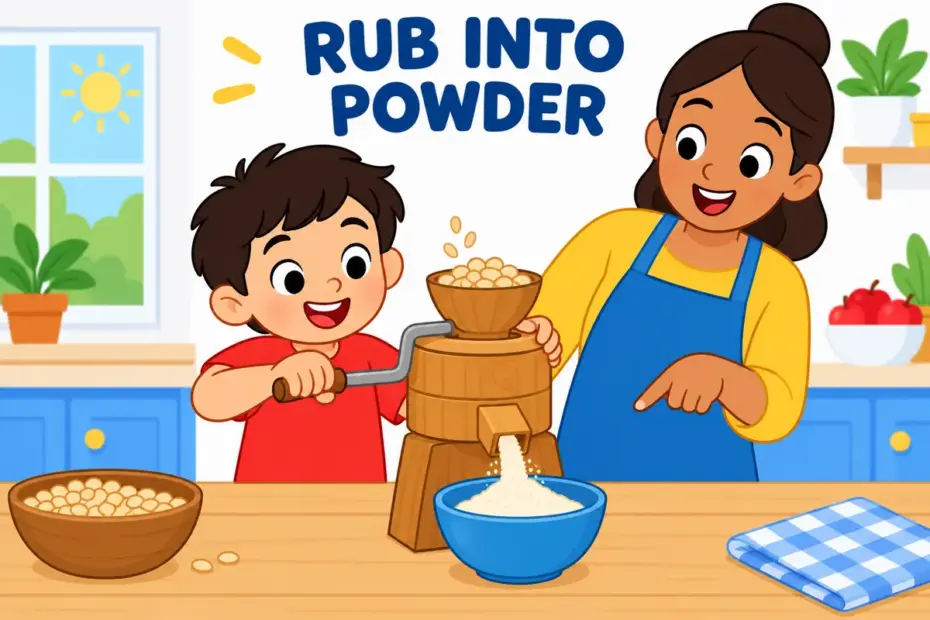
Grind means to crush something into powder with friction, or, as a noun, a tiring routine: a barista will grind beans for every fresh pot. The verb is transitive and irregular, so its past tense is ground, and the noun usually sits in the phrase the daily grind.
Grind at a glance
- Grind is both a verb and a noun, and the verb is irregular: grind, ground, ground.
- As a verb it is transitive, taking an object that names what is crushed, rubbed or sharpened.
- The verb covers three actions: crushing to powder, rubbing harshly, and sharpening on a wheel.
- The noun means tedious routine, most often in the fixed phrase the daily grind.
- The commonest error is the invented past form grinded, which is not standard English.
What does grind mean?
Grind is a verb meaning to crush something into small particles, to rub surfaces harshly together, or to sharpen by friction; as a noun it means a long, tiring routine. The Cambridge entry for grind separates the crushing sense from the figurative sense of unrelenting work.
| Sense | Plain meaning | Example sentence |
|---|---|---|
| Crush to powder | Reduce a solid to fine particles | She ground the peppercorns in a small mill. |
| Rub harshly | Press surfaces together with friction | The gears grind whenever the oil runs low. |
| Sharpen | Shape an edge on a wheel or stone | The smith ground the blade on a heavy wheel. |
| Tiring routine | Long, repetitive work as a noun | The daily grind leaves little time for rest. |
One limitation is worth stating plainly. Grind is not a synonym for chop, because chopping cuts while grinding wears material down. The nearest everyday verb is crush, which stresses pressure rather than the slow friction of grind.
How do you use grind in a sentence?
Grind is transitive, so it always needs an object naming the thing being worn down. The verb also pairs with a small set of prepositions and particles, and each pairing fixes the result: powder, a strip, or a smooth edge.
| Pattern | Example | What it signals |
|---|---|---|
| grind + object | He ground the coffee for the morning pot. | The core transitive pattern. |
| grind + object + into + noun | She ground the seeds into a fine paste. | Names the finished form. |
| grind + object + to + noun | The mill ground the wheat to flour. | Emphasises complete reduction. |
| grind + against or together | Metal plates ground against each other. | Intransitive use for harsh friction. |
| grind through + noun | The class ground through the revision guide. | Slow, laborious progress. |
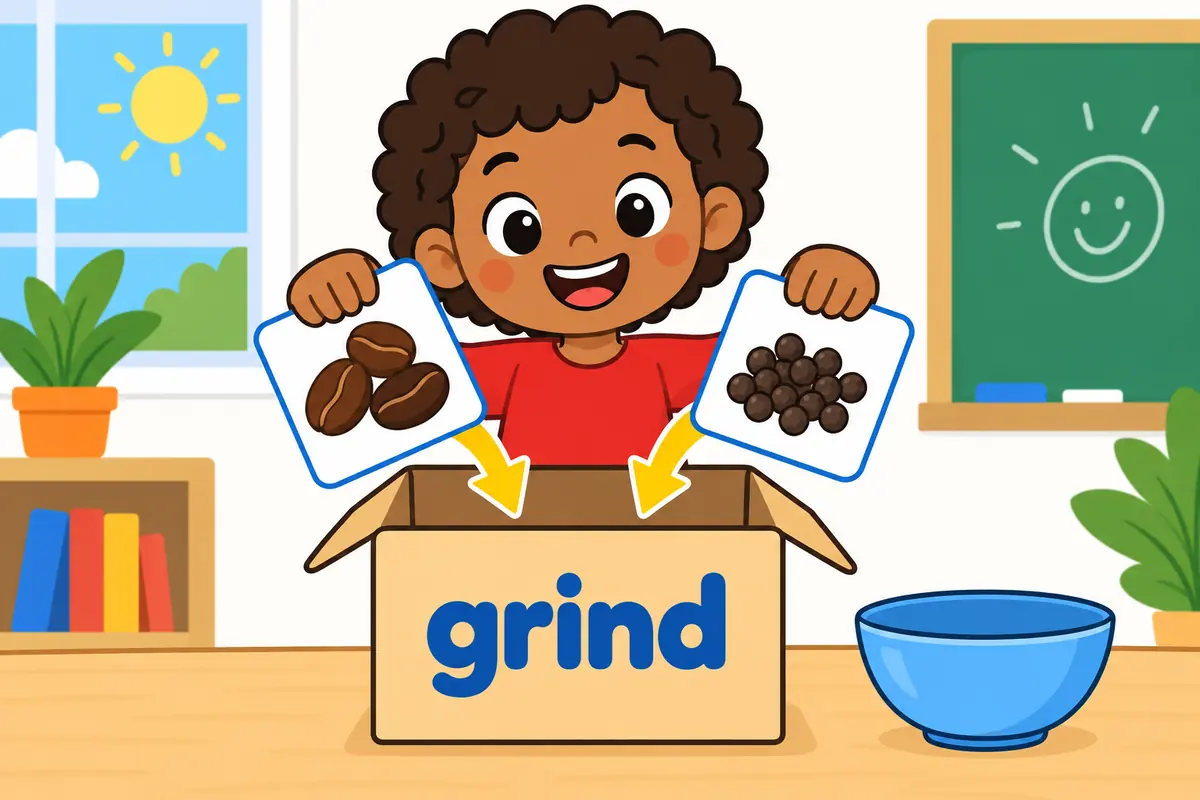
Grind in a sentence: examples across contexts
Grind shifts from the kitchen to the office without changing its central idea of friction and effort. Eight contexts show the verb and its noun at work.
| Context | Example sentence | Why this works |
|---|---|---|
| Kitchen | She ground the spices just before adding them to the pan. | Uses the crushing sense with a concrete object. |
| Workshop | The old gears grind whenever the oil runs low. | Shows the harsh-friction sense in a machine. |
| Industry news | The plant grinds thousands of tonnes of grain each week. | Scales the verb up to industrial output. |
| Workplace email | We are grinding through the last of the audits. | Signals slow, unavoidable effort. |
| Conversation | The daily grind is easier with good colleagues. | Uses the noun in its set phrase. |
| Academic prose | Students ground their arguments in primary sources. | A different, figurative verb sense of steady grounding. |
| Fitness writing | She ground out the final set of squats. | Extends the verb to stubborn physical effort. |
| Music writing | The organist ground through the difficult passage. | Applies the laborious sense to performance. |
The noun sense, as in the daily grind, overlaps with toil and unending labour.
Grind vs grate
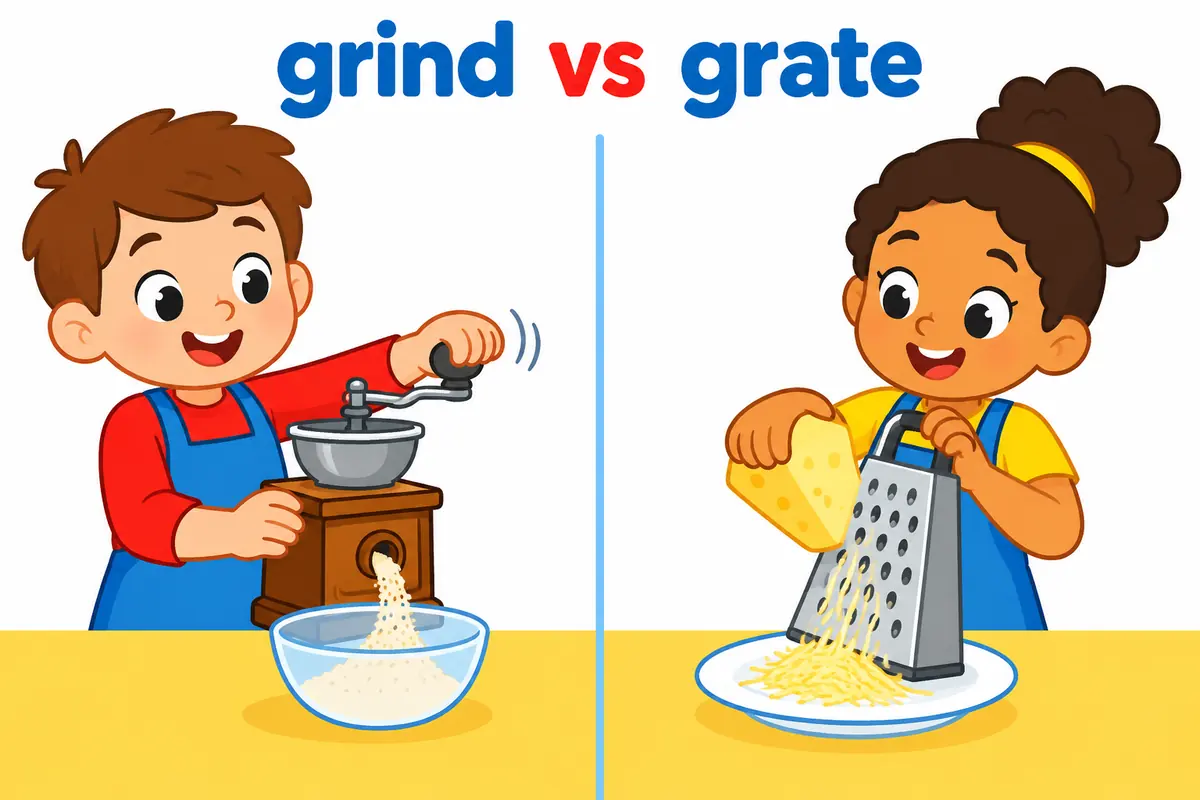
Grind and grate both describe hard surfaces rubbing, but the results differ. Grinding reduces a solid to powder or shapes an edge, while grating shreds a substance into thin strips. To grate a carrot is not the same act as grinding pepper.
| Attribute | grind | grate |
|---|---|---|
| Core meaning | Reduce to powder or shape by friction | Shred into thin strips |
| Typical object | Coffee, grain, spices, blades | Cheese, carrot, nutmeg |
| Result | Powder, paste or a sharp edge | Fine shreds or a rough surface |
| Also means | Harsh rubbing and tiring routine | An irritating sound or annoyance |
| Register | Neutral, common in every register | Neutral, common in cooking and description |
Verdict: use grind when the outcome is powder, an edge or stubborn effort, and grate when a solid is cut into shreds or when a sound sets your teeth on edge.
Word forms and grammar of grind
Grind is irregular, which is where most learner errors begin, and a machine may mill grain on an industrial scale. For a blade, the everyday verb is sharpen, though grind describes shaping metal on a wheel.
| Form | Part of speech | Example |
|---|---|---|
| grind | verb, base form | Please grind the beans coarsely. |
| grinds | verb, third person | The mill grinds a tonne before noon. |
| ground | verb, past and participle | She ground the spices by hand. |
| grinding | verb, present participle | The machine is grinding the last batch. |
| grinder | noun | A coffee grinder sits on the counter. |
| the grind | noun, set phrase | The daily grind rarely lets up. |
Common mistakes with grind
- Incorrect:
He grinded the pepper.Correct: He ground the pepper. Rule: the past tense is ground, not grinded. - Incorrect:
She was grinding of the spices.Correct: She was grinding the spices. Rule: grind takes a direct object and needs no preposition. - Incorrect:
Please grind the kitchen knife.Correct: Please sharpen the kitchen knife. Rule: sharpen is the everyday verb for blades; grind suits wheels and metal being shaped. - Incorrect:
The team ground through the report in ten minutes.Correct: The team raced through the report in ten minutes. Rule: grind through implies slow, laborious work, so it cannot describe speed. - Incorrect:
She griped the spices into powder.Correct: She ground the spices into powder. Rule: gripe means to complain, so it cannot mean to crush.
Practice using grind
Work through the six items, then read the reasons as closely as the answers.
- Fill the gap: The mill ______ the wheat into fine flour.
- Choose the better word: She (ground / grated) the nutmeg over the pudding.
- Correct the error: He grinded the coffee too finely.
- Build a sentence: use the daily grind about a long week of chores.
- Spot the register: which belongs in a recipe — grind the seeds into a paste, or grind the seeds into a paste, yeah?
- Rewrite in the passive: The smith ground the blade on a wheel. Use was ground.
Answers
- ground — the wheat is the object and the past tense of grind is ground.
- grated — nutmeg is shredded into fine strips, which is grating, not grinding.
- He ground the coffee too finely — grinded is not a standard past form.
- Model answer: The daily grind of chores left her no time to read.
- Grind the seeds into a paste — a recipe uses the bare imperative and no filler.
- The blade was ground on a wheel — the passive keeps the focus on the blade being shaped.
The bottom line
Use grind in a sentence when something is crushed to powder, rubbed harshly or shaped by friction, and give the verb an object naming what is worn down. Two nuances decide most sentences: the past tense is ground, not grinded, and the same word becomes a noun for tiring routine in the daily grind. When the result is strips rather than powder, grate is the better verb.
Frequently asked questions about grind
Is the past tense ground or grinded?
The standard past tense and past participle are both ground: she ground the beans, and the beans were ground this morning. Grinded appears in casual writing but is not accepted in edited English. The same irregular pattern appears in find and found, and in wind and wound.
What does the daily grind mean?
The daily grind is an informal phrase for the tiring, repetitive routine of ordinary work or chores. It carries a note of weariness rather than pride. A commuter might speak of escaping the daily grind, meaning the same dull cycle, not a single difficult day.
Can grind be used without an object?
Grind is transitive when it means crushing, so it needs an object: grind the spices. It can stand alone in the friction sense, as in the gears grind, and in the laborious sense, as in we ground through the last chapter. The crushing sense always wants a clear object.
What is the difference between grind and grate?
Grinding wears a solid down into powder, paste or a sharp edge, so coffee and grain are ground. Grating cuts a solid into thin strips, so cheese and carrot are grated. Both describe friction, but only grind leaves you with powder.
Do you ever find yourself struggling to differentiate between using “grind” as a noun versus a verb in a sentence? Understanding the correct usage of this versatile word can help to elevate your writing and communication skills.
“Grind” can serve as both a noun and a verb, depending on the context in which it is used. When used as a noun, “grind” can refer to a tedious and repetitive task or a specific degree of coarseness in particles. As a verb, “grind” typically conveys the action of crushing, rubbing, or pulverizing something into smaller pieces.
7 Examples Of Grind Used In a Sentence For Kids
-
Let’s grind the spices to make yummy masala.
-
I like to grind my teeth when I am sleepy.
-
The mill is used to grind wheat into flour.
-
Mama bear likes to grind coffee beans for her morning brew.
-
Use a mortar and pestle to grind herbs for cooking.
-
The gears in a bicycle grind when they need oiling.
-
The old man used a stone to grind his spices.
14 Sentences with Grind Examples
- Students in India often feel the grind of balancing academics, extracurricular activities, and part-time jobs.
- During exam season, the grind of late-night study sessions becomes a common sight on college campuses.
- Many students rely on coffee to help them power through the grind of assignments and deadlines.
- Group study sessions are helpful for tackling the grind of complex subjects and topics.
- The grind of preparing for competitive exams can be overwhelming, but staying consistent is key.
- College students often find themselves caught in the grind of navigating campus politics and social dynamics.
- Time management is essential for minimizing the grind of rushing to complete assignments at the last minute.
- Student organizations can provide a welcome break from the daily grind of classes and studying.
- Seeking guidance from professors and seniors can help alleviate the grind of feeling lost in unfamiliar subjects.
- Balancing a healthy diet and exercise routine can help students manage the grind of a hectic college schedule.
- The grind of securing internships and job placements starts early for many college students in India.
- Learning effective study techniques can make the grind of exam preparation more manageable.
- Joining study groups can make the grind of understanding complex concepts easier to handle.
- Seeking mental health support is important for students dealing with the grind of academic pressure and personal challenges.
How To Use Grind in Sentences?
Grind is a verb that means to crush something into small particles or powder. To use grind in a sentence, first identify the action you want to describe. For example, “I need to grind the coffee beans before brewing my morning cup of coffee.” In this sentence, the word grind is used to convey the action of crushing the coffee beans into smaller pieces.
When constructing a sentence with grind, remember to include a subject (the doer of the action) and an object (the thing being ground). For instance, “She used a mortar and pestle to grind the spices for the recipe.” Here, “She” is the subject performing the action, and “the spices” is the object receiving the action.
It’s essential to pay attention to verb tenses when using grind in a sentence. For instance, “The mill grinds wheat into flour” uses the present tense form of grind, while “She ground the coffee beans for tomorrow’s breakfast” uses the past tense form.
Remember that grind can also be used metaphorically to describe working hard or laboriously at something. An example of this usage is, “He had to grind through the final exams to pass the course.”
Practice constructing sentences with grind in various contexts to become more familiar with its usage.
Conclusion
In conclusion, the grind is a term that describes the process of working hard and consistently towards a goal or objective. Whether it is in academics, sports, career, or personal development, the grind requires perseverance, dedication, and effort. Achieving success often involves pushing through challenges, staying focused, and maintaining a strong work ethic.
By consistently putting in the effort and staying committed to the grind, individuals can make progress, improve their skills, and ultimately reach their desired outcomes. Embracing the grind mindset can lead to growth, development, and accomplishment in various aspects of life. Remember, success is not always immediate, but with determination and persistence, the grind can pave the way for achieving long-term success and fulfillment.


