
Hail means frozen rain, but as a verb it means to praise someone warmly, to call a vehicle, or, in hail from, to come from a place. To use hail in a sentence, let the surrounding words show which sense you mean: “Fans hailed the goalkeeper” praises, while “Snow turned to hail” names the ice.
Hail at a glance
- Hail is both a noun, the frozen pellets of a storm, and a verb meaning to praise, to call or to come from.
- The verb forms are hails, hailed and hailing; the weather noun is normally uncountable.
- The verb patterns are hail + person, hail + person + as + noun, hail + a vehicle, and hail from + place.
- Hail as praise belongs to news writing and formal tributes, while hail a taxi is everyday speech.
- The commonest confusion is the homophone hale, which means healthy, not icy or praised.
What does hail mean?
Hail is a noun meaning frozen rain, and it is also a verb meaning to praise, to call, or, followed by from, to have come from somewhere. The Cambridge entry for hail separates the weather sense from the greeting and praise senses, and that split is the first thing a reader has to settle. A sentence about weather needs no object, while a sentence about praise always names the person or thing being praised.
| Sense | Plain meaning | Example sentence |
|---|---|---|
| Frozen rain (noun) | Ice pellets that fall in a storm | Hail battered the young corn. |
| Praise (verb) | Greet or acclaim somebody warmly | Editors hailed the discovery. |
| Call (verb) | Signal a vehicle or driver to stop | She hailed a bus at the corner. |
| Come from (verb + from) | Have one’s home or origin in a place | The twins hail from Cork. |
One limitation matters. The praise sense of hail is formal: a newspaper hails a hero, but a friend says well done. Where the approval is warm rather than grand, praise the effort and acclaimed the film are the plainer alternatives, and hail would sound like a banner headline in a text message.
How do you use hail in a sentence?
The verb changes pattern with its sense, so match the pattern to the meaning before you write. The five rows below cover nearly every real sentence, and only the last keeps the literal meaning of frozen rain.
| Pattern | Example | What it signals |
|---|---|---|
| hail + person or thing | Neighbours hailed the rescue team. | Direct praise with no comparison. |
| hail + person + as + noun | Critics hailed her as a new voice. | A title or role is being conferred. |
| hail + a vehicle | He hailed a taxi outside the station. | The call sense, physical and everyday. |
| be hailed as | The vaccine was hailed as a breakthrough. | Passive praise, common in news reports. |
| hail from + place | Their grandparents hail from Kerala. | Origin, used of people or families. |
The call sense is where the verb stays informal: a driver may also flag down a cab that is already moving, a phrase that describes the raised arm rather than the hail itself.

Hail in a sentence: examples across contexts
Hail keeps its spelling and changes its register. The nine sentences below move from a weather report to a formal tribute, and each one names the thing being frozen, praised, called or traced.
| Context | Example sentence | Why this works |
|---|---|---|
| Weather report | Hail stripped leaves from the orchard trees. | The uncountable noun needs no article and takes a natural subject. |
| Sports report | Supporters hailed the substitute who scored twice. | The praise sense takes a human object. |
| News report | The mayor hailed the volunteers as the city’s backbone. | The word as marks the role being conferred. |
| Workplace email | We hailed the launch as a turning point for the team. | Formal praise can sit inside business writing. |
| Travel writing | Drivers who hail a ride at night should stand in the light. | The call sense stays practical and literal. |
| Family history | Her parents hail from a fishing village on the west coast. | The origin sense pairs from with a place. |
| Academic prose | Historians have hailed the treaty as a fragile compromise. | Passive and hedged, as scholarly praise usually is. |
| Customer service | The courier was hailed for returning the lost wallet. | Passive praise credits a named person. |
| Conversation | We will hail the first bus that comes along. | The call sense in plain speech. |
Two cues separate the senses at a glance: a following from signals origin, and a following as signals praise. Without one of those markers, a reader will usually take hail as weather.
Hail vs hale
Hail and hale sound identical, which is why they are swapped in writing even by careful spellers. The two words share a pronunciation and nothing else: hail covers ice, praise and calling, while hale describes robust health and survives mostly in the fixed phrase hale and hearty.
| Attribute | hail | hale |
|---|---|---|
| Part of speech | noun and verb | adjective |
| Core meaning | Frozen rain; to praise, call or originate | Strong and healthy |
| Usual frame | Hail battered the roof; they hail from Delhi | hale and hearty; a hale old man |
| Register | News, weather and everyday speech | Literary and slightly old-fashioned |
| What it implies | Ice, approval or a raised arm | Fitness in later life |
Verdict: write hail for weather, praise, a taxi or an origin, and keep hale for the single idea of health. If the sentence could appear in a weather bulletin or on a sports page, the word is hail; if it describes an eighty-year-old who still gardens, it is hale.
Word forms and grammar of hail
Hail inflects like a regular verb, and its two nouns look the same as the base form, which is why learners try to add letters that do not belong. A single hailstone names one pellet, while hail names the fall as a whole.
| Form | Part of speech | Example |
|---|---|---|
| hail | verb, base form | Fans will hail the winner tonight. |
| hails | verb, third person singular | The paper hails her as a pioneer. |
| hailed | verb, past and past participle | Crowds hailed the returning crew. |
| hailing | verb, present participle | Sailors were hailing the passing ferry. |
| hail | noun, uncountable | Hail covered the road in minutes. |
| hailstone | noun, countable | A hailstone cracked the greenhouse pane. |
| hale | adjective, different word | The hale gardener was ninety. |
The non-standard form hailing from for a single fact (“he is hailing from Leeds”) is a common learner slip for the simple present hails from, which reports origin rather than an action happening now.
Common mistakes with hail
- Incorrect:
He was very hale after the inquiry cleared him.Correct: He was hailed after the inquiry cleared him. Rule: Hale means healthy; only hailed reports public praise. - Incorrect:
The trophy hails the team’s victory.Correct: Supporters hailed the trophy as a victory. Rule: Hail needs the person or group giving praise as its subject, not the prize. - Incorrect:
I am hailing from Lagos.Correct: I hail from Lagos. Rule: Origin uses the simple present, not the progressive. - Incorrect:
She hailed a taxi at the corner to stop.Correct: She hailed a taxi at the corner. Rule: Hail already means summon by a gesture, so to stop repeats it.
Practice using hail
Work through the six items, then read the reason with each answer rather than only the key.
- Fill the gap: The neighbours ______ the firefighters who cleared the road.
- Choose the better word: The ninety-year-old gardener is still (hail / hale).
- Correct the error: They are hailing from a small town in Peru.
- Build a sentence: use hail … as about a film that critics loved.
- Spot the register: which belongs in a weather bulletin — hail will sweep the coast, or let us hail a hero?
- Rewrite with the noun: Ice fell hard on the tents. Use hail instead.
Answers
- hailed — the neighbours are the subject and the firefighters receive the praise.
- hale — the sentence is about health, so the homophone hale is required.
- They hail from a small town in Peru — origin takes the simple present.
- Model answer: The critics hailed the film as a quiet triumph.
- Hail will sweep the coast — the weather sense fits a bulletin, praise does not.
- The hail fell hard on the tents — the uncountable noun needs no article.
The bottom line
Use hail in a sentence once you know which of its four senses you want, because the word changes meaning without changing shape. Hail as a noun is frozen rain, and as a verb it means to praise, to call a vehicle or, with from, to come from a place. Two details decide most sentences: praise usually takes as or the passive, and only the weather sense can stand without an object. Where the approval is small and private, a plainer verb such as cheer the team or welcome the guests will read more naturally than hail.
Frequently asked questions about hail
Is the noun hail countable?
Normally not. Hail names the frozen pellets as a mass, like rain or snow, so it takes no article and no plural: hail covered the field. A single pellet is a hailstone, which is countable, and a sudden fall can also be called a hailstorm. Use hailstones only when you are counting separate pieces.
Can hail take the passive voice?
Yes, and the passive is common in journalism: the discovery was hailed as a breakthrough. It keeps attention on the person or thing being praised and hides the praiser, which suits reports where no single source deserves the credit. In speech the active version, everyone hailed the winner, sounds more direct.
Why do we say hail a taxi?
The call sense grew out of the older meaning of greeting or summoning someone loudly. Raising an arm to stop a cab is a form of the same gesture, so the verb fits naturally. The phrase is fixed in everyday English, and hail a cab means exactly the same. No one today thinks of ice when they hail a ride.
Does hail always mean frozen rain?
No. Frozen rain is only the noun sense. As a verb, hail means to praise publicly, to signal a vehicle to stop, or, with from, to come from a place, as in they hail from Manila. The sense is decided by the words around it, especially from and as.
Hail in a Sentence: Quick Answer
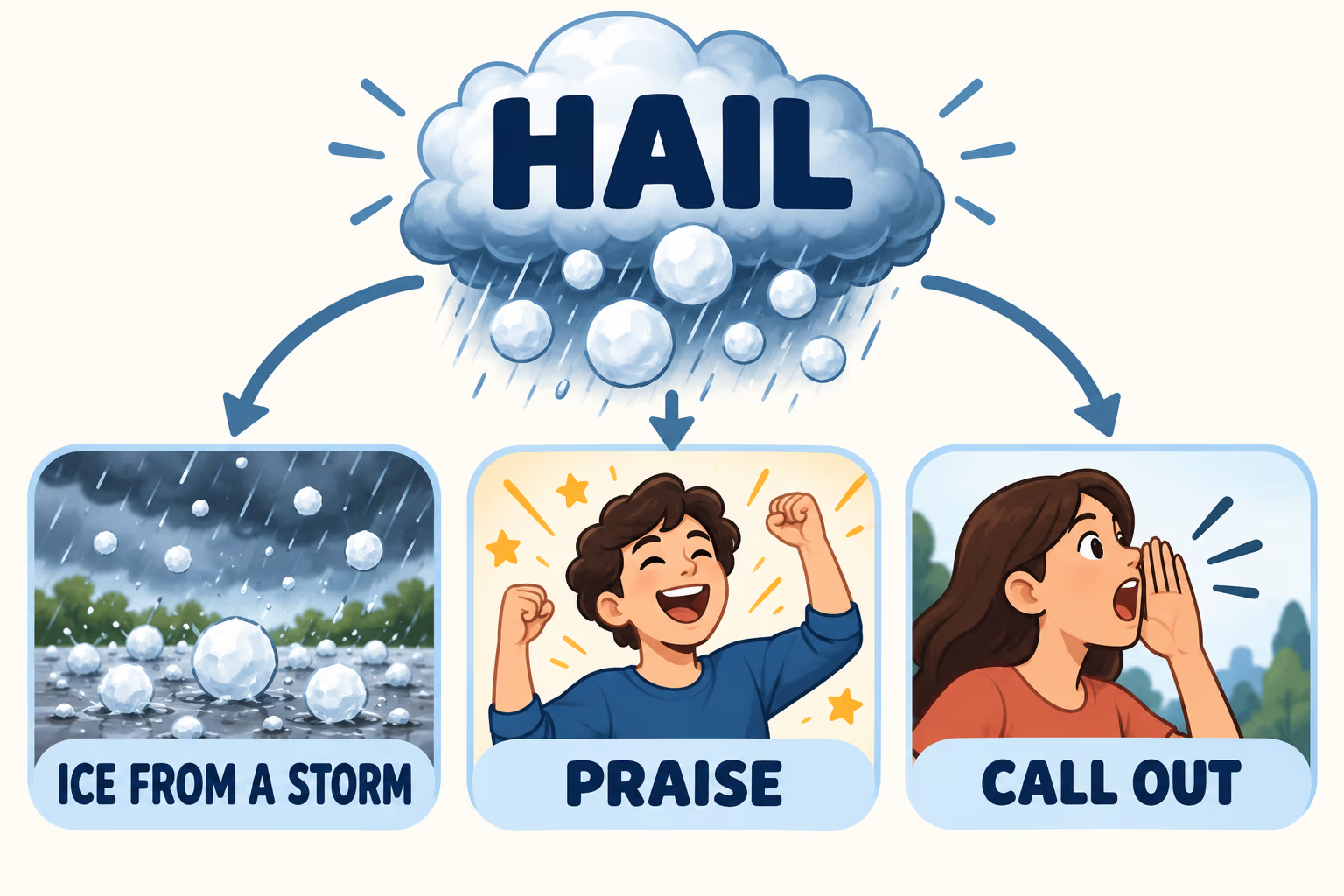
Hail has several meanings. As a noun, it is balls or lumps of ice that fall from a thunderstorm. As a verb, it can mean to praise someone publicly, call out to get attention, or (in hail from) come from a place. The sentence around it tells you which meaning is intended.
Weather: “Large hail dented the car.” Praise: “Critics hailed the film as a classic.” Call: “She hailed a taxi.” Origin: “The musician hails from Accra.”
What Does Hail Mean?
The word hail has a weather meaning and several verb meanings. They sound and look alike, so check the sentence for clues such as storm, as a hero, a taxi, or from a city.
- Hail (noun): frozen precipitation made of ice stones that form in thunderstorms. Example: “Hail covered the garden.”
- Hail (verb, praise): to describe or welcome someone or something enthusiastically. Example: “The reviewers hailed the book as a breakthrough.”
- Hail (verb, call): to call to someone or signal for a vehicle. Example: “He hailed a cab outside the station.”
- Hail from (phrasal verb): to come from a particular place or background. Example: “Our new coach hails from Jamaica.”
As a weather term, hail is not simply any frozen precipitation. The National Severe Storms Laboratory explains that hailstones form when thunderstorm updrafts carry water droplets into very cold air, where they freeze and collect additional ice. Snow forms differently, and small ice pellets called sleet are not the same as hail. NOAA’s National Severe Storms Laboratory explains how hail forms.
Hail Examples: Ice From a Storm
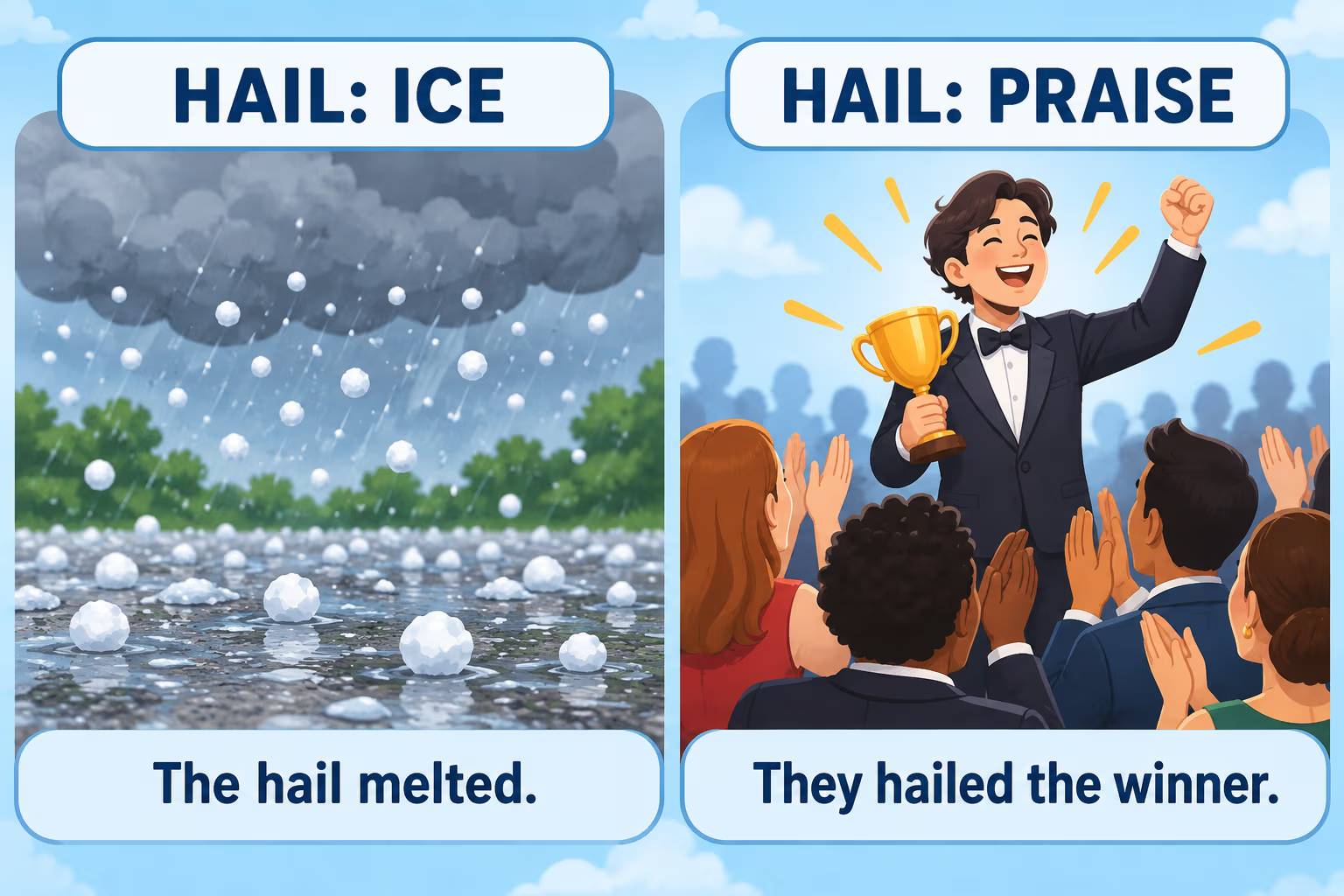
- Small hail rattled against the kitchen window during the storm.
- The forecast warned that hail could damage young plants.
- We waited indoors until the hail stopped falling.
- A few hailstones remained on the grass after the clouds cleared.
- The driver pulled into a covered garage to protect the car from hail.
- Photographs showed hail piled along the roadside after the storm.
- The farmer checked the orchard for damage from hail.
- One hailstone melted into a drop of water on the warm pavement.
In these examples, hail is a noun. It can be the subject (“Hail covered the field”) or the object of a preposition (“damage from hail”). The plural is hailstones when you mean individual pieces. A hailstorm is a storm that produces hail.
Hail Examples: Praise or Approval
- Readers hailed the debut novel as a fresh take on a familiar story.
- The mayor hailed the volunteers for their quick response.
- Supporters hailed the team’s comeback as a remarkable achievement.
- Several historians hail the discovery as an important piece of evidence.
- The award hailed her years of work in community theater.
- Critics hailed the restoration as a careful return to the building’s original design.
- Students hailed the teacher’s clear review session before the exam.
- Local papers hailed the bridge as a welcome improvement for commuters.
In the praise sense, hail is usually followed by the person or thing being praised: “The panel hailed the scientist.” A common pattern is hail someone or something as + description: “They hailed the rescue as a success.” You can also see the passive form was hailed or has been hailed: “The design was hailed as innovative.” This verb often sounds formal or emphatic; in casual writing, praised or welcomed may feel more natural.
Hail Examples: Call Someone or a Vehicle
- She raised her hand to hail the bus before it passed the stop.
- The traveler hailed a taxi in front of the hotel.
- From the far side of the street, Marco hailed his friend.
- The guide hailed the group and pointed toward the trail entrance.
- We tried to hail a cab after the concert ended.
- A passenger hailed the ferry crew as the boat approached the dock.
Here, hail means to call, signal, or attract attention. The object is often a person or a ride: hail a cab, hail a passing car, or hail someone across the room. In this meaning, the verb does not mean “praise.”
Hail From: Sentences About Someone’s Origin

The phrasal verb hail from means to come from or be associated with a place. It is often used in profiles, introductions, and formal descriptions.
- The poet hails from a small town near the coast.
- Several members of the orchestra hail from different countries.
- My grandparents hail from a farming community in Oaxaca.
- The recipe hails from the northern part of the region.
Use hail from with an origin: “She hails from Toronto.” For a more conversational tone, write is from or comes from. Do not confuse this expression with the weather noun: a person who “hails from Denver” is not connected to falling ice.
Hail Verb Forms and Common Patterns
| Form or pattern | Use | Example |
|---|---|---|
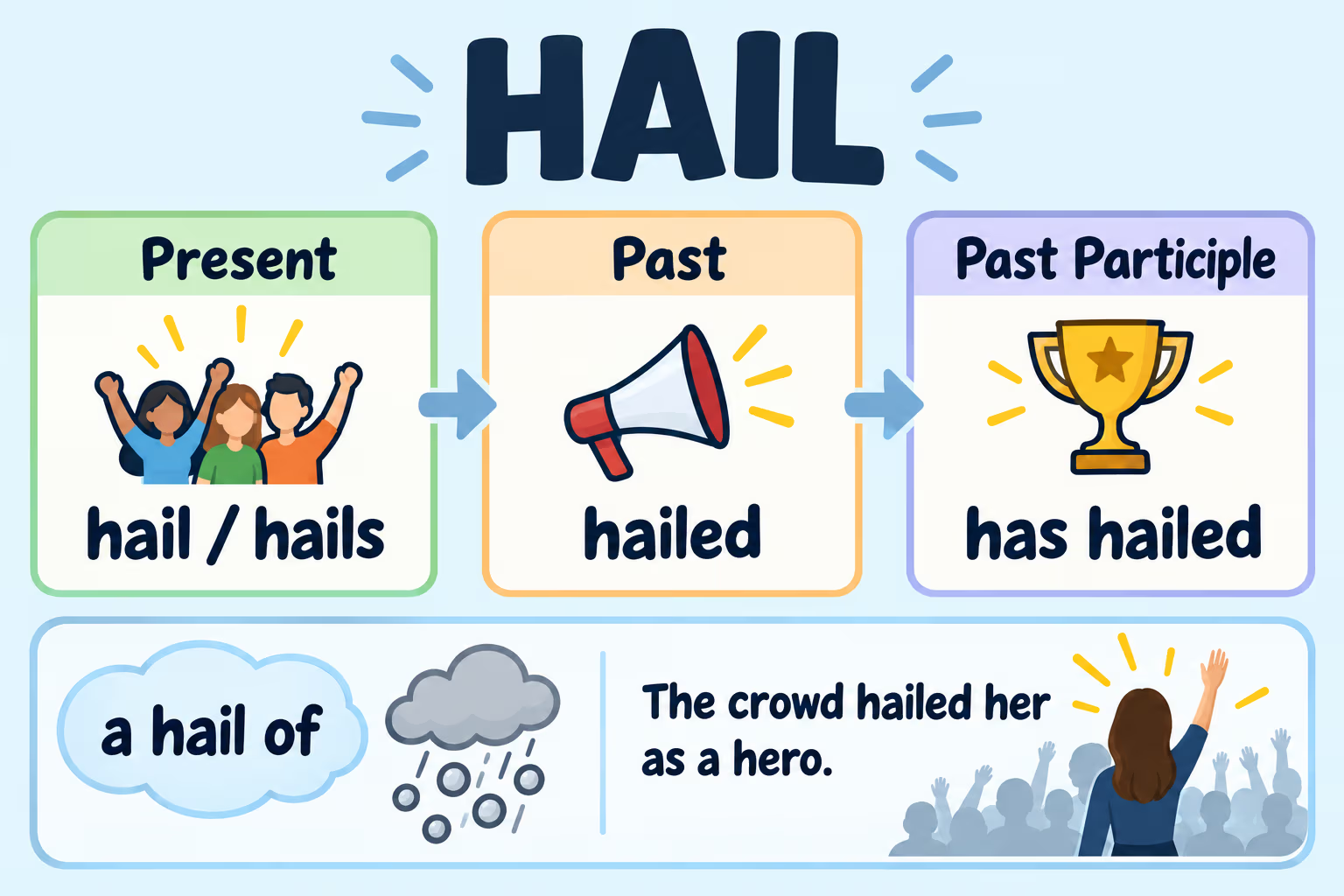
| hail / hails | Present tense | Fans hail the captain; the crowd hails the captain. |
| hailed | Simple past or past participle | They hailed the decision yesterday. |
| has/have hailed | Present perfect | Several outlets have hailed the series as original. |
| hail someone/something as | Praise or identify as | They hailed the discovery as a major advance. |
| hail a person or vehicle | Call to get attention or a ride | He hailed a taxi in the rain. |
| hail from a place | Come from a place | The players hail from three states. |
| a hail of + plural noun | A large number arriving rapidly | A hail of questions followed the announcement. |
The verb is regular: its past form is hailed, not “hailt.” The noun phrase a hail of is figurative and describes many things arriving in quick succession, such as “a hail of arrows,” “a hail of criticism,” or “a hail of questions.” Context distinguishes it from the weather noun.
Tips for Using Hail Correctly
- Look for weather clues. Words such as storm, ice, stones, and roof usually signal the precipitation noun.
- Check what follows the verb. Hailed the winner as a hero means praised; hailed a cab means signaled for a ride.
- Keep the phrase “hail from” together. It points to a place of origin: “The artist hails from Nairobi.”
- Use the right subject agreement. Write “I hail,” “you hail,” “she hails,” and “they hail.” In past tense, all subjects use hailed.
- Choose a plain synonym when tone calls for it. Praised, welcomed, or called may sound simpler than hailed.
Hail can create dangerous weather. The National Weather Service advises people to move indoors during severe thunderstorms; large hail can injure people and damage vehicles, roofs, and plants. Avoid going outside to catch hailstones. See the National Weather Service thunderstorm safety guidance and follow local alerts.
Frequently Asked Questions
What is a simple sentence with hail?
“Hail bounced off the roof.” In this sentence, hail is the ice that falls during a storm.
What does “hail someone as” mean?
It means to praise or describe someone in a particular way: “The community hailed the nurse as a hero.”
What does “hail from” mean?
Hail from means to come from a place or background. For example, “The singer hails from Lagos.”
Is hail a noun or a verb?
It can be both. Weather hail is a noun; in “They hailed the champion,” it is a verb meaning praised; and in “She hailed a cab,” it means called or signaled for a ride.
What is the past tense of hail?
The past tense is hailed: “The audience hailed the performance.” The past participle is also hailed: “The performance has been hailed as a success.”
How is hail different from sleet?
Hailstones grow in thunderstorm updrafts as layers of ice collect on them. Sleet consists of small ice pellets that form when raindrops freeze before reaching the ground. For the details of hail formation, see NOAA NSSL’s hail overview.
Sources and Further Reading
- NOAA National Severe Storms Laboratory: Hail Basics — hail formation and how hailstones grow and fall.
- National Weather Service: Severe Thunderstorm Safety — thunderstorm hazards and safety guidance.
- Cambridge Dictionary: “Hail from” — the phrasal verb meaning to come from a place.

Have you ever been caught in a sudden storm and watched as balls of ice fell from the sky? This phenomenon, known as hail, occurs when updrafts in thunderstorms carry raindrops upward into extremely cold areas of the atmosphere, where they freeze into ice pellets before falling back to the ground.
Hail can range in size from small pebbles to large grapefruits, posing a danger to property, crops, and even people caught outside during a storm. Despite its destructive potential, hail is a fascinating natural occurrence that continues to captivate and intrigue scientists and weather enthusiasts alike.
7 Examples Of Hail Used In a Sentence For Kids
- Hail falls from the sky during a storm.
- When it is sunny, there is no hail.
- Hail can be small or big in size.
- It is fun to catch hail on your hand.
- Hail makes a tinkling sound on windows.
- Hail is cold and melts quickly in your hand.
- We should stay indoors when hail is falling.
14 Sentences with Hail Examples
- Hail the arrival of the monsoon season, as it brings relief from the scorching summer heat.
- College students in India often hail the weekend with excitement and plans for relaxation.
- During exam season, students may hail their textbooks as their best friends.
- Hail the professor’s decision to extend the deadline for the assignment.
- Students may hail the opening of a new cafe near campus as a much-needed study break spot.
- Aspiring entrepreneurs hail the opportunity to attend business conferences and network with industry professionals.
- College festivals are hailed as a time for students to showcase their talents and creativity.
- Hail the availability of free Wi-Fi on campus, making it easier for students to access online resources.
- Students may hail the return of the football season, eagerly supporting their college team.
- Hail the food delivery app that helps students satisfy their late-night food cravings.
- Hail the start of internship season, as students gain valuable experience in their field of study.
- Group study sessions can be hailed as a productive way for students to prepare for exams.
- International exchange programs are often hailed as life-changing experiences for college students.
- Hail the college library for providing a quiet space for students to focus and study.
How To Use Hail in Sentences?
Hail is used as a verb to mean to greet or acclaim enthusiastically. When incorporating hail into a sentence, follow these simple steps for beginners:
-
Identify the subject of the sentence: Who or what is being greeted or acclaimed enthusiastically? This will typically come first in the sentence.
-
Use the word hail in its proper form: Hail can be used in different tenses, such as present tense (hail/hails) or past tense (hailed).
-
Complete the sentence with appropriate context: Include details that help to paint a clear picture of the situation in which the hail is taking place. This could involve describing who is doing the hailing and why.
For example, “The fans hail their favorite team’s victory with cheers and applause.” In this sentence, “the fans” is the subject, “hail” is the verb, and “their favorite team’s victory with cheers and applause” provides context for how the hailing is occurring.
By following these steps and practicing with various scenarios, beginners can effectively incorporate the word hail into their writing to convey enthusiastic greetings or acclaim.
Conclusion
In conclusion, the sentences with the word “hail” demonstrate different uses of the term, ranging from weather-related phenomena to welcoming or paying tribute to someone. When discussing weather, “hail” is commonly used to describe frozen precipitation falling from the sky during storms. For example, “The hailstorm damaged the crops in the fields.” Conversely, in a figurative sense, “hail” can be used to show approval, greet someone, or show respect. For instance, “Hail to the victors of the championship!”
Overall, the diversity in sentences containing the word “hail” showcases the versatility of language in conveying meanings and emotions. Whether describing a natural event or showing reverence, the word “hail” can evoke various sentiments and contexts in communication.


