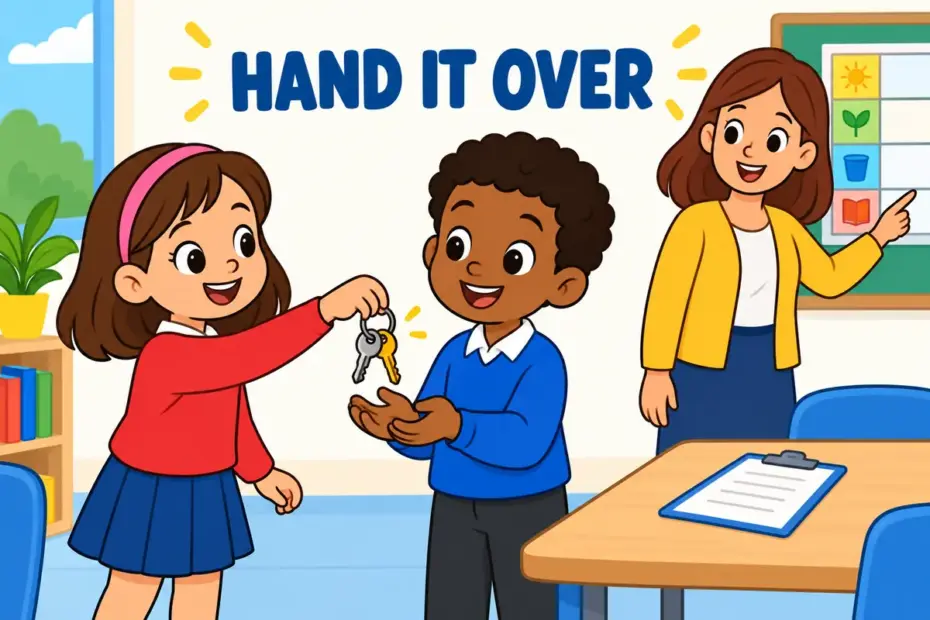
Hand over means to give something to somebody else, usually because they are now responsible for it. To use hand over in a sentence, name the giver, the thing and the receiver: “Maya handed the keys over at noon.” The verb is separable, so the object can sit on either side of over.
Hand over at a glance
- Hand over is a separable phrasal verb; its forms are hands over, handed over and handing over.
- The object may follow the particle (hand over the keys) or sit between the two words (hand the keys over).
- A pronoun object must sit between them: hand them over, never hand over them.
- The usual subjects are people passing property, duties, documents or a person in custody.
- The commonest error is writing hand over them, which breaks the pronoun rule.
What does hand over mean?
Hand over is a separable phrasal verb meaning to pass possession or control of something from one person or group to another. The Cambridge entry for hand over records the transfer sense, and what separates it from a plain gift is obligation: you hand over what you owe, guard or no longer have the right to keep. Three senses matter in practice.
| Sense | Plain meaning | Example sentence |
|---|---|---|
| Physical transfer | Pass an object directly to someone | She handed the parcel over at the desk. |
| Control or duty | Give up authority or responsibility | The captain handed over command at dawn. |
| Surrender to authority | Give a person or thing to officials | The guards handed the suspect over to police. |
One limitation is worth stating plainly. Hand over is the wrong choice for a casual gift, because the word implies a duty, a handover point or an official receiver. Nobody hands a birthday present over. Where nothing changes hands in duty, give the book is the plainer and more natural choice. When goods actually travel as part of a job, deliver the parcel names the journey, while hand over names only the moment of transfer.
How do you use hand over in a sentence?
Hand over is separable, which means the object can follow the particle or sit between the two words. A pronoun object must sit between them, so hand them over is correct and hand over them is not. The particle never strands after the object the way a preposition can, and the sentence needs both a giver and a receiver to be complete.
| Pattern | Example | What it signals |
|---|---|---|
| hand over + object | Hand over your passport, please. | A neutral instruction; the object follows the particle. |
| hand + object + over | Hand your passport over, please. | Same meaning, with a little more emphasis on the thing. |
| hand + pronoun + over | Hand it over. | The only grammatical position for a pronoun. |
| hand over + to + receiver | She handed the keys over to the new manager. | Names who receives control. |
| be + handed over | The documents were handed over on Friday. | Reporting that leaves the giver unnamed. |
When the emphasis falls on trust rather than transfer, entrust the keys to someone puts the confidence first, and hand over simply reports the physical change of hands.
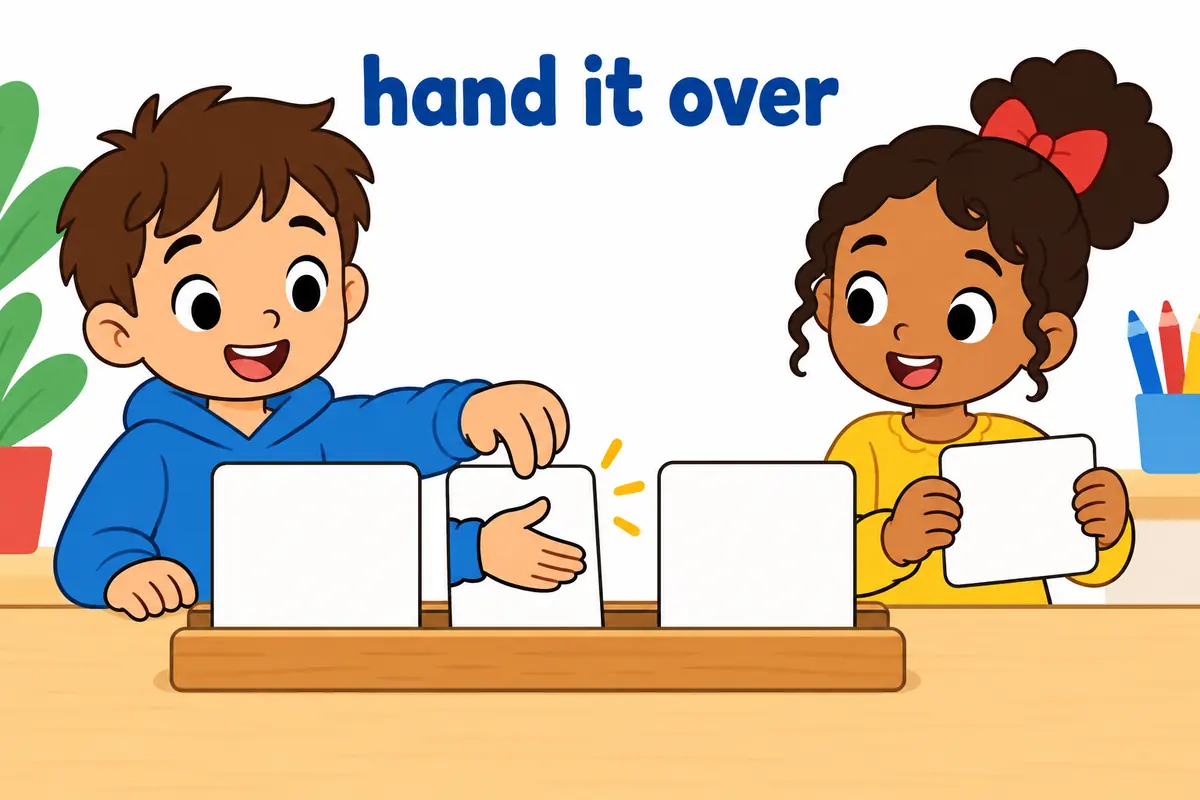
Hand over in a sentence: examples across contexts
Hand over barely changes meaning from one setting to the next, but the receiver changes what the sentence implies. The nine examples below move from a classroom to a government desk, and each one names who ends up holding the thing.
| Context | Example sentence | Why this works |
|---|---|---|
| Classroom | The teacher handed the class register over to the substitute. | A routine duty passes to a named stand-in. |
| Workplace email | Priya will hand over the account to Sam before her leave. | Names both the giver and the receiver, as a handover note should. |
| News report | The outgoing minister handed over the department at noon. | A time marker makes the transfer newsworthy and precise. |
| Legal writing | The tenant handed the keys over to the letting agent. | The formal receiver justifies the phrasal verb over plain give. |
| Customer service | Please hand your receipt over at the counter. | A polite instruction with the object before the particle. |
| Uniformed services | The officer handed over command to her deputy. | Command is the abstract thing changing hands, not an object. |
| Government | The council handed the site over to the developers. | Institutional transfer of property between named bodies. |
| Family | Dad handed the car keys over with a long sigh. | The detail signals reluctance without naming it. |
| Conversation | Just hand it over and we can go. | The pronoun pattern and imperative keep it colloquial. |
In a written handover note, transfer the account reports the same move in the flat tone a business record needs.
Hand over vs hand in and hand out
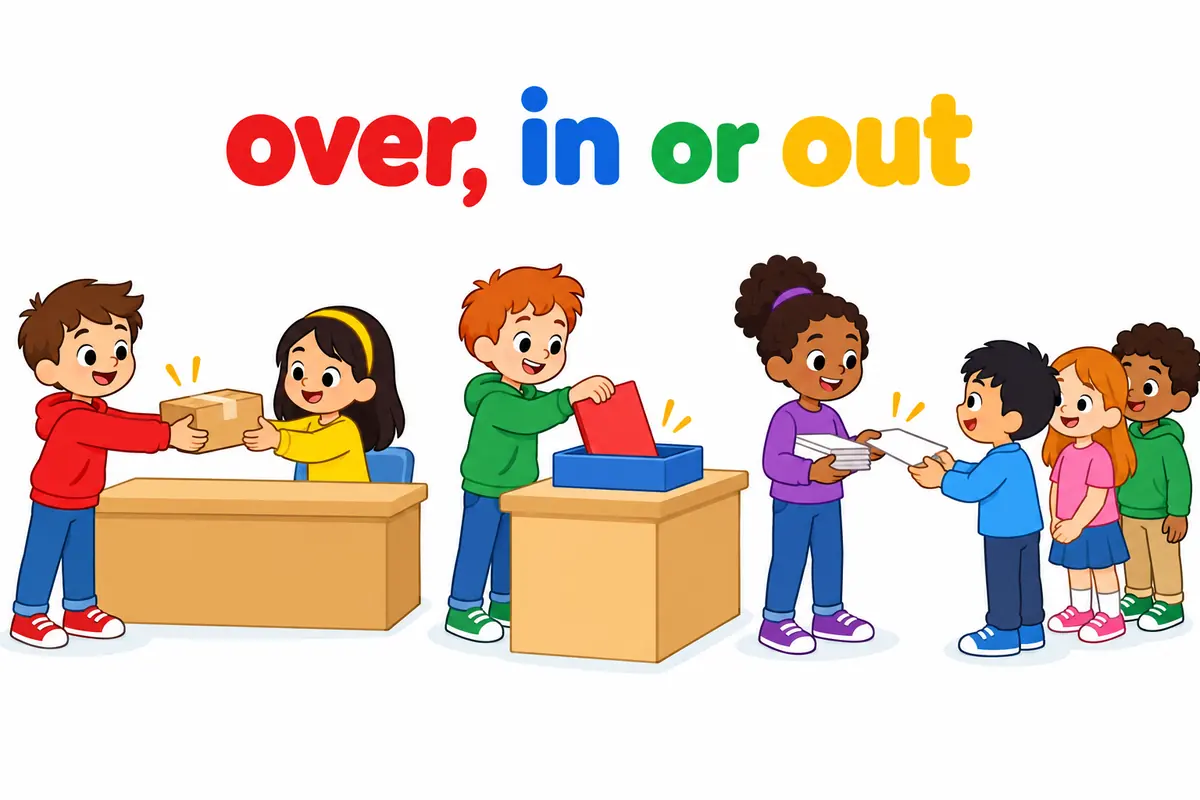
Hand over, hand in and hand out share the verb hand but point in three different directions. Hand over passes something to a named person who takes control; hand in submits it upward to an office or a teacher; hand out distributes copies outward to many people.
| Attribute | hand over | hand in | hand out |
|---|---|---|---|
| Core job | Transfer possession or control | Submit something to an authority | Distribute to several people |
| Direction | Across to a person or body | Upward to an office | Outward to many hands |
| Typical object | keys, command, documents | homework, a form, a resignation | leaflets, worksheets, medals |
| Who ends up with it | The named receiver | A department or teacher | A whole crowd |
| Example | Hand over the keys. | Hand in your essay. | Hand out the leaflets. |
Verdict: choose hand over when one named person takes control, hand in when a piece of work goes up to be checked, and hand out when copies go out to a group. Where the giving up matters more than the receiving, relinquish control is the formal cousin, and its opposite is withhold the documents.
Word forms and grammar of hand over
Hand over inflects like any regular verb, and it is the spelling of the noun that catches people. The verb is always two words, while the noun is one.
| Form | Part of speech | Example |
|---|---|---|
| hand over | phrasal verb, base | Hand over the file before you leave. |
| hands over | third person singular | He hands over the reports each Friday. |
| handed over | past and past participle | They handed over the site yesterday. |
| handing over | present participle | She is handing over her duties this week. |
| handover | noun, one word | The handover took an hour. |
| hand-over | attributive adjective | The hand-over meeting was brief. |
The non-standard form to avoid is the two-word noun, as in the hand over took all morning. Write handover whenever the word is doing the job of a noun.
Common mistakes with hand over
- Incorrect:
She handed over them to the police.Correct: She handed them over to the police. Rule: A pronoun object sits between the verb and the particle. - Incorrect:
The hand over took all morning.Correct: The handover took all morning. Rule: The noun is one word; only the verb is two. - Incorrect:
I handed over to him the keys.Correct: I handed the keys over to him. Rule: Keep the object next to the verb rather than after a long prepositional phrase. - Incorrect:
Please hand in over your assignment.Correct: Please hand in your assignment. Rule: Hand in and hand over are separate phrasal verbs and never combine. - Incorrect:
The company hands over its staff every year.Correct: The company hands out bonuses every year. Rule: Hand over transfers control; it cannot mean distribute.
Practice using hand over
Work through the six items, then read the reasoning rather than only the key.
- Fill the gap: The retiring editor will ______ the magazine to her successor on Friday.
- Choose the better word: The teacher asked us to (hand over / hand in) our essays by Monday.
- Correct the error: The guard handed over them at the gate.
- Build a sentence: use hand + pronoun + over about returning a borrowed pencil.
- Spot the register: which belongs in a police report, the officers handed the suspect over to custody, or they sort of passed the guy along?
- Rewrite with the noun: They handed the project over on Monday. Use handover instead.
Answers
- hand over — the editor is the giver and the successor is the named receiver, which suits the phrasal verb.
- hand in — essays go upward to a teacher as work to be checked, so hand in fits and not hand over.
- The guard handed them over at the gate — a pronoun object must sit between hand and over.
- Model answer: When the bell rang, I handed it over to Mia. The pronoun it goes between handed and over.
- The officers handed the suspect over to custody — a report keeps the full verb and avoids the vague sort of.
- The project handover happened on Monday — the noun is one word and can carry the place of the whole verb.
The bottom line
Use hand over in a sentence when something passes from one person or group into the control of another, and choose the word order that keeps the object clear. Two nuances decide most sentences: a pronoun must sit between hand and over, and the one-word noun is handover. Where no duty or control changes hands, give is the plainer choice.
Frequently asked questions about hand over
Can hand over mean surrender?
Yes, in an official context. Police and security writing uses hand over for the moment a person or item is passed into custody, as in the officers handed the suspect over. The surrender sense still carries the core idea of transferring control, so it is never used for a voluntary gift between friends.
Is hand over formal or everyday English?
Hand over sits in the middle. It appears in ordinary speech, as in just hand it over, and also in formal reports about documents, command and custody. The plain verb give replaces it in casual talk, while official writing prefers hand over because it names a clear transfer point.
What is the noun form of hand over?
The noun is handover, spelled as one word, and it means the act or the meeting at which something is transferred. A project handover, a shift handover and a smooth handover all use that spelling. The two-word version belongs only to the verb, as in they hand over the keys.
Can you hand over responsibility rather than an object?
Yes, and that is one of its commonest uses. You can hand over a task, an account, command or a whole department, because the word tracks control rather than physical possession. Get the receiver right in these sentences, since responsibility usually passes to a named person or team.
How to use hand over in a sentence
Hand over means to give someone possession or control of something: “Please hand over the keys to the caretaker.” The thing transferred can be a physical item or a responsibility. For example, “The manager handed over responsibility for the project” describes a change in who is in charge.
The Merriam-Webster entry for hand over identifies it as a verb meaning to yield control. The phrase often emphasizes the transfer itself. It does not automatically mean that ownership changes permanently: you can hand over a borrowed item or temporarily hand over a task.
Word order: hand over the keys or hand the keys over
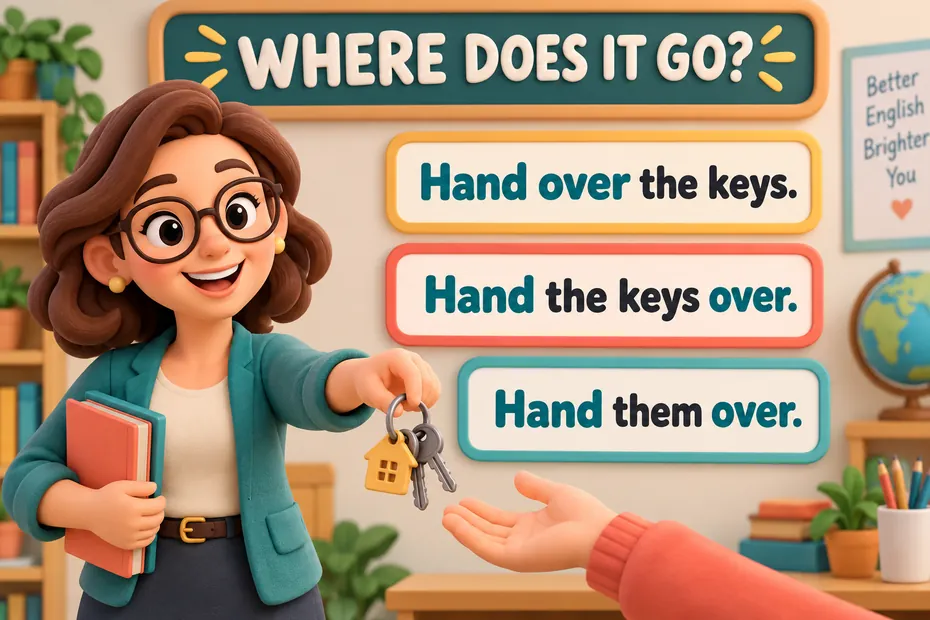
With a noun object, two common orders are possible: hand over the keys and hand the keys over. Both describe giving the keys to someone. You can name the recipient with to: “Hand the keys over to Maya.”
With a short object pronoun, place the pronoun between hand and over: hand them over, hand it over, and hand those over. For an ordinary learner sentence, use “Please hand it over,” rather than “Please hand over it.”
| Object | Natural construction | Example |
|---|---|---|
| Noun after over | hand over + noun | Hand over the folder. |
| Noun before over | hand + noun + over | Hand the folder over. |
| Pronoun before over | hand + pronoun + over | Hand it over. |
| Recipient named | hand something over to someone | Hand it over to the coordinator. |
Use the full noun first if readers do not know what it refers to. “Please hand it over” is clear when the folder is already visible or has been mentioned. “Please hand the folder over” is better when several objects are in the conversation.
Verb forms and the noun handover
The main verb changes normally: hands over, handed over, and handing over. Write “She hands over the notes at noon,” “She handed over the notes yesterday,” and “She is handing over the notes now.” Over does not change with the tense.
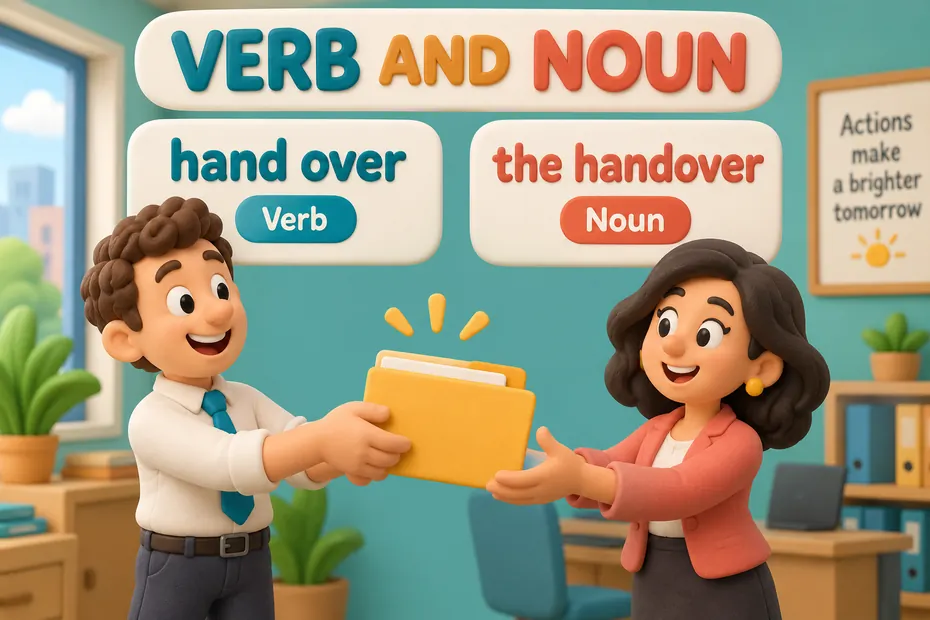
Keep hand over as two words when it is a verb. The related noun handover names the transfer or transition: “The handover took place on Monday.” The dictionary’s handover entry records that noun form.
Compare “We will hand over the project tomorrow” with “The project handover is tomorrow.” The first describes what we will do; the second names the event. This distinction is useful in work emails, meeting notes, and reports.
Hand over, hand in, and hand out
Hand in means submit, as in “Hand in the assignment by Friday.” Many of the older school examples below use hand over for submissions. They can describe physically giving a paper to someone, but hand in is often the more natural phrase when the focus is submitting completed work.
Hand out commonly describes distribution: “The organizer handed out copies of the timetable.” Hand over emphasizes a transfer of possession or control, while hand out often emphasizes giving things to recipients in a group.
A single scene can involve several actions. An assistant may hand over a box of worksheets to a teacher; the teacher then hands out the worksheets; students later hand in their answers. Each phrase highlights a different stage.
Physical items and responsibilities
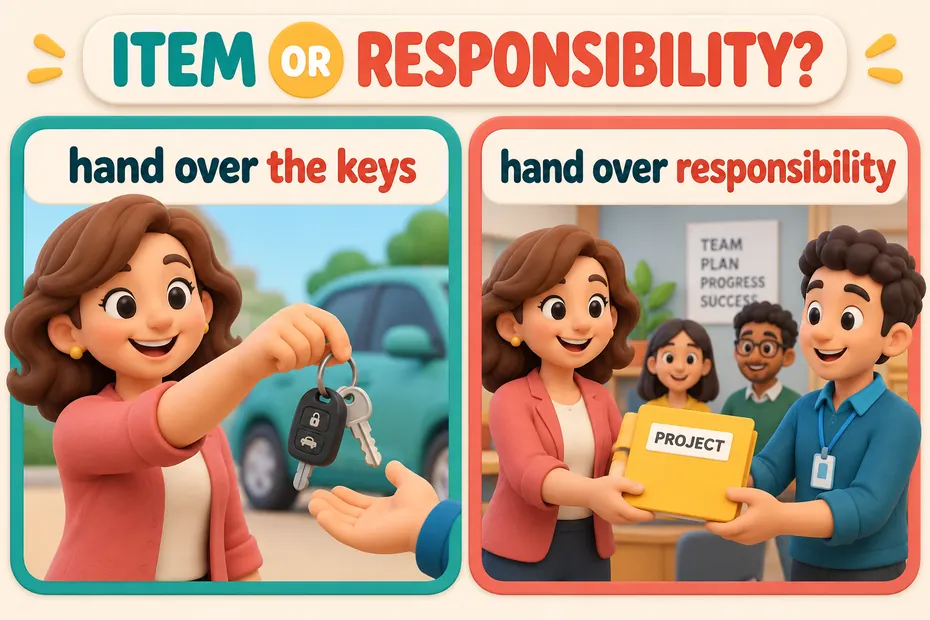
“The host handed over the microphone” names a physical object. “The chair handed over responsibility for the meeting” names a role. Both work because something passes to another person, but the second does not require someone to carry an object across the room.
For responsibilities, identify what is changing and who takes it on. “We handed over the project” may leave questions about the files, the work, and the decision-making role. “We handed over responsibility for editing the report to Maya” is more specific.
The phrase can sound direct or forceful in an imperative: “Hand it over.” A courteous request adds context and politeness: “Could you hand the folder over to Maya, please?” Choose the tone that suits your relationship and the situation.
Natural examples to adapt
- Please hand over the keys before you leave.
- She handed the folder over to the new coordinator.
- Could you hand it over when you have finished reading?
- The team handed over responsibility for the final presentation.
- He is handing over the equipment at the end of the session.
- The departing editor handed over her notes to her replacement.
- We will hand the completed design over tomorrow.
- The caretaker asked us to hand the spare key over.
- The project handover included an explanation of the unfinished tasks.
- After the demonstration, Maya handed the model over to Sam.
Each sentence makes the object or responsibility reasonably clear. If the recipient matters, name them. If the timing matters, add a time phrase. Avoid packing several transfers into one sentence when separate sentences would be easier to follow.
A quick editing check
First identify what changes hands or who takes control. Next check the verb form and the position of any pronoun. Finally decide whether hand in or hand out would express the intended action more precisely. “Hand it over to Maya” transfers something; “hand in your answers” submits work; “hand out the forms” distributes them.
Frequently asked questions
Is hand over one word or two?
The verb is two words. The noun handover is one word: “We hand over the files during the handover.”
Can I write hand over it?
For the ordinary phrasal verb, write “hand it over.” Short object pronouns normally come between hand and over.
Does hand over always mean permanent ownership?
No. The phrase can describe a temporary transfer of possession, equipment, or responsibility. Explain the arrangement if duration matters.
What is a simple example for children?
“Please hand the ball over to Maya.” It clearly names the item and the person receiving it.
Have you ever encountered a situation where you needed to hand over something to someone else? The phrase “hand over” is commonly used to describe the action of giving something to another person, often implying a transfer of ownership or possession.
In various scenarios, whether in a formal business setting or during a casual interaction, the act of handing over an item or responsibility can convey trust, responsibility, or even surrender. Understanding how to use “hand over” correctly in a sentence can help communicate your intentions clearly and effectively.
7 Examples Of Hand Over Used In a Sentence For Kids
- Hand over the pencil to your friend.
- Can you hand over the book to me, please?
- Let’s all hand over our toys for show-and-tell.
- Don’t forget to hand over your homework to the teacher.
- It’s time to hand over the snacks for our picnic.
- Hand over the crayons so we can draw.
- Remember to hand over the ball after you’re done playing.
14 Sentences with Hand Over Examples
- Hand over your assignment before the deadline.
- Make sure you hand over your project proposal to the professor by Friday.
- Don’t forget to hand over your library books at the circulation desk.
- You need to hand over your ID card before entering the examination hall.
- The event organizers asked us to hand over our registration forms at the entrance.
- It is important to hand over your course registration form to the administrative office.
- Remember to hand over your mobile phone at the security check before entering the exam room.
- The college authorities requested us to hand over our feedback forms after the seminar.
- Before leaving for the summer break, students must hand over their room keys to the hostel warden.
- The group project leader needs to hand over the final presentation to the professor.
- The professor asked me to hand over my personal notes for research purposes.
- Please hand over your leave applications to the college administration for approval.
- Students are required to hand over their medical documents to the college clinic for verification.
- The college council president will hand over the responsibility to the newly elected candidate next week.
How To Use Hand Over in Sentences?
To use Hand Over in a sentence, follow these steps:
-
Understand the meaning: Hand Over means to give something to someone else, typically after holding or possessing it.
-
Identify the subject: Determine who is handing something over and who is receiving it. For example, “She will hand over the documents to the manager.”
-
Use the correct tense: Depending on the situation, use the appropriate tense for Hand Over. For present tense, say “He hands over the keys,” and for past tense, say “She handed over the report yesterday.”
-
Position the phrase: Place Hand Over in a sentence where it accurately conveys the action of giving something to someone else. For instance, “The suspect was forced to hand over his weapon.”
-
Contextualize: Provide enough context for the reader to understand the significance of Hand Over in the sentence. For example, “The teacher asked the students to hand over their homework assignments before leaving.”
-
Practice: To become more comfortable using Hand Over in sentences, practice constructing different sentences in various tenses and with different subjects.
-
Review: Always double-check your sentence to ensure proper grammar, punctuation, and usage of Hand Over.
By following these steps, you can effectively use Hand Over in a sentence with confidence and clarity.
Conclusion
In various scenarios, individuals give or transfer something to another person using the phrase “hand over” in a sentence. This action typically involves passing an object, responsibility, or control from one party to another. Examples include “He will hand over the report to the manager tomorrow” or “The CEO handed over the reins of the company to her successor.”
“Hand over” is a simple and commonly used expression that conveys the act of giving or relinquishing something to someone else. Whether in the context of physical objects or metaphorical responsibilities, this phrase indicates a transfer of ownership or authority, making it a versatile and widely understood term in everyday language.



