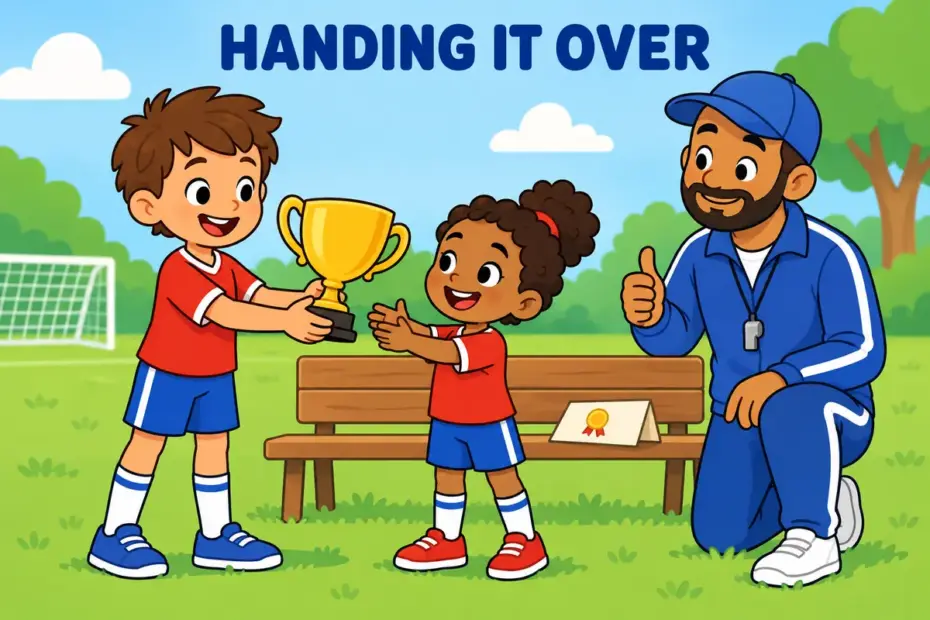
Relinquish means to give up something you hold — power, control, a claim or a possession — usually in a deliberate, often reluctant way. To use relinquish in a sentence, name the thing being given up and, if it matters, the person receiving it: “The manager relinquished control of the budget.” The verb is transitive, so it always needs an object.
Relinquish at a glance
- Relinquish is a transitive verb; its forms are relinquishes, relinquished, relinquishing and relinquishment.
- The core meaning is to give up something held, especially power, control, a claim or a possession.
- The usual objects are control, power, a claim, a right, a title and responsibility.
- Relinquish belongs to formal and journalistic writing rather than casual conversation.
- The commonest error is writing relinquish to or relinquish of before the thing given up.
What does relinquish mean?
Relinquish is a transitive verb meaning to give up something you hold, especially power, control, a claim or a possession. The Cambridge entry for relinquish records the same core sense, and the verb almost always suggests a deliberate handover rather than an accident. Where an act is forced, abandon a plan or lose fits better, because relinquish keeps a hint that the holder made a choice.
| Sense | Plain meaning | Example sentence |
|---|---|---|
| Give up control | Hand over power or authority you held | The board relinquished control of the estate. |
| Give up a possession | Let a thing go, often reluctantly | She relinquished the keys at the front desk. |
| Give up a claim | Drop a formal entitlement or right | They relinquished all claim to the land. |
One limitation matters. Relinquish does not mean lose, and it does not mean forgive. The word asserts a deliberate giving-up, so it is the wrong choice when something is taken away by force, and it says nothing about whether the holder felt any regret.
How do you use relinquish in a sentence?
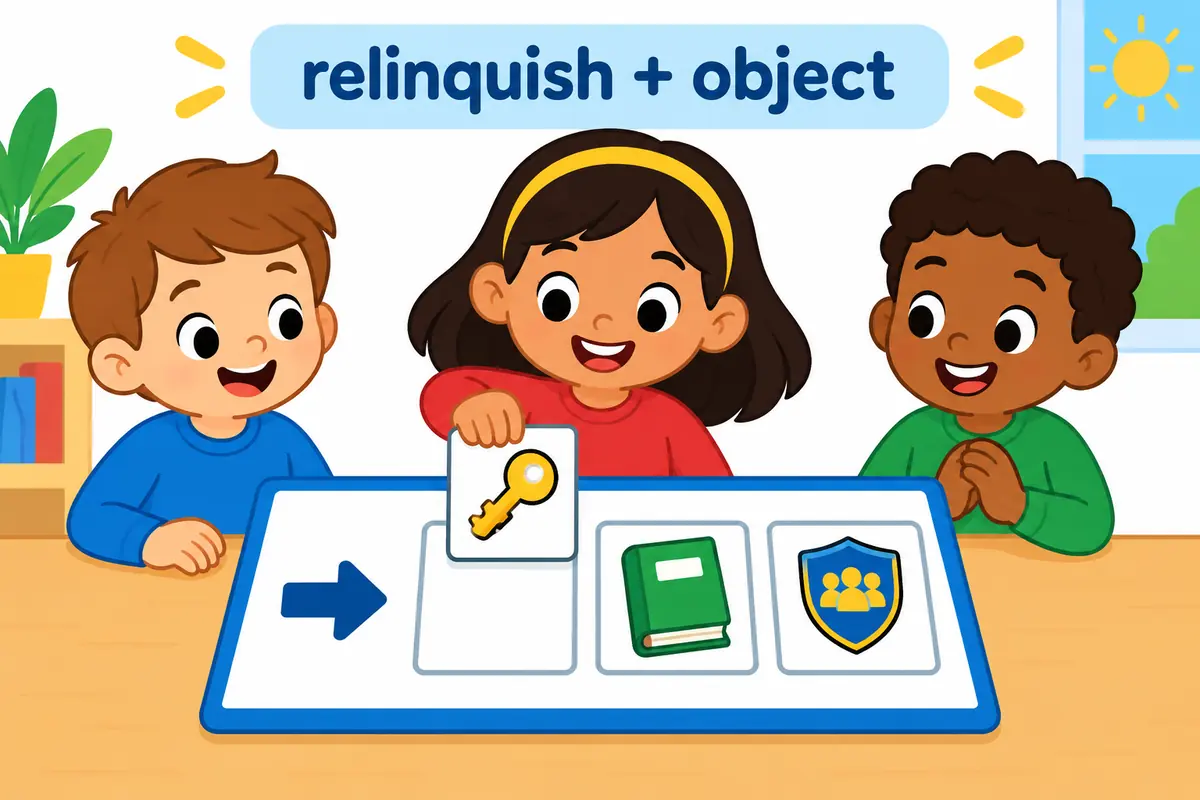
Relinquish names who or what gives something up and what is given up; the receiver, if named at all, appears after to. Five patterns cover nearly every real sentence, and the preposition to only ever introduces the person who receives the thing.
| Pattern | Example | What it signals |
|---|---|---|
| subject + relinquish + object | The board relinquished its veto. | The plain active pattern; name what is given up. |
| relinquish + control of + noun | She relinquished control of the estate. | The commonest collocation in news and business. |
| relinquish + object + to + person | He relinquished the chair to his deputy. | The to-phrase names the receiver, never the thing given up. |
| be relinquished | The old rights were relinquished in 2011. | Passive; used when the act matters more than the actor. |
| relinquish + claim or right | They relinquished all claim to the land. | A formal, legal flavour. |
A manager who leaves a job will resign a post, but English keeps relinquish for the power, rights or property that outlast the job.
Relinquish in a sentence: examples across contexts
Relinquish changes register more than it changes meaning. The nine sentences below keep the same verb while moving from a classroom to a legal notice, and each one names the thing being handed over.
| Context | Example sentence | Why this works |
|---|---|---|
| Classroom | The captain relinquished the trophy so the younger players could keep it. | A concrete object makes the giving-up easy to picture. |
| Workplace email | Priya relinquished her place on the committee after the restructure. | Formal but not legal; standard in office writing. |
| News report | The minister relinquished control of the department during the inquiry. | Names the power given up, which reporting requires. |
| Legal writing | The tenant relinquished all claim to the deposit. | The claim sense carries a formal, binding tone. |
| Politics | The veteran MP relinquished the seat to a younger candidate. | The to-phrase names the receiver. |
| Sports commentary | The champion relinquished the title after one defence. | Relinquish pairs naturally with titles and belts. |
| Academic prose | The author relinquished editorial control to the journal. | Shows a deliberate handover, not a loss. |
| Business writing | The founders relinquished voting rights but kept their shares. | Precise about which right moved. |
| Conversation | He finally relinquished the remote control. | Even here the verb keeps a playful, deliberate edge. |
Only the last example belongs to speech. Elsewhere the verb marks a formal, recorded handover: a general may surrender control of a city under a treaty, and a director may yield ground to a rival board, but both acts stay deliberate in a way that lose is not.
Relinquish vs abdicate
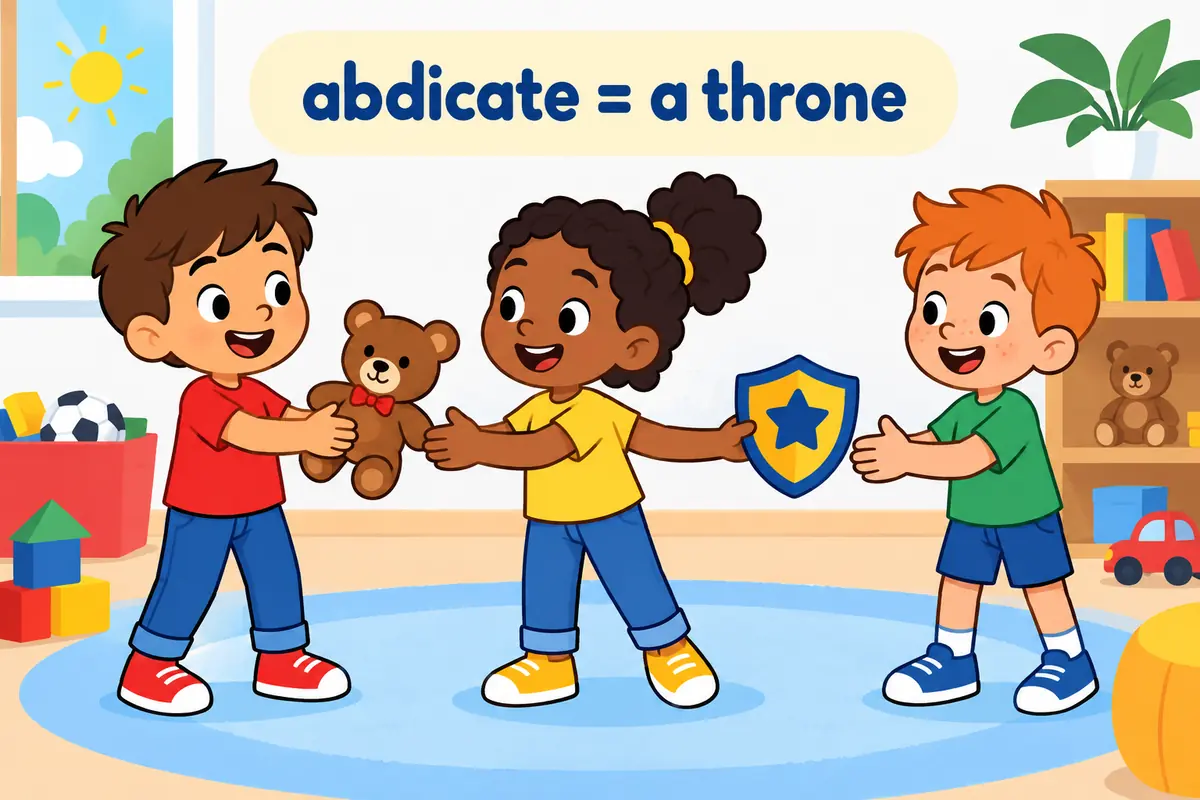
Abdicate a throne and relinquish overlap for monarchs and leaders, but abdicate is the narrower word; renounce a claim is narrower still, because it means to reject something publicly.
| Attribute | relinquish | abdicate | renounce |
|---|---|---|---|
| Core job | Give up something held | Step down from a throne or high office | Publicly reject a claim or belief |
| What is given up | Power, control, a claim, a possession | A throne, crown or high office | A right, a claim, a belief |
| Implies reluctance | Often, but not always | Not necessarily | No; it is a declaration |
| Typical object | An abstract thing or a role | A monarch, pope or president | A title, citizenship, a belief |
| Register | Formal, wide | Formal, mostly royal | Formal, legal or personal |
Verdict: use abdicate only when a throne or high office is given up, renounce when the giving-up is a public declaration, and relinquish for everything else that is handed over deliberately.
Word forms and grammar of relinquish
Relinquish inflects regularly, and its noun appears less often than the verb. The table lists the forms, including the past participle that anchors the passive.
| Form | Part of speech | Example |
|---|---|---|
| relinquish | verb, base form | The board will relinquish the lease. |
| relinquishes | verb, third person singular | She relinquishes the lead role in June. |
| relinquished | verb, past and past participle | He relinquished the keys at the desk. |
| relinquishing | verb, present participle | Relinquishing control took years. |
| relinquishment | noun, rare | The relinquishment of the claim was final. |
The related adjective does not exist in common use; writers use relinquished as a participle instead.
Common mistakes with relinquish
- Incorrect:
She relinquished to the pressure.Correct: She relinquished her hold on the project. Rule: Relinquish is transitive, so the thing given up must be named, and to cannot replace an object. - Incorrect:
He relinquished his post because he was dismissed.Correct: He surrendered his post after the dismissal. Rule: Relinquish implies a deliberate handover, so it clashes with being forced out. - Incorrect:
They relinquished from the claim.Correct: They relinquished the claim. Rule: The verb takes a direct object with no preposition. - Incorrect:
The company relinquished of its voting rights.Correct: The company relinquished its voting rights. Rule: There is no of after the verb; add of only in the noun phrase the relinquishment of rights.
Practice using relinquish
Work through the six items, then read the reasons in the answer key rather than only the keys.
- Fill the gap: The outgoing director ______ control of the trust in March.
- Choose the better word: She (relinquished / lost) the lease when she moved abroad on purpose.
- Correct the error: The captain relinquished of the trophy after the final.
- Build a sentence: use relinquish plus an object about a student who steps down as club secretary.
- Spot the register: which belongs in a formal report — the group relinquished the lease, or the group gave up the lease?
- Rewrite with the noun: The king relinquished power. Use relinquishment instead.
Answers
- relinquished — the director gave up control deliberately, and the object control is present.
- relinquished — she acted on purpose, so the deliberate handover word fits better than lost.
- The captain relinquished the trophy after the final — the verb takes no of.
- Model answer: Sam relinquished the role of club secretary so a younger member could lead.
- The group relinquished the lease — a formal report keeps the formal verb and avoids gave up.
- The king carried out a quiet relinquishment of power — the noun needs an article and of.
The bottom line
Use relinquish in a sentence when someone deliberately gives up power, control, a claim or a possession, and name that thing as the object. The two details that settle most sentences are that the verb is transitive and that it keeps a hint of choice, so it clashes with force. Where the giving-up is forced, lose is more accurate; where it is a public declaration, renounce is the sharper word.
Frequently asked questions about relinquish
Is relinquish a formal word?
Relinquish belongs to formal, written English, where it usually takes power, control, a claim or a title as its object. In everyday speech most people say give up, hand over or let go instead. A sentence such as the board relinquished control reads naturally in a report but sounds stiff in a text message.
What is the difference between relinquish and renounce?
Relinquish means to give up something you hold, such as control, a claim or a possession, and it can be quiet or reluctant. Renounce means to reject something publicly and formally, as in renounce a title or a belief. A king can relinquish power without renouncing the crown, because only the second word states a public declaration.
Does relinquish always mean giving up willingly?
Not always, but the word leans that way. Relinquish describes a deliberate handover, so it suits a decision, a resignation or a negotiated deal. When force or accident removes something, English prefers lose, forfeit or was stripped of, because those words drop the sense that the holder chose to let go.
What is the noun form of relinquish?
The noun is relinquishment, formed by adding -ment to the verb. It is uncommon and sounds legal, so most writers prefer a plainer phrase such as the handover of the claim or the surrender of control. When you do use it, give it an article, as in a quiet relinquishment of power.
Have you ever struggled with the concept of relinquishing control in a situation? The term “relinquish” means to voluntarily give up or let go of something, whether it be power, authority, or possession.
Sometimes it can be challenging to relinquish control, especially when we are used to being in charge or making decisions. Learning to trust others and loosen our grip on a situation can be a valuable skill in personal growth and relationships.
7 Examples Of Relinquish Used In a Sentence For Kids
- Relinquish the toy so others can play with it.
- Can you relinquish the crayon so your friend can draw?
- It’s important to relinquish things we don’t need.
- Remember to relinquish your turn after playing.
- Let’s all learn to relinquish and share with our friends.
- We should relinquish our seats to elders on the bus.
- It’s good manners to relinquish and take turns in games.
14 Sentences with Relinquish Examples
- Relinquish your fear of failure and embrace challenges to grow academically.
- As college students, it is important to relinquish procrastination habits and manage time effectively.
- It’s time to relinquish the idea of perfection and focus on progress and improvement in your studies.
- Relinquish the urge to compare yourself to others and instead focus on your own unique journey.
- It is essential to relinquish negative thoughts and beliefs that may be hindering your academic success.
- College is a time to relinquish old study habits and adopt new strategies for better learning outcomes.
- Relinquish the pressure to conform to societal expectations and explore your true passions and interests.
- Don’t be afraid to relinquish control and ask for help when needed in your academic pursuits.
- Relinquish the idea that success comes overnight and instead embrace the process of continuous learning and growth.
- It’s important to relinquish distractions and create a conducive environment for productive study sessions.
- College is a time to relinquish your comfort zone and step into challenging opportunities for personal development.
- Relinquish the need for external validation and focus on your own self-worth and achievements.
- As college students, it’s crucial to relinquish self-doubt and have confidence in your abilities and potential.
- Relinquish any preconceived notions about certain subjects or topics and approach them with an open mind and willingness to learn.
How To Use Relinquish in Sentences?
Relinquish means to voluntarily give up or let go of something, such as power, control, or possessions. When using this word in a sentence, remember to use it in a context where someone is choosing to release their hold on something.
For example, you could say, “The king decided to relinquish his throne to his eldest son.” In this sentence, he is willingly giving up his position of power.
To properly use relinquish in a sentence, follow these steps:
1. Identify a situation where someone is willingly letting go of something.
2. Choose the appropriate form of the word (relinquish, relinquished, relinquishing) based on the tense of the sentence.
3. Place relinquish in the sentence where it makes sense grammatically and conveys the intended meaning clearly.
4. Make sure to use it correctly within the sentence structure so that it flows naturally.
Practice using relinquish in different sentences to become more comfortable with its usage. As you become more familiar with the word, you will find it easier to incorporate it into your writing and speech.
Conclusion
In conclusion, sentences using the keyword “relinquish” showcase the act of giving up or surrendering something. From relinquishing control over a project to relinquishing power or rights, the word highlights the voluntary release or abandonment of a responsibility or possession. These sentences effectively illustrate scenarios where individuals let go of something they once held, whether it’s a physical object, a position, or authority. By understanding the context in which “relinquish” is used, readers can grasp the nuances of how the term conveys the idea of yielding or conceding.
By examining the examples provided, it is evident that the word “relinquish” signifies a conscious decision to forego ownership or control. Whether it be relinquishing an argument to maintain harmony or relinquishing a dream to pursue a different path, these sentences effectively capture the essence of releasing one’s grip on something. “Relinquish” can signal a moment of resignation, acceptance, or even generosity, depending on the context in which it is employed, underscoring the versatile nature of the term in everyday language.


