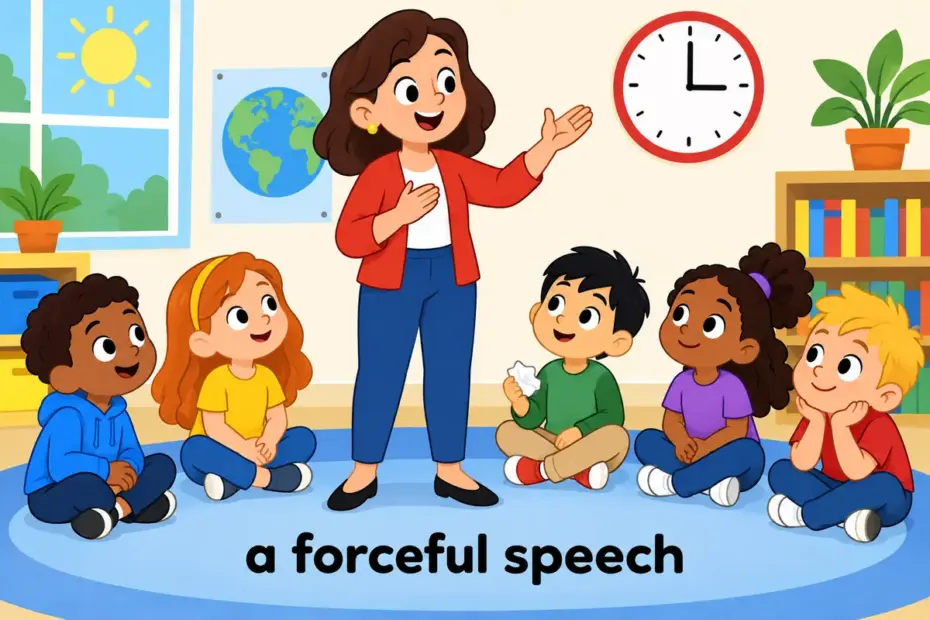
Harangue is a noun for a long, forceful speech that scolds or urges a group, and a verb for delivering one. A harangue in a sentence usually follows give, deliver or launch into, and its targets are audiences rather than single listeners: “The coach’s halftime harangue woke up the whole team.”
Harangue at a glance
- Harangue is both a noun and a verb: the noun is the speech, the verb is the act of delivering it.
- The noun appears in give, deliver or launch into a harangue.
- The verb is transitive, so you harangue a person or group, often about or for something.
- Harangue is forceful and critical; it suits news, history and political writing, not thanks or praise.
- The commonest error is treating harangue as a neutral word for any public speech.
What does harangue mean?
Harangue is a noun meaning a long, loud and forceful speech that criticises or urges a group, and a verb meaning to address someone in exactly that way. The Cambridge entry for harangue records both parts of speech, and the difference decides your sentence: the noun names the speech, the verb names the delivery. Where a speech is planned and uplifting rather than critical, a sermon is the closer noun, because harangue always carries a scolding edge.
| Sense | Plain meaning | Example sentence |
|---|---|---|
| Noun | A long, forceful and critical speech to a group | The principal delivered a harangue about litter in the corridors. |
| Verb | To address a person or group forcefully and at length | The sergeant harangued the recruits for an hour about their boots. |
| Extended use | A long scolding passage in writing or media | The editorial reads like a harangue against the council. |
One limitation is worth stating plainly. Harangue is never neutral. It does not mean a warm welcome speech or a short announcement, and using it for praise sounds sarcastic. If the speech is calm and reasoned, choose talk, address or remarks instead.
How do you use harangue in a sentence?
Decide first whether you are naming the speech or the act. As a noun it follows verbs such as give, deliver and launch into; as a verb it takes the audience as its object. Five patterns cover nearly every real sentence.
| Pattern | Example | What it signals |
|---|---|---|
| deliver / give / launch into + harangue | The coach delivered a harangue at halftime. | You are naming the speech itself as a countable thing. |
| harangue + person or group | The manager harangued the team at closing time. | The verb is transitive, so the audience cannot be left out. |
| harangue + about / for + topic | She harangued us about the noise all evening. | Names the grievance that triggered the outburst. |
| be harangued | Passengers were harangued by a stranger at the gate. | Passive keeps attention on the target, common in news. |
| a harangue against / on + issue | His speech was a harangue against wasted spending. | Frames it as a public attack on a cause, not a person. |
An admonition is a short, quiet warning, so it works in a note to a colleague where a full harangue would be wildly out of proportion.
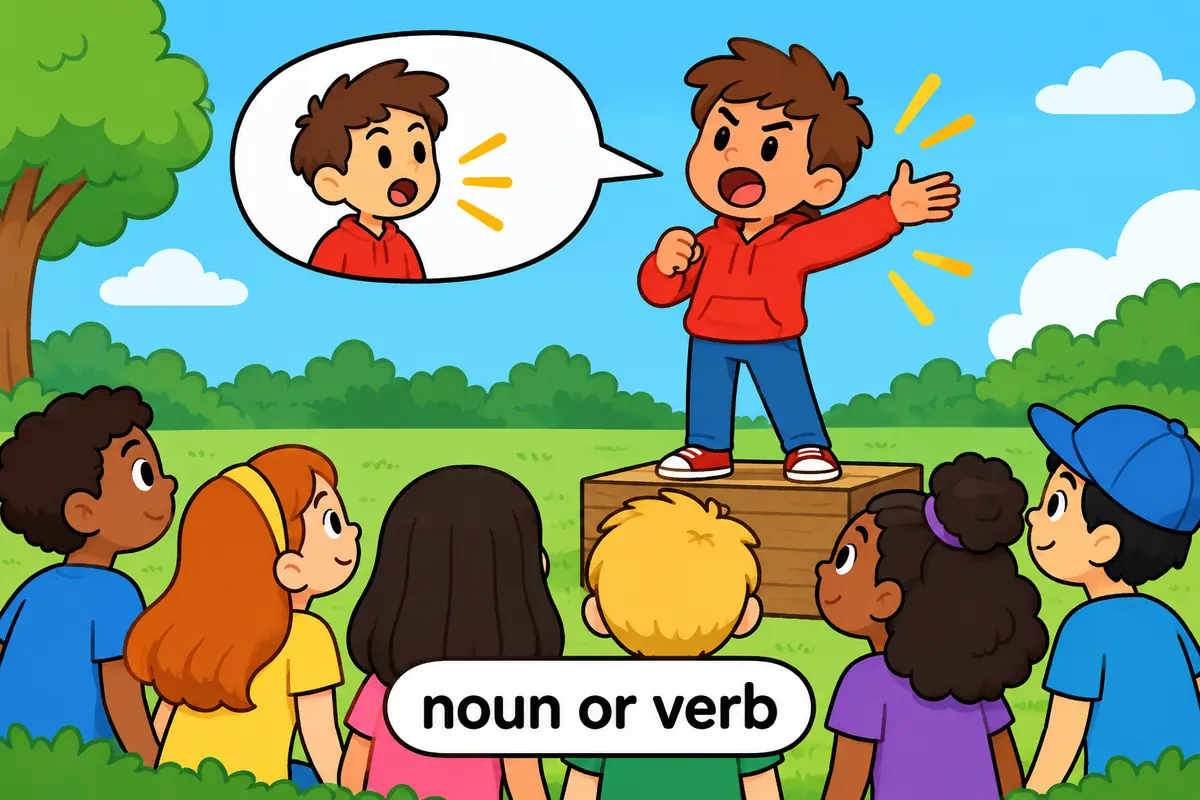
Harangue in a sentence: examples across contexts
Harangue keeps its scolding force in every register; only its setting changes. The sentences below move from a classroom to a news report, and each one names who is being addressed.
| Context | Example sentence | Why this works |
|---|---|---|
| Classroom | The teacher’s harangue about homework lasted longer than the lesson. | Names the topic and the length, which is what the noun implies. |
| Workplace email | Please do not harangue the night staff about the rota. | The verb takes the group as object and the topic after about. |
| News report | The minister faced a ten-minute harangue from angry residents. | The passive frame keeps the target of the speech in view. |
| Sports commentary | A halftime harangue turned a flat performance into a win. | Compresses cause and effect into one noun phrase. |
| History essay | He harangued the assembly until the vote was reversed. | Shows the verb carrying actual consequence, not noise. |
| Family conversation | Dad gave us a harangue about the phone bill again. | Colloquial but idiomatic, with gave plus the noun. |
| Political speech | Her address turned into a harangue against the opposition. | The against phrase marks it as a public attack. |
| Academic prose | The pamphleteer’s harangues were printed and sold cheaply. | Uses the plural to describe a repeated body of writing. |
| Customer service | A customer harangued the desk clerk over a cancelled flight. | Over plus the grievance is the usual verb pattern. |
A rant is the closest informal word here, and it often describes the same noisy complaint in speech.
Harangue vs tirade
Harangue and tirade both describe a long angry outburst, so writers reach for either without thinking. The line between them is the audience: a harangue is delivered to people, while a tirade can pour out with nobody listening.
| Attribute | harangue | tirade |
|---|---|---|
| Core idea | A forceful speech aimed at an audience | A long burst of angry speech |
| Needs listeners | Yes, by definition | No; it can be private or alone |
| Usual form | Noun and verb | Noun only |
| Typical length | Minutes, often formal | Unpredictable, often uncontrolled |
| Register | Formal and journalistic | Neutral, common in everyday writing |
Verdict: use harangue when the speech is aimed at a group and has a purpose, and tirade when the anger is vented without an audience. A diatribe leans towards written or reasoned denunciation rather than a delivered speech.
Word forms and grammar of harangue
Harangue inflects like a regular verb and, unusually, doubles as its own noun. The table lists the forms and the one that learners invent by mistake.
| Form | Part of speech | Example |
|---|---|---|
| harangue | noun, singular | The harangue ended when the bell rang. |
| harangues | noun, plural | His harangues bored the whole committee. |
| harangue | verb, base form | Do not harangue the new interns. |
| harangues | verb, third person | She harangues the group every Monday. |
| harangued | verb, past and participle | He harangued the crowd for twenty minutes. |
| haranguing | verb, present participle | They were still haranguing each other at midnight. |
| harangue as adjective | non-standard | Write a haranguing speech, not a harangue speech. |
The related noun form declamation describes an impassioned recitation, but it lacks the scolding force that harangue always carries.
Common mistakes with harangue
- Incorrect:
The boss gave harangue to the staff.Correct: The boss gave a harangue to the staff. Rule: As a countable noun, harangue normally needs an article. - Incorrect:
The judge delivered a harangue praising the volunteers.Correct: The judge delivered a warm address praising the volunteers. Rule: Harangue implies criticism, so it cannot introduce praise. - Incorrect:
The coach harangued for ten minutes.Correct: The coach harangued the players for ten minutes. Rule: The verb is transitive and needs its audience as the object. - Incorrect:
She harangued on the team about the schedule.Correct: She harangued the team about the schedule. Rule: The object takes no preposition; about introduces the topic. - Incorrect:
His harangue was a nice speech.Correct: His speech was a blistering harangue. Rule: Do not pair this forceful word with mild adjectives such as nice.
Practice using harangue
Work through the six items, then check the reasoning as well as the answer.
- Fill the gap: The captain ______ the squad about their slow warm-up.
- Choose the better word: After the meeting, the staff sat through a long (harangue / sermon).
- Correct the error: The manager gave harangue to the whole department.
- Build a sentence: use launch into a harangue about a broken lift in a flat building.
- Spot the register: which belongs in a news report — the mayor faced a harangue from residents, or the mayor got a big telling-off?
- Rewrite as a noun: The coach harangued the players at halftime. Use harangue instead.
Answers
- harangued — the squad is the object the verb needs, and about introduces the topic.
- harangue — the speech was critical; a sermon is planned and uplifting.
- The manager gave a harangue to the whole department — the countable noun needs a.
- Model answer: The tenants launched into a harangue about the broken lift.
- The mayor faced a harangue from residents — the news register avoids got and telling-off.
- The coach delivered a harangue to the players at halftime — delivered pairs naturally with the noun.
The bottom line
Use harangue in a sentence when a forceful, critical speech is aimed at a group, and decide first whether you need the noun or the verb. The two nuances that settle most sentences are these: as a verb it is transitive, so the audience must appear, and as a noun it always implies scolding, so it is the wrong word for praise. When the tone is calm, talk, address or remarks serve better.

Frequently asked questions about harangue
Is harangue a noun or a verb?
Harangue is both. The noun names the speech, as in the coach delivered a harangue at halftime. The verb names the act of delivering it, as in the coach harangued the players. Both carry the same idea of a long, forceful and critical address.
What is the difference between a harangue and a speech?
A speech is neutral and can be warm, short or formal. A harangue is a specific kind of speech that is long, forceful and critical. Every harangue is a speech, but most speeches are not harangues, because the word always implies scolding or pressure.
Does a harangue have to be angry?
It has to be forceful and critical rather than merely angry. A harangue can be cold and controlled, as when a manager lists failures for twenty minutes. The constant is pressure on the audience, so a gentle explanation never counts as a harangue.
Can harangue be used in everyday conversation?
It appears in conversation, usually with give or launch into, as in Dad gave us a harangue about the phone bill. The word still sounds a little formal, so speakers often switch to rant or telling-off when the setting is casual.
Have you ever found yourself in a situation where someone delivers a lengthy and forceful speech, often filled with criticism or strong opinions? This type of speech is known as a “harangue.”
A harangue is a passionate and aggressive speech intended to persuade or criticize others. It typically involves a speaker forcefully expressing their opinions or beliefs on a particular topic, often in a long-winded and exhausting manner.
7 Examples Of Harangue Used In a Sentence For Kids
- Harangue means to talk loudly and angrily for a long time.
- Don’t harangue your friends; they might not like it.
- It’s not polite to harangue others when they are talking.
- Remember to be kind and not harangue your classmates.
- Sometimes people harangue when they are upset or frustrated.
- It’s important to listen and not harangue when someone else is speaking.
- When you feel like you want to harangue, take a deep breath and calm down.
14 Sentences with Harangue Examples
- Harangue your classmates about the importance of attending lectures regularly.
- Make sure to harangue your roommates about keeping the common area clean.
- It’s always a good idea to harangue your friends about the dangers of procrastination.
- Don’t forget to harangue your group members about meeting deadlines for assignments.
- Harangue your peers about the benefits of joining extracurricular activities on campus.
- Take the opportunity to harangue your juniors about the importance of time management.
- Harangue your friends about the significance of networking for future career opportunities.
- Make sure to harangue your classmates about the importance of academic integrity.
- It’s essential to harangue your group mates about effective communication during group projects.
- Don’t hesitate to harangue your roommates about respecting each other’s privacy.
- Harangue your peers about maintaining a healthy work-life balance during exam season.
- Remember to harangue your friends about the importance of mental health awareness.
- Take the initiative to harangue your classmates about the benefits of staying hydrated and taking breaks during study sessions.
- It’s crucial to harangue your group members about the significance of backing up project files.
How To Use Harangue in Sentences?
To use the word Harangue in a sentence, follow these simple steps:
-
Understand the meaning: Harangue means a lengthy and aggressive speech or lecture, typically delivered in a critical or forceful manner.
-
Choose the right context: Harangue is usually used when referring to a speech that is forceful, critical, or delivered with intensity.
-
Form your sentence: Start by determining the subject and predicate of your sentence. For example, “The politician delivered a passionate harangue against corruption in the government.”
-
Practice using it: To become more comfortable with the word harangue, try incorporating it into everyday conversations or writing exercises.
-
Pay attention to tone: When using harangue, remember that it conveys a sense of intensity and criticism. Make sure the context of your sentence aligns with this definition.
-
Expand your vocabulary: As you become familiar with using harangue, consider learning synonyms and antonyms to improve your vocabulary and communication skills.
-
Ask for feedback: If you’re unsure about your usage of harangue, don’t hesitate to ask for feedback from a teacher, tutor, or language partner.
By following these steps and practicing regularly, you can effectively incorporate the word harangue into your vocabulary and improve your overall language skills.
Conclusion
In conclusion, a harangue is a forceful and aggressive speech aimed at criticizing or scolding someone or a group of people. It often involves intense language and is used to persuade, berate, or incite action. Examples of sentences with the word “harangue” include “The coach delivered a long harangue to the team after their disappointing performance” and “The politician’s fiery harangue ignited a heated debate among the audience.”
Overall, a harangue is a powerful form of communication that can evoke strong emotions and leave a lasting impact on its audience. It is important to use this type of speech judiciously and with consideration for its potential effects on listeners.


