
How do you use heavy lifting in a sentence?
Heavy lifting means physically moving heavy objects or, figuratively, doing the hardest part of a task. A natural example is “Maya did most of the heavy lifting on the report.” Use the phrase for demanding work, then name the project or responsibility so the reader can tell which meaning you intend.
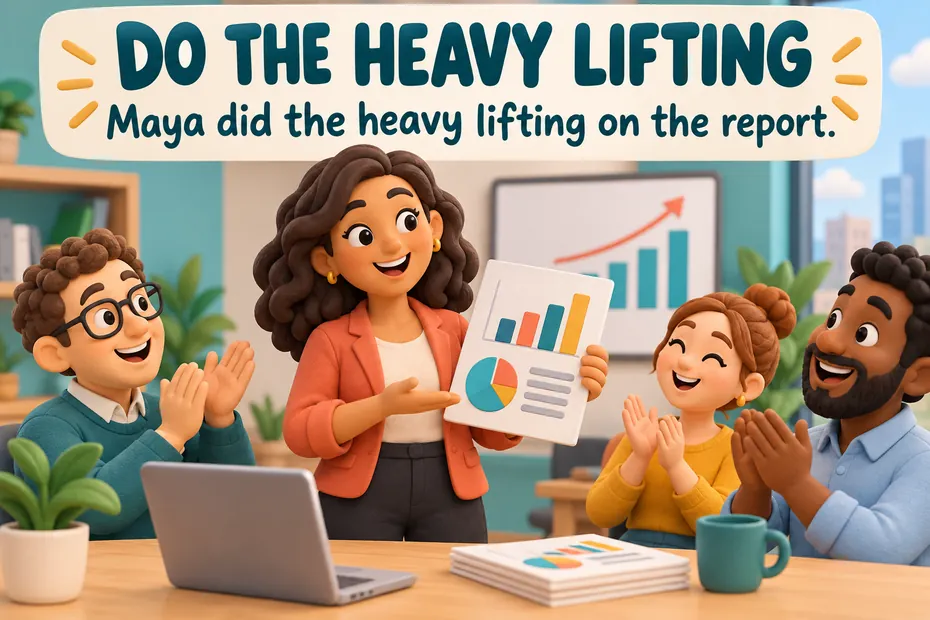
What does the idiom heavy lifting mean?
In figurative use, heavy lifting is the difficult, substantial work that makes a result possible. It can involve research, planning, calculations, negotiations, or another demanding contribution. Someone who “does the heavy lifting” might never pick up a physical object. The expression borrows the image of effort from lifting a heavy load.
Merriam-Webster treats the expression as a noun referring to laborious duty. In ordinary writing, the whole phrase functions as a noun phrase: “The heavy lifting is finished.” It names work rather than acting as the main verb. In “Nora did the heavy lifting,” did is the verb.
Natural patterns with original examples
| Pattern | Example | Meaning |
|---|---|---|
| Do the heavy lifting | The research team did the heavy lifting before the presentation. | Perform the demanding work |
| Do most of the heavy lifting | Leah did most of the heavy lifting on the proposal. | Make the largest substantial contribution |
| Leave the heavy lifting to someone | We left the heavy lifting to the experienced editing team. | Assign the difficult part to someone |
| Heavy lifting is done | The heavy lifting is done; we only need to format the pages. | The main difficult work is complete |
| Handle the heavy lifting | The spreadsheet handles the heavy lifting of calculating totals. | A tool performs the demanding processing |
| Literal heavy lifting | The move required heavy lifting, so we hired movers. | Moving heavy physical objects |

How can you distinguish literal and figurative use?
Look at the task named nearby. Furniture, crates, and appliances suggest literal lifting. Reports, analysis, and negotiations suggest figurative effort. “The volunteers did the heavy lifting” is ambiguous by itself: they might have moved tables or organized the entire event. Add “by moving the tables” or “by arranging the permits” to make your meaning clear.
For an academic example, write “The literature review did much of the heavy lifting in establishing the argument.” Here the review supports the argument, and the phrase describes its substantial contribution. “Heavy lifting during exam time” is less precise. “Reviewing the difficult chapters was the heavy lifting of exam preparation” identifies the demanding part.
A tool can also do the heavy lifting: “The software does the heavy lifting of sorting the records.” This is a figurative description of its work, not a claim that the software thinks or physically lifts anything. Name the operation when accuracy matters; vague praise gives readers less information than a concrete task.

Grammar, tone, and clearer alternatives
Write heavy lifting as two words in “We did the heavy lifting.” Do not replace lifting with liftings to refer to several projects. Say “She did the heavy lifting on three projects.” Treat the work as singular in “The heavy lifting was completed yesterday,” even when several people performed it.
The article the is natural when identifying a task’s difficult portion: “He did the heavy lifting on the redesign.” Without an article, “This role involves heavy lifting” usually describes a kind of work, often literal. “Some heavy lifting remains” is also possible and means that substantial work is still necessary.
The older article below says to avoid casual or flippant use, but this is not a strict grammar rule. Speakers can use the expression humorously: “The coffee did the heavy lifting this morning.” Whether the joke suits your audience is a tone decision. In a formal report, name the work directly: “The team completed the statistical analysis” is more informative than “The team did the heavy lifting.”
The children’s lifting examples below are vocabulary examples, not a complete safety procedure. Bending the knees alone does not make a lift safe. The UK Health and Safety Executive advises avoiding hazardous manual handling where possible, assessing unavoidable tasks, and reducing the risks. Actual lifting decisions depend on the load and circumstances; follow suitable guidance rather than treating an example sentence as instruction.
Frequently asked questions
Can heavy lifting refer to mental work?
Yes. Research, problem solving, and planning can be described as heavy lifting when they are the demanding part of a project. Mention the particular task to make that figurative meaning clear.
Is do the heavy lifting correct?
Yes. “Do the heavy lifting” is a natural construction. Change the verb for tense: “She does the heavy lifting,” “She did the heavy lifting,” or “She will do the heavy lifting.”
Does heavy lifting always mean all the work?
No. It focuses on the difficult or substantial portion. “Most of the heavy lifting” leaves room for others’ contributions, and “some heavy lifting” describes only part of the demanding work.
Is heavy lifting suitable for a work email?
Usually, when the audience understands the idiom. For a precise assignment, name the responsibility: “Please handle the data analysis.” That avoids uncertainty about what the difficult work includes.
Sources and usage notes
The idiom definition was checked against Merriam-Webster: heavy lifting. The physical-lifting clarification follows the Health and Safety Executive’s manual-handling guidance. All example sentences in this guide are original. The earlier article is preserved below.
Have you ever come across the phrase “heavy lifting” and wondered what it meant? In the most literal sense, heavy lifting refers to the physical act of lifting and moving objects that are particularly large or heavy.
Metaphorically, heavy lifting has come to represent the challenging or difficult tasks that require significant effort and energy to accomplish. In both contexts, the term emphasizes the intensity and hard work involved in completing the task at hand.
7 Examples Of Heavy Lifting Used In a Sentence For Kids
- Heavy lifting can make our muscles stronger.
- It’s important to bend our knees when doing heavy lifting.
- We should always ask for help when we need to do heavy lifting.
- Carrying a big bag of books is an example of heavy lifting.
- Too much heavy lifting can make us tired, so we should take breaks.
- We should always be careful when doing heavy lifting to avoid getting hurt.
- It’s fun to pretend to do heavy lifting like our favorite superheroes!
14 Sentences with Heavy Lifting Examples
- Heavy lifting during exam time can be quite exhausting, but necessary for success.
- Make sure to schedule breaks in between study sessions to avoid burnout from all the heavy lifting.
- Group study sessions can make the heavy lifting of assignments more manageable and even enjoyable.
- Waking up early to get a head start on the day’s heavy lifting can lead to a more productive day.
- Proper time management can help prevent last-minute heavy lifting before deadlines.
- Balancing social activities with the heavy lifting of academics is essential for a well-rounded college experience.
- Learning to delegate tasks can alleviate some of the heavy lifting you may face as a college student.
- Utilizing online resources can make the heavy lifting of research projects more efficient.
- Setting realistic goals can help you tackle the heavy lifting of your academic workload one step at a time.
- Physical exercise, such as weightlifting, can complement the mental heavy lifting of studying.
- Setting up a study group to tackle the heavy lifting of challenging course material can be beneficial for everyone involved.
- Creating a study schedule can help you stay organized and divide the heavy lifting of studying into manageable chunks.
- Seeking help from professors or tutors can make the heavy lifting of understanding complex topics easier.
- Practicing self-care, such as getting enough sleep and eating well, can help you stay energized for the heavy lifting of college life.
How To Use Heavy Lifting in Sentences?
Heavy Lifting is a term often used to describe challenging tasks that require a lot of effort and energy. When using this phrase in a sentence, it is important to properly convey the context in which it is being used. For example, “I had to do the heavy lifting on the project because my colleagues were unfamiliar with the tasks.” In this sentence, heavy lifting refers to the difficult and time-consuming work that the speaker had to do.
To effectively use Heavy Lifting in a sentence, consider the following tips:
- Be sure to use Heavy Lifting in situations where you are describing a task or responsibility that requires significant effort or expertise.
- When using the term, it is helpful to provide context so that the listener or reader understands the specific challenge or difficulty involved.
- Heavy Lifting can be used figuratively to describe mental or emotional burdens, as well as physical tasks that require strength.
- Avoid using Heavy Lifting in a casual or flippant manner, as it is typically reserved for describing serious or challenging situations.
By following these guidelines, you can effectively incorporate Heavy Lifting into your vocabulary and communicate more clearly with others.
Conclusion
In conclusion, incorporating sentences with heavy lifting into your writing can help convey complex ideas in a clear and concise manner. By using vivid and descriptive language, you can engage readers and enhance the impact of your message. These sentences add depth and richness to your writing, making it more compelling and memorable.
Whether you are crafting a persuasive argument, telling a story, or explaining a concept, sentences with heavy lifting can effectively communicate your intended meaning. By taking the time to carefully construct these sentences, you can elevate the quality of your writing and leave a lasting impression on your audience. So, next time you sit down to write, consider incorporating sentences with heavy lifting to make your message more powerful and resonant.