
Log off means to end your connection to a computer, network or app, the reverse of logging in. To use log off in a sentence, name the system and keep the pair together: “Please log off before you leave the lab.” The verb is usually intransitive and takes from only when a system is named.
- Log off is a phrasal verb; its forms are logs off, logged off and logging off.
- It means ending a session on a device, account or network.
- The dominant pattern is intransitive, with from appearing before a named system.
- Its usual home is IT policy, workplace writing and customer support.
- The commonest error is using log off for anything non-digital, such as lights or doors.
What does log off mean?
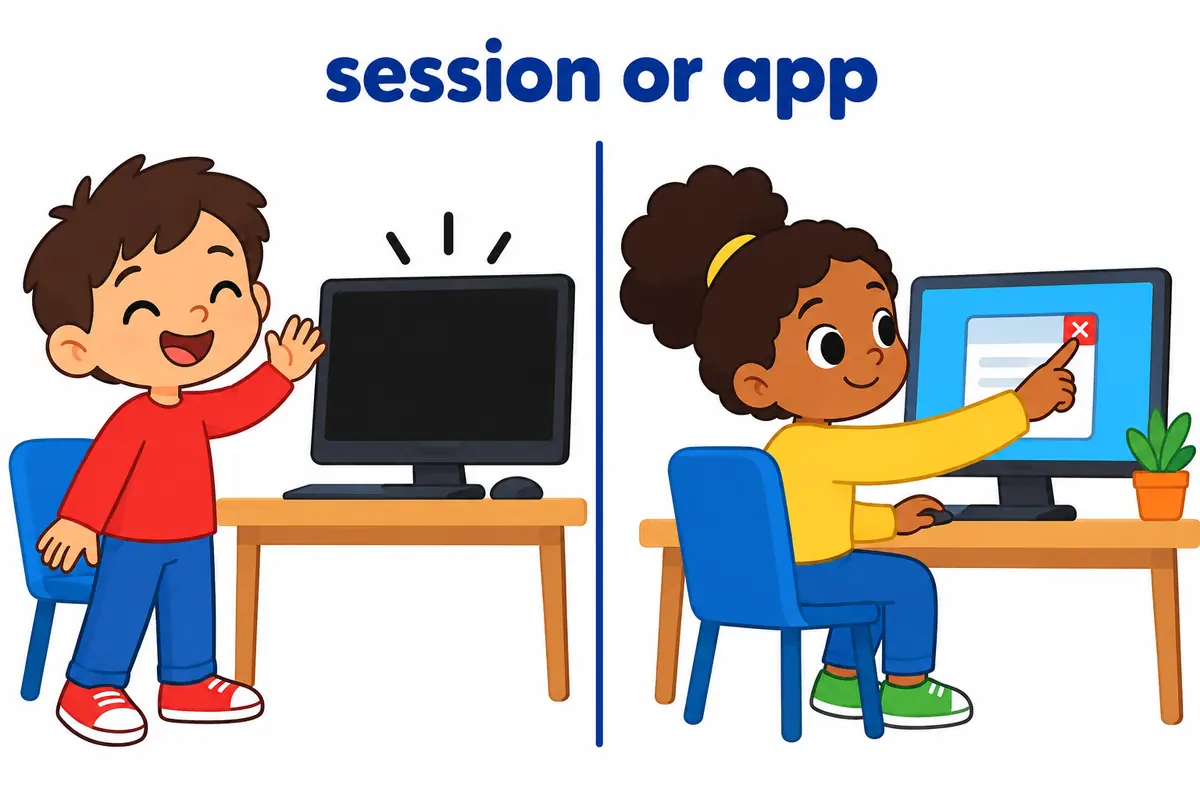
Log off is a phrasal verb meaning to end a session on a computer, account or network. The Cambridge entry for log off treats it as the opposite of log in, and the two verbs share the same fixed particle. Where the point is simply to close one program, quit the app is the closer verb, because log off leaves the whole session rather than one window.
| Sense | Plain meaning | Example sentence |
|---|---|---|
| End a session | Close your connection to a system | Log off when your shift ends. |
| Protect an account | Leave so nobody else can use it | Always log off on a shared laptop. |
| Close a terminal | End a session on a named device | He logged off the public terminal. |
One limitation is worth stating plainly. Log off is digital only. You log off a system, not a light, a door or a conversation, and it does not mean delete an account: a user can log off and log in again later, so logging off never removes a worker’s access to the network.
How do you use log off in a sentence?
Keep the verb and its particle together. Unlike mix up, log off does not split around an object, so log off the laptop is acceptable but log it off is not. The table shows the five patterns in everyday use.
| Pattern | Example | What it signals |
|---|---|---|
| log off | Remember to log off before you leave. | Intransitive and complete on its own. |
| log off + object | Log off the shared computer when you finish. | Transitive use names the device or account. |
| log off from + system | She logged off from the bank portal. | From introduces the system being left. |
| log off before or after | He logged off before the update started. | A time clause showing sequence. |
| noun: log-off | Do a quick log-off at the end of the shift. | The hyphenated noun names the act itself. |
Because the particle is fixed, the verb sounds native exactly when off stays attached, which is why the pair behaves less flexibly than break off the talks or other separable verbs.

Log off in a sentence: examples across contexts
Log off belongs wherever a session must end. The nine sentences below move from a school lab to a security policy, and each one shows what is being closed.
| Context | Example sentence | Why this works |
|---|---|---|
| Classroom | Log off the computer lab machines before the bell. | A direct instruction with a named device. |
| Workplace email | Please log off the shared account when your shift ends. | Polite request that protects the account. |
| IT policy | Staff must log off before leaving their desks. | Uses must with the intransitive pattern. |
| News report | Thousands of users logged off after the data breach. | Describes a collective action in a security story. |
| Conversation | I logged off early because the video call would not load. | Natural spoken use with a reason clause. |
| Academic writing | Participants logged off from the platform once the task ended. | From marks the system being left in a study. |
| Banking | Always log off from the app before closing the browser. | A safety instruction with from. |
| Healthcare | Nurses log off the terminal after each patient record. | Transitive use in a data-protection setting. |
| Customer support | If the screen freezes, log off and sign in again. | Gives a fix using a short verb phrase. |
The one sentence that names a person rather than a machine is the fifth, and it survives in speech because the reason clause carries the detail.
Log off vs quit
Log off and quit both stop something, and they are not interchangeable. quit the app closes one program or ends one activity, while log off ends your whole session on a system.
| Attribute | log off | quit |
|---|---|---|
| Core meaning | End a session on a system | Stop using a program or activity |
| What is left | A computer, account or network | A single program or task |
| Grammar | Usually intransitive, with from before a system | Often transitive: quit the app |
| Other sense | None | Resign from a job |
| Register | Digital and neutral | Neutral, spoken and written |
Verdict: choose log off when a connection to a system ends, and choose quit when you merely close a program or stop taking part. Where only one window closes, exit the program describes the action better still.
Word forms and grammar of log off
Log off forms its tenses like any regular verb, and the particle behaves like the one in back off the argument: it stays with the verb. The table also lists the hyphenated noun and the common variant log out.
| Form | Part of speech | Example |
|---|---|---|
| log off | base phrasal verb | Log off before you go. |
| logs off | third person singular | She always logs off at five. |
| logged off | past and past participle | He logged off and closed the lid. |
| logging off | present participle | I am logging off in a moment. |
| log-off | noun, hyphenated | One quick log-off protects your files. |
| log out | variant phrasal verb | Log out is an accepted synonym of log off. |
Common mistakes with log off
- Incorrect:
She logged off the meeting.Correct: She left the meeting. Rule: log off suits systems and accounts; use leave for meetings and conversations. - Incorrect:
Please log off your laptop from the charger.Correct: Please unplug your laptop from the charger. Rule: log off never means disconnect a cable. - Incorrect:
I log off yesterday at six.Correct: I logged off yesterday at six. Rule: a finished past time needs the past form logged. - Incorrect:
He is log off now.Correct: He is logging off now. Rule: after be, use the -ing participle, not the base form. - Incorrect:
Log off the door when you leave.Correct: Lock the door when you leave. Rule: log off is digital only and cannot take a door as its object.
Practice using log off
Work through the six items, then check the reasoning rather than only the answer.
- Fill the gap: Please ______ before you hand the tablet to the next student.
- Fill the gap: She ______ from the banking app as soon as she paid the bill.
- Choose the better word: After the report was saved, he (logged off / quit) the whole system.
- Correct the error: We must log off the lights at the end of the day.
- Build a sentence: use log off about leaving a shared library computer.
- Spot the register: which fits an IT policy — Staff must log off before leaving, or Please remember to log off, thanks?
Answers
- log off — the verb needs no object when the system is understood.
- logged off — a finished action in the past takes the past form.
- logged off — the whole session ended, which is the log off sense, not one program.
- We must turn off the lights — log off is digital only.
- Model answer: I logged off the library computer so my account stayed safe.
- Staff must log off before leaving — a policy uses must and avoids please and thanks.
The bottom line
Use log off in a sentence when a session on a computer, account or network ends, and keep the verb and its particle together. The two nuances that decide most sentences are that log off is digital only and that the particle never splits around an object. When someone merely stops by, the right verb is leave the desk, not log off.
Frequently asked questions about log off
Is log off one word or two?
The verb is two words, as in log off before you go. The noun is one hyphenated word, as in a quick log-off. Some writers treat the noun as one closed word, but the hyphen is the safer choice in formal documents, and dictionary entries show it that way.
What is the difference between log off and log out?
Log off and log out are accepted synonyms that both mean ending a session. Log out is slightly more common in American software menus, while log off appears more often in policy and support writing. Neither closes a single program, so choose either for a full session ending.
Is log off formal or informal?
Log off is neutral and belongs to IT policy, workplace writing and customer support. It is neither slang nor formal enough for a legal document, where sign out of or terminate the session may be preferred. In conversation it sounds entirely ordinary.
Can you say log off from something?
Yes, when the system is named: she logged off from the bank portal is correct. Without a named system, plain log off is enough, so log off from the computer adds nothing. Keep from for a specific platform, service or account.
Do you ever find yourself spending too much time on the internet or social media? If so, you may benefit from learning how to “log off.” Logging off simply means to disconnect or sign out of a digital platform or device.
Taking the time to log off can help reduce stress, improve productivity, and promote mental well-being. With the abundance of technology in today’s society, knowing when to log off and take a break is essential for maintaining a healthy balance in your daily life.
7 Examples Of Log Off Used In a Sentence For Kids
- Please log off the computer now.
- It’s time to log off and play outside.
- Remember to always log off before closing the app.
- Don’t forget to log off before bedtime.
- Can you help me log off please?
- Let’s log off and have a snack.
- After we finish, we should log off together.
14 Sentences with Log Off Examples
- Log off before leaving the computer lab.
- Make sure to log off your college portal account after checking your grades.
- Remember to log off from the library computers once you are done with your research.
- It’s important to log off of your social media accounts when using public computers.
- Don’t forget to log off from the college’s Wi-Fi network when you are done studying.
- Always log off from online classes when the session is over.
- Before shutting down your laptop, don’t forget to log off from all your accounts.
- Make it a habit to log off from online meetings once they are finished.
- Ensure you log off from the college’s online platform after submitting your assignments.
- It’s a good practice to log off from your email account when using shared computers.
- Remember to log off of the college’s virtual library system after browsing for research materials.
- Don’t share your password with anyone and always log off from your accounts when you’re finished.
- Before stepping away from the computer, remember to log off to protect your privacy.
- It’s important to log off on time to avoid any unauthorized access to your accounts.
How To Use Log Off in Sentences?
Log Off means to sign out or disconnect from a device or system. Here is a simple guide on how to use Log Off in a sentence:
-
When you are done using your computer, make sure to Log Off to ensure your information is secure.
-
Before leaving the library, please remember to Log Off the public computer you were using.
-
To Log Off of the school’s online portal, click on your name in the top right corner and select the Log Off option.
-
If you are using a shared computer, always remember to Log Off after you are done to protect your privacy.
-
It is important for security reasons to always Log Off before closing the internet browser on a public computer.
-
Log Off of your email account when using a public computer to prevent unauthorized access to your messages.
-
Remember to Log Off of your social media accounts when using a shared device to ensure your account remains secure.
-
Some applications may automatically Log Off after a period of inactivity to protect your data.
-
If you are using a company computer, always Log Off when leaving your workstation to protect confidential information.
-
To Log Off of the online banking platform, click on your profile icon and select the Log Off option for added security.
Conclusion
In conclusion, logging off is a simple action that can be done to ensure privacy and security when using digital devices or online platforms. Whether it is logging off a social media account, computer, or website, taking this step helps prevent unauthorized access and protects sensitive information from being exposed. Remembering to log off after each session can also help maintain digital hygiene and reduce the risk of cyber threats.
By incorporating the habit of logging off into your daily digital routine, you can safeguard your online presence and data, contributing to a safer and more secure digital experience. So, next time you finish using a device or platform, don’t forget to log off to protect your privacy and maintain the integrity of your information.


