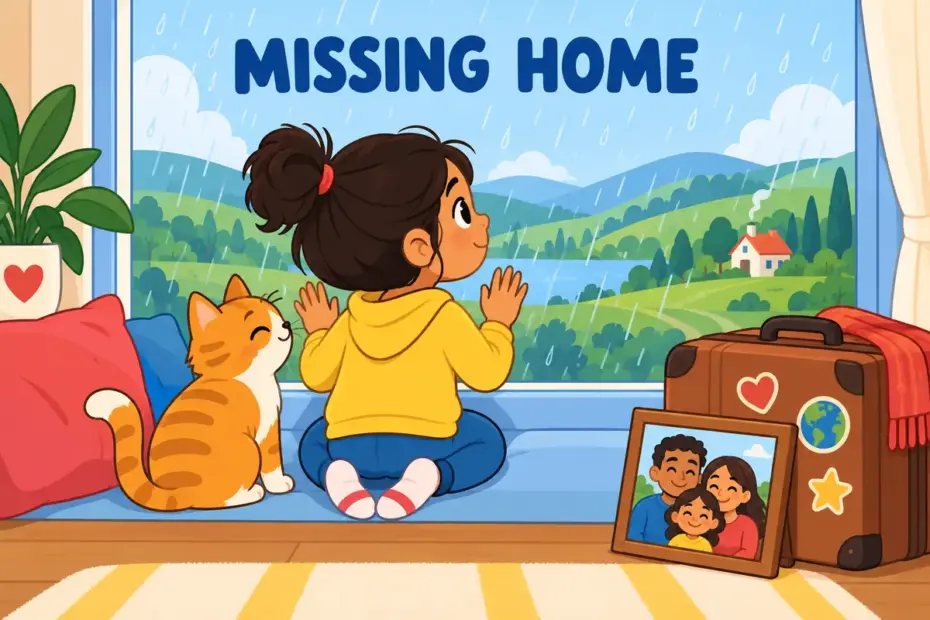
To long for something is to want it deeply, usually because you do not have it. The phrasal verb long for always keeps for before its object: you long for rest, not long rest. Consider “After months away, she longed for home.”
Long for at a glance
- Long for is a phrasal verb made of the verb long plus the preposition for, and the two words never separate.
- The meaning is to want something you do not have, often something lost, far away or out of reach.
- Its forms are long for, longs for, longed for and longing for.
- Common objects are home, peace, freedom, summer, a change and the past.
- The register is reflective and literary, so it suits essays and letters more than casual talk.
- The commonest error is dropping for: you long for a thing, never long a thing.
What does long for mean?
Long for is a phrasal verb meaning to want something very much, especially something absent, lost or hard to reach. The Cambridge entry for long for records this bare verb-plus-preposition form, and it is the only shape the expression takes in standard English. Two senses matter in practice. The first is an emotional wish for something missing; the second is a steady desire for a change or a condition you cannot yet have. The word keeps the ache of absence, which is why it fits poetry and letters so well.
| Sense | Plain meaning | Example sentence |
|---|---|---|
| Wish for something absent | Want a person, place or thing you miss | The sailors longed for home. |
| Desire for a change | Want a different state or condition | Everyone longed for rain. |
| Wistful memory | Want a past time to return | He longs for the summers of his childhood. |
Near-synonyms such as yearn for and pine for add a sharper note of ache, while crave points at a stronger, often physical need. Use long for only when the object is absent or not yet yours. If an event is planned and likely, look forward to is the natural choice, and if you simply want a plain fact stated, want is enough.
How do you use long for in a sentence?
Long for is a prepositional phrasal verb: the word for is a preposition, not a movable particle, so the two words stay locked together and the object always follows for. That single fact explains why the verb is inseparable and why it rarely appears in the passive. The patterns below cover almost every sentence you will need.
| Pattern | Example | What it signals |
|---|---|---|
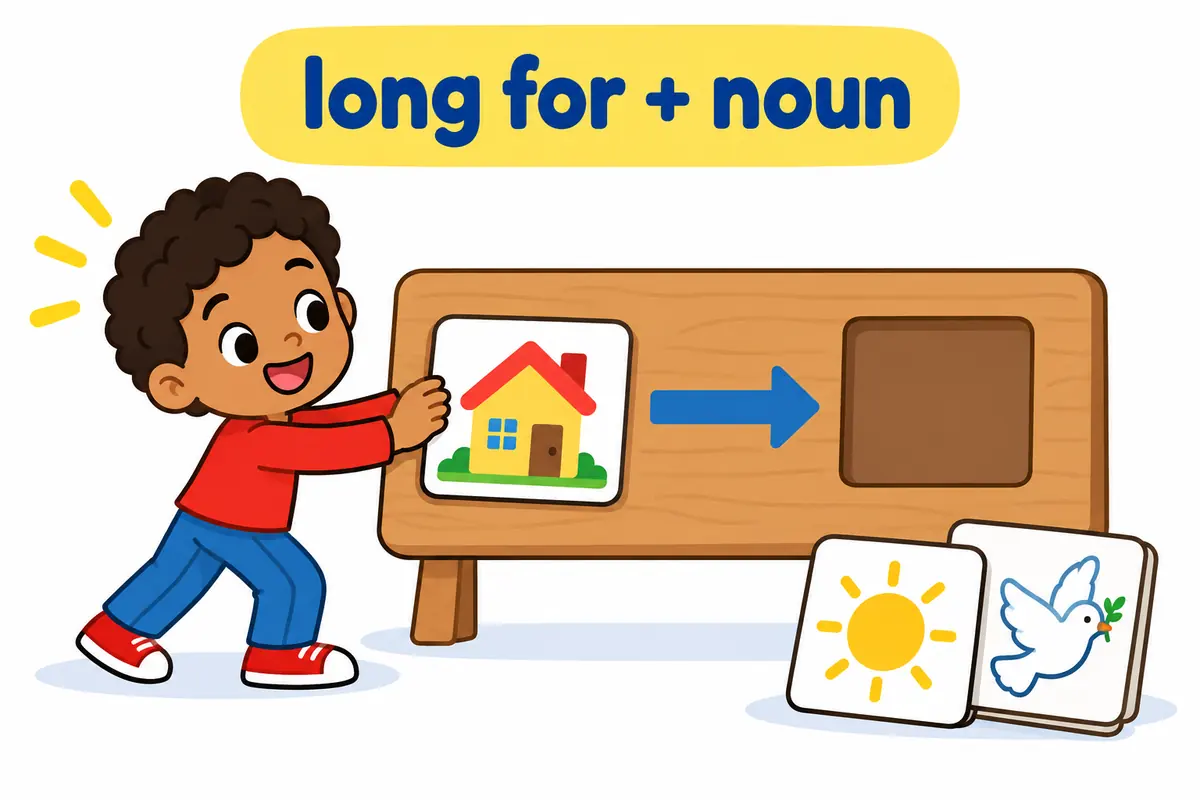
| long for + noun | The children longed for snow. | A simple wish for an absent thing |
| long for + the + noun | He longed for the quiet of the old house. | A specific, remembered state |
| long for + object + to + verb | She longed for the day to end. | A wish for an event or change |
| long to + verb (no for) | They longed to see the sea again. | Desire focused on an action |
| have / has longed for + noun | We have longed for rain all summer. | An ongoing, patient desire |
Other for-phrasal verbs keep the same fixed order, including ask for and call for, so the pattern is worth learning as a family. You cannot move for to the end, and you cannot insert the object between long and for.
Long for in a sentence: examples across contexts
Long for changes colour with its setting: private in a diary, public in a headline, analytical in an essay. The table shows the same verb carrying different weight in eight real registers.
| Context | Example sentence | Why this works |
|---|---|---|
| Everyday conversation | I have been longing for a quiet weekend. | Present perfect shows a desire that has lasted a while. |
| Personal letter | Grandma says she longs for the sound of the sea. | Reports another person’s inward wish gently. |
| Diary entry | I longed for the summer to arrive. | Past tense plus an event gives private longing a timeline. |
| News report | Residents have longed for faster trains for years. | Frames a public, long-standing demand as shared feeling. |
| Academic essay | The poem’s speaker longs for a home that no longer exists. | Names an absence rather than an object, which suits literary analysis. |
| Workplace email | The team longs for clearer briefs from the client. | Softer than demand, but still records a real gap. |
| Travel writing | After a week of rain, we longed for sun. | Ties the wish to a place and a sensory contrast. |
| Headline | Village Longs for Its Library Back | Compresses a public longing into four words. |
Long for vs look forward to
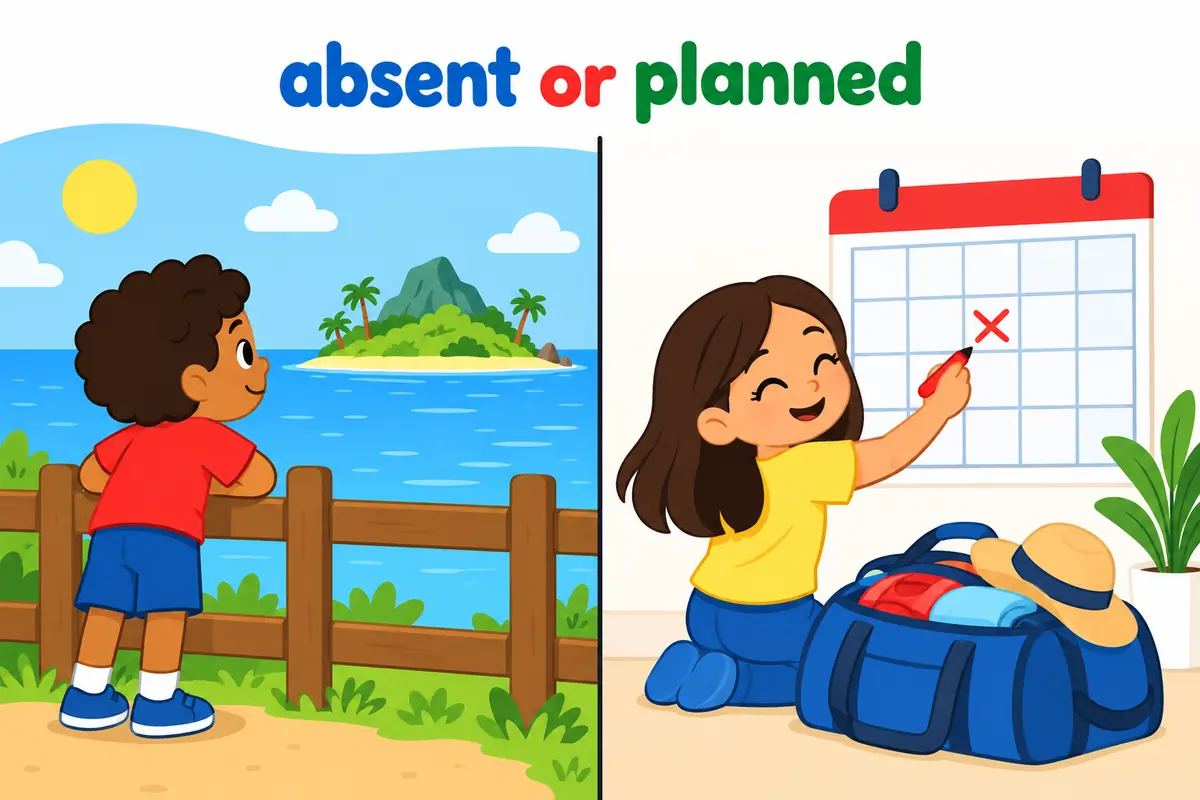
The word learners most often swap with long for is the phrase look forward to, because both express a happy pull toward something. They divide cleanly by whether the thing is absent or planned.
| Attribute | Long for | Look forward to |
|---|---|---|
| Core meaning | Want something you lack or cannot reach | Expect a planned or likely event with pleasure |
| Feeling | A wistful, sometimes painful ache | Bright, comfortable anticipation |
| Typical object | Home, peace, rain, a lost time | A date, a trip, a meeting, a holiday |
| Certainty | Uncertain or impossible | Arranged or very likely |
| Time focus | A far-off or past time | A fixed point in the near future |
| Register | Literary and reflective | Neutral, common in speech and email |
Choose long for when the thing is missing or out of reach, and look forward to when it is already on the calendar. A wish is the plainer verb to fall back on when the object could be either.
Word forms and grammar of long for
The verb long is regular, but it competes with an adjective and a noun spelled the same way, so the table marks each form by its job.
| Form | Part of speech | Example |
|---|---|---|
| long for | Base phrasal verb | I long for quiet. |
| longs for | Third-person singular | She longs for news. |
| longed for | Past tense and past participle | They longed for rain. |
| longing for | Present participle | He is longing for Friday. |
| long to | Verb plus infinitive, no for | We long to travel. |
| longing | Noun with the same spelling | A deep longing for home. |
| long for to see | Non-standard | Avoid; write long to see instead. |
Common mistakes with long for
- Incorrect: She longs peace and quiet. Correct: She longs for peace and quiet. Rule: long needs the preposition for before a noun object.
- Incorrect: He longed for to see his family. Correct: He longed to see his family. Rule: use long to plus a verb, and never for to.
- Incorrect: Home was longed for by the soldiers. Correct: The soldiers longed for home. Rule: this prepositional verb resists the passive, so keep the person as the subject.
- Incorrect: We are longing for the meeting next Tuesday. Correct: We are looking forward to the meeting next Tuesday. Rule: a planned event takes look forward to; long for suits what is absent.
- Incorrect: They longed for. Correct: They longed for silence. Rule: for must have an object, so never let it dangle.
- Incorrect: The children longs for summer. Correct: The children long for summer. Rule: a plural subject takes the base form long, not longs.
Practice using long for
- Fill in the blank: After three weeks of rain, the hikers ______ sunshine every morning.
- Choose the better word: We are ______ the concert on Friday. (longing for / looking forward to)
- Correct the error: She longs peace and quiet.
- Build a sentence: use long for + the day + a verb to describe a child waiting for school holidays.
- Spot the register: which sentence belongs in a formal letter? (a) I’m dying for a break. (b) I long for a short rest.
- Fill in the blank: The poem’s speaker ______ a country she has never seen.
Answers
- longed for — the past time phrase and the plural subject call for the past form.
- looking forward to — a scheduled event takes look forward to, not long for.
- She longs for peace and quiet. — the verb requires for before its object.
- Model: The child longs for the day when school ends. — long for takes a noun phrase plus a relative clause.
- (b) I long for a short rest. — long for suits a formal, reflective register; dying for is informal.
- longs for — a singular subject takes the -s form.
The bottom line
Long for is the verb to reach for when you want something absent or out of reach, and it keeps for locked before its object at all times. Choose it for reflective, literary and formal writing, and choose look forward to when the thing is already planned. Remember that long for in a sentence never separates and never takes for to before a verb.
Frequently asked questions about long for
What is the past tense of long for?
The past tense is longed for, as in “They longed for rain all summer.” Long for follows the regular pattern, so the -ed ending attaches to long and the preposition for stays in place. The third-person singular is longs for, and the present participle is longing for. None of these forms ever separates the two words.
Does long for take an object?
Yes. Long for is a prepositional phrasal verb, so for must be followed by a noun, pronoun or noun phrase: long for home, long for peace, long for a change. You cannot drop the object or leave for dangling at the end. When you want to express an action rather than a thing, switch to long to plus a verb.
Is long for formal or informal?
Long for sits in reflective, literary and formal writing such as essays, letters and news features. In casual speech, want, wish for or be dying for usually sound more natural. The first-person present, I long for, still appears in speech, but the third-person forms now read as slightly literary.
What are some synonyms of long for?
Close synonyms include yearn for, pine for, hanker after and crave. Yearn for and pine for stress a wistful ache, hanker after suggests a restless urge, and crave points at a strong bodily or emotional need. Choose long for when you want a steady, dignified wish for something absent.
Have you ever found yourself yearning for something out of reach? To “long for” something means to deeply desire or crave it, often with a sense of yearning or nostalgia. This common phrase describes the feeling of strongly wishing for something that seems unattainable.
“Long for” is a powerful expression that conveys a strong emotional longing or desire. It captures the essence of yearning for something beyond one’s grasp, whether it be a person, a place, a memory, or a dream. This sentiment is universal and can be felt in various aspects of our lives, drawing on emotions of longing, nostalgia, and hope.
7 Examples Of Long For Used In a Sentence For Kids
- I long for a big slice of mango on a hot day.
- She longs for her best friend to come and play.
- We long for the weekend so we can relax and have fun.
- He longs for his favorite toy that he left at home.
- They long for a delicious snack after school.
- The cat longs for a cozy spot by the window.
- The flowers long for rain to help them grow tall.
14 Sentences with Long For Examples
- Long for a break from all the assignments and exams.
- Sometimes, we long for home-cooked food while living in a hostel.
- As a student, we long for meaningful conversations with like-minded individuals.
- Many students long for the freedom to choose their own schedule.
- After a long day of classes, students often long for a good night’s sleep.
- Some students long for a chance to explore their creative side outside of academics.
- It’s common for students to long for a more interactive learning environment.
- During exam season, many students long for a stress-free day without any studying.
- While studying for hours, students might long for a distraction to break the monotony.
- College students often long for opportunities to travel and experience new things.
- As college comes to an end, students long for a successful career ahead.
- Students who are passionate about a particular subject may long for in-depth discussions in class.
- Being away from home, students may long for familiar faces and surroundings.
- In the midst of all the chaos, students may long for moments of peace and tranquility.
How To Use Long For in Sentences?
Long For is a phrasal verb that is used to express a deep desire or strong craving for something. To use Long For in a sentence, follow these simple steps:
-
Identify what you desire: Before using Long For, determine what you long for. This could be a person, a place, an experience, or an object.
-
Formulate your sentence: Once you know what you desire, construct a sentence that includes the subject, the phrasal verb Long For, and the object of your desire. For example: “She has always longed for a peaceful vacation by the beach.”
-
Pay attention to the tense: Depending on the context of your sentence, you may need to adjust the tense of the verb that accompanies Long For. For example, “He longed for her presence during the meeting” (past tense) or “They are longing for a chance to travel abroad” (present continuous tense).
-
Express your emotions: When using Long For, you are conveying a strong emotion or feeling of longing. Make sure your sentence accurately reflects this emotion to convey your desire effectively.
By following these steps, you can effectively use Long For in your sentences to express your deep desires and cravings. Remember to practice incorporating this phrasal verb into your everyday language to become more comfortable with using it.
Conclusion
In conclusion, using sentences with long-form can help provide detailed explanations, offer in-depth analysis, and convey complex ideas effectively. These sentences are valuable tools for authors, academics, and professionals seeking to communicate complex information clearly and comprehensively. By incorporating sentences with long-form, writers can present their ideas with precision, depth, and clarity, enhancing the overall quality and impact of their written work.
Furthermore, sentences with long-form allow for a more nuanced exploration of topics, enabling readers to gain a thorough understanding of the subject matter. Whether used in research papers, reports, or articles, sentences with long-form can help readers grasp intricate concepts, follow logical arguments, and engage with the content at a deeper level. Embracing sentences with long-form writing can enhance communication and ensure a more thorough and effective transfer of knowledge and ideas.


