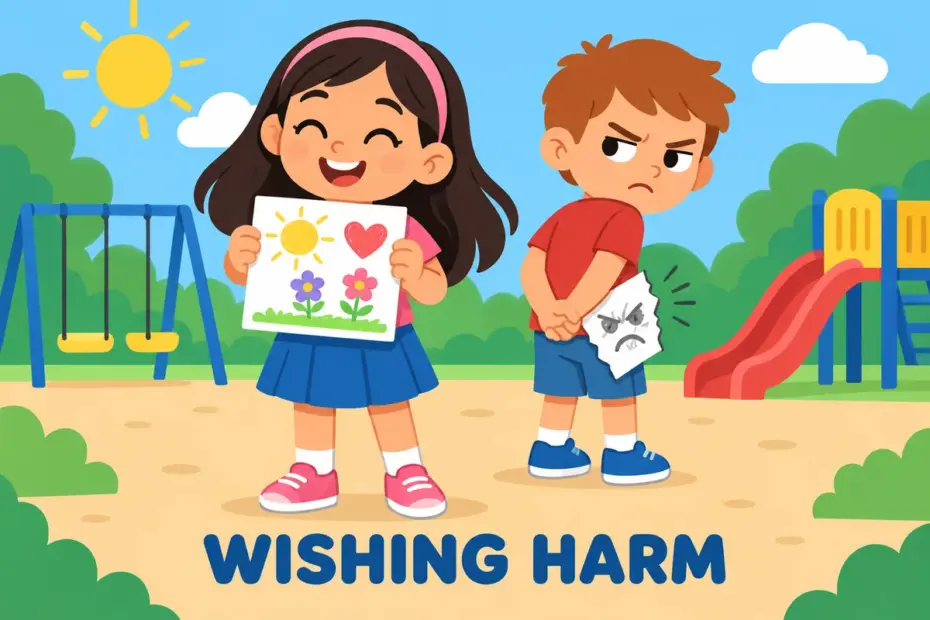
Malevolent means wishing harm to others or showing a settled intention to do evil. To use malevolent in a sentence, keep it before the noun it colours: “She gave the newcomer a malevolent look.” The adjective describes an attitude or an expression, not a single act.
Malevolent at a glance
- Malevolent is an adjective meaning wishing harm; its noun is malevolence and its adverb malevolently.
- It most often modifies look, smile, glare, plan, force and figure.
- Malevolent describes a lasting disposition or a look that suggests one, not one isolated deed.
- It belongs to literary, journalistic and formal writing rather than everyday speech.
- The commonest error is confusing malevolent with malicious, which names a specific harmful act.
What does malevolent mean?
Malevolent is an adjective meaning wishing or showing a wish to harm others. The Cambridge entry for malevolent gives the core sense of causing harm or wanting to do evil. It has two working uses: a person or group can be malevolent, and a look, smile or silence can be malevolent because it reveals that intention.
| Sense | Plain meaning | Example sentence |
|---|---|---|
| Wishing harm | A person wants others to suffer | The malevolent neighbour spread lies for years. |
| Revealing ill will | A look or tone shows the wish to harm | He answered with a malevolent smile. |
| Impersonal evil force | A thing seems to wish us harm | The house had a malevolent presence. |
One limitation matters. Malevolent is not a synonym for evil in general, and it does not describe harm that is accidental or indifferent. A careless driver is not malevolent, because the harm is not wanted. For the milder opposite, a benign presence suggests a kindly or harmless force, which is exactly what a malevolent one is not.
How do you use malevolent in a sentence?
Malevolent works like most adjectives: place it before the noun, or after a linking verb such as seem or become. Five patterns cover nearly every real sentence, and the preposition pattern trips learners because malevolent does not take to.
| Pattern | Example | What it signals |
|---|---|---|
| malevolent + noun | A malevolent force haunted the old mill. | Attaches the ill will directly to the thing. |
| malevolent + look / smile / glare | She shot him a malevolent glare. | The commonest use: an expression betraying intent. |
| seem / become malevolent | The silence seemed malevolent. | Places the word after a linking verb to colour a mood. |
| malevolent toward + person | The rival was malevolent toward anyone who succeeded. | Names the target of the ill will. |
| more / most malevolent | His was the most malevolent laugh of all. | Comparison with more, never malevolenter. |
The practitioner rule is simple: if you can swap in wishing harm without changing the sense, malevolent fits. If the sentence needs a person glaring from the shadows, a sinister presence is often the sharper phrase, because sinister stresses the threat we cannot name.

Malevolent in a sentence: examples across contexts
Malevolent keeps one meaning and shifts its clothing. The nine sentences below run from a bedtime story to a legal argument, and each names what carries the ill will.
| Context | Example sentence | Why this works |
|---|---|---|
| Storytelling | The malevolent giant hoarded the river’s water. | A concrete desire explains the villain’s motive. |
| Classroom | Nobody liked the malevolent trick of hiding the class hamster. | Shows the wish to cause distress, not mere mischief. |
| Workplace email | We must not mistake firm management for a malevolent agenda. | Formal writing uses the adjective to deny a charge. |
| News report | Police described a malevolent campaign of harassment. | Signals a sustained intention to harm. |
| Literary analysis | The fog is malevolent because it seems to steer ships onto rocks. | Ascribes intention to a setting. |
| Legal writing | The plaintiff alleged a malevolent scheme to ruin her business. | Frames intent as the heart of the claim. |
| Film review | Her malevolent calm is scarier than any shouting. | Applies the word to a controlled demeanour. |
| Conversation | That was a malevolent thing to say about a child. | Even in speech the word marks intended cruelty. |
| Academic prose | Later historians rejected the idea of a malevolent state. | Uses the word as a claim about collective intent. |
Malevolent vs malicious
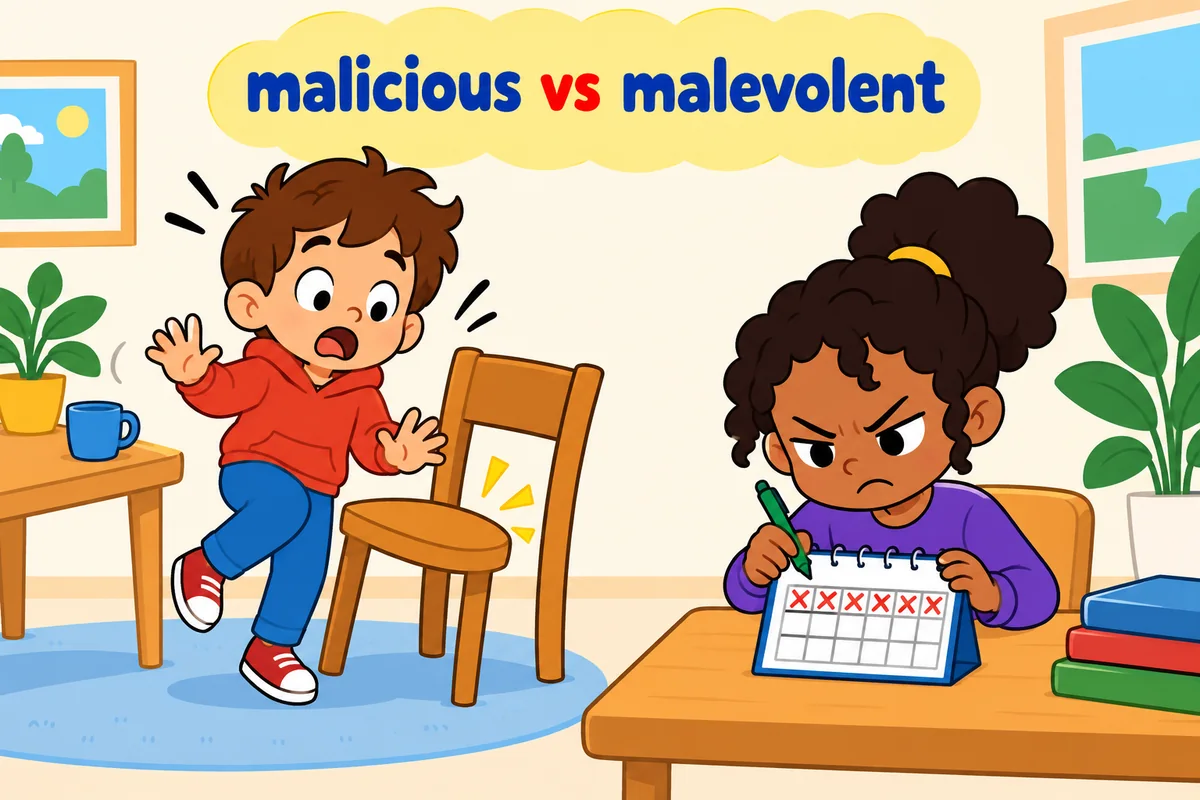
Malevolent and malicious share the Latin root for bad, and learners swap them at once. The difference is scope. Malevolent is a disposition, a settled wish to harm; malicious names a particular harmful act or its intent. A person can be malevolent all year and perform one malicious deed. The medical adjective a malignant growth shares the root again but describes an uncontrolled disease, never a mood.
| Attribute | malevolent | malicious |
|---|---|---|
| Core idea | A wish to harm | An act or intent to harm |
| Scope | Lasting disposition or mood | A specific deed or plan |
| Typical noun | Look, smile, force, presence | Act, gossip, code, damage |
| Duration | Ongoing | Bounded to one event |
| Register | Literary and formal | Neutral to legal |
Verdict: choose malevolent for the person who wishes harm and malicious for the act that carries it out. If you need a verb, malign intent names the speaking of harmful falsehoods rather than the desire behind them.
Word forms and grammar of malevolent
Malevolent inflects regularly, and its noun is common in reviews and analysis. The table also lists the form learners invent by mistake.
| Form | Part of speech | Example |
|---|---|---|
| malevolent | adjective | The stare was malevolent. |
| more malevolent | comparative adjective | His tone grew more malevolent. |
| most malevolent | superlative adjective | It was the most malevolent silence she could recall. |
| malevolently | adverb | He smiled malevolently. |
| malevolence | noun | The malevolence in his voice shocked the room. |
| malevolenter | non-standard | Use more malevolent instead. |
Its noun malevolence names the quality itself and is common in fiction and film criticism.
Common mistakes with malevolent
- Incorrect:
The storm was malevolent and destroyed three houses.Correct: The storm was destructive and destroyed three houses. Rule: Malevolent needs intent; weather has none, so use destructive or fierce. - Incorrect:
He was malevolent to his brother.Correct: He was malevolent toward his brother. Rule: The adjective takes toward or towards, not to. - Incorrect:
Her malevolenter remark hurt everyone.Correct: Her more malevolent remark hurt everyone. Rule: Long adjectives compare with more, never -er. - Incorrect:
The mistake was malevolent.Correct: The mistake was careless. Rule: Malevolent requires a wish to harm; a slip of the pen does not have one.
Practice using malevolent
- Fill the gap: The villain fixed the hero with a ______ stare.
- Choose the better word: Leaving the gate open was (malevolent / careless), not cruel.
- Correct the error: The rival was malevolent to everyone who beat him.
- Build a sentence: use toward with malevolent about a jealous classmate.
- Spot the register: which belongs in a novel — a malevolent hush fell over the room, or things felt kind of evil?
- Rewrite with the noun: The look was malevolent. Use malevolence instead.
Answers
- malevolent — a stare can reveal a wish to harm, so the adjective fits the noun.
- careless — there was no wish to harm, only an accident.
- The rival was malevolent toward everyone who beat him — the adjective takes toward.
- Model answer: The jealous classmate was malevolent toward anyone who won a prize.
- The novel takes a malevolent hush — fiction prefers the single exact adjective.
- The malevolence of the look was obvious — the noun names the quality itself.
The bottom line
Use malevolent in a sentence to describe a person, look or force that wishes harm, and keep it in front of the noun it colours. The two nuances that decide most sentences are these: malevolent is a lasting disposition rather than one deed, and it takes toward instead of to. Where the sentence names a single harmful act, malicious is the more exact word.
Frequently asked questions about malevolent
Is malevolent a strong word?
Yes. Malevolent is stronger than unkind or unfriendly because it states an active wish to harm. It belongs to villains, threats and dark moods rather than to rudeness. Calling a colleague malevolent for a brusque email would overstate the case, while describing a campaign of harassment as malevolent keeps the word at full strength.
Can a place be described as malevolent?
Writers do it often, and it is idiomatic. A house, forest or fog can be malevolent when it seems to will harm, as in a malevolent presence in the attic. The usage works because it borrows intention for a setting, so keep it to fiction, memoir and atmospheric description rather than technical writing.
What is the noun form of malevolent?
The noun is malevolence, meaning the wish to do harm, and it names the quality itself, as in the malevolence in his voice. The adverb is malevolently, and both forms follow the adjective’s tone. Its opposite noun is benevolence, which marks the same divide between wishing harm and wishing good.
How is malevolent different from evil?
Evil names the quality of being morally wrong and can describe acts, systems or outcomes. Malevolent narrows this to a person or force that wants to cause harm. A flood can be evil in a loose sense, but not malevolent, because it holds no intention. Use malevolent whenever the wish to harm is the point.
Have you ever encountered someone with malevolent intentions? The word “malevolent” describes a strong feeling or intention to do evil or harm to others.
In various literature and media, malevolent characters are often portrayed as villains seeking to cause chaos and destruction. Their malevolent actions create tension and conflict within the storyline, serving as the antagonists to the protagonist’s journey.
7 Examples Of Malevolent Used In a Sentence For Kids
- The malevolent witch cast a spell on the princess.
- The malevolent dragon tried to scare the brave knight.
- The malevolent ghost haunted the old house.
- The malevolent goblin stole the princess’s crown.
- The malevolent snake hissed at the little mice.
- The malevolent wolf lurked in the dark forest.
- The malevolent wizard turned the prince into a frog.
14 Sentences with Malevolent Examples
- The college gossip spreading malevolent rumors about his classmates was eventually caught and reprimanded by the authorities.
- Some students believe that their malevolent professor is purposely setting impossible tasks to make them fail.
- The malevolent glare from the senior student made the newcomers feel unwelcome and intimidated.
- The rival college team displayed a malevolent attitude throughout the debate, trying to unsettle their opponents.
- The anonymous messages containing malevolent threats led to an investigation by the college authorities.
- The act of sabotage on the science experiment was seen as a malevolent attempt to ruin someone else’s hard work.
- The online comments directed at the student council were filled with malevolent intent, causing distress among the members.
- Some students suspect that the sudden increase in exam difficulty was a malevolent move by the faculty to reduce passing rates.
- The malevolent pranks pulled during the college festival caused chaos and outrage among the participants.
- The political debate turned malevolent when personal attacks were launched against the candidates.
- The professor’s tone became increasingly malevolent as he criticized the students’ lack of effort in their assignments.
- An anonymous letter filled with malevolent accusations caused a rift within the student body.
- The competitive spirit in the college was tainted by acts of malevolent sabotage among the sports teams.
- The atmosphere in the hostel turned malevolent as tensions rose among roommates over trivial matters.
How To Use Malevolent in Sentences?
Malevolent is an adjective used to describe someone or something that has or shows a wish to do evil or harm others. Here is a helpful guide on how to use malevolent in a sentence for beginners:
-
Identify the character: Start by identifying the person, creature, or object that you believe is acting in a harmful or evil way. This could be someone in a story, a figure in mythology, or even a fictional character.
-
Interpret the intention: Consider the intentions of the character or object. Are they seeking to cause harm, create chaos, or spread negativity towards others?
-
Form your sentence: Once you have a clear understanding of the malevolent nature of the subject, construct your sentence. For example, “The malevolent witch cast a curse on the village.” This sentence conveys that the witch has harmful intentions towards the village.
-
Context matters: Ensure that the context of your sentence supports the use of the word malevolent. It should clearly show that the subject is acting with malicious intent.
-
Practice makes perfect: The more you practice using malevolent in sentences, the more comfortable you will become with incorporating it into your vocabulary.
Remember, using malevolent effectively can enhance your writing and communication skills by introducing a nuanced word to convey specific meanings.
Conclusion
In conclusion, malevolent intentions are evident in various behaviors and actions that aim to harm others or cause mischief. The malevolent nature of individuals can be seen in their malicious acts, such as spreading rumors to damage someone’s reputation, engaging in deceit to manipulate others, or intentionally causing harm for personal gain. These malevolent tendencies highlight the darker aspects of human behavior and underline the importance of being cautious of malicious intentions in order to protect oneself and others from harm. It is important to recognize and address malevolent behavior to promote a safer and more harmonious environment for all.


