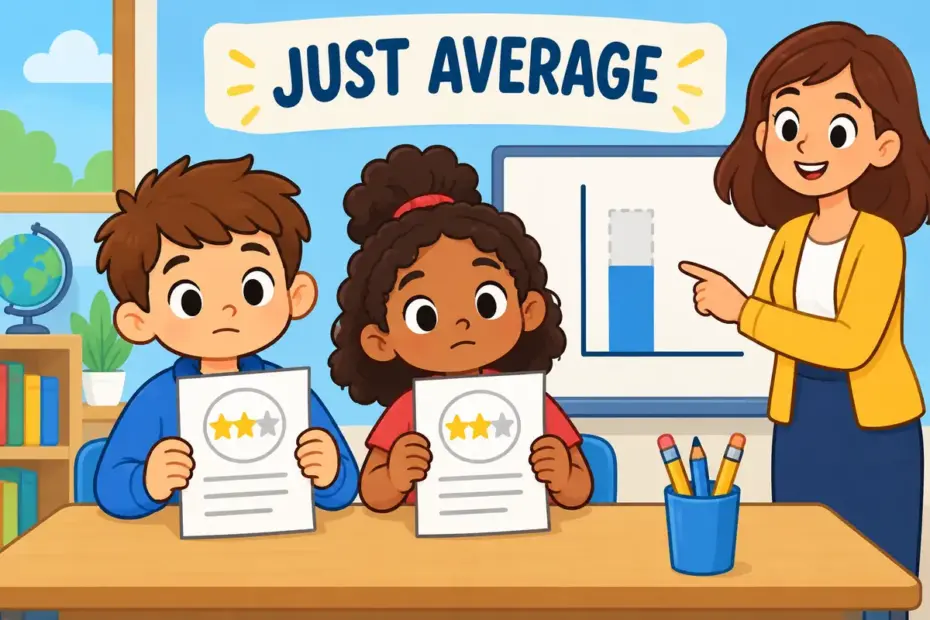
Mediocre describes something that is only average in quality and not good enough to satisfy. To use mediocre in a sentence, place it before a noun or after a linking verb, and let context show the disappointment: “The food was mediocre and overpriced.” The adjective is a judgement, so it rarely stays neutral.
Mediocre at a glance
- Mediocre is an adjective, and it has no natural comparative or superlative forms of its own.
- The usual pattern is mediocre before a noun or after a linking verb such as be, seem or prove.
- It means neither good nor bad, yet it always leans towards disapproval.
- The typical subjects are food, films, performances, results and effort.
- Mediocre is neutral in register but negative in effect, so it fits reviews and reports alike.
- The commonest error is treating it as a mild synonym of average, which stays neutral.
What does mediocre mean?
Mediocre is an adjective meaning of only moderate or middling quality, and it implies that more was expected. The Cambridge entry for mediocre keeps the sense of ordinary quality, while everyday use adds the sting of disappointment. Where a speaker truly means neutral, average is the fairer word, because it reports the middle without judging it.
| Sense | Plain meaning | Example sentence |
|---|---|---|
| Moderate quality | Neither strong nor weak | The band gave a mediocre performance. |
| Falling short | Below the standard that was hoped for | Mediocre results cost the team its place. |
| Undistinguished | Forgettable and unremarkable | It was a mediocre film saved by one scene. |
One limitation is worth stating plainly. Mediocre describes the thing, never the person’s worth: a mediocre meal is forgettable, but calling a colleague mediocre attacks their work and risks real offence. Keep the judgement on the output and name the standard it missed.
How do you use mediocre in a sentence?
Mediocre works like other quality adjectives, but the standard it falls short of usually appears nearby: a mediocre score, a mediocre season, a mediocre attempt at something named in the sentence. Supplying that frame turns a vague insult into a fair judgement.
| Pattern | Example | What it signals |
|---|---|---|
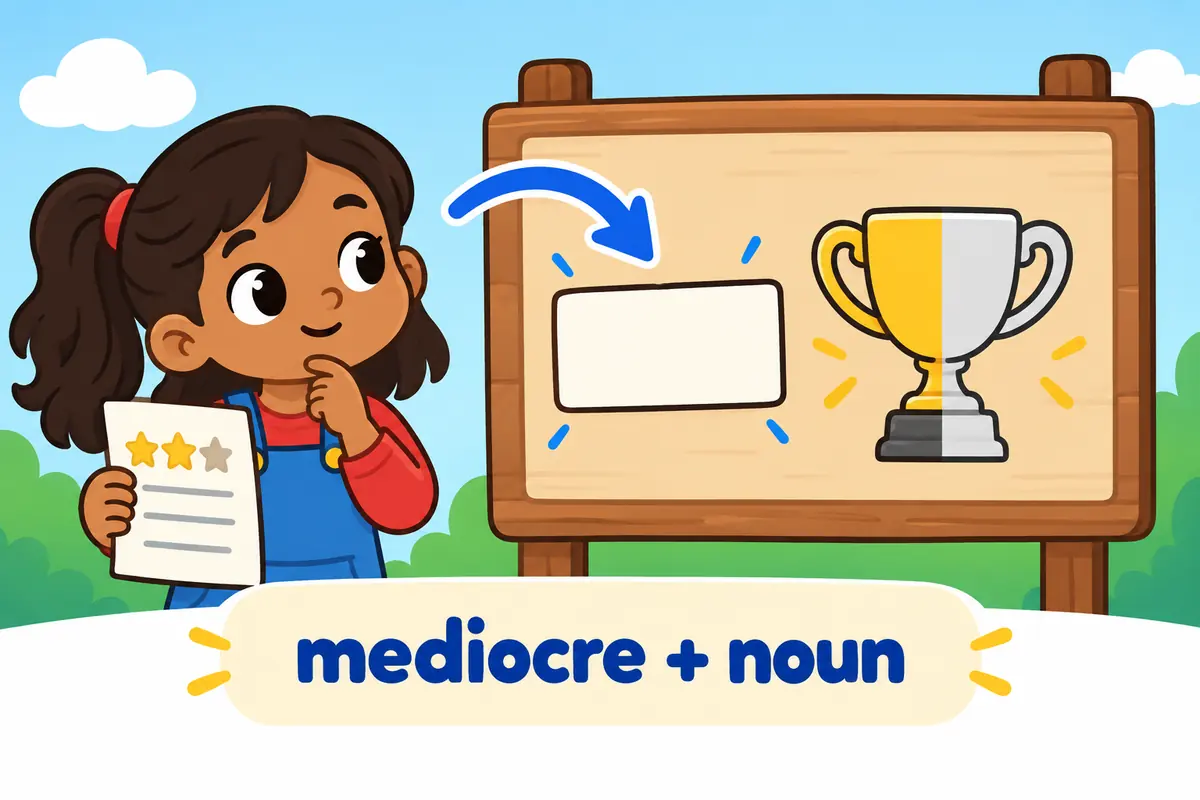
| mediocre + noun | They served a mediocre lunch. | Labels the thing judged in one phrase. |
| be/seem mediocre | The sequel seemed mediocre next to the original. | Uses a linking verb and compares standards. |
| mediocre at + activity | He is mediocre at chess but loves it. | Limits the judgement to one skill. |
| a mediocre + noun + of/in | She gave a mediocre reading of the poem. | Attaches the verdict to a specific attempt. |
| merely mediocre | The first draft was merely mediocre. | Softens the judgement in a longer list. |
Mediocre in a sentence: examples across contexts
Mediocre keeps the same negative charge everywhere, but the context decides how harsh it sounds. The sentences below move from a canteen to a research report, and each one names the thing being judged.
| Context | Example sentence | Why this works |
|---|---|---|
| Classroom | The teacher called the essay mediocre but full of good ideas. | A paired praise keeps the judgement on the work. |
| Restaurant review | Mediocre starters spoiled an otherwise lovely evening. | Contrast sharpens how far the food fell short. |
| Workplace email | We cannot ship a mediocre product to loyal customers. | Names the stakes that make averageness costly. |
| News report | Critics called the festival line-up mediocre. | Attribution keeps the verdict as an opinion. |
| Sports commentary | A mediocre season ended with a narrow escape. | Links the word to a measurable span of time. |
| Film review | The script is mediocre, though the score is wonderful. | A concession shows the word judges one part only. |
| Academic prose | Mediocre data undermined the whole conclusion. | Applies the verdict to evidence rather than people. |
| Conversation | Honestly, the coffee there is mediocre. | The hedge marks it as a personal opinion. |
| Music writing | A mediocre recording can still capture a great night. | Separates technical quality from atmosphere. |
Only the loosest example lacks a named standard. Whenever mediocre judges a person rather than a thing, the sentence needs a clear reason to avoid sounding like a cheap insult.
Mediocre vs average and middling
Mediocre overlaps with middling and, more distantly, with ordinary. Average sits in the exact middle without judgement, middling suggests a modest position on a scale, and mediocre adds the verdict that the middle was not good enough.
| Attribute | mediocre | average | middling |
|---|---|---|---|
| Core judgement | Disappointing quality | Statistically in the middle | Modest but acceptable |
| Typical subject | Food, work, results | Scores, wages, weather | Quality, effort, success |
| Emotional charge | Negative | Neutral | Mildly negative to neutral |
| Register | Neutral, common in reviews | Neutral and technical | Informal and conversational |
| Implies a standard | Yes, a higher one was expected | No | Sometimes, softly |
Verdict: use average for a neutral middle, middling for a modest position you are stating without much heat, and mediocre when the middle failed to meet an expected standard.
Two nearby words sharpen the choice: inferior judges something as plainly below standard, while passable accepts that it is merely adequate.
Word forms and grammar of mediocre
Mediocre is an adjective with a noun, mediocrity, and an adverb so rare that most writers avoid it. The table also marks a comparative that sounds awkward and a noun learners sometimes place in the wrong slot.
| Form | Part of speech | Example |
|---|---|---|
| mediocre | adjective | It was a mediocre effort at best. |
| mediocrity | noun | The team settled into comfortable mediocrity. |
| mediocrely | adverb, rare | The task was mediocrely done, but safely. |
| more mediocre | comparative, awkward | Reword instead: even weaker than the last attempt. |
Because mediocre already means middle quality, a comparative such as more mediocre sounds odd; writers usually rephrase. Note too that mediocrity names the state, not the person, so a sentence can criticise the result without naming anyone.
Common mistakes with mediocre
- Incorrect:
The room was mediocre expensive.Correct: The room was mediocre and expensive. Rule: Mediocre cannot modify another adjective; join the two judgements with and. - Incorrect:
He is a mediocrity chef.Correct: He is a mediocre chef. Rule: The noun mediocrity cannot stand in the adjective slot before a noun. - Incorrect:
The film was very mediocre.Correct: The film was mediocre. Rule: Mediocre resists degree words because the middle has no extreme to intensify. - Incorrect:
Her mediocre won the race.Correct: Her mediocre time still won the race. Rule: Mediocre is an adjective and must attach to the noun it judges.
Practice using mediocre
Work through the six items, then check the reasoning rather than only the answer.
- Fill the gap: The judges gave the singer a ______ score and moved on.
- Choose the better word: The rainfall was (mediocre / average) for the region in April.
- Correct the error: It was a mediocrity performance by a talented cast.
- Build a sentence: use mediocre at about a friend who is only fair at a sport they enjoy.
- Spot the register: which belongs in a review — the service was mediocre but the setting was lovely, or the service was kind of mediocre?
- Rewrite with the noun: The club has become a mediocre side.
Answers
- mediocre — a quality score that fails an expected standard fits the adjective.
- average — rainfall is a neutral measurement, not a disappointment.
- It was a mediocre performance by a talented cast — the noun cannot modify another noun.
- Model answer: Leo is mediocre at tennis but plays every weekend for fun.
- The service was mediocre but the setting was lovely — published reviews avoid vague hedges.
- The club has sunk into mediocrity — the noun names the state without naming a person.
The bottom line
Use mediocre in a sentence to judge work, food, results or effort that met neither a high standard nor a disaster, and name the standard it quietly missed. The two nuances that decide most uses are these: the word always leans negative even though it means average, and it should judge the output rather than a person’s worth. Where you mean a neutral middle, unremarkable is often the fairer choice.
Frequently asked questions about mediocre
Is mediocre the same as average?
They describe a similar position but carry different feelings. Average reports the middle of a range and stays neutral, so an average wage is simply typical. Mediocre keeps the middle meaning but adds the judgement that the result fell short of what was hoped for. Choose average for figures and mediocre for disappointed expectations.
Is mediocre an insult?
It can be, especially when it judges a person rather than a product. Applied to food, a film or a draft, it is a fair critical verdict. Applied to a colleague or a child, it attacks worth and sounds harsh. Keeping the word on the work, and naming the standard it missed, makes the criticism defensible.
Can you say more mediocre or very mediocre?
Both sound awkward because mediocre already names the middle of a scale, leaving no clear extreme to intensify. Writers usually rephrase, saying weaker, even more disappointing or worse than the last attempt. If a degree word feels natural in your sentence, mediocre is probably not the exact word you want.
What part of speech is mediocre?
Mediocre is an adjective, so it describes a noun or follows a linking verb such as be, seem or prove. Its noun is mediocrity, as in the team settled into mediocrity, and its adverb, mediocrely, is so rare that most writers avoid it. There is no standard verb form and no plural.
Do you struggle to distinguish between a mediocre sentence and a great one? Understanding what makes a sentence mediocre can be the first step towards improving your writing. When a sentence is mediocre, it lacks impact or clarity, failing to engage the reader and convey a clear message.
A mediocre sentence often lacks creativity, is overly simplistic, and may contain common grammatical errors. It fails to captivate the audience or effectively communicate the writer’s ideas. By recognizing the characteristics of a mediocre sentence, you can enhance your writing skills and elevate the quality of your work.
7 Examples Of Mediocre Used In a Sentence For Kids
- My drawing was mediocre but I’m proud of it!
- Let’s practice more so we can improve and not be mediocre.
- It’s okay to be mediocre sometimes, we can always try our best next time.
- We can work together to make our project better than mediocre.
- Even if our performance was mediocre, we had fun trying!
- Everyone has mediocre days, but tomorrow will be better.
- Remember, it’s okay to be mediocre at something new, we learn as we go!
14 Sentences with Mediocre Examples
- Students should strive for excellence in their academics rather than settling for mediocre grades.
- It is important for college students to continuously improve in order to not remain at a mediocre level of performance.
- Some students may be satisfied with mediocre results, but it is crucial to aim for higher achievements.
- Attending classes regularly is crucial in order to avoid falling into a pattern of mediocre academic performance.
- Taking advantage of resources such as tutoring services can help students improve from a mediocre level.
- Participating in extracurricular activities can enhance a student’s college experience and prevent them from becoming mediocre.
- Writing assignments hastily can result in mediocre grades, so it’s important to put in the necessary effort.
- Setting academic goals can motivate students to strive for excellence rather than settling for mediocre outcomes.
- It is common for students to face challenges in their studies, but pushing through them can prevent them from accepting a mediocre performance.
- Seeking feedback from professors can help students identify areas where they may be performing at a mediocre level.
- Establishing a study routine can prevent students from falling into a pattern of mediocre study habits.
- Collaborating with classmates on group projects can help prevent the group from producing a mediocre final product.
- Exploring different study techniques can help students break out of a mediocre study routine and improve their academic performance.
- Adopting a growth mindset can help students overcome feelings of mediocre abilities and strive for continuous improvement.
How To Use Mediocre in Sentences?
Mediocre is a descriptive word used to refer to something that is of average or ordinary quality. It is often used to describe things that are not impressive or exceptional but are also not particularly terrible.
To use Mediocre in a sentence, you can say something like, “The movie received mixed reviews because many viewers found it to be mediocre in terms of its plot and acting.” In this sentence, Mediocre is used to convey that the movie was not exceptional but also not terrible.
Another example could be, “Despite his hard work, his performance in the competition was deemed mediocre compared to the other contestants.” Here, Mediocre is used to suggest that the performance was average or ordinary.
When using Mediocre in a sentence, it is important to remember that it is typically used to describe things that are not outstanding but also not terrible. It is a useful word for conveying the idea that something is just average or unremarkable.
In summary, Mediocre is a word that is used to describe things that are average or ordinary in quality. By using it in a sentence, you can convey the idea that something is not exceptional but also not terrible.
Conclusion
In conclusion, sentences with mediocre quality lack depth, clarity, or impact, failing to engage and effectively communicate ideas. When sentences are mediocre, they may be forgettable, uninspiring, or fail to convey the intended message clearly. It is crucial to strive for excellence in sentence construction to enhance understanding, retention, and overall effectiveness of communication.
Improving sentence quality involves choosing precise words, structuring sentences cohesively, and ensuring they accurately convey the intended meaning. By being mindful of sentence construction and avoiding mediocrity, writers can elevate their writing to effectively engage readers, convey ideas convincingly, and leave a lasting impression.


