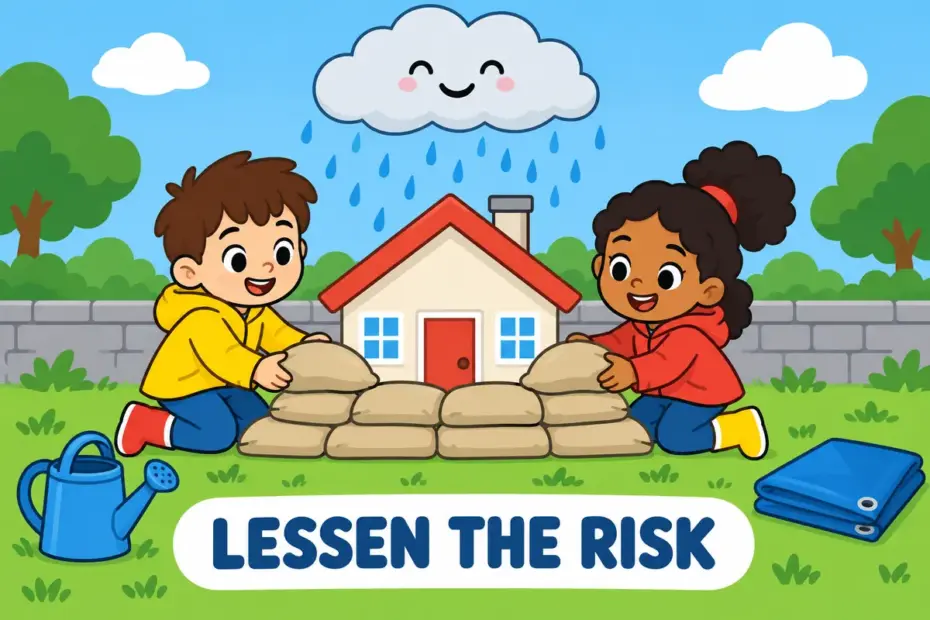
Mitigate means to make something harmful or unwelcome less severe, so a measure that mitigates risk reduces its impact. To use mitigate in a sentence, name the harm in the object position, as in “Sandbags mitigated the flood damage.” The verb is transitive and belongs to planning, law and technical writing.
Mitigate at a glance
- Mitigate is a transitive verb; its forms are mitigates, mitigated, mitigating and mitigation.
- It means to make a harm such as risk, damage or impact less severe.
- The usual subjects are measures, rules, design features and careful planning.
- Mitigate belongs to formal, technical and legal writing rather than conversation.
- The commonest error is mixing it up with militate, which needs against.
- Mitigating circumstances in law reduce blame without removing it.
What does mitigate mean?
Mitigate is a transitive verb meaning to make something harmful or unwelcome less severe. The Cambridge entry for mitigate gives that core sense of reducing severity, and it covers three related uses: lowering a risk, softening an impact, and, in law, reducing blame. Where the harm is physical pain, alleviate the pain is the closer verb.
| Sense | Plain meaning | Example sentence |
|---|---|---|
| Reduce a risk | Make a hazard less likely to cause harm | Floodgates mitigate the risk downstream. |
| Soften an impact | Make a bad effect less damaging | Insulation mitigates the noise from the road. |
| Reduce blame (legal) | Give reasons that lower responsibility | The evidence mitigated his part in the offence. |
One limitation deserves stating plainly. Mitigate never means prevent: it reduces how bad a harm is, not whether it happens, so a measure that mitigates flooding still leaves water in the street. When prevention is the claim, use prevent or avoid, and when the harm must vanish, eliminate is the honest verb.
How do you use mitigate in a sentence?
Name the harm in the object position and let the measure be the subject: a barrier mitigates damage, planning mitigates risk. The verb is almost always transitive and active, though the passive keeps attention on the harm when the remedy is obvious.
| Pattern | Example | What it signals |
|---|---|---|
| mitigate + risk, damage or impact | The barrier mitigated the damage. | The direct object is the harm itself. |
| mitigate + the impact of | Roofs mitigate the impact of heavy rain. | Common with an of-phrase naming the cause. |
| measures to mitigate + noun | The council approved measures to mitigate flooding. | A purpose infinitive in policy register. |
| be mitigated by or through | The loss was mitigated by insurance. | Passive voice, with the remedy after by. |
| mitigate + harm to | The rule mitigates harm to tenants. | Names who benefits in a to-phrase. |
Mitigate never takes against or for: those prepositions belong to other verbs. Where the aim is simply a smaller number, reduce the impact says the same thing in plainer words.
Mitigate in a sentence: examples across contexts
Mitigate keeps its formal, technical flavour in every register; the nine sentences below move from a classroom to a planning document, and each pairs a measure with the harm it lowers.
| Context | Example sentence | Why this works |
|---|---|---|
| Classroom | Thick curtains mitigated the glare that made the whiteboard hard to read. | Names a measure and the specific harm. |
| Workplace email | Extra checks mitigated the risk of shipping the wrong order. | Formal, risk-focused subject. |
| News report | The reservoir mitigated the drought’s effect on nearby farms. | Concrete cause and measured effect. |
| Legal writing | The judge considered evidence that mitigated the offence. | Uses the legal reduce-blame sense. |
| Engineering report | Flexible joints mitigate the stress on the bridge deck. | A technical present-tense pattern. |
| Environmental writing | Planting mangroves mitigates coastal erosion during storms. | Signals ongoing risk reduction. |
| Academic prose | The study asked whether tariffs mitigated the shock to local wages. | Frames mitigation as a research question. |
| Planning document | New drains will mitigate flooding in the low streets. | A future measure against a hazard. |
| Conversation | An early night mitigated the jet lag. | An everyday remedy in a lighter register. |
Only the last sentence drops into casual speech, and even there the verb keeps its careful tone. That consistency is why the word appears so often in risk assessments, where every claim about harm must be hedged precisely.
Mitigate vs alleviate and diminish
Mitigate overlaps with two close verbs and matches neither. diminish means to grow smaller, alleviate means to ease a burden, and mitigate means to reduce the severity of harm before or during it. Each points at a different object.
| Attribute | mitigate | alleviate | diminish |
|---|---|---|---|
| Core job | Make harm less severe | Ease pain or hardship | Make something smaller |
| Usual object | risk, damage, impact | pain, pressure, poverty | numbers, sound, value |
| Typical subject | a measure, rule or design | medicine, money, policy | time, distance, use |
| Removes the cause? | No | No | Not necessarily |
| Register | Formal, technical, legal | Neutral to formal | Neutral |
| Common collocation | mitigate the risk | alleviate suffering | diminish the effect |
Verdict: choose diminish for size, alleviate for comfort, and mitigate when a hazard is made less damaging. For fear rather than harm, allay the fears is the closer verb.
Word forms and grammar of mitigate
Mitigate inflects regularly, and its noun mitigation appears often in planning and law. The participial adjective mitigating is standard in the fixed phrase mitigating circumstances, where it reduces blame rather than harm.
| Form | Part of speech | Example |
|---|---|---|
| mitigate | verb, base form | Trees mitigate the heat in a courtyard. |
| mitigates | verb, third-person singular | The levy mitigates the shortage. |
| mitigated | verb, past and past participle | Prompt action mitigated the loss. |
| mitigating | verb participle; also adjective | The judge noted mitigating factors. |
| mitigation | noun | The plan offers little mitigation for drivers. |
| mitigable | adjective, technical | The risk is real but mitigable. |
The noun is mitigation, and the adjective mitigative is rare outside specialist writing. Do not build mitigration by analogy with migration, and keep mitigating as an adjective only in the fixed legal phrase.
Common mistakes with mitigate
- Incorrect:
The delay mitigated against a quick finish.Correct: The delay militated against a quick finish. Rule: Militate against means to argue against; mitigate means to make less severe and takes no against. - Incorrect:
The coach mitigated the tired players.Correct: The coach relieved the tired players. Rule: Mitigate takes the harm, not the person who suffers it. - Incorrect:
The dam mitigated for the flood risk.Correct: The dam mitigated the flood risk. Rule: Mitigate is transitive and needs a direct object, never for. - Incorrect:
The seawall mitigated the flooding completely.Correct: The seawall prevented the flooding completely. Rule: Mitigate reduces harm; it does not stop it happening. - Incorrect:
They took steps to mitigate the headache.Correct: They took steps to alleviate the headache. Rule: Pain is alleviated or relieved; mitigate belongs with risk, damage and impact.
Practice using mitigate
Work through the six items, then check the reasoning rather than only the key.
- Fill the gap: A wide brim ______ the glare on the pitch.
- Choose the better word: The extra staff (mitigated / militated) against a long queue at the gate.
- Correct the error: The new rules mitigated for the safety risk.
- Build a sentence: use be mitigated by about a noisy building site.
- Spot the register: which belongs in a risk assessment — the bund mitigates the risk of spillage, or the wall keeps most of the spill away?
- Rewrite with the noun: The drains mitigated the flooding. Use mitigation instead.
Answers
- mitigated — the brim is the measure and the glare is the harm it lowers.
- militated — the staff argued against the queue; mitigated would need the queue as its object.
- The new rules mitigated the safety risk — mitigate takes a direct object, with no for.
- Model answer: The noise was mitigated by a temporary screen around the drills.
- The bund mitigates the risk of spillage — a risk assessment stays technical and names the harm.
- The drains provided some mitigation of the flooding — the noun is uncountable and needs no article.
The bottom line
Use mitigate in a sentence when a measure reduces harm without claiming to stop it, and name the harm itself as the object. The two nuances that decide most sentences are these: mitigate takes risk, damage or impact rather than a person, and militate against is a different verb entirely. Where the force must be softened rather than the count lowered, temper the response is a gentler choice.
Frequently asked questions about mitigate
Does mitigate mean the same as prevent?
Mitigate does not mean prevent. Prevention stops harm from happening, while mitigation reduces how much harm occurs or how badly it lands. A sea wall mitigates flooding because water still rises; a pump that keeps the cellar dry prevents it. Keep the two verbs apart when planning documents matter.
What is the difference between mitigate and militate?
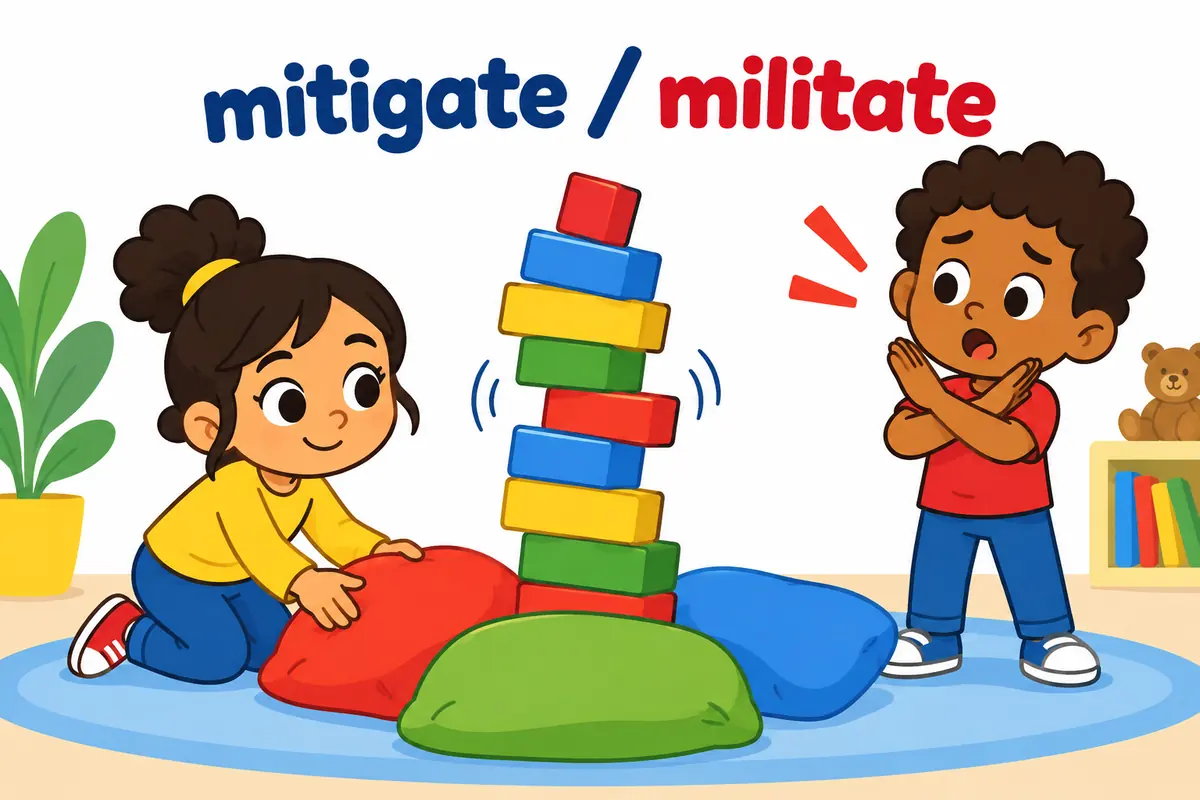
Mitigate means to make something less severe, and it takes a direct object such as risk or damage. Militate means to argue or weigh against something, and it appears in the phrase militate against. The two verbs sound alike, so a spellchecker will not catch the swap, but the grammar differs.
What does mitigating mean in law?
In legal writing, mitigating describes facts that reduce blame without removing it. Mitigating circumstances, such as an early plea or genuine remorse, do not excuse an offence; they lower the penalty a court is likely to impose. The noun is mitigation, and it never means acquittal.
Can mitigate take a person as its object?
Mitigate takes the harm, not the person. Writers say the canopy mitigated the heat or the policy mitigated the risk, never the canopy mitigated the walkers. When a person is protected from hardship, relieved, helped or sheltered fits; mitigate stays with the abstract damage being reduced.
Looking to understand how to use the word “mitigate” effectively in your sentences? Mitigate means to make something less severe, serious, or painful. This versatile word is often used to describe actions taken to reduce the negative impact of a situation.
When you mitigate a problem, you are lessening its intensity or consequences. By incorporating “mitigate” into your vocabulary, you can effectively communicate efforts to alleviate difficulties, manage risks, or minimize adverse effects. Let’s explore how this word can enhance the clarity and precision of your sentences.
7 Examples Of Mitigate Used In a Sentence For Kids
- We can mitigate the heat by drinking lots of water.
- Planting trees helps to mitigate air pollution.
- Wearing a mask can mitigate the spread of germs.
- Eating fruits and vegetables can help mitigate sickness.
- Doing exercises can help mitigate stress.
- Sharing toys with friends can mitigate fights.
- Smiling and saying sorry can mitigate arguments.
14 Sentences with Mitigate Examples
- Mitigate your stress levels by practicing yoga and meditation regularly.
- Make sure to mitigate distractions while studying by turning off your phone and finding a quiet place to focus.
- To mitigate the risk of failing a class, seek help from your professor or a tutor as soon as you start struggling.
- Create a study schedule to mitigate last-minute cramming before exams.
- It’s important to mitigate procrastination by breaking down your tasks into smaller, manageable chunks.
- Join a study group to mitigate feelings of isolation and stay motivated throughout the semester.
- Mitigate financial strain by finding part-time work or applying for scholarships and grants.
- Utilize academic resources such as the library or writing center to mitigate challenges in your coursework.
- Forming healthy habits like eating nutritious meals and exercising regularly can help mitigate the effects of academic stress.
- Participating in extracurricular activities can mitigate feelings of burnout and help you maintain a well-rounded college experience.
- Build a strong support system of friends and mentors to mitigate feelings of loneliness or homesickness.
- Seek guidance from career counselors to mitigate uncertainty about your future after college.
- Keep track of your expenses and create a budget to mitigate financial difficulties during your college years.
- Attend workshops and seminars on time management and organization to mitigate feelings of overwhelm during busy periods in college.
How To Use Mitigate in Sentences?
Mitigate means to make something less severe, serious, or painful. Here is a simple guide on how to use mitigate in a sentence:
-
Identify the problem: Begin by recognizing the issue or challenge that you want to make less severe.
-
Choose the right context: Make sure that the situation calls for reducing the intensity or unpleasantness of something.
-
Use the word accurately: When constructing your sentence, remember to place mitigate in a way that clearly shows its purpose in lessening the impact of the problem.
-
Provide a solution or action: Explain what you are doing or what needs to be done to reduce the severity of the issue.
Example sentence:
– “Adding extra insulation to the walls of the house will help mitigate the effects of the cold weather during winter.”
In this sentence, the word mitigate is used to show that adding extra insulation can lessen the impact of the cold weather on the house, making it a more comfortable environment.
Remember that using mitigate accurately in a sentence can help you effectively communicate your intention to lessen the severity of a situation. With practice and understanding of its meaning, you can effortlessly incorporate this word into your everyday conversations.
Conclusion
In essence, sentences with the keyword “mitigate” serve to show how actions or measures can be taken to reduce the severity, impact, or risk of a particular situation. By using this word in a sentence, one emphasizes the importance of addressing and alleviating negative consequences. Whether referring to climate change, conflict resolution, or financial strategies, the word “mitigate” highlights the proactive steps that can be taken to make situations more manageable and less severe.
Using sentences with “mitigate” effectively communicates a sense of urgency and responsibility towards finding solutions and improving outcomes. It underscores the idea that we have the power to take meaningful steps to lessen the harmful effects of various challenges, offering hope and direction in the face of adversity.


