Mix up is a separable phrasal verb with two everyday jobs: to confuse two things, as in “I mix up the twins,” and to combine things by stirring, as in “mix up the batter.” The object decides which sense is meant, and a pronoun object always lands between the verb and the particle.
Mix up at a glance
- Mix up is a separable phrasal verb; its forms are mixes up, mixed up and mixing up.
- The two main senses are confusing one thing for another and combining things by stirring.
- Typical objects are names, dates, documents, files or batches of ingredients.
- Mix up sits in informal to neutral writing; the hyphenated noun mix-up suits news reports.
- The commonest error is putting a pronoun after the particle: mix up them is wrong.
What does mix up mean?
Mix up is a phrasal verb meaning either to confuse two people or things, or to combine ingredients by stirring them together. The Cambridge entry for mix up records both senses, and the object separates them: you mix up two similar names, but you mix up a bowl of batter. Where the point is only to combine things, blend the flavours is the plainer verb, because mix up also carries the idea of a mistake.
| Sense | Plain meaning | Example sentence |
|---|---|---|
| Confuse | Fail to tell two things apart | I always mix up those two streets. |
| Combine | Put ingredients together into one mixture | Mix up the eggs and sugar first. |
| Involve in trouble | Get drawn into something undesirable | He got mixed up with a betting ring. |
| Noun: mix-up | A mistake or confused situation | A mix-up at the desk sent us to the wrong room. |
One limitation is worth stating plainly. Mix up never means solve or fix: a mix-up is the problem, not the cure. When two things are combined on purpose and no error is implied, mix, combine or blend is the more precise choice.
How do you use mix up in a sentence?
Put the two items into the verb and keep the particle mobile. Mix up is separated by its object, and the pattern table below shows where each sense takes its noun.
| Pattern | Example | What it signals |
|---|---|---|
| mix up + plural object | Teachers mix up our names every September. | The object is two items the speaker cannot tell apart. |
| mix + pronoun + up | Mix them up in the bowl. | A pronoun must sit between the verb and the particle. |
| mix up + object | Mix up a small batch of glue. | The object is the mixture being made. |
| mix A up with B | People mix coriander up with parsley. | Names both items and the confusion between them. |
| get mixed up in or with | She got mixed up in a neighbour’s dispute. | Passive pattern for unwanted involvement. |
Mix up in a sentence: examples across contexts
Mix up keeps its meaning while its register shifts. The nine sentences below move from a classroom to a safety notice, and each one shows whether the word means confuse or combine.
| Context | Example sentence | Why this works |
|---|---|---|
| Classroom | The teacher mixed the two answer sheets up and handed them back wrongly. | Uses the confuse sense with a concrete object. |
| Recipe | Mix up the flour and butter until the dough comes together. | Uses the combine sense as a clear instruction. |
| Workplace email | Please do not mix up the invoices for the two clients again. | Names both documents and the error to avoid. |
| News report | A mix-up in the schedule left two flights boarding at the same gate. | Uses the noun for a public error. |
| Conversation | Sorry, I mixed you up with your sister on the phone. | The A-up-with-B pattern people use in speech. |
| Academic writing | Participants were asked not to mix up the control and test samples. | A precise instruction in methods writing. |
| Customer service | We are sorry we mixed your order up with another delivery. | Formal apology that keeps the split verb. |
| Technical writing | Do not mix up the polarity of the two wires. | A safety instruction where confusion is dangerous. |
| Sports commentary | The referee mixed up the two players and booked the wrong one. | Names a mistaken identity under pressure. |
When only the order is wrong, a writer may prefer to jumble the order instead, which names the arrangement rather than a mistaken identity.
Mix up vs confuse
Mix up overlaps with confuse and is not a direct swap for it. confuse two similar words covers the mental error and the sense of baffling somebody, while mix up adds a combine sense that confuse lacks.
| Attribute | mix up | confuse |
|---|---|---|
| Core meaning | Mistake one thing for another, or combine | Fail to tell the difference |
| Grammar | Phrasal verb, separable, with a noun form | Single transitive verb, no noun form |
| Can mean combine | Yes | No |
| Can mean baffle | No | Yes |
| Register | Informal to neutral | Neutral to formal |
Verdict: choose mix up for the everyday slip and the combine sense, and choose confuse when you mean baffle somebody or want a single formal verb.
Word forms and grammar of mix up
Mix up inflects like any regular verb, and the particle behaves like the one in add up the figures: it can move after a noun object but not after a pronoun. The table also flags the spelling learners get wrong.
| Form | Part of speech | Example |
|---|---|---|
| mix up | base phrasal verb | Please mix up the paints. |
| mixes up | third person singular | He mixes up the twins constantly. |
| mixed up | past and past participle | I mixed up the dates. |
| mixing up | present participle | You are mixing up cause and effect. |
| mix-up | noun, hyphenated | The mix-up delayed the ceremony. |
| mixup | non-standard spelling | Write the noun with a hyphen, never as mixup. |
Common mistakes with mix up
- Incorrect:
Please mix up them.Correct: Please mix them up. Rule: A pronoun object goes between the verb and the particle. - Incorrect:
There was a mixup with the booking.Correct: There was a mix-up with the booking. Rule: The noun takes a hyphen. - Incorrect:
I mixed up with the addresses.Correct: I mixed up the addresses. Rule: The verb takes a direct object; with introduces only the second item in mix A up with B. - Incorrect:
The puzzle mixed me up for an hour.Correct: The puzzle confused me for an hour. Rule: Mix up does not mean baffle; use confuse for that sense. - Incorrect:
We mixed up a plan for the trip.Correct: We drew up a plan for the trip. Rule: Mix up never means plan or prepare a document.
Practice using mix up
Work through the six items, then check the reasoning rather than only the answer.
- Fill the gap: I always ______ the two Jameses in my class.
- Fill the gap: ______ the eggs and sugar before you add the flour.
- Choose the better word: The two files were (mixed up / confused) and sent to the wrong office.
- Correct the error: Can you mix up them for me?
- Build a sentence: use mix A up with B about a coat that looks like a friend’s.
- Spot the register: which fits a polite email — We are sorry we mixed up your booking, or We totally mixed your booking up?
Answers
- mix up — a pronoun-free object lets the particle follow the verb.
- Mix up — the combine sense used as an instruction.
- mixed up — files are mistaken for one another, which is the confuse sense.
- Can you mix them up for me? — the pronoun must sit between verb and particle.
- Model answer: I mixed my coat up with my friend’s because both are blue.
- We are sorry we mixed up your booking — a formal email avoids totally and keeps the verb intact.
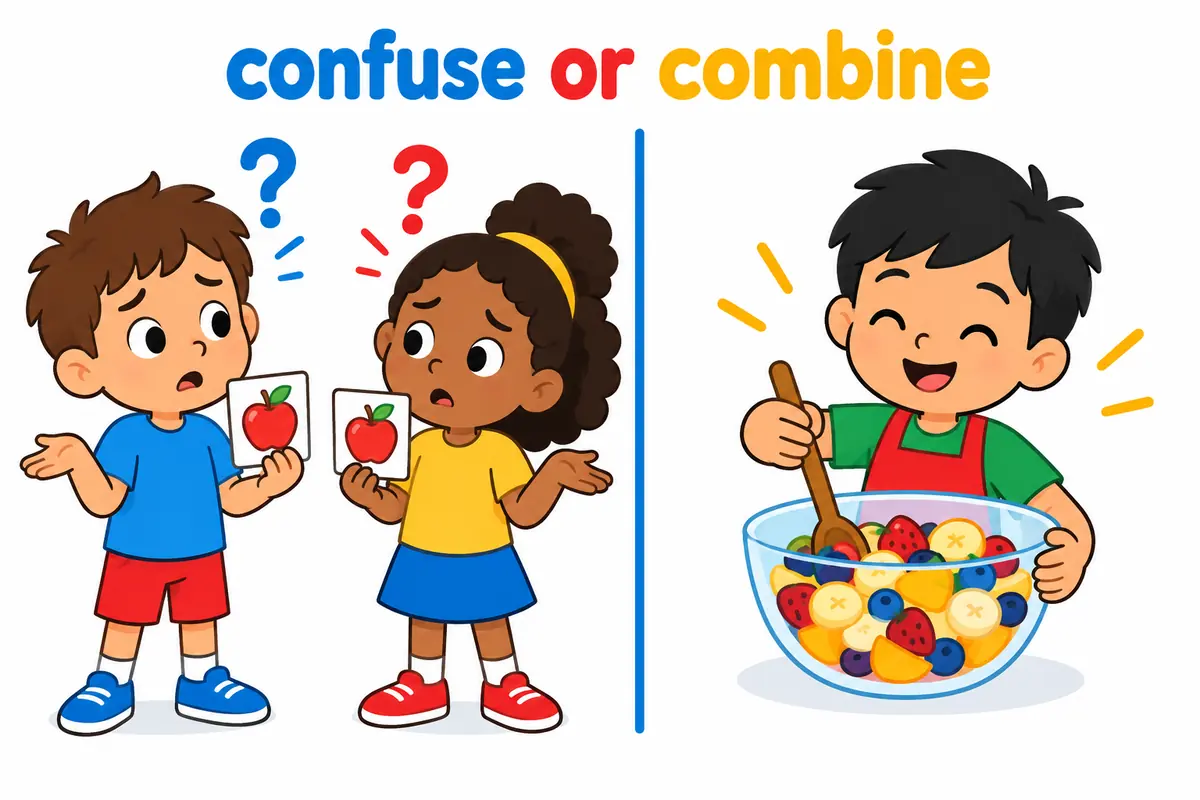
The bottom line
Use mix up in a sentence when two things are mistaken for each other or when ingredients are combined, and keep a pronoun between the verb and the particle. The two nuances that decide most sentences are that the verb is separable and that only the confuse sense means an error. If the mistake has already happened, say so plainly and clarify the instructions rather than repeating them.
Frequently asked questions about mix up
Is mix up one word or two?
The verb is always two words, as in mix up the paints. The noun is one hyphenated word, as in a booking mix-up. Writing the noun as mixup without a hyphen is a common spelling error that dictionaries do not list, so keep the hyphen in every formal document.
What is the difference between mix and mix up?
Mix means to combine things, usually on purpose, as in mix the paint. Mix up adds either an element of mistake, as in mix up two names, or a casual combine sense, as in mix up a cake. Choose mix when no error or separability is involved.
Is mix up formal or informal?
Mix up is informal to neutral, and it appears in conversation, emails and news reports. The hyphenated noun mix-up is common in journalism. In academic or legal writing, confuse or combine is usually the safer choice because the phrasal verb can sound casual.
Can you say mix up them?
No. When the object is a pronoun, it must go between the verb and the particle: mix them up. A full noun phrase may go either side, so mix up the paints and mix the paints up are both correct. The pronoun rule is the one to remember.
Have you ever felt confused about the difference between two similar things? This common phenomenon is called a “mix up,” where one mistakenly confuses or interchanges two separate items, facts, or concepts.
Mix ups can occur easily when similarities between things lead to confusion, causing misunderstandings or mistakes. The key to avoiding mix ups lies in careful attention to details and clear communication. Let’s explore how mix ups happen and strategies to prevent them.
7 Examples Of Mix Up Used In a Sentence For Kids
- Mix up the colors to create a beautiful rainbow.
- Let’s mix up different shapes to make a fun picture.
- Don’t mix up your toys with your friend’s toys.
- We can mix up ingredients to bake a yummy cake.
- Clap your hands and mix up your dance moves.
- It’s fun to mix up different fruits for a tasty salad.
- Can you help me mix up the cards for a card game?
14 Sentences with Mix Up Examples
- Mix up your study schedule to keep things interesting and prevent burnout.
- Don’t mix up your assignment submission dates, make sure to check your syllabus regularly.
- It’s easy to mix up similar-sounding concepts, so take the time to clearly understand them.
- Mix up your group members for projects to gain diverse perspectives and ideas.
- Avoid mixing up your notes from different subjects to stay organized.
- If you feel overwhelmed, take a break and mix things up with a new hobby or activity.
- It’s important not to mix up your sources when citing references in your research papers.
- Don’t mix up the formulas and equations in math and science subjects, practice regularly.
- Mix up your study environment by trying out different cafes or libraries around campus.
- If you mix up your exam timings, it could lead to unnecessary stress and confusion.
- Stay focused during lectures and try not to mix up important points or information.
- Group discussions can help clarify any mix-ups you may have in understanding complex topics.
- Use color-coding or different fonts to avoid mixing up important information in your notes.
- Participate in student-led workshops to learn new study techniques and mix up your routine.
How To Use Mix Up in Sentences?
Mix Up means to blend or combine different elements or things in an unpredictable or random way. Here’s a guide on how to use it in a sentence:
-
Start by identifying the elements or things you want to mix up. This could be anything from ingredients in a recipe to colors in a design.
-
Next, think about how you want to combine these elements. You can mix up the order, the quantity, or even the type of elements you’re using.
-
Once you have a clear idea of how you want to mix up the elements, start putting your plan into action. For example, if you’re mixing up ingredients in a recipe, follow the instructions but feel free to experiment with different combinations.
-
Don’t be afraid to get creative and have fun with it. Mixing up different elements can lead to unexpected and interesting results.
-
Finally, evaluate the outcome of your mix up. If you like the results, you can continue to mix up things in a similar way in the future. If not, you can always try a different approach next time.
By following these steps, you can effectively use Mix Up in a sentence and explore the exciting possibilities of blending different elements in a unique and unpredictable way.
Conclusion
In conclusion, the examples of sentences with “mix up” illustrate a common mistake or confusion resulting in a jumble or error in order or identity. Whether it’s mistakenly switching two items, misunderstanding instructions, or confusing details, a mix-up can lead to misunderstandings and inaccuracies. It serves as a reminder to pay attention to details and communicate clearly to prevent mix-ups that can cause trouble or delays.
By being mindful and double-checking information, we can avoid mix-ups in various situations, be it in tasks at work, following recipes, or organizing events. Clarifying instructions, labeling items clearly, and verifying details can help ensure smooth operations and prevent mix-ups that could lead to unnecessary complications or misunderstandings.


