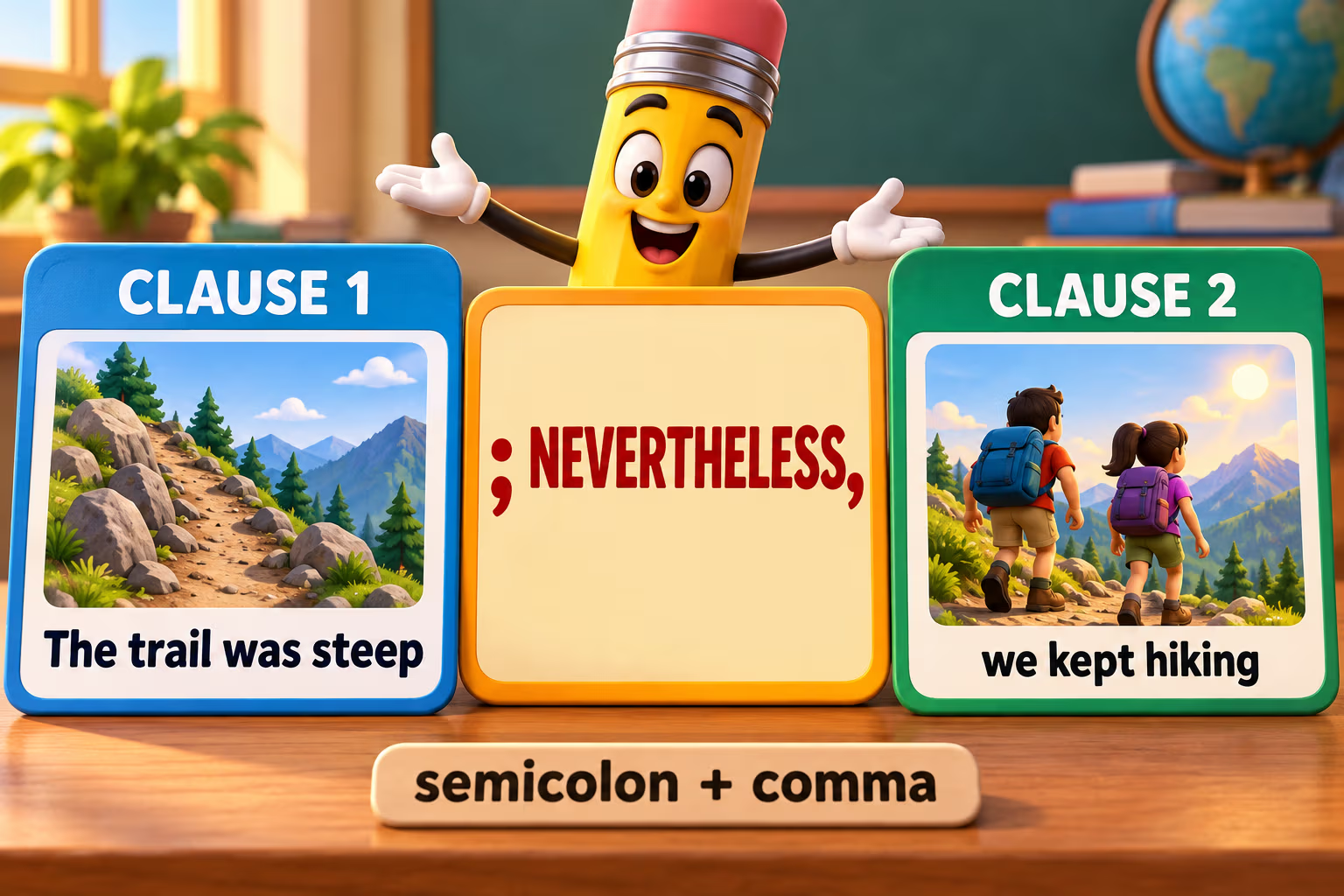
“Nevertheless” is an adverb meaning “despite that” or “in spite of what came before.” Use it to acknowledge one fact and then introduce a contrasting result: “The road was icy; nevertheless, we drove slowly.” Between two independent clauses, place a semicolon before nevertheless and a comma after it, or begin a new sentence.
Nevertheless in a Sentence: Quick Guide
- Meaning: despite that; in spite of what was just mentioned.
- Job: signals that the next point remains true despite an earlier fact or obstacle.
- Between complete clauses: use
independent clause; nevertheless, independent clause. - At a sentence opening: follow it with a comma: “Nevertheless, we continued.”
- Alternatives: nonetheless, still, and sometimes however; each has its own tone and placement.
What does “nevertheless” mean?
Nevertheless means “despite something that has just been mentioned.” The Oxford Advanced Learner’s Dictionary gives the synonym nonetheless and shows the word at the beginning, inside, and at the end of a sentence. Cambridge likewise defines it as a way to introduce a fact that contrasts with what came before, and lists nonetheless, however, still, and yet among related words.
The word does not erase or deny the first fact. Instead, it says that the next statement holds in spite of it: “The instructions were brief; nevertheless, the team completed the repair.” The instructions were brief, and the team completed the repair anyway. This contrast can be unexpected, but it need not be a strict contradiction.
Where can “nevertheless” appear in a sentence?
Nevertheless can open a sentence, sit near the verb, interrupt a clause, or appear at the end. The punctuation depends on its role: an opening transition is normally followed by a comma; a parenthetical interruption is enclosed by commas; an integrated adverb usually needs no commas.
| Position | Example | Punctuation and effect |
|---|---|---|
| Sentence opening | “Nevertheless, the clinic stayed open during the storm.” | Use a comma after the introductory transition. |
| After the subject or auxiliary | “The clinic nevertheless stayed open during the storm.” | Integrated into the clause; commas are not needed. |
| Mid-sentence interruption | “The clinic was, nevertheless, open during the storm.” | Use a pair of commas when the word is set off parenthetically. |
| At the end | “The result was disappointing nevertheless.” | It can qualify the statement at the end without a comma. |
| Standalone response | “Nevertheless.” | Possible as a deliberate conversational fragment; a full sentence is clearer in formal prose. |
Placement can shift emphasis. At the beginning, nevertheless clearly guides the reader from an earlier point to a contrast. Before the main verb, it can sound more integrated or slightly formal. Set it off in the middle only when it interrupts the sentence; do not add commas automatically every time the word appears.
Should you use a semicolon, comma, or period?
Choose punctuation by looking at the clauses on both sides. Nevertheless is a conjunctive adverb, not a coordinating conjunction like but. Purdue OWL recommends a semicolon when a conjunctive adverb joins two independent clauses. A period can separate the same thoughts; but follows a different pattern and takes a comma when it joins complete clauses.
| Pattern | Example | Why it works |
|---|---|---|
; nevertheless, | “The forecast looked poor; nevertheless, the crew set sail.” | A semicolon joins two independent clauses; a comma follows the introductory conjunctive adverb. |
, but | “The forecast looked poor, but the crew set sail.” | But is a coordinating conjunction, so the comma comes before it. |
. Nevertheless, | “The forecast looked poor. Nevertheless, the crew set sail.” | A period closes the first sentence; the next begins with an introductory transition and comma. |
; nevertheless inside a clause | “The forecast was nevertheless accurate.” | No clause boundary falls after the word here, so a comma is not called for. |
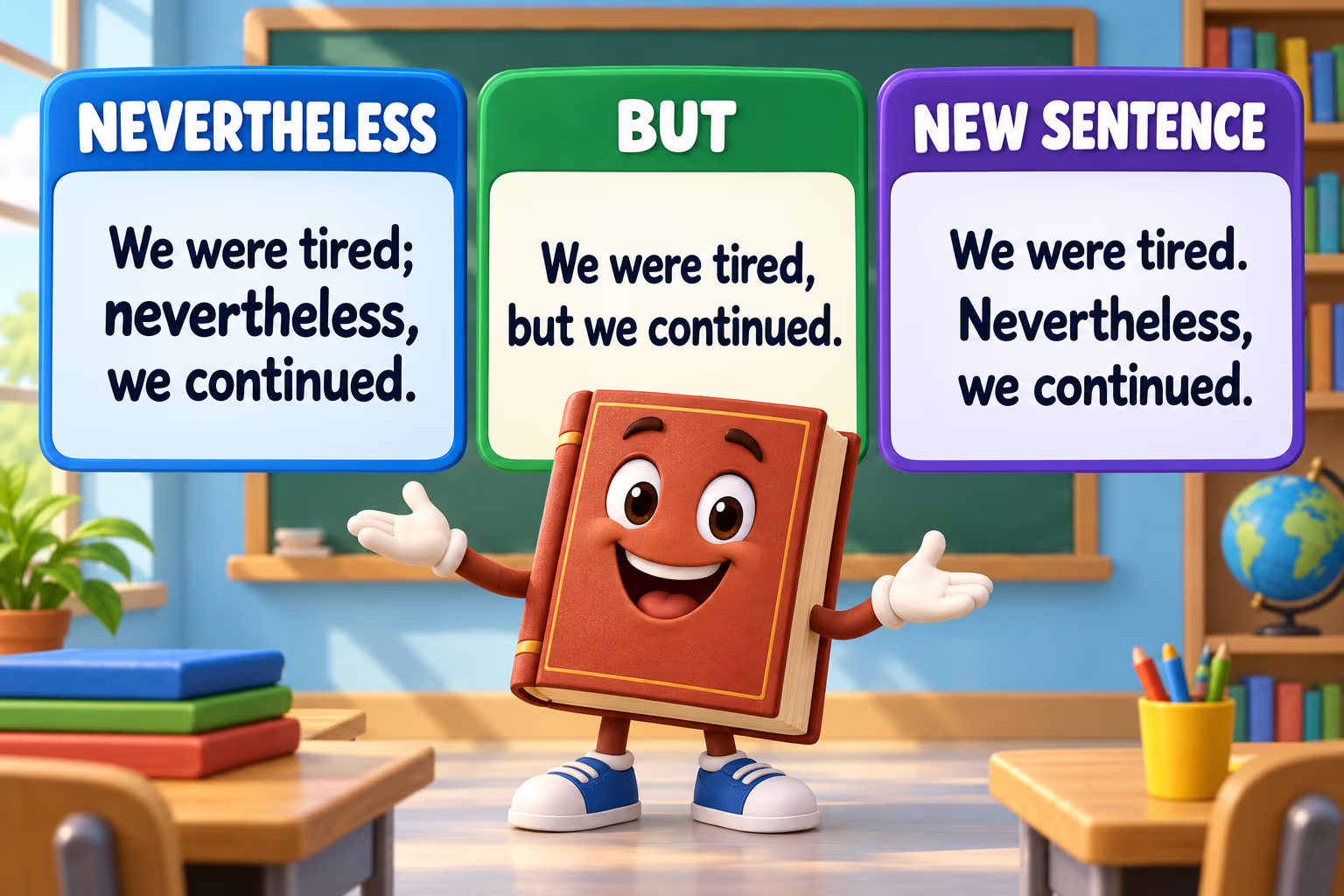
Do not join two complete sentences with only a comma: “The forecast looked poor, nevertheless the crew set sail” is a comma splice. Use a semicolon before nevertheless, replace it with a coordinating conjunction such as but, or split the thoughts into separate sentences. For more examples, see our guides to comma rules and colons versus semicolons. Purdue OWL’s comma and semicolon guide and its run-on and comma-splice handout explain the independent-clause rule.
Natural “nevertheless” examples
In natural usage, nevertheless makes the contrast meaningful rather than simply adding a formal-sounding word. It is common in careful speech and writing, especially when the second point is surprising, important, or worth emphasizing. These fresh examples show a range of placements:
- “The train was delayed by forty minutes; nevertheless, we arrived before the ceremony.”
- “Nevertheless, the editor kept the paragraph because it clarified the main argument.”
- “The recipe looks complicated. Nevertheless, each step is manageable.”
- “Although the sample was small, the pattern was nevertheless consistent.”
- “The proposal was nevertheless worth discussing.”
- “The room was cold; the musicians, nevertheless, played the full program.”
- “The walk was longer than expected; nevertheless, the children enjoyed the view.”
- “I disagree with the conclusion. I understand, nevertheless, how the author reached it.”
- “The task is demanding but nevertheless achievable.”
- “Her first attempt failed; nevertheless, she revised the design and tried again.”
- “The report is brief. It is nevertheless useful for new volunteers.”
- “The result was disappointing nevertheless, and the team planned its next attempt.”
Use the word when the contrast deserves emphasis. In an everyday sentence, but or still may sound more conversational. Nevertheless is not a decoration to add to every sentence, and it does not by itself make two clauses grammatical; punctuation must still show where the clauses begin and end.
How can you correct the original comma-splice examples?
The original examples below remain exactly as published. In several, each side of the comma can stand as a complete sentence, so the comma alone does not correctly join them. The repair column changes only the punctuation or connector; it demonstrates the standard patterns without replacing the source examples.
| Original wording (preserved below) | One clear repair | Reason |
|---|---|---|
| “I don’t like vegetables, nevertheless I ate them all.” | “I don’t like vegetables; nevertheless, I ate them all.” | Two independent clauses with a conjunctive adverb take a semicolon and following comma. |
| “The rain was pouring, nevertheless we played outside.” | “The rain was pouring. Nevertheless, we played outside.” | A period cleanly separates the clauses; the transition takes a comma at the start of the second sentence. |
| “The puzzle was difficult, nevertheless I finished it.” | “The puzzle was difficult, but I finished it.” | A comma before the coordinating conjunction but joins the complete clauses. |
| “My friend was upset, nevertheless I told a joke to cheer them up.” | “My friend was upset; nevertheless, I told a joke to cheer them up.” | The semicolon marks the boundary and the comma follows the transition. |
| “I fell down, nevertheless I got back up and kept running.” | “I fell down; nevertheless, I got back up and kept running.” | This keeps the original contrast while correcting its clause punctuation. |
A comma splice is a punctuation issue, not a reason to discard a useful example. The intended meaning in these sentences is clear; the edits simply make the relationship between complete clauses easier to read. The next examples in the original list already use semicolons or sentence boundaries in several places.
Have you ever wondered how to use the word “nevertheless” in a sentence? “Nevertheless” is an adverb that is often used to introduce a contrasting statement or idea.
It is commonly used to show a shift in thought or to emphasize a point that contradicts the previous information. “Nevertheless” can effectively connect two clauses or sentences, highlighting a difference in ideas while maintaining the overall coherence of the text.
7 Examples Of Nevertheless Used In a Sentence For Kids
- I don’t like vegetables, nevertheless I ate them all.
- The rain was pouring, nevertheless we played outside.
- The puzzle was difficult, nevertheless I finished it.
- My friend was upset, nevertheless I told a joke to cheer them up.
- I fell down, nevertheless I got back up and kept running.
- The book was long, nevertheless I read it all by myself.
- The cat scratched me, nevertheless I still gave it a hug.

14 Sentences with Nevertheless Examples
- Nevertheless, he decided to join the dance club despite his lack of experience.
- College can be stressful; nevertheless, it is important to prioritize mental health.
- Nevertheless, she managed to complete the assignment before the deadline despite facing technical issues.
- It can be challenging to balance social life and academics; nevertheless, it is important to find a healthy balance.
- Nevertheless, the student decided to pursue a double major to broaden their career prospects.
- College can be expensive; nevertheless, scholarships and financial aid options are available.
- Group projects can be frustrating; nevertheless, collaboration helps improve teamwork skills.
- Nevertheless, she attended the lecture even though she didn’t feel well.
- Time management is crucial in college; nevertheless, procrastination is a common challenge.
- Balancing part-time work and studies can be tough; nevertheless, it can be a valuable learning experience.
- Networking is important for future career opportunities; nevertheless, it can be intimidating for introverted students.
- Nevertheless, she persisted in improving her grades despite initially struggling with a difficult course.
- It is important to stay organized in college; nevertheless, it can be challenging with a busy schedule.
- College is a time for self-discovery and growth; nevertheless, it is normal to face moments of uncertainty and doubt.

How To Use Nevertheless in Sentences?
Nevertheless is a powerful word that can help you express contrasting ideas in a sentence. Here’s a simple guide on how to use it effectively:
- Placement: Nevertheless is usually placed at the beginning of a sentence to signal a shift in perspective or to introduce a contrasting idea. For example: “I didn’t get the job offer. Nevertheless, I am determined to keep applying.”
- Usage: When you use Nevertheless, you are acknowledging a previous point or situation while also introducing a different viewpoint or outcome. This word helps to show resilience, determination, or defiance in the face of obstacles. For instance: “She was tired after a long day at work. Nevertheless, she went to the gym for her workout.”
- Alternatives: If you find yourself using “but” or “however” frequently, try switching it up with Nevertheless to add variety and sophistication to your writing.
- Practice: To become more comfortable using Nevertheless, try incorporating it into your everyday conversations or writing. Pay attention to how it affects the tone and flow of your sentence.
In conclusion, Nevertheless is a versatile word that can add depth and nuance to your sentences by introducing a contrasting idea or perspective. With practice, you can confidently use this word to enhance your communication skills.

Conclusion
In conclusion, the use of “nevertheless” in sentences serves to connect contrasting ideas or show a shift in focus from one point to another. This transitional word helps to maintain a logical flow in writing by indicating a concession or a counterpoint in the context. For instance, “She was exhausted; nevertheless, she continued to work late into the night” illustrates how “nevertheless” introduces a contradictory statement while still linking it to the previous information.
By employing “nevertheless” in sentences, writers can effectively acknowledge differing viewpoints or circumstances without derailing the overall coherence of their argument or narrative. This word allows for a smooth transition between conflicting ideas, enabling clarity and emphasis on the intended message. In summary, “nevertheless” is a valuable tool in communication, ensuring that divergent thoughts are presented in a cohesive and understandable manner.
Frequently Asked Questions About “Nevertheless”
Can “nevertheless” start a sentence?
Yes. When it introduces a sentence that contrasts with an earlier point, follow it with a comma: “The bus was late. Nevertheless, the group reached the museum on time.” The comma marks the introductory transition. A capital letter is used because it begins the sentence, not because the word is a proper noun.
Is “nevertheless” a conjunction?
Nevertheless is an adverb, often called a conjunctive adverb when it links related ideas. It does not work like the coordinating conjunction but. If it connects two independent clauses in one sentence, use a semicolon before it and a comma after it, as in “The road was narrow; nevertheless, the driver continued.”
Do you always put a comma after “nevertheless”?
No. Use a comma when nevertheless opens a sentence or is set off as an interruption: “Nevertheless, we agreed” or “We were, nevertheless, ready.” An integrated placement usually takes no comma: “We were nevertheless ready.” At the end, it can also appear without one: “The advice was useful nevertheless.”
What punctuation comes before “nevertheless”?
When nevertheless introduces a second independent clause in the same sentence, put a semicolon before it: “The first plan failed; nevertheless, the team found another route.” A period is also correct if you make two sentences. Use a comma before but, because but is a coordinating conjunction.
Are “nevertheless” and “nonetheless” interchangeable?
They are close synonyms meaning “despite that,” and many sentences can use either. Both can introduce a contrast, appear inside a clause, or occur at the end. Check the rhythm and tone of your sentence: nevertheless can sound formal, while the shorter still or but may feel more conversational.