
Opt for means to choose one option instead of another, usually after weighing alternatives; to use opt for in a sentence, follow it with the thing you choose: “The council opted for a later start.” The verb is prepositional, so the object always comes after for and never before it.
Opt for at a glance
- Opt for is a prepositional phrasal verb meaning to choose one option over another.
- It takes a noun or gerund object: opt for the train, opt for going early.
- It is never separable, so the object follows for and cannot move.
- Register is neutral to formal, common in business, news and academic writing.
- The infinitive form is opt to, not opt for to: they opted to leave.
- The commonest error is inserting a to-infinitive after for, as in opt for to resign.
What does opt for mean?
Opt for is a prepositional verb meaning to choose or decide on one thing rather than another. The Cambridge entry for opt for treats the verb and its particle as a single unit, which is why the object cannot slip between them.
| Sense | Plain meaning | Example sentence |
|---|---|---|
| Choose an option | Decide on one of several | The panel opted for the cheaper design. |
| Choose a course of action | Commit to a plan | The firm opted for a staged launch. |
| Choose a person | Select someone for a role | Members opted for a new treasurer. |
One limitation is worth stating. Opt for is the wrong choice when there is no real alternative: a lone candidate is chosen or appointed, not opted for. It also records a decision already taken, so it cannot describe a standing preference; for that, prefer the quieter route is the better verb.
How do you use opt for in a sentence?
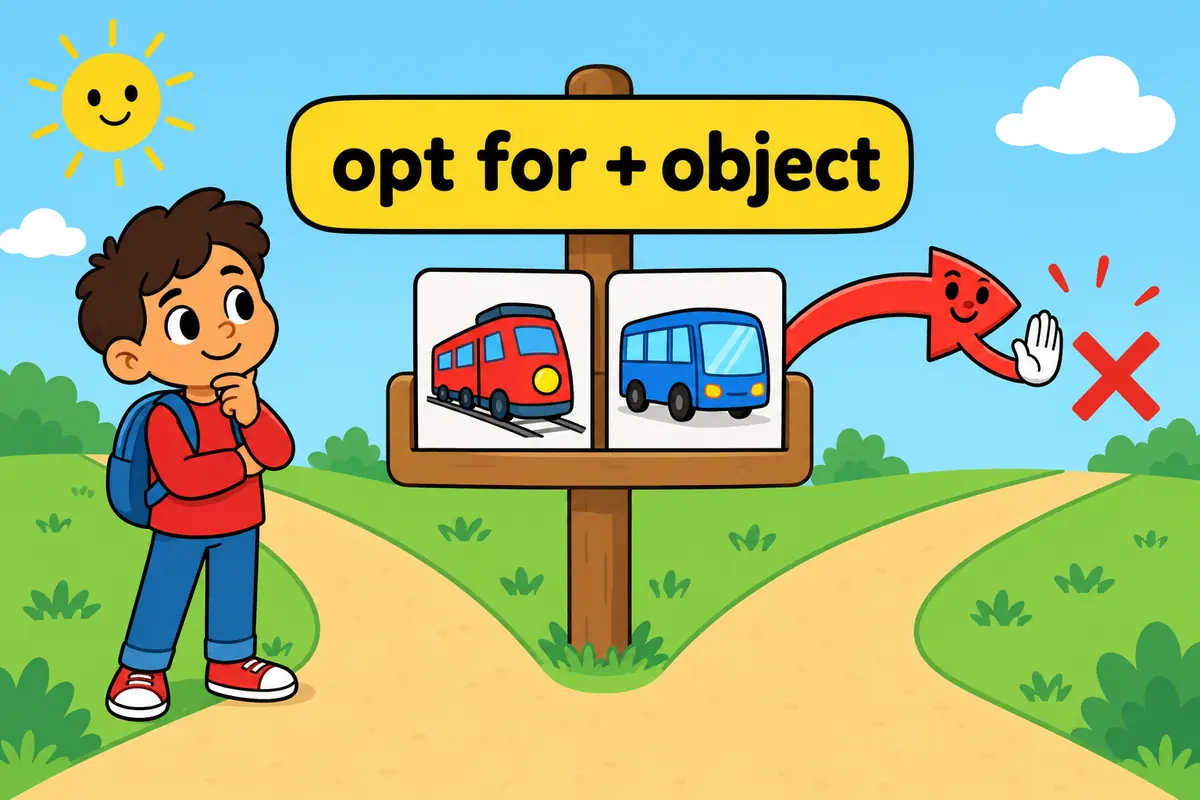
The pattern is fixed because for is a preposition, not a movable particle. The chosen thing follows for directly, and nothing may sit between them.
| Pattern | Example | What it signals |
|---|---|---|
| opt for + noun | The team opted for the earlier train. | A concrete option is chosen. |
| opt for + gerund | She opted for working from home. | An activity is chosen; for takes the -ing form. |
| opt for + pronoun | The committee opted for them after a long debate. | A person or group is chosen. |
| opt + to + verb | They opted to delay the launch. | The infinitive pattern; for cannot appear here. |
| opt for, passive | A later start was opted for by the staff. | Possible but rare; the active voice is preferred. |
Opt for in a sentence: examples across contexts
Opt for moves easily between registers because it reports a decision without emotion. The nine sentences below keep the same verb while changing the setting.
| Context | Example sentence | Why this works |
|---|---|---|
| Classroom | The science club opted for a field trip instead of a film. | A group decision with a named alternative. |
| Workplace email | We opted for the later slot to avoid the commute. | A practical choice in a polite register. |
| News report | The council opted for a levy rather than a cut. | Contrasts two policies in one clause. |
| Academic writing | The researchers opted for a mixed method design. | A methodological choice stated impersonally. |
| Conversation | I opted for the soup and my brother went for the pie. | The verb sits beside a colloquial alternative. |
| Policy writing | The regulator opted for a warning, not a fine. | A measured official decision. |
| Travel writing | We opted for the coastal road and missed the traffic. | Everyday choice with a consequence. |
| Business strategy | The board opted for steady growth over a risky merger. | Weighs two named strategies. |
| Sports report | The coach opted for youth in the second half. | A selection of people, not of things. |
Opt for vs go for
Opt for and go for the bargain both name a choice, but they carry opposite temperatures.
| Attribute | opt for | go for |
|---|---|---|
| Core job | Choose after weighing options | Choose eagerly or grab |
| Register | Neutral to formal | Informal |
| Implies | A considered decision | Enthusiasm or opportunism |
| Typical object | A plan, method or policy | A bargain, chance or snack |
| Imperative use | Rare | Common, as in go for it |
Verdict: choose opt for in reports and proposals, and go for in speech and informal writing.
Word forms and grammar of opt for
Opt for inflects only on the base verb; the particle never changes. The table also lists the infinitive and the unrelated particle pattern that learners mix in.
| Form | Part of speech | Example |
|---|---|---|
| opt for | prepositional verb, base | We opt for the quiet route. |
| opts for | third person singular | She opts for the morning class. |
| opted for | past and past participle | They opted for a recount. |
| opting for | present participle | Opting for a fixer saved time. |
| opt to | verb + infinitive | He opted to stay another night. |
| opt out | phrasal verb, different meaning | Two families opted out of the scheme. |
For a formal pick from a list, select an item is close in meaning, though it is more neutral and lacks the idea of weighing alternatives.
Common mistakes with opt for
- Incorrect:
She opted for to take the job.Correct: She opted to take the job, or she opted for the job. Rule: For takes a noun or gerund; the infinitive follows opt directly with no for. - Incorrect:
They opted the cheaper plan for.Correct: They opted for the cheaper plan. Rule: Opt for is prepositional and never separable. - Incorrect:
He opted for prefer tea.Correct: He opted for tea. Rule: Opt for already means choose, so adding prefer repeats the idea. - Incorrect:
The manager opted for he.Correct: The manager opted for him. Rule: The object after for takes the objective case. - Incorrect:
We opted to for postpone the meeting.Correct: We opted to postpone the meeting. Rule: Use the bare infinitive after opt, never to for.
Practice using opt for
The six exercises mix gap-filling, error repair and register choices. Check the reasoning in the answer list, not only the key.
- Fill the gap: The family ______ an early flight to beat the crowds.
- Fill the gap: After the survey, the board ______ keeping the old logo.
- Choose the better word: In the job advert, we (opted for / went for) a neutral tone.
- Correct the error: She opted for to work part time.
- Build a sentence: use opt for + gerund about a club choosing to meet online.
- Spot the register: which belongs in a formal proposal — the panel opted for option two, or the panel went for option two?
Answers
- opted for — a specific option follows the preposition for.
- opted for — the gerund keeping follows for correctly.
- opted for — a job advert is formal, and go for would sound casual.
- She opted to work part time — opt takes the infinitive without for.
- Model answer: The club opted for meeting online during the winter.
- The panel opted for option two — a proposal keeps the neutral, formal verb.
The bottom line
Use opt for in a sentence when a person or group has chosen one option from a real set, and place the chosen thing directly after for. Two rules settle most lines: the verb is prepositional and never separable, and the infinitive pattern is opt to, with no for. Where a project formally takes on a method, adopt a policy may be the tighter word.
Frequently asked questions about opt for
Is opt for one word or two?
It is always two words written separately, and it is never hyphenated. The same is true of opt to, opt in and opt out. Only the base verb opts can stand alone, as in she opts for the earlier train. Treat opt for as a fixed pair, with for carrying the sense of choosing among options.
What is the difference between opt for and opt to?
Opt for is followed by a noun or a gerund, as in they opted for a delay or they opted for delaying. Opt to is followed by a bare infinitive, as in they opted to delay. The choice depends only on what comes next, never on a difference in meaning, so match the grammar to the following word.
Is opt for formal or informal?
Opt for is neutral to formal. It appears in business plans, news reports and academic prose, and it sounds slightly more considered than go for. In relaxed speech, people often say go for or pick instead. The verb is rarely wrong, but it can sound stiff where a plain word such as choose would pass unnoticed.
Can opt for be used in the passive?
It can, but the passive sounds awkward because the preposition ends up trailing. A writer may say a later start was opted for, yet the active alternative the staff opted for a later start reads more naturally. Keep the chooser as the subject unless there is a strong reason to hide them.
Opting for a particular choice means selecting it from a range of options available. When we “opt for” something, we make a conscious decision to choose one thing over others. This phrase is commonly used in a variety of contexts to indicate a preference or a deliberate selection.
Choosing to “opt for” a certain path can reveal a lot about our priorities and preferences. It highlights our ability to evaluate different choices and make a decision based on what aligns best with our goals or desires. Whether it’s about selecting a vacation destination, a career path, or a meal at a restaurant, opting for one option over others is a key part of decision-making in our daily lives.
7 Examples Of Opt For Used In a Sentence For Kids
- Opt for the green pencil, it is your favorite color.
- Opt for the banana over the chocolate, it is healthier.
- Opt for the red toy car to play with today.
- Opt for the blue shirt to wear to school tomorrow.
- Opt for the big storybook for storytime.
- Opt for the purple crayon to color your drawing.
- Opt for the apple juice instead of soda.
14 Sentences with Opt For Examples
- Opt for taking online courses to have a flexible schedule.
- It is advisable to opt for buying second-hand textbooks to save money.
- College students should opt for using public transportation to reduce carbon footprint.
- Opt for joining a student club to meet new people and make friends.
- When it comes to food choices, opt for healthier options in the college cafeteria.
- To improve time management, opt for using a planner or a scheduling app.
- Opt for participating in career fairs and workshops to enhance your job prospects.
- Instead of buying lunch every day, opt for packing homemade meals to save money.
- For better mental health, college students should opt for practicing mindfulness and meditation.
- When choosing electives, opt for subjects that interest you rather than just fulfilling requirements.
- To stay organized, opt for using color-coded folders for different subjects.
- Opt for subscribing to online academic resources for in-depth study materials.
- College students should opt for internships to gain practical experience in their field.
- Opt for creating a study group to collaborate with peers and improve learning outcomes.
How To Use Opt For in Sentences?
When using Opt For in a sentence, remember that this phrase means to choose or select something as a preference. Here’s a guide on how to properly incorporate it into your sentences:
-
Identify the decision: First, pinpoint the choice you need to make. This could be between different options, courses of action, or preferences.
-
Introduce “Opt For”: When you are ready to express your decision, use the phrase “Opt For” to indicate that you are choosing one option over others.
-
Provide the preferred choice: After “Opt For,” state the specific option you are selecting. This can be a noun, pronoun, or phrase that represents your preference.
-
Complete the sentence: Make sure to complete your sentence by adding any necessary context or details, so the meaning is clear to your audience.
For example:
– “I will opt for the chocolate ice cream instead of vanilla.”
– “She decided to opt for the blue dress for the party.”
– “They opted for a beach vacation this summer over a mountain retreat.”
By following these steps, you can effectively use Opt For in your sentences to convey your choices and preferences clearly. Remember to consider your decision carefully before using this phrase!
Conclusion
In various situations, individuals may choose to opt for a particular decision or action based on their preferences or circumstances. These choices can range from selecting a certain product or service to deciding on a course of action in a given scenario. Whether it’s opting for a healthier lifestyle by choosing to exercise regularly or opting for a more sustainable option by using eco-friendly products, the concept of opting for something reflects the power of choice and personal decision-making.
By considering various options and ultimately deciding to opt for one, individuals can assert their autonomy and shape their lives according to their values and desires. Whether it’s in daily choices or more significant decisions, the act of opting for something signifies a deliberate and thoughtful approach to navigating life’s endless possibilities.


