
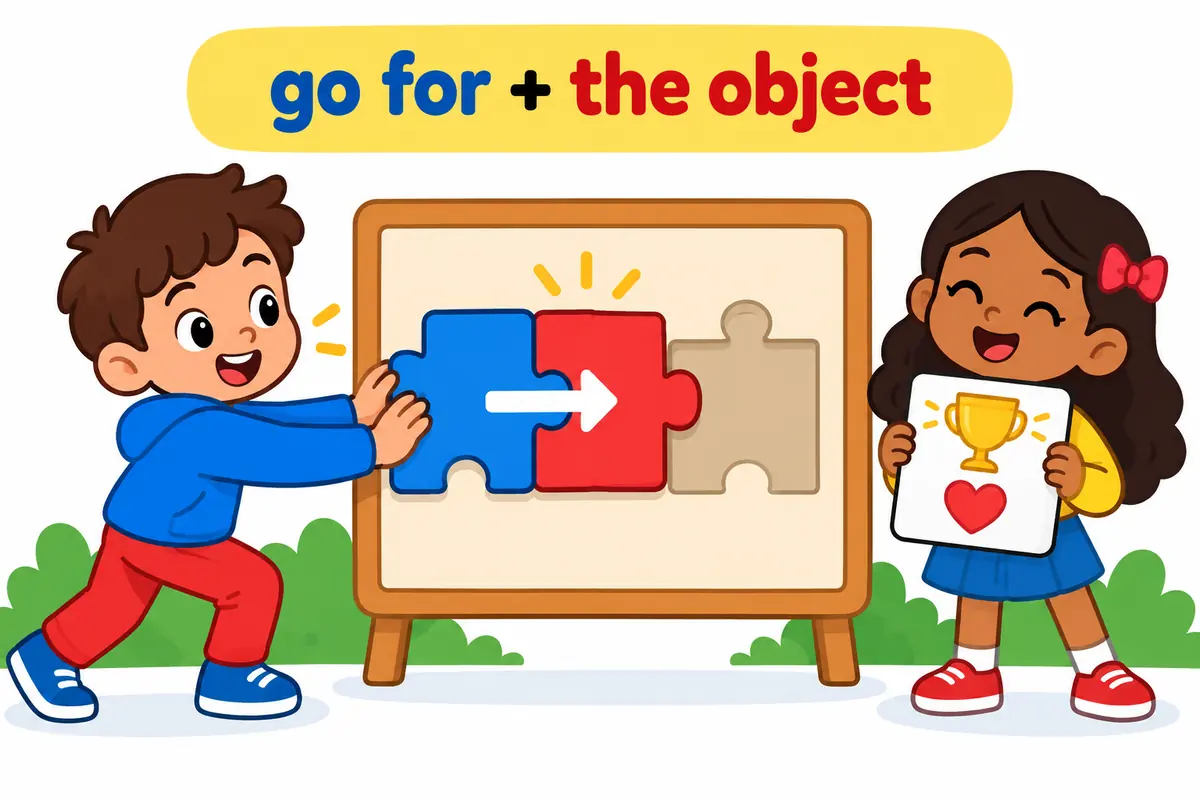
Go for is a phrasal verb meaning to choose, attempt, fetch, like or attack, depending on context. To use go for in a sentence, put the object after the particle: “She went for the job.” The phrase is transitive and inseparable, so the object never sits between go and for.
Go for at a glance
- Go for is a transitive phrasal verb with several distinct senses.
- The most common sense is to choose or prefer: I will go for the soup.
- It is inseparable, so the object follows for and never sits between the words.
- The particle can strand at the end of a question: What are you going for?
- The fixed idiom go for it means to make an attempt.
- The commonest error is splitting the phrase with a pronoun, as in go it for.
What does go for mean?
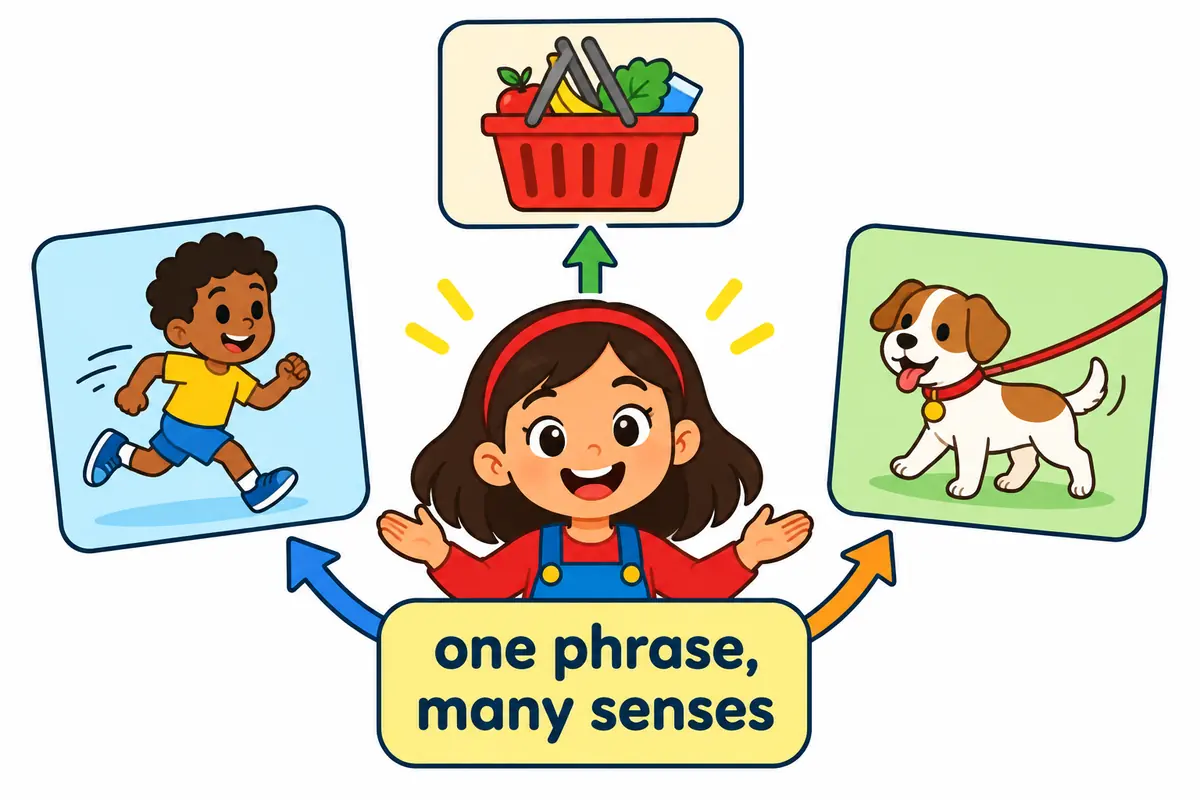
Go for is a phrasal verb whose meaning shifts with the noun or pronoun that follows it. The Cambridge entry for go for lists several senses under one headword, so the object decides which one is active. When the object is a goal, go for means to try to obtain it, which is close to pursue a target. When the object is a choice, it means to select, and when the context is an attempt, it means to attempt something hard. In a third pattern the object is a person and the meaning turns to attack. In British English a fourth sense means to fetch, as when someone is told to fetch a doctor. The sense is never guessed from go alone; it comes from what follows.
| Sense | Plain meaning | Example sentence |
|---|---|---|
| Choose | Select one option over another | I will go for the blue jacket. |
| Attempt | Try to achieve a goal | She went for the world record. |
| Like, informal | Be attracted to something | He does not go for loud music. |
| Fetch, chiefly British | Go and bring someone or something | Go for a nurse, quickly. |
| Attack | Turn on a person or thing | The dog went for the postman. |
| Apply to | Be true of someone as well | The same rule goes for everyone. |
One limitation is worth stating plainly: go for never means to travel toward a destination. For that idea, use leave for or set off for, because go for describes choosing, trying or targeting, not moving somewhere.
How do you use go for in a sentence?
The grammar of go for turns on two facts: it is transitive, and it is inseparable. The object always follows the particle, and nothing may sit between go and for. In questions and relative clauses, however, the whole phrase can be split across the clause so the particle strands at the end. The table shows the patterns.
| Pattern | Example | What it signals |
|---|---|---|
| go for + noun (choose) | We will go for the cheaper plan. | selecting an option |
| go for + noun (attempt) | He went for the top prize. | aiming at a goal |
| go for + noun (target) | The cat went for the bird. | attacking or seizing |
| what + be + subject + going for | What are you going for? | the particle stranded at the end |
| go for it | You have trained for months, so go for it. | a fixed call to attempt |
The stranding pattern in the fourth row is normal English, not an error: the object moves to the front as a question word, and for stays behind. Compare that with the impossible form, go the plan for, which no speaker uses.
Go for in a sentence: examples across contexts
| Context | Example sentence | Why this works |
|---|---|---|
| Classroom | For the project topic, I will go for the water cycle. | Shows the choosing sense with a clear option. |
| Workplace email | We decided to go for the second supplier. | Records a business choice plainly. |
| Sports report | The striker went for goal from thirty metres. | Shows the attempting sense. |
| Everyday chat | I do not really go for horror films. | Uses the informal liking sense. |
| News report | The crowd went for the referee after the final whistle. | Shows the attack sense. |
| Family | Go for a doctor, the baby is burning up. | Uses the British fetching sense. |
| Academic writing | Both groups went for the same incentive. | Describes a shared target. |
| Advice | Apply now and go for it. | Uses the fixed encouraging idiom. |
| Rules | The new deadline goes for every department. | Uses the apply-to sense. |
Reading the column of objects makes the pattern obvious. A thing chosen, a prize chased, a target seized and a person attacked each steer the same two words toward a different meaning.
Go for vs choose
Choose is the verb learners substitute when they want a single clear sense, and the two differ in force and formality.
| Attribute | Go for | Choose |
|---|---|---|
| Core meaning | Select, attempt, like or seize | Select one option |
| Register | Informal to neutral | Neutral to formal |
| Senses | Several, set by the object | One, always selection |
| Typical subject | A person acting on impulse or aim | A person or body deciding |
| Object type | Options, goals, food, people | Options and candidates |
Choose choose when the sentence needs a single precise act of selection, and go for when the decision is quick, spoken or carries a note of ambition, because only go for can also mean to attempt or seize.
Word forms and grammar of go for
| Form | Part of speech | Example |
|---|---|---|
| go for | phrasal verb, base | I usually go for tea. |
| goes for | verb, third person singular | She goes for the harder puzzle. |
| went for | verb, past | They went for a long walk. |
| going for | verb, -ing form | He is going for promotion this year. |
| gone for | past participle | They have gone for the safest route. |
| go for it | fixed idiom | If you want the place, go for it. |
Other phrasal verbs built on the same base behave differently: go back means to return and is intransitive, while go away means to leave and takes no object at all. Only go for carries the choosing and seizing senses, which is why the base verb alone is no guide.
Common mistakes with go for
Splitting the phrase with a pronoun. Incorrect: You have trained for months, so go it for. Correct: You have trained for months, so go for it. Go for is inseparable, so the pronoun stays after the particle.
Using it for a destination. Incorrect: We go for London on Friday. Correct: We leave for London on Friday. Go for does not mark travel toward a place; leave for or set off for does.
Confusing it with go to. Incorrect: I go for the gym every morning. Correct: I go to the gym every morning. Go to names a destination or activity, while go for names a choice.
Dropping the object. Incorrect: The team went for in the final minute. Correct: The team went for the goal in the final minute. Because the verb is transitive, an object must follow the particle.
Building a wrong past tense. Incorrect: She goed for the top prize. Correct: She went for the top prize. The past tense of go is went, and the particle stays unchanged.
Practice using go for
- Fill in the blank: For dessert, I think I will ______ the apple pie.
- Choose the better verb: The team decided to (go for / choose) the risky strategy with seconds left.
- Correct the error: Without more funds, we cannot go it for this year.
- Build a sentence: encourage a friend to try for a new job, using go for and its fixed idiom.
- Spot the register: which sentence belongs in a business email, “We have decided to go for the lower quote.” or “We’re gonna go for the cheap one, innit.”
- Fill in the blank: The same safety rule ______ every member of staff.
Answers
- go for — the choosing sense takes the object after the particle.
- go for — the phrase adds the note of attempting something risky.
- Without more funds, we cannot go for this project this year. — the phrase is inseparable, so it cannot be split.
- Apply for the job, then go for it. — the fixed idiom encourages an attempt.
- The first sentence belongs in a business email. — the second is too casual.
- goes for — a singular subject takes goes, and the apply-to sense fits.
The bottom line
Go for is a transitive, inseparable phrasal verb that changes sense with its object, covering choice, ambition, liking, fetching and attack. Use go for in a sentence with the object after the particle, and let the noun signal the meaning. Choose the plainer verb choose when you need one precise act of selection.
Frequently asked questions about go for
Is go for separable?
No. Go for is inseparable, so the object always follows the particle and nothing may sit between the two words. You say go for the prize, never go the prize for. The only apparent splitting happens when the object moves forward in a question, leaving the particle stranded at the end, as in what are you going for.
What does go for mean in British English?
In British English, go for often means to fetch or go and bring someone, as in go for a doctor. This sense is less common in American English, where fetch or get covers it. The same words mean to choose or attempt in both varieties, and only the context makes the fetching sense clear.
Is go for it formal?
No. Go for it is an informal fixed idiom that urges someone to make an attempt, close to give it a try. It fits conversation, encouragement and light writing, but a formal report would say attempt it or proceed. The phrase never takes an object of its own, because it already contains it.
What is the past tense of go for?
The past tense is went for, as in she went for the record. The past participle is gone for, used after have or had, and the -ing form is going for. Only the verb changes; the particle for stays fixed, which is why the phrase always keeps the same two-word shape in every tense.
Looking to add more dynamic verbs to your sentences? A great option is “go for,” a versatile phrasal verb commonly used to express choosing a particular option or making a decision. When you “go for” something, you are opting for a specific choice or course of action.
Whether you’re deciding on a restaurant to dine at, a movie to watch, or a strategy to implement, “go for” can help convey your intentions clearly and succinctly. This phrasal verb is essential for expressing your preferences and decisions in a straightforward and impactful way.
7 Examples Of Go For Used In a Sentence For Kids
- Go for a walk in the park.
- Let’s go for a ride on the merry-go-round.
- We can go for a picnic in the garden.
- Go for a run in the playground.
- It’s time to go for a swim in the pool.
- We should go for a playdate with friends.
- Let’s go for some ice cream at the store.
14 Sentences with Go For Examples
- Go for the early morning study sessions to maximize productivity.
- Go for the internships that offer hands-on experience in your field of study.
- Go for joining clubs and societies that align with your interests and career goals.
- Go for seeking help from professors and tutors when you’re struggling academically.
- Go for attending networking events to expand your professional circle.
- Go for creating a study schedule to stay organized and on track with assignments.
- Go for participating in student competitions to showcase your skills and talents.
- Go for exploring different electives to diversify your knowledge base.
- Go for forming study groups with classmates to enhance understanding of complex topics.
- Go for taking up part-time jobs to gain relevant work experience.
- Go for setting achievable goals for each semester to stay motivated.
- Go for utilizing online resources for additional learning opportunities.
- Go for seeking out opportunities for studying abroad to broaden your horizon.
- Go for attending career fairs to explore internship and job opportunities.
How To Use Go For in Sentences?
To understand how to use Go For in a sentence, think of it as a way to express support, approval, or a decision to choose something. For example, “I will go for the chocolate ice cream” shows a choice being made.
Remember, Go For is often used when there are options or opportunities available and you are indicating your preference or decision.
Here are some tips on using Go For effectively:
- Use Go For followed by the option you are choosing or the action you are taking. For example, “I will go for a run after work.”
- Go For can also mean supporting or advocating for something or someone. For instance, “I will go for the candidate who prioritizes education.”
- You can use Go For to indicate enthusiasm or approval. For instance, “I definitely go for the idea of a team building exercise.”
Remember that Go For is a versatile phrase that can be used in various contexts to convey your choices, preferences, or support for something. Practice using it in different sentences to become comfortable with its usage. Experiment with different scenarios to see how you can use Go For effectively in your everyday conversations.
Conclusion
In conclusion, “go for” is a versatile phrase that can be used in various contexts to express willingness, determination, or a choice towards something. Whether it’s about making a decision, pursuing a goal, or selecting an option, “go for” is a simple yet effective way to convey one’s intentions. For example, a student might decide to “go for” an advanced degree, an athlete may “go for” the gold medal, or a job seeker could “go for” a particular position.
By using the phrase “go for,” individuals can clearly communicate their preferences, aspirations, and actions. This straightforward expression encapsulates the idea of moving towards a desired outcome with purpose and resolve, making it a valuable tool in everyday language for expressing intentions and decisions.


