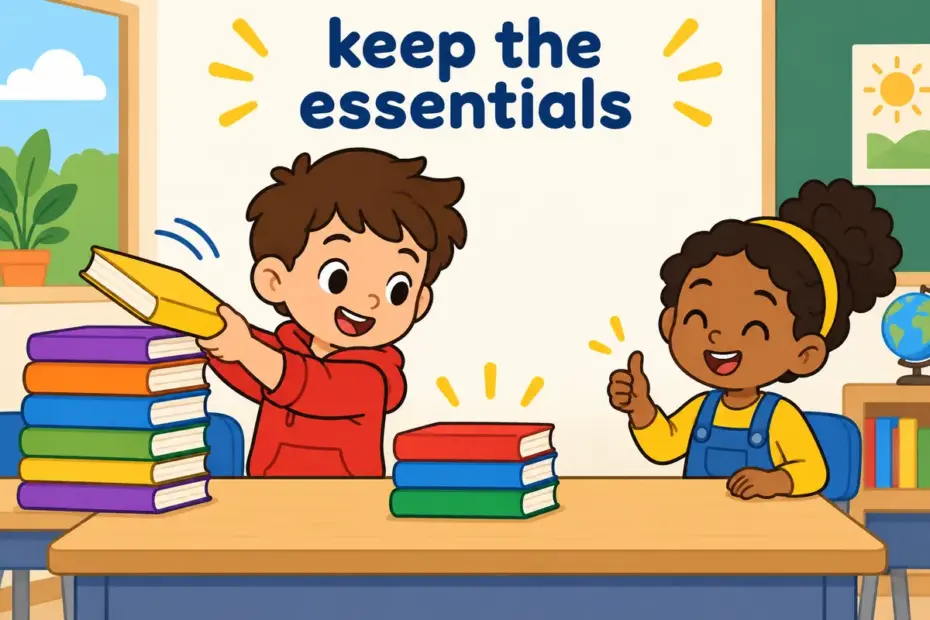
Pare down means to reduce something to its essential parts by cutting away what is not needed, and to use pare down in a sentence you name the thing being cut: “The editor pared down the report to two pages.” The object may sit between verb and particle or follow it, but a pronoun goes between the two.
Pare down at a glance
- Pare down is a transitive phrasal verb; its parts are pare, plus pares, pared or paring, followed by down.
- The dominant pattern is pare down plus an object, as in pare down the list.
- The single sense is reducing a thing to what is essential, whether a budget, a menu or a manuscript.
- Pare down is neutral in register and appears in emails, news and everyday speech alike.
- The commonest error is writing pair down, which confuses a homophone that means to match two things.
What does pare down mean?
Pare down is a phrasal verb meaning to reduce something to its basic or essential parts by removing whatever is not needed. The Cambridge entry for pare down records the verb and its separable particle, and the image is one of cutting away, as a cook pares a skin from a fruit. That physical origin explains why the phrase suits lists, budgets, squads and drafts, because each can lose whole pieces and still work. When the cuts are tiny and repeated, whittle is the stronger verb.
| Sense | Plain meaning | Example sentence |
|---|---|---|
| Reduce to essentials | Remove everything that is not necessary | The director pared down the plan to three steps. |
| Shrink by stages | Lower a number or size gradually over time | They pared down the guest list over a week. |
| Cut away an outer layer | The literal sense of the shorter verb pare | Pare the apple down to its core before stewing it. |
One limitation is worth stating plainly. Pare down does not mean cancel or remove entirely. A pared-down service still runs, and a pared-down meal is still a meal. The verb says that the thing has been made leaner, not that it has gone.
How do you use pare down in a sentence?
Pare down is transitive, so it always needs an object, and it is separable, so the object may follow the whole phrase or slide between the two parts. Pare down the list and pare the list down are both correct. A pronoun is the exception: it must sit between verb and particle, giving pare it down and never pare down it. The particle cannot be stranded in front, so down the list was pared is not natural English.
| Pattern | Example | What it signals |
|---|---|---|
| pare down + object | The editor pared down the report. | Verb plus particle plus object, the safest order. |
| pare + object + down | The editor pared the report down. | The object splits the phrase, also correct. |
| pare + pronoun + down | The editor pared it down. | A pronoun must come between the two parts. |
| be pared down | The menu was pared down to six dishes. | Passive voice, used when the result matters more than the doer. |
| pared-down + noun | A pared-down budget won approval. | The hyphenated form works as a single adjective. |
Length matters when you choose the order: a short object reads well between the parts, while a long one reads better after down. Teams that want operations to run with less effort often streamline a process, because it stresses smoothness rather than reduction.
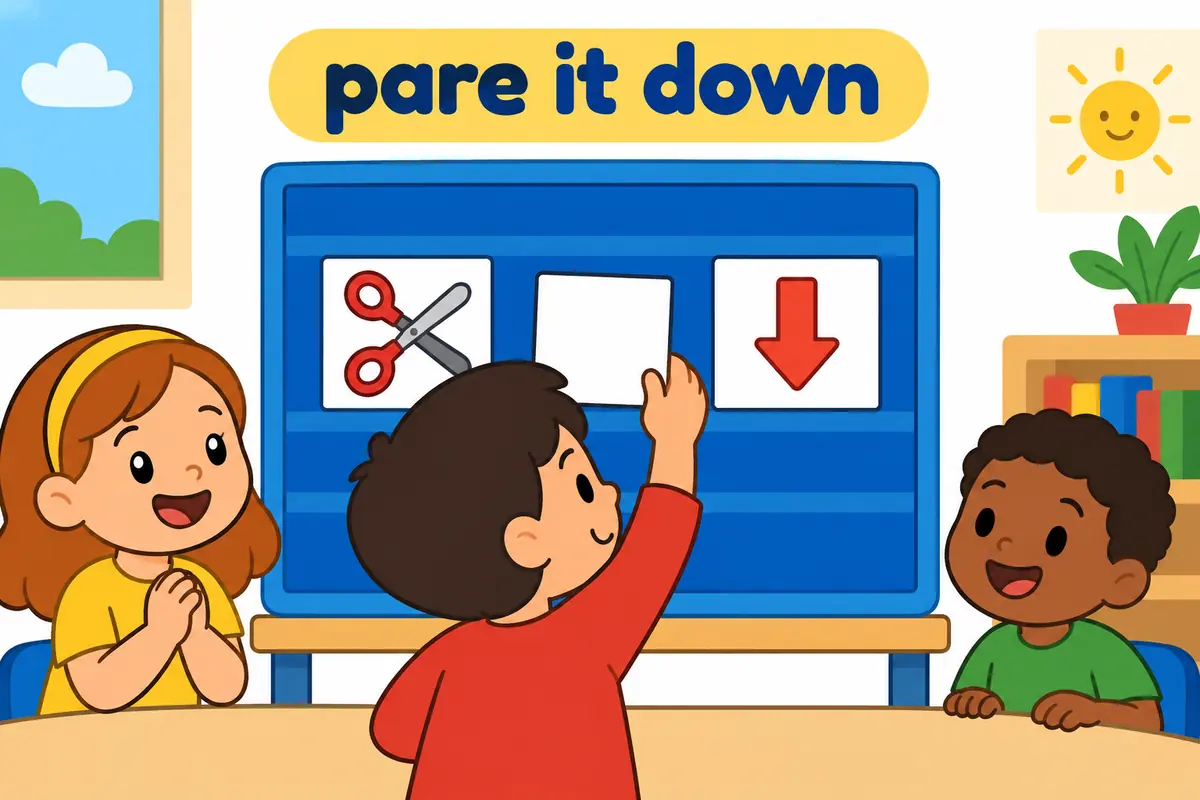
Pare down in a sentence: examples across contexts
Pare down keeps one meaning and changes its company. The ten sentences below move from a classroom to a company report, and each one names something concrete that has been made smaller.
| Context | Example sentence | Why this works |
|---|---|---|
| Classroom | The teacher pared down the reading list to three short poems. | A specific number shows the reduction. |
| Workplace email | We will pare down the agenda before Thursday. | A deadline gives the cutting a purpose. |
| News report | The council pared down the plan after public objections. | Names the body doing the cutting. |
| Finance writing | The airline pared down its costs by a fifth. | A figure makes the reduction measurable. |
| Home cooking | Pare the apples down to the core before stewing them. | The literal sense keeps the word vivid. |
| Personal writing | Moving house made us pare down to two suitcases. | A life change gives the phrase emotional weight. |
| Academic prose | The final chapter was pared down to fit the word limit. | A constraint explains why the cutting happened. |
| Sports reporting | The coach pared down the squad to eighteen players. | A number marks a selection made smaller. |
| Conversation | I need to pare down my phone apps this weekend. | The everyday use stays informal and light. |
Writers condense dense research into a short summary when the aim is only shorter prose.
Pare down vs trim
Pare down and trim overlap, and the difference is how much you expect to remove. Trim means to cut a little from the surface or the edges, while pare down means to remove whole parts until only the essentials are left. You trim a hedge and trim a paragraph; you pare down a budget and pare down a list of demands.
| Attribute | pare down | trim |
|---|---|---|
| Core meaning | Reduce to the essential parts | Cut a little from the surface or edges |
| Strength | Stronger, removes whole parts | Gentler, neatens what remains |
| Typical objects | Budgets, lists, reports, squads | Hair, hedges, text, small costs |
| Implies a goal | Reaches a bare minimum | Keeps a tidy shape |
| Register | Neutral to formal | Neutral, often physical |
| Result | Something smaller and simpler | Something neater, barely smaller |
Verdict: use pare down when whole parts must go and only the essentials should remain, and use trim when the cut is light and the shape is the point.
Word forms and grammar of pare down
Pare down inflects by changing the verb and leaving the particle alone. The table also lists the shorter verb from which the phrase is built and the hyphenated adjective writers often need.
| Form | Part of speech | Example |
|---|---|---|
| pare down | phrasal verb, base form | We must pare down the list. |
| pares down | phrasal verb, third person singular | She pares down her notes each week. |
| pared down | phrasal verb, past and past participle | They pared down the design. |
| paring down | phrasal verb, present participle | Paring down the menu took an hour. |
| pared-down | adjective, hyphenated | A pared-down version was published. |
| pare | verb, base of the phrase | Pare the skin away before cooking. |
The shorter verb is covered on the page for pare, and it means to cut away an outer layer, often with a small knife. A verb built from a different meaning of down, break down, divides a whole into its parts and is not a synonym.
Common mistakes with pare down
- Incorrect:
We pared down it before the meeting.Correct: We pared it down before the meeting. Rule: a pronoun must sit between the verb and the particle. - Incorrect:
Please pair down the report.Correct: Please pare down the report. Rule: pare is the verb for cutting; pair means to match two things together. - Incorrect:
The budget pared down after the review.Correct: The budget was pared down after the review. Rule: the verb is transitive, so it needs an object or a passive. - Incorrect:
The team pared down on expenses.Correct: The team pared down expenses. Rule: pare down takes a direct object and never the preposition on. - Incorrect:
They pared down the company, so it closed.Correct: They reduced the company until it closed. Rule: pare down means making leaner, not shutting down.
Practice using pare down
Work through the six items, then read the reasoning rather than only the answer.
- Fill the gap: The committee ______ the shortlist down to four names.
- Choose the better word: We only tidied the edges, so we (pared down / trimmed) the hedge.
- Correct the error: She pared down it to a single page.
- Build a sentence: use pared-down before a noun about a budget.
- Spot the register: which fits a project email — we pared the scope down to go live in March, or we made the scope heaps smaller?
- Rewrite with down after the object: They pared down the syllabus. Move the object between the parts.
Answers
- pared — the shortlist is the object and the action happened in the past.
- trimmed — the cut is light and only the edges changed, so trim fits.
- She pared it down to a single page — a pronoun must go between the two parts.
- Model answer: A pared-down budget won approval.
- We pared the scope down to go live in March — a project email avoids the slangy phrasing.
- They pared the syllabus down — the short object sits neatly between verb and particle.
The bottom line
Use pare down in a sentence when something must lose whole parts and keep only what matters, and remember that the phrase is transitive and separable. Two nuances decide most sentences: a pronoun always goes between pare and down, and the result stays usable rather than disappearing. When the cut is light and the aim is neatness, trim of the edges is the better verb, because pare down implies a deeper reduction.
Frequently asked questions about pare down
Is it pare down or pair down?
The correct phrase is pare down. Pare is the verb that means to cut away, and it comes from a word for trimming, while pair means to match two things together. Pair down is a homophone error that gives a sentence no meaning, so a careful writer keeps the two spellings apart.
What is the past tense of pare down?
The past tense is pared down, as in the team pared down the plan. Only the verb changes with tense; the particle down never changes. The past participle is identical, which is why the passive works, as in the plan was pared down by the team on Friday.
Is pare down informal or formal?
Pare down sits in the middle. It is relaxed enough for a message to a colleague and tidy enough for a news report or a company memo. It is not slang, but neither is it technical, so most writers can use it wherever a plain phrase such as reduce would also fit.
Can you use pare down without an object?
No. Pare down is transitive, so it needs something to be pared down. A sentence such as the budget pared down is incomplete because no one did the cutting. Add the object, as in they pared down the budget, or use the passive, as in the budget was pared down.
Ever felt like your writing is too wordy and could use some trimming down? That’s where the term “pare down” comes in handy. When you pare down your writing, you’re essentially cutting out any unnecessary or redundant words to make your sentences clearer and more concise.
Paring down your writing can improve the flow and impact of your message, helping to keep readers engaged without getting bogged down in excessive details. By practicing the art of “paring down,” you can enhance the overall quality of your writing and make your points more effectively.
7 Examples Of Pare Down Used In a Sentence For Kids
- Pare down your toys to make space for new ones.
- Can you pare down the number of crayons on your desk?
- Let’s pare down the size of our drawings to fit on the paper.
- It’s time to pare down the amount of snacks in your lunchbox.
- Please remember to pare down your excitement during storytime.
- We need to pare down the steps in our dance routine.
- Try to pare down the number of questions you ask in class.
14 Sentences with Pare Down Examples
- Pare down the number of extracurricular activities you are involved in to focus more on your studies.
- Make sure to pare down your expenses by cooking meals at home rather than eating out every day.
- It’s important to pare down the length of your essays to meet the word count requirements for your assignments.
- To alleviate stress, try to pare down your commitments and prioritize self-care activities.
- Pare down the amount of time you spend on social media to increase productivity and focus on your studies.
- Consider studying in a quiet library to pare down distractions and improve your concentration.
- It may be helpful to pare down your wardrobe to just essential clothing items for a minimalist and organized approach.
- Practice time management skills to effectively pare down procrastination habits and meet deadlines.
- Join study groups to pare down the workload and share resources with classmates for better understanding of course material.
- To maintain a healthy work-life balance, make sure to pare down the number of hours you spend studying each day.
- Consider using online resources to pare down the cost of textbooks and study materials.
- Aim to pare down unnecessary clutter in your study space for a more conducive learning environment.
- It’s important to pare down unhealthy eating habits and prioritize nutritious meals for overall well-being.
- Seek guidance from professors or mentors to help you pare down overwhelming assignments and projects into manageable tasks.
How To Use Pare Down in Sentences?
To use Pare Down in a sentence, start by identifying the information or elements that are unnecessary or excessive. Then, consider the main idea or message you want to convey and focus on including only the most essential details.
For example, instead of saying “The house is big, spacious, and has a beautiful garden with lots of colorful flowers,” you could Pare Down the sentence to “The house has a beautiful garden with colorful flowers.” This way, you are conveying the same message without including redundant details.
Another tip for using Pare Down effectively is to prioritize clarity and conciseness. Eliminate any words or phrases that do not add value to the sentence or that may confuse the reader. Keep your sentence straightforward and to the point.
Lastly, remember that Pare Down can be applied to various types of writing, such as emails, presentations, reports, and creative works. By mastering the skill of Pare Down, you can communicate more effectively and efficiently in all areas of your life.
In summary, when using Pare Down in a sentence, focus on removing unnecessary information, prioritizing clarity and conciseness, and applying the skill to different types of writing. By following these guidelines, you can improve your communication skills and convey your message more effectively.
Conclusion
In conclusion, the phrase “pare down” refers to the act of reducing or simplifying something. Through examples like “She decided to pare down her wardrobe by donating old clothes” or “The company had to pare down its expenses in order to stay afloat,” we see how this concept is applied in different contexts. Whether it involves decluttering possessions, cutting costs, or streamlining processes, the goal of paring down is to make things more efficient and manageable.
By understanding the importance of paring down, individuals and organizations can focus on what truly matters, eliminate unnecessary distractions, and work towards their goals with greater clarity. Embracing this mindset of simplification can lead to increased productivity, reduced stress, and overall improved performance in various aspects of life or business.


