Parody is a comic imitation of a work, style or person, made by copying its features and exaggerating them for humour. To use parody in a sentence, name both the borrowing and the original: “The sketch is a parody of a cooking show.” The noun normally takes the pattern a parody of something.
Parody at a glance
- Parody is a noun and a verb; the noun means a comic imitation of a work or style.
- The plural is parodies, and the verb forms are parodies, parodied and parodying.
- The fixed noun pattern is a parody of something, never a parody on something.
- Its adjective is parodic, and the person who makes one is a parodist.
- Parody copies an original closely enough to be recognised, then exaggerates it.
- The commonest error is using parody for a straight copy or for satire.
What does parody mean?
Parody is a noun meaning a humorous imitation of a work, style or person, and it is also a verb meaning to imitate something for comic effect. The Cambridge entry for parody gives both the comic-imitation sense and the weaker sense of a poor imitation. In everyday use the comic sense dominates, and the imitation must be close enough for the audience to recognise what is being copied.
| Sense | Plain meaning | Example sentence |
|---|---|---|
| Comic imitation | A funny copy of a work or style | The film is a parody of a spy thriller. |
| The style itself | The mode of humorous copying | The review praises the novel as parody at its best. |
| Verb | To imitate for humour | The troupe parodied the news bulletin. |
One honest limit is worth stating. Parody is not a plain copy, and it is not the same as a tribute. A parody points out the features of its target by exaggerating them, so a sentence that calls a sincere imitation a parody misleads the reader. When no humour is intended, imitation or adaptation is the better word.
How do you use parody in a sentence?
The noun is a count noun and takes of before its target, while the verb behaves like any other transitive verb and needs an object. The frames below cover the natural uses.
| Pattern | Example | What it signals |
|---|---|---|
| a parody of + noun | The advert is a parody of a royal wedding. | the standard noun frame naming the target |
| parody + object (verb) | Students parodied the head teacher’s assembly speech. | the verb use, with the target as object |
| be read as parody | The final chapter can be read as parody. | an interpretation rather than a label |
| a parody of itself | The sequel became a parody of itself. | an idiom for something worn out by excess |
| parody + in the style of | She wrote a parody in the style of a travel diary. | naming the borrowed form explicitly |
Parody in a sentence: examples across contexts
Parody changes company as it moves between registers, from a classroom joke to a serious review. Each example below names the borrowed form so the sentence stays clear.
| Context | Example sentence | Why this works |
|---|---|---|
| Classroom | The class wrote a parody of a fairy tale for the school play. | the target is named and the purpose is fun |
| Film review | The comedy works as parody because it copies the genre exactly. | the imitation is treated as a craft |
| Music writing | The band released a parody of its own biggest hit. | a playful self-imitation |
| Advertising | The campaign is a gentle parody of office life. | a broad target rather than one work |
| Academic prose | Scholars read the poem as a parody of heroic verse. | an interpretation argued from the text |
| News report | The video parody of the debate spread within hours. | a media artefact with a named subject |
| Conversation | He does a funny parody of his brother’s accent. | the informal sense of playful mimicry |
| Theatre | The sketch troupe built its show from parody. | the noun used as an uncountable craft |
| Legal writing | The court held that the parody did not confuse buyers. | parody named as a category in a dispute |
| Book review | The author turns travel writing into parody. | a genre transformed by comic imitation |
Parody vs satire, caricature and homage
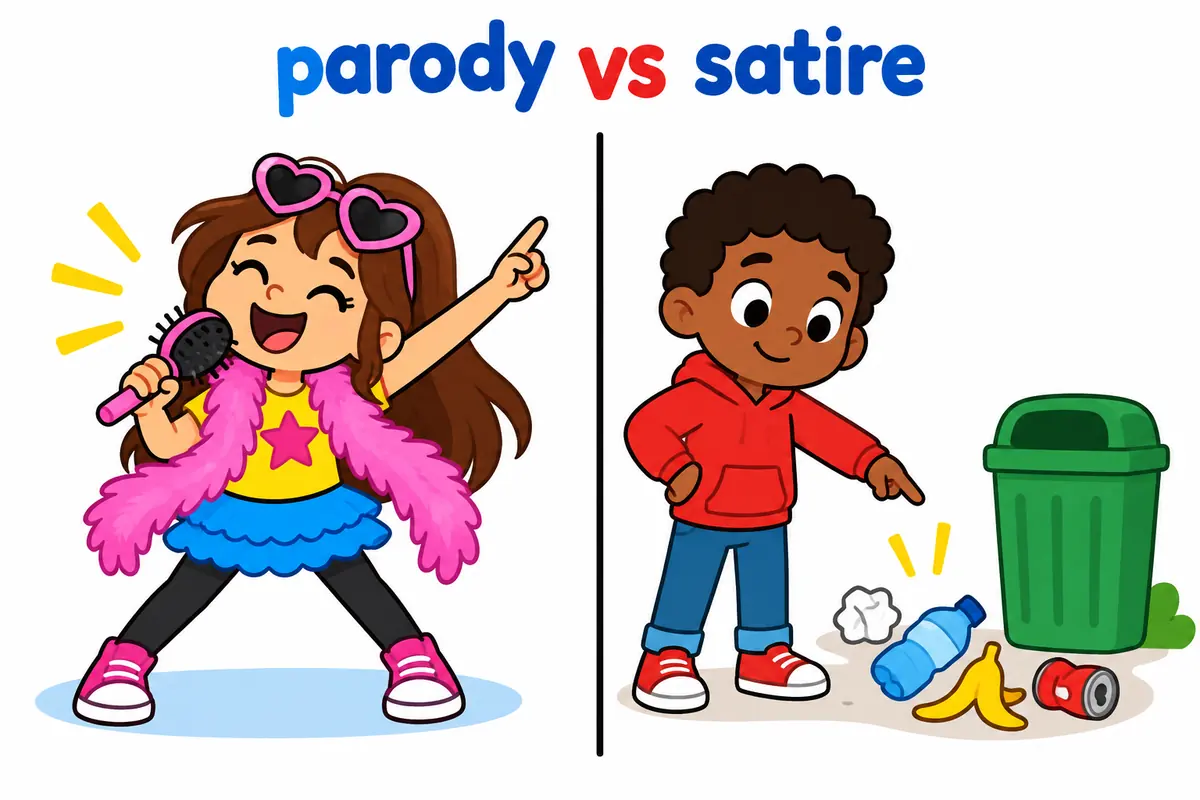
Four words gather around comedy and imitation, and each names a different job. Parody copies a form to make the audience laugh at how the original works; satire uses humour to expose a fault; caricature distorts a person or thing; homage imitates from respect rather than mockery.
| Word | Core job | Target | Attitude |
|---|---|---|---|
| parody | copy a form for comedy | a work or style | playful |
| satire | expose a fault | a behaviour or system | critical |
| caricature | distort for effect | a person or subject | mocking |
| homage | imitate from respect | a maker or body of work | admiring |
| spoof | send up a genre lightly | a whole genre | affectionate |
| lampoon | attack with ridicule | a public figure | hostile |
Verdict: choose parody when the fun comes from the copying itself, satire when a fault is being criticised, and homage when the borrowing is meant to honour. A sketch can be both parody and lampoon, but the two words are not interchangeable, because one describes the form and the other the attack.
Word forms and grammar of parody
Parody works as a noun and a verb, and the table also lists the close relatives that learners mix in.
| Form | Part of speech | Example |
|---|---|---|
| parody | noun, singular | The song is a parody of a lullaby. |
| parodies | noun plural or verb 3sg | Her parodies of the news are popular. |
| parodied | verb, past and past participle | The presenter parodied his own catchphrase. |
| parodying | verb, present participle | They are parodying a game show. |
| parodic | adjective | The film’s parodic ending divides critics. |
| parodist | noun | As a parodist, she copies voices exactly. |
| spoof | noun or verb | The trailer is an affectionate spoof. |
| burlesque | noun | The play is a burlesque of grand opera. |
Two look-alike relations are useful to keep straight. A spoof is a light parody of a whole genre, while a burlesque is an older stage form that treats a serious subject absurdly. Neither is a plain synonym of parody, because each carries its own history and tone.
Common mistakes with parody
- Incorrect:
The film is a parody on horror movies.Correct: The film is a parody of horror movies. Rule: the noun takes of, not on. - Incorrect:
Her cover is a parody and a sincere tribute.Correct: Her cover is an homage and a sincere tribute. Rule: respect, not mockery, is homage; parody exaggerates the original. - Incorrect:
The cartoon parodies.Correct: The cartoon parodies political adverts. Rule: as a verb, parody is transitive and needs an object. - Incorrect:
The report parodied the company’s poor results.Correct: The report criticised the company’s poor results. Rule: parody imitates a form; to expose a fault you satirise or criticise. - Incorrect:
He made a parody to his teacher’s voice.Correct: He did a parody of his teacher’s voice. Rule: the fixed phrase is a parody of, with the verb do or write. - Incorrect:
The sequel is a parody.Correct: The sequel became a parody of itself. Rule: without a target, name the idiom a parody of itself for something worn out by excess.
Practice using parody
- Fill the blank: The sketch is a ______ of a breakfast advert.
- Choose the better word: The article mocks the mayor’s vanity, so it is (parody / satire).
- Correct the error: The troupe parodied on the talent show.
- Build a sentence: use the verb parody with a school assembly as its object.
- Spot the register: which fits a film review — the film works as parody, or the film copies stuff to be funny?
- Choose the admiring word: a wordless tribute that copies a director’s style is (homage / parody).
Answers
- parody — the fixed noun frame is a parody of.
- satire — the target is a fault, not a form, so satire fits.
- The troupe parodied the talent show — the verb takes a direct object with no preposition.
- Model answer: The older pupils parodied the head teacher’s assembly speech.
- The film works as parody — a review keeps the precise technical term.
- homage — copying from respect is homage, not parody.
The bottom line
Parody in a sentence names a comic imitation that copies a work or style closely enough to make fun of how it works. The noun takes the frame a parody of, the verb takes a direct object, and neither is a plain copy. Keep satire for sharpening a fault and homage for honouring an original, because the three words look similar and do different jobs. The quick test is to ask whether the sentence laughs at a form or criticises a fault.
Frequently asked questions about parody
Is parody the same as satire?
No. Parody copies a work, style or person and exaggerates it for comedy, while satire uses humour to expose a fault in behaviour or society. A parody of a cooking show laughs at the show itself; a satire of cooking shows attacks the culture around them. The two often appear together, but they name different intentions.
Can parody be a verb?
Yes. Parody works as a transitive verb meaning to imitate for humour, with forms parodies, parodied and parodying. As a verb it needs an object, so you write the pupils parodied the advert rather than the pupils parodied. The noun remains the more common form in everyday writing.
What is the plural of parody?
The plural is parodies, formed by changing the final y to i and adding es. The same spelling serves as the third person singular of the verb, so the phrase her parodies is a noun while she parodies is the verb. Context tells them apart because the verb follows a subject such as she or he.
Does a parody have to be funny?
Humour is the point, though it can be gentle, affectionate or sharp rather than laugh-out-loud. A parody succeeds when the audience recognises the original and enjoys the exaggeration. Where the intention is sincere imitation, the better words are homage or adaptation, because parody always carries the note of mockery.
Have you ever come across a hilarious imitation or a clever mockery of a famous work? That, my friend, is what we call a parody. A parody is essentially a comedic imitation of a person, a literary work, or a genre, designed to poke fun at the original and entertain audiences.
Parodies often play with familiar themes, characters, or styles, creating a satirical twist that can end up being downright hilarious. Whether it’s a playful take on a blockbuster movie, a reinterpretation of a classic novel, or a humorous spin on a popular song, parodies have a way of adding humor and creativity to our daily entertainment.
7 Examples Of Parody Used In a Sentence For Kids
- The parody we watched was funny.
- My brother likes to make parodies of songs.
- We laughed a lot at the parody of the movie.
- The comedian did a great parody of a famous actor.
- Let’s create a parody of our favorite story.
- The parody made us all giggle.
- Have you seen a parody before?
14 Sentences with Parody Examples
- The college drama society put on a hilarious parody of a popular Bollywood movie.
- The political science students created a satirical parody video about the Indian government.
- The English literature class analyzed a parody of a famous Shakespearean play.
- The engineering students made a parody of a TED talk for their project presentation.
- The marketing students wrote a social media parody advertisement to highlight consumer behavior.
- The medical students performed a parody skit about different specialties in the healthcare field.
- The computer science students developed a video game parody of a classic arcade game.
- The architecture students designed a parody building that combined elements of different architectural styles.
- The fashion design students created a parody fashion show featuring exaggerated and unconventional designs.
- The business students presented a parody of a corporate board meeting to demonstrate leadership and communication skills.
- The history students made a parody timeline of significant events in India’s independence movement.
- The psychology students staged a parody therapy session to explore different counseling techniques.
- The environmental science students filmed a parody documentary about climate change and conservation efforts.
- The economics students wrote a parody research paper on the impact of demonetization on the Indian economy.
How To Use Parody in Sentences?
To use the word parody in a sentence, it is important to understand its meaning and how it is typically used. A parody is a humorous or exaggerated imitation of a person, literary work, movie, or other form of art that aims to mock or critique the original.
When incorporating parody into a sentence, consider using it to describe a work of art or a humorous imitation. For example, “The comedian performed a brilliant parody of the popular TV show, leaving the audience in stitches.” In this sentence, parody is used to describe the comedic imitation of the TV show.
Remember to use parody in a context that highlights its humorous or satirical nature. You can also use it to describe something that is cleverly imitating or making fun of something else. For instance, “The viral video was a hilarious parody of a famous music video, racking up millions of views online.”
Overall, when using the word parody in a sentence, aim to capture the essence of humor, imitation, or satire that is characteristic of a parody. By understanding its meaning and how it is commonly used, you can effectively incorporate it into your writing or conversations.
Conclusion
In conclusion, parody is a form of humor or satire that imitates or exaggerates the style of a particular work, artist, or genre for comedic effect. It often involves using well-known elements in a humorous or exaggerated way to poke fun at the original piece. For example, “The parody of a popular song had the audience in stitches with its cleverly altered lyrics and exaggerated performance.”
Overall, parody serves as a tool for entertainment, commentary, and cultural criticism, offering a light-hearted or satirical take on familiar themes. Whether in literature, music, film, or other forms of media, parody can provide a comedic and often thought-provoking perspective on the world around us by cleverly mimicking and exaggerating elements of popular culture.


