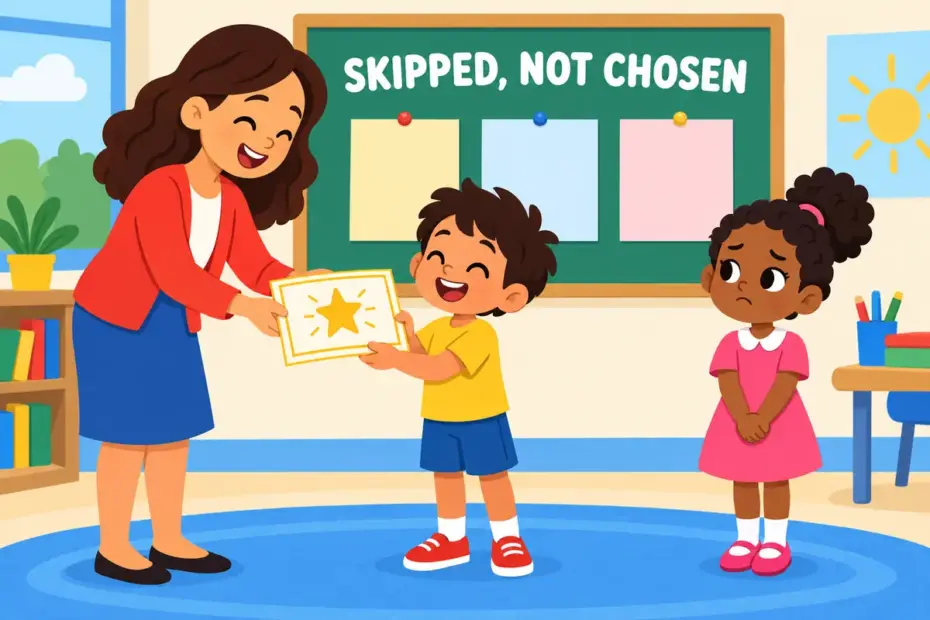
Pass over means to skip or ignore someone, especially when choosing another person, and it can also mean to move across something or omit a detail. To use pass over in a sentence, name the person or thing skipped, as in she was passed over for the captaincy. The selection sense is the one that stings.
Pass over at a glance
- Pass over is a phrasal verb; its past form is passed over and its present participle is passing over.
- In the selection sense it is separable, so a pronoun can sit in the middle: they passed her over.
- The role or reward that was missed follows for: passed over for promotion.
- In a second sense it means to omit or skip a topic, as in pass over the details.
- The commonest error is writing past over, because past and passed sound identical.
What does pass over mean?
Pass over is a phrasal verb meaning to skip or ignore someone, often in favour of another, or to move across something and to omit it. The Cambridge entry for pass over records the skip-someone sense and the move-across sense. When the point is simply not noticing something, ignore a warning is stronger and plainer, and when you deliberately leave something out, skip a step is the everyday phrase.
| Sense | Plain meaning | Example sentence |
|---|---|---|
| Skip a person | Choose someone else and leave them out | She was passed over for the manager’s job. |
| Omit a topic | Leave something out on purpose | We can pass over the first chapter for now. |
| Move across | Travel over a place or surface | The plane passed over the town at dusk. |
| Touch briefly | Mention something only in passing | The report passes over the funding question. |
One limitation matters. Pass over in the selection sense describes a decision someone else made, so a person is passed over rather than passing over themselves. It also says nothing about fairness: a candidate can be passed over for good reasons or for none, and the verb reports the skip without judging it.
How do you use pass over in a sentence?
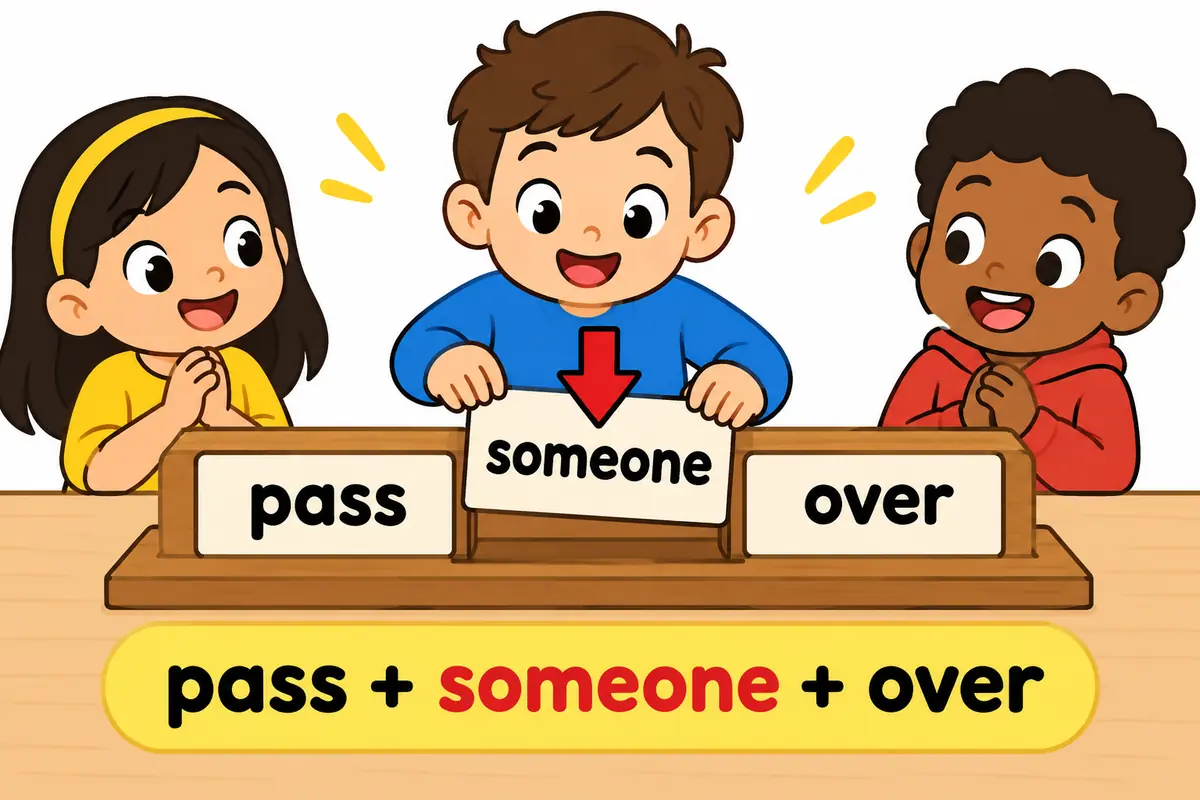
Pass over is separable in the selection sense, so the person may follow the verb or sit between the two parts. The pronoun strongly prefers the middle, which is why they passed her over sounds more natural than they passed over her. The verb is transitive here, and the missed reward follows for.
| Pattern | Example | What it signals |
|---|---|---|
| pass + person + over | They passed her over for the role. | Separable; the person sits in the middle. |
| be passed over for + reward | He was passed over for promotion. | Passive; names the reward that was missed. |
| pass over + topic | Let us pass over the costs for now. | Omit or skip a subject deliberately. |
| pass over + place | A storm passed over the valley. | Move across a surface, intransitive. |
| pass over + in silence | The memoir passes over the war years. | Omission that the writer notices. |
The clearest test is the pronoun. If you can put it in the middle, as in passed him over, you are using the selection sense. If the phrase names a place and nothing is skipped, as in the cloud passed over the hill, you are using the movement sense and nothing can go in the middle.
Pass over in a sentence: examples across contexts
The phrase appears in careers, families, news and quiet description, and the surrounding words show what was skipped. The nine sentences below keep pass over while changing the thing that was left behind.
| Context | Example sentence | Why this works |
|---|---|---|
| Workplace email | She was passed over for the team lead, and nobody explained why. | Names the role and the silence around it. |
| News report | The veteran was passed over for the award for the third year. | Uses for to show what was missed. |
| Sports report | The coach passed over two fit players for the final. | Separable form with the object in the middle. |
| Conversation | Do not pass over her idea just because she is new. | Direct advice about ignoring a person. |
| Academic writing | The summary passes over the difficult evidence. | Omission of a topic, stated neutrally. |
| Literature | Time passes over some losses and sharpens others. | Figurative movement, poetic but clear. |
| Teaching | We will pass over exercise four and return to it later. | Deliberate skip in a lesson. |
| Weather report | A band of rain passed over the coast overnight. | The movement sense, with a place following. |
| Family life | He felt passed over when the cousins were all invited. | Feel plus the passive, reporting emotion. |
Most of these sentences name what was skipped, and that habit is what makes the phrase precise. A bare they passed over two people leaves the reader asking what for, which is exactly the information the role or reward supplies.
Pass over vs overlook
Pass over and overlook both suggest something went unnoticed or unused, but they differ in intention and in what is at stake. Pass over is about selection; overlook is about attention.
| Attribute | pass over | overlook |
|---|---|---|
| Core meaning | Skip a person in favour of another | Fail to notice or consider something |
| What is skipped | A person or thing entitled to be chosen | A fact, detail, fault or view |
| Intention | Usually deliberate | Often accidental |
| Grammar | Separable, with for before the reward | Takes a direct object |
| Typical feel | Unfair and personal | Careless and impersonal |
| Typical sentence | passed over for promotion | overlooked an error |
Verdict: use pass over when somebody is skipped and feels it, and overlook when something simply goes unseen. A candidate who is overlooked for a role may not have been considered at all, whereas a candidate passed over was considered and set aside. To leave something out on purpose, omit a detail is the more neutral verb. Being passed over when everyone else is invited registers as a slight.
Word forms and grammar of pass over
The verb is regular, and its two senses share the same inflections. The table also gathers the near neighbours that learners mix with it.
| Form | Part of speech | Example |
|---|---|---|
| pass over | phrasal verb, base form | They often pass over quiet applicants. |
| passes over | third person singular | He passes over the small print. |
| passed over | past and past participle | She was passed over twice. |
| passing over | present participle | The board is passing over local candidates. |
| pass by | phrasal verb, related | The chance passed by unnoticed. |
| bypass | verb, related | They bypassed the usual process. |
Pass by is the closest relative, and it describes something or someone going past without being taken up, which is why a chance can simply pass by a whole town or a person. Bypass is transitive and more clinical, so it suits systems rather than feelings.
Common mistakes with pass over
- Incorrect:
She was past over for promotion.Correct: She was passed over for promotion. Rule: past is a preposition or adjective; the verb form is passed. - Incorrect:
They passed over from him.Correct: They passed him over. Rule: the person is the object and sits between the parts, with no from. - Incorrect:
He was passed over the job.Correct: He was passed over for the job. Rule: the missed reward follows for. - Incorrect:
Do not pass over on my question.Correct: Do not pass over my question. Rule: the topic is a direct object, so no on is needed. - Incorrect:
The manager passed over to give her the award.Correct: The manager passed her over for the award. Rule: the selection sense puts the person in the middle and names the reward with for.
The single mistake that reveals a learner fastest is the homophone past. Passed is the verb, past places something behind you, and a sentence such as she was past over mixes the two beyond repair.
Practice using pass over
Work through the six items, then read the reason beside each answer.
- Fill the gap: After ten good years, he was ______ for the directorship.
- Choose the better word: The reviewer simply (passed over / overlooked) a spelling error on the cover.
- Correct the error: She was past over for the scholarship.
- Build a sentence: use pass over about a coach who skips a willing player.
- Spot the register: which fits a news report — she was passed over for the post, or they totally passed her over?
- Change the voice: rewrite The board passed over the younger applicant in the passive.
Answers
- passed over — the reward follows for and the verb form is passed.
- overlooked — an error is not noticed, which is attention rather than selection.
- She was passed over for the scholarship — passed is the verb, and the reward follows for.
- Model answer: The coach passed over a willing player for the final.
- She was passed over for the post — a report favours the passive and avoids totally.
- The younger applicant was passed over by the board — the passive keeps the person as the subject.
The bottom line
Use pass over in a sentence when someone is skipped, especially for a role or reward, and let for name what they missed. Two details decide most sentences: the selection sense is separable, so the person can sit between pass and over, and the verb is passed, not past. When something simply goes unseen, overlook is the better word.
Frequently asked questions about pass over
What does passed over mean at work?
At work, passed over means someone was skipped when a role or reward was given to another person. The usual pattern is be passed over for plus the role, as in she was passed over for team lead. It often implies that no clear reason was given.
Is pass over separable?
In the selection sense it is separable, so the person can follow the verb or sit between the two parts. Pronouns prefer the middle, which is why they passed her over sounds natural. In the movement sense, as in a storm passed over the valley, nothing can go in the middle.
What is the difference between pass over and overlook?
Pass over means skipping a person in favour of another, and it usually implies a deliberate choice. Overlook means failing to notice something such as an error, and it is often accidental. Pass over affects people; overlook affects facts and details.
What is the past tense of pass over?
The past tense and past participle are both passed over, as in he was passed over twice. The third person singular is passes over, and the present participle is passing over. Watch the spelling: passed carries the verb, while past never does.
Have you ever wondered about the phrase “pass over” and what it means? In simple terms, “pass over” refers to the act of overlooking or skipping something, often without giving it much attention.
This phrase is commonly used in various contexts, whether in everyday conversations or formal writing, to convey the idea of quickly moving past or disregarding something. By understanding the concept of “passing over,” you can enhance your writing clarity and effectively communicate your message.
7 Examples Of Pass Over Used In a Sentence For Kids
- The bird will pass over the tall trees.
- The clouds will pass over the bright sun.
- We can pass over the small river on the bridge.
- Let’s watch the airplanes pass over the city.
- I saw a big boat pass over the ocean waves.
- The butterflies will pass over the colorful flowers.
- The birds will pass over our playground in the evening.
14 Sentences with Pass Over Examples
- Pass over the assignment to your classmate for a quick review.
- Don’t forget to pass over your notes before the exam.
- Let’s pass over this chapter in the textbook, it’s not relevant to our syllabus.
- We can pass over this topic during today’s discussion.
- I will pass over the attendance sheet so everyone can sign it.
- Can you please pass over the study material for tomorrow’s presentation?
- Let’s pass over the responsibility of organizing the event to someone else.
- We should pass over this difficult question and come back to it later.
- It’s important to pass over the relevant information during group projects.
- Let’s pass over the selection of the topic to our team leader.
- I need to pass over the research findings to my group members.
- We should pass over the feedback forms for everyone to fill out.
- Can you pass over the pen so I can make some notes on the presentation?
- Don’t forget to pass over any important announcements during the meeting.
How To Use Pass Over in Sentences?
To use Pass Over correctly in a sentence, you should first understand its meaning. Pass Over means to skip over or move past something without stopping.
Here are some tips on how to use Pass Over in a sentence:
-
Identify the subject that is moving past or skipping over something.
Example: “The rabbit was able to pass over the log without any difficulty.” -
Mention what is being skipped over or moved past.
Example: “He decided to pass over the details and get straight to the main point.” -
Use Pass Over as a phrasal verb to convey the action of moving past or skipping over.
Example: “The hiker needed to pass over several obstacles to reach the mountain summit.” -
Remember that Pass Over can also be used in a metaphorical sense, such as ignoring or disregarding something.
Example: “She chose to pass over the negative comments and focus on the positive feedback.”
By following these simple tips, you can easily incorporate Pass Over into your everyday vocabulary. Happy practicing!
Conclusion
In summary, the phrase “pass over” is often used in contexts where something is ignored, skipped, or overlooked. Whether it’s skimming through information hastily, dismissing an option, or physically moving past an object, the term conveys a sense of neglect or omission. For example, when rushing through a list, one might pass over important details without giving them proper attention. Similarly, during a search, overlooking a crucial clue could result in missing valuable information.
Overall, “pass over” encapsulates the act of intentionally or inadvertently disregarding something in a variety of scenarios. It serves as a reminder to be thorough and mindful in our actions to avoid overlooking vital details or opportunities that may be crucial for successful outcomes.


