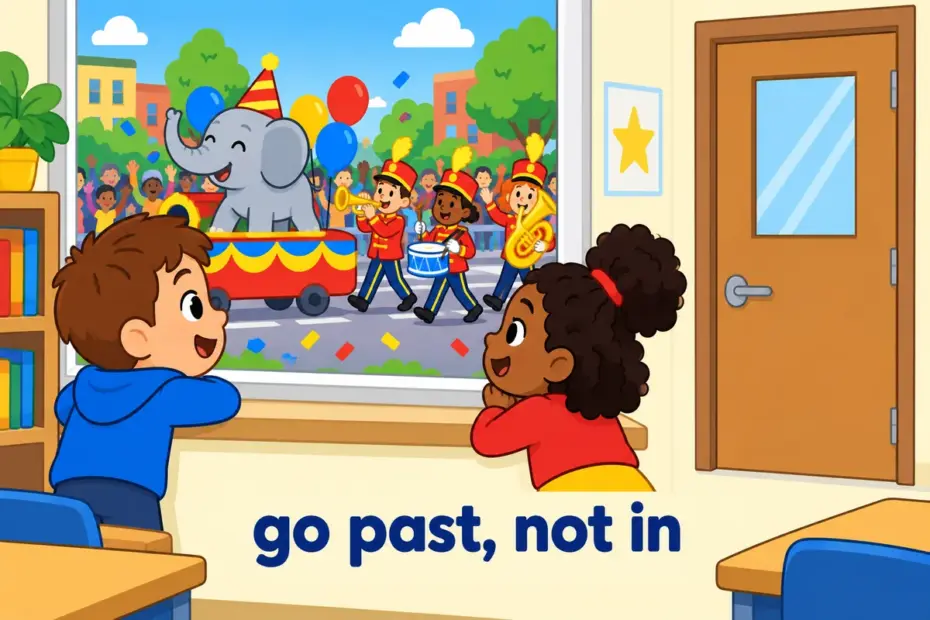
Pass by means to go past a place or a person without stopping, or to leave someone behind unnoticed. To use pass by in a sentence, let the verb stand alone or add a place after by: “The parade passed by our window.” The literal verb is inseparable.
Pass by at a glance
- Pass by is a phrasal verb; its forms are passes by, passed by and passing by.
- It is intransitive when it means to go past, and prepositional when a place follows by.
- A third sense means to overlook or leave someone behind, as in life passed him by.
- The usual subjects are people, traffic, parades, time and opportunity.
- The commonest error is treating pass by as a synonym for visit, which needs a different verb.
What does pass by mean?
Pass by is a phrasal verb meaning to move past a place or person without stopping, to happen and slip away, or to overlook someone entirely. The Cambridge entry for pass by covers the literal movement and the sense of being missed, and the presence of an object tells you which one is active.
| Sense | Plain meaning | Example sentence |
|---|---|---|
| Go past | Move by a place without stopping | The bus passes by the school at eight. |
| Slip away | Of time or a chance, go without being used | The summer passed by too quickly. |
| Leave behind | Overlook or outpace a person | Success passed him by for years. |
One limitation is worth stating plainly. Pass by never means to visit or to call in. Someone who passes by a shop does not enter it, so use stop in or call at when the journey ends inside. To let a chance slip rather than take it is closer to miss than to pass by.
How do you use pass by in a sentence?
The literal verb is intransitive, so nothing follows it: the parade passes by. When a place is named, by becomes a preposition and the noun follows it, as in we passed by the old mill. The figurative sense is the exception, because it splits the verb and puts the person in the middle: time passed him by. Keep the particle next to the verb in every other pattern.
| Pattern | Example | What it signals |
|---|---|---|
| pass by (no object) | The fire engines passed by with sirens wailing. | Pure intransitive movement, the literal core. |
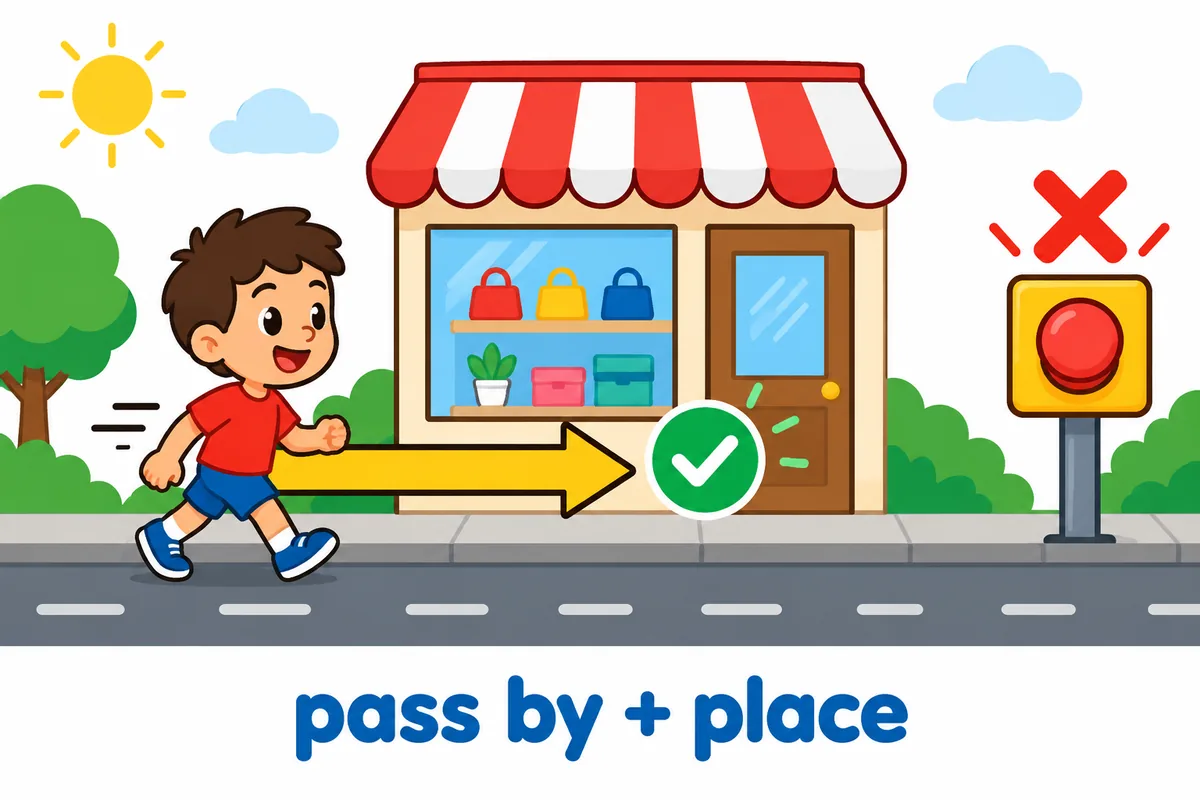
| pass by + place | We pass by the market on the way home. | By is a preposition and the place follows it. |
| pass + person + by | Fame passed the quiet painter by. | The split figurative sense, person in the middle. |
| let + object + pass by | Do not let the offer pass you by. | An instruction about seizing a chance. |
| passing by | Passing by, she waved at the gardeners. | A participle that sets the scene neatly. |
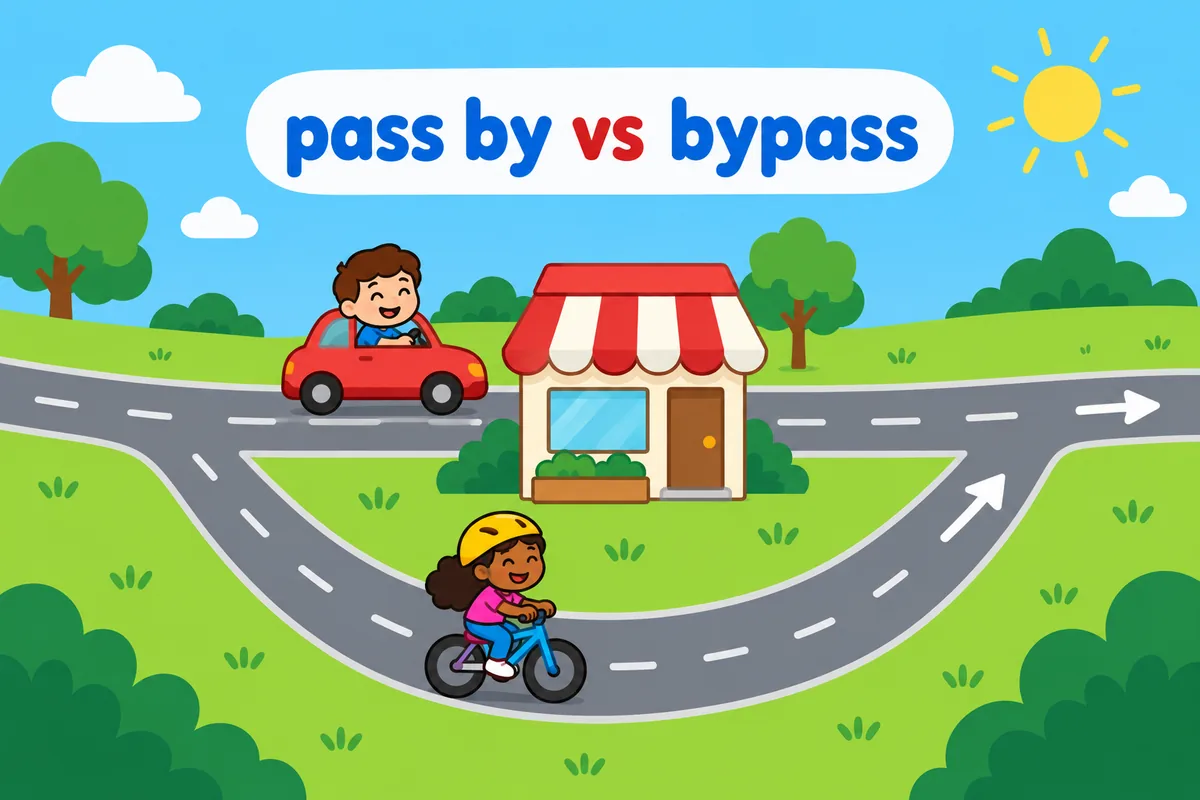
Where the point is to skip something deliberately, bypass is the sharper verb, because it implies a chosen detour rather than a simple movement past.
Pass by in a sentence: examples across contexts
Pass by suits movement observed from the side, and the examples below move from a street corner to a business report. Each sentence keeps the sense of proximity without contact.
| Context | Example sentence | Why this works |
|---|---|---|
| Classroom | The school bus passes by our classroom window each morning. | A routine habit shows the literal movement. |
| Street directions | Pass by the post office and turn left at the lights. | By introduces the landmark as a preposition. |
| Workplace email | Please do not let this deadline pass by unnoticed. | The figurative sense warns against inaction. |
| News report | The procession passed by the town hall in silence. | An intransitive sentence with a public subject. |
| Travel writing | Travellers pass by fields of lavender without a second glance. | Contrasts movement with deliberate inattention. |
| Sports report | The winger let one clear chance pass him by. | The split form puts the player in the middle. |
| Business writing | Two strong quarters get by on cost cuts alone. | A near neighbour in form keeps the tone cautious. |
| Conversation | We were just passing by, so we did not stay long. | The participle explains a brief encounter. |
| History essay | The reform passed the old craftsmen by. | Abstract subject with the split figurative sense. |
Only the figurative sentences split the verb, which is the pattern to watch for in formal writing.
Pass by vs pass away and bypass
Pass away is the same base verb with a different particle and a very different meaning, while bypass is a one-word verb that implies a deliberate detour. Ignore overlaps with the figurative sense, but it names the attitude rather than the movement.
| Attribute | pass by | pass away | bypass |
|---|---|---|---|
| Core meaning | Go past without stopping | Die, politely said | Go around on purpose |
| Usual object | A place, or none | None | A town, a rule or a step |
| Literal movement | Yes, alongside | No | Yes, around |
| Can split | Only in the figurative sense | No | No, it is one verb |
| Register | Neutral and everyday | Neutral and gentle | Neutral, often technical |
Verdict: use pass by for simple movement past something, pass away when the subject is a death, and bypass when someone deliberately avoids a place, a rule or a step.
Word forms and grammar of pass by
Pass by changes only the base verb, so its forms keep the particle intact. Do not confuse it with pass over, which means to skip or promote past someone, or with the unrelated one-word verb bypass.
| Form | Part of speech | Example |
|---|---|---|
| pass by | phrasal verb, base | I pass by the bakery every day. |
| passes by | phrasal verb, third person singular | The river passes by three villages. |
| passed by | phrasal verb, past and past participle | A taxi passed by as we waited. |
| passing by | phrasal verb, present participle | Passing by, he tipped his hat. |
| bypass | different verb, one word | Use bypass for the road that avoids a town. |
Common mistakes with pass by
- Incorrect:
We passed by at the museum yesterday.Correct: We stopped at the museum yesterday. Rule: Pass by means to go past without stopping, so it cannot mean to visit. - Incorrect:
She passed by him a note.Correct: She passed him a note. Rule: By does not make pass mean hand over; use pass with a direct object. - Incorrect:
The years have passed by me.Correct: The years have passed me by. Rule: In the figurative sense the pronoun goes between pass and by. - Incorrect:
He was passed by from the shortlist.Correct: He was passed over for the shortlist. Rule: Being skipped is pass over, not pass by. - Incorrect:
Do not let the chance to pass by.Correct: Do not let the chance pass by. Rule: The bare infinitive has no to after let.
Practice using pass by
Complete the six items, then read the reasons in the answers rather than only the keys.
- Fill the gap: The river ______ our cottage on its way to the sea.
- Choose the better word: Drivers who (pass by / bypass) the village avoid the narrow bridge.
- Correct the error: We pass by to your house every Friday evening.
- Build a sentence: use let something pass by about a job offer.
- Spot the register: which suits a formal report — the trade delegation passed by the port, or the delegation sort of passed the port?
- Rewrite with a pronoun: Time passed by the retired teacher. Put the pronoun in the right place.
Answers
- passes by — the river moves past without stopping, so the verb stays intransitive.
- bypass — the drivers avoid the village on purpose, which is the sense of bypass.
- We pass by your house every Friday evening — by is a preposition and takes no extra to.
- Model answer: Do not let the job offer pass you by without reading it.
- The trade delegation passed by the port — a formal report avoids vague fillers, and by makes the landmark a preposition.
- Time passed the retired teacher by — the figurative sense puts the person between pass and by.
The bottom line
Use pass by in a sentence when someone or something moves past a point without stopping, and keep the verb intransitive or add the place after the preposition by. The two nuances that decide most sentences are these: the literal verb never splits, while the figurative sense of being left behind puts the person in the middle, as in fame passed her by. When the avoiding is deliberate, evade or bypass is the stronger choice.
Frequently asked questions about pass by
Is pass by one word or two?
Pass by is two words as a phrasal verb, and the particle stays separate from the verb, as in we passed by the old mill. The one-word bypass is a different verb meaning to go around something. When you mean simple movement past a point, keep the space between pass and by.
What is the difference between pass by and pass away?
Pass by means to go past a place without stopping, while pass away is a gentle way to say that someone has died. They share the base verb but change meaning with the particle. Context almost always makes the difference clear, because pass away is intransitive and usually refers to a person.
Can you pass by a person?
Yes, and the sentence can be literal or figurative. Literally, a runner passes by a spectator on the pavement. Figuratively, recognition passes a person by, which means it never reaches them. In the figurative version the name or pronoun sits between pass and by.
Does pass by mean to visit?
No, and this is the commonest misunderstanding. To pass by a place is to go near it without stopping, so the visit never happens. If the journey ends inside, use stop in, call at or visit. Pass by describes only the movement along the way.
Have you ever noticed a sentence that seems to just pass by without much attention? When a sentence doesn’t stand out or make a lasting impact, it could be considered a “pass by” example.
In writing, a “pass by” sentence is one that lacks engagement, creativity, or significance, causing it to be easily forgotten or overlooked by the reader. It fails to leave a memorable impression or effectively convey the intended message.
7 Examples Of Pass By Used In a Sentence For Kids
- The bus will pass by the school at 8 AM.
- I saw a bird pass by my window.
- The dog likes to watch cars pass by on the road.
- A butterfly will pass by the flowers in the garden.
- The train will pass by the station very soon.
- Look out the window and see the clouds pass by.
- The wind makes the leaves pass by on the ground.
14 Sentences with Pass By Examples
- Pass by the library to check out some books for your research project.
- Don’t pass by the cafeteria without grabbing a quick snack between classes.
- Make sure to pass by the student services office to inquire about scholarship opportunities.
- It’s always a good idea to pass by the gym for a quick workout after class.
- Pass by the computer lab to print out your assignment before the deadline.
- Don’t pass by the notice board without checking for important announcements.
- Remember to pass by the bookstore to buy the textbooks for your upcoming exams.
- You should pass by the career counseling center to discuss your future job prospects.
- Pass by the student union building to see if there are any upcoming events or workshops.
- Make it a habit to pass by the study group sessions for extra help with your subjects.
- Pass by the university administration office to submit your documents for registration.
- Don’t pass by the academic advisor’s office without scheduling an appointment for course guidance.
- Stop and pass by the cafeteria bulletin board to read about the latest campus news.
- Before you head home, pass by the student club fair to join any extracurricular activities that interest you.
How To Use Pass By in Sentences?
Pass by is a phrasal verb that is often used in English to refer to moving past or going by something or someone. It can also mean to stop briefly at a place on your way to somewhere else.
One way to use ” pass by ” in a sentence is:
- “I will pass by the store on my way home to pick up some groceries.”
Here, “pass by” indicates that the speaker plans to stop at the store briefly while traveling home. It implies that the store is on their route, and they will make a quick visit there before continuing on their journey.
Another example could be:
- “The bus will pass by the museum, so we can get off there and visit it.”
In this sentence, “pass by” suggests that the bus will travel past the museum, providing an opportunity for the speaker and others to disembark and visit the museum before the bus continues on its route.
Remember that ” pass by ” is versatile and can be used to describe physically moving past something, stopping at a location, or even ignoring something. practice using it in different contexts to become more familiar with its usage.
Conclusion
In summary, the examples of sentences with “pass by” highlight situations where individuals move past something or someone without interacting with them directly. Whether it’s a quick glance at a storefront or a simple act of ignoring someone on the street, the phrase “pass by” encapsulates the act of not engaging or stopping. These sentences illustrate the fleeting nature of these interactions, emphasizing the brevity and lack of significance in such passing moments.
Overall, the use of “pass by” in these contexts serves to convey a sense of indifference, detachment, or simply the act of going about one’s business without interruption. These examples showcase how everyday encounters can be described with this phrase, shedding light on the transient nature of human interactions in various settings.


