
Pervasive means spreading through every part of a place, group or system so that the effect is felt everywhere. To use pervasive in a sentence, name what has spread and where it reaches: “A pervasive smell of smoke filled the corridor.” The adjective usually precedes a noun or follows a linking verb such as became or remains.
Pervasive at a glance
- Pervasive is an adjective; pervasively is the adverb, pervasiveness the noun and pervade the verb.
- It describes something spread through all parts of a place, group or system.
- It appears before a noun (a pervasive mood) or after became, seems or remains.
- The register is formal and analytical, common in reports and academic writing.
- The commonest error is confusing pervasive with evasive, which means avoiding a question.
What does pervasive mean?
Pervasive is an adjective meaning present or spread through every part of something, so that no corner is untouched. The Cambridge entry for pervasive ties it to spreading widely, and the key idea is coverage rather than amount: one faint but constant smell can be pervasive, while a strong smell in a single room is not. Where the spread is simply common, prevalent is the more neutral word.
| Sense | Plain meaning | Example sentence |
|---|---|---|
| Spread through a place | Present in every part of a physical space | A pervasive damp had reached every cupboard. |
| Spread through a group or system | Felt throughout an organisation or an idea | Distrust of the new timetable was pervasive. |
| Of an influence or feeling | Constantly present and hard to escape | A pervasive hum of traffic never stopped. |
One limitation is worth stating plainly. Pervasive describes extent, not approval, and it often carries a hint of unease because what spreads everywhere is usually hard to remove. For a welcome trend, widespread or common is the fairer choice.
How do you use pervasive in a sentence?
Pervasive is an adjective, so it describes the reach of a thing rather than an action. The five patterns below cover how it attaches to a noun, a place and a group.
| Pattern | Example | What it signals |
|---|---|---|
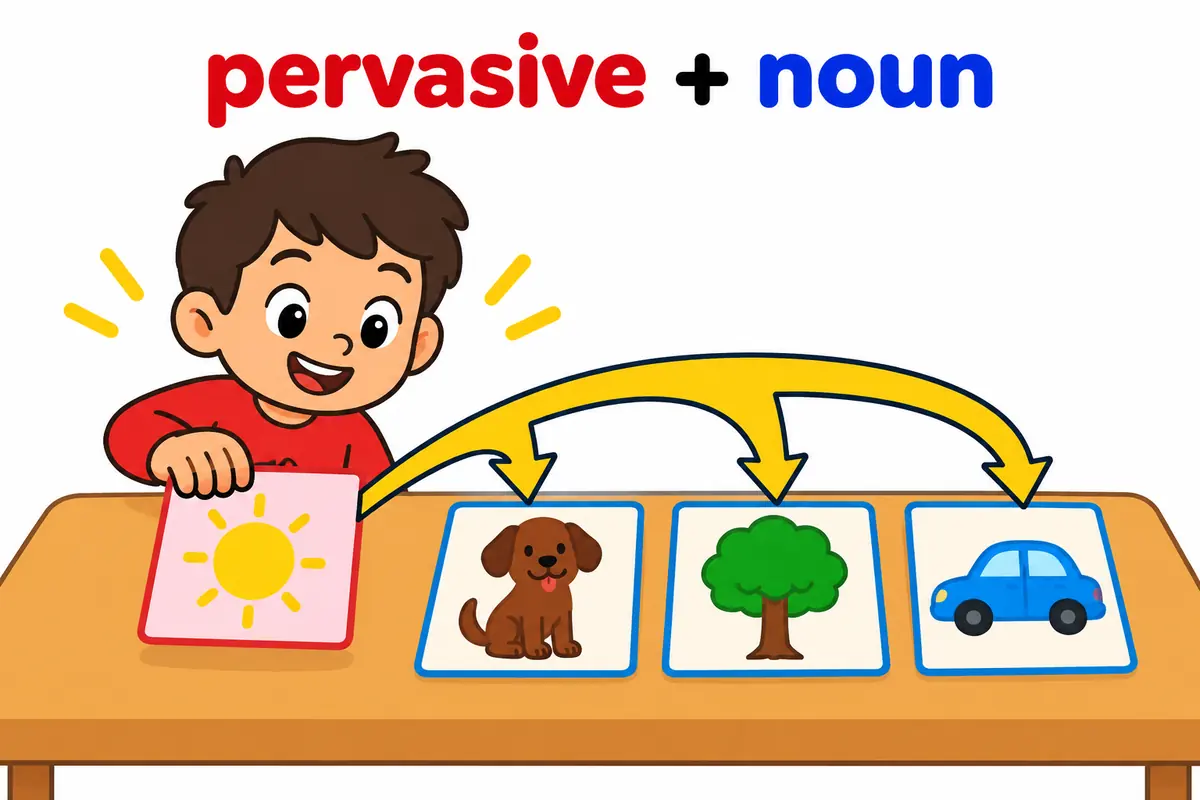
| pervasive + noun | a pervasive smell | Labels how far something reaches. |
| linking verb + pervasive | The mood became pervasive. | Reports that something spread everywhere. |
| pervasive + in, among or through + place or group | Fear was pervasive among the staff. | Names the group that is covered. |
| adverb + pervasive | increasingly pervasive | Shows the spread growing over time. |
| pervade, the verb | Doubt pervaded the report. | Puts the act of spreading first. |
Pervasive in a sentence: examples across contexts
Pervasive keeps the same sense of coverage while the subject changes. The nine sentences below move from a survey to a science report, and each one names what has spread.
| Context | Example sentence | Why this works |
|---|---|---|
| Classroom | A pervasive silence followed the head’s question. | Shows an atmosphere filling the whole room. |
| Workplace email | The survey found pervasive dissatisfaction with the rota. | Uses the adjective for a pattern across a staff. |
| News report | Pervasive flooding closed every road into the village. | Names an effect that reached everywhere at once. |
| Science writing | A pervasive film of oil coated the tanks. | Describes an invisible covering that no test missed. |
| Academic prose | Social media play a pervasive role in teenage sleep loss. | Uses the word for an influence threaded through daily life. |
| Marketing | The campaign’s pervasive logo followed viewers from screen to screen. | Shows coverage shading into irritation. |
| Legal writing | The report described a pervasive failure of record-keeping. | Applies the word to a systemic fault. |
| Conversation | That song was pervasive last summer. | Uses the everyday register of the word. |
| Sports writing | A pervasive lack of fitness cost them the second half. | Spreads the cause across the whole team. |
Seven of the nine subjects are unwelcome, which shows how naturally the word tilts towards problems. A total presence would call for omnipresent instead.
Pervasive vs evasive
Pervasive is most often confused with evasive, and the two share a rhythm while describing opposite ideas.
| Attribute | pervasive | evasive |
|---|---|---|
| Core meaning | Spreading through everything | Avoiding a direct answer |
| Typical subject | A smell, mood, trend or problem | A person, reply or manoeuvre |
| Focus | Reach and coverage | Avoidance and delay |
| Emotional colour | Often uneasy | Often suspicious |
| Register | Formal, analytical | Neutral to critical |
Verdict: choose pervasive when something has spread everywhere, and evasive when somebody is dodging a question.
Word forms and grammar of pervasive
Pervasive has a full word family, and the verb is the form writers forget. The table lists the set and the near neighbour that learners confuse it with.
| Form | Part of speech | Example |
|---|---|---|
| pervasive | adjective | a pervasive silence |
| pervasively | adverb | The dye spread pervasively through the cloth. |
| pervasiveness | noun | The pervasiveness of the rumour surprised the staff. |
| pervade | verb | Doubt pervaded the whole report. |
| pervasion | noun, rare | The pervasion of plastic waste worries scientists. |
| evasive | adjective — different meaning | an evasive answer |
Where the reach is total, ubiquitous is the stronger word, and pervasion names the spread itself.
Common mistakes with pervasive
- Incorrect:
His pervasive answer avoided the question.Correct: His evasive answer avoided the question. Rule: Evasive means dodging; pervasive means spread everywhere. - Incorrect:
The pervasive of the problem worried them.Correct: The pervasiveness of the problem worried them. Rule: The noun is pervasiveness; pervasive is the adjective. - Incorrect:
One pervasive room smelled of paint.Correct: A pervasive smell of paint filled the room. Rule: Pervasive needs something that actually spreads through a space. - Incorrect:
The rumour was pervade among students.Correct: The rumour pervaded the student body. Rule: Pervade is the verb and takes an object. - Incorrect:
Pervasive to the whole school, the rule was ignored.Correct: The rule was ignored throughout the school. Rule: Pervasive is not followed by to; it sits before a noun or after a linking verb.
Practice using pervasive
Work through the six items, then check the reasoning rather than only the answer.
- Fill the gap: A ______ smell of new paint reached every room.
- Choose the better word: When asked about the delay, the official gave an (pervasive / evasive) reply.
- Correct the error: The rumour was pervasive among the whole staff.
- Build a sentence: use pervasive among about a mood that has spread through a class.
- Spot the register: which belongs in a science report — the mould was pervasive, or the mould was everywhere, honestly?
- Rewrite with the noun: The fault was pervasive. Use pervasiveness instead.
Answers
- pervasive — the smell has reached every room, which is the coverage sense.
- evasive — the official avoided the question rather than spreading anything.
- The rumour pervaded the whole staff — the verb form replaces the adjective plus be.
- Model answer: A nervous mood was pervasive among the class before the exam.
- The mould was pervasive — a report keeps formal wording and drops the filler honestly.
- The pervasiveness of the fault surprised the inspectors — the noun names the extent itself.

The bottom line
Use pervasive in a sentence when something has spread through every part of a place, group or system, and name the space or group it covers. The two nuances that decide most sentences are these: the word measures coverage rather than quantity, and it usually hints at something unwelcome. For a trend that is merely common, widespread is the plainer choice.
Frequently asked questions about pervasive
Is pervasive a negative word?
It is not negative by definition, but it leans that way, because the things described as pervasive are usually hard to escape or hard to remove. A pervasive calm is possible and pleasant, yet even then the word stresses that the calm has reached everywhere. Context alone decides whether the coverage is welcome.
What is the difference between pervasive and widespread?
Widespread means found in many places, while pervasive means found throughout something so that no part is free of it. A widespread problem appears in many schools; a pervasive problem runs through every part of one school. Pervasive is the stronger of the two and implies that escape is difficult.
Can pervasive describe a person?
It rarely describes a person directly, because the word is about coverage rather than character. You would not normally call a colleague pervasive. It describes what a person produces or spreads, such as a pervasive influence, a pervasive sense of unease, or a pervasive rumour that follows them from room to room.
Is there a verb form of pervasive?
Yes, the verb is pervade, and it means to spread through something: a smell pervaded the kitchen. The noun pervasiveness names the quality, and the rarer noun pervasion names the act of spreading. The adjective pervasive stays the most common form in everyday and academic writing alike.
Have you ever come across a word that seems to be everywhere but you’re not quite sure what it means? Allow me to introduce you to the term “pervasive.”
“Pervasive” is an adjective used to describe something that is widespread, prevalent, or existing in every part of a particular area. It often denotes something that is all-encompassing or widely present in various aspects of life.
7 Examples Of Pervasive Used In a Sentence For Kids
- Pervasive means something that is everywhere.
- Pollution is a pervasive problem we need to solve.
- The color red is very pervasive in nature.
- Kindness should be pervasive in our hearts.
- We should be mindful of the pervasive use of plastics.
- Love is a pervasive emotion that brings people together.
- Education is important for pervasive knowledge.
14 Sentences with Pervasive Examples
- Pervasive use of social media among college students is shaping modern communication patterns.
- Students often grapple with the pervasive challenge of striking a balance between academics and extracurricular activities.
- The influence of peer pressure can be pervasive within college social circles.
- It is important for students to be aware of the pervasive issues of mental health on campus.
- The pervasive use of smartphones in classrooms can be a distraction to students during lectures.
- The desire to excel in academics can create a pervasive culture of competition among students.
- College campuses can sometimes be affected by a pervasive sense of inequality among students.
- The phenomenon of procrastination is pervasive among college students facing assignment deadlines.
- The influence of fashion trends can be pervasive among students trying to fit in with their peers.
- Students may encounter pervasive academic stress during exam season.
- The accessibility of online resources has led to a pervasive culture of plagiarism among students.
- The pervasive presence of fast food chains near colleges can impact students’ eating habits.
- The pervasive use of e-commerce platforms has made online shopping a popular trend among college students.
- The use of slang and colloquial language can be pervasive among students in casual conversations.
How To Use Pervasive in Sentences?
Pervasive means “existing in or spreading through every part of something.” To use pervasive in a sentence, you should identify a situation where something is widespread or prevalent.
Here are a few examples:
- The scent of fresh flowers was pervasive throughout the garden.
- Pervasive rumors about the company’s financial troubles led to a decrease in stock prices.
- In today’s society, social media has become pervasive in our daily lives.
- The influence of technology is pervasive in modern education systems.
- Climate change is a pervasive issue that affects all aspects of life on Earth.
When using pervasive in a sentence, it’s important to ensure that the context supports the idea of something being widespread or prevalent. You can also look for synonyms such as ubiquitous, omnipresent, or prevalent to help you communicate the same idea.
By practicing with different sentences that incorporate the word pervasive, you can become more comfortable using it in your writing or conversations. Remember that clarity and context are key when using new vocabulary words like pervasive.
Conclusion
In conclusion, the use of sentences with the keyword “pervasive” highlighted its prevalence and widespread nature in a variety of contexts. From discussing pervasive issues like climate change to describing the pervasive influence of technology in our daily lives, these sentences demonstrated the all-encompassing and unavoidable nature of pervasive phenomena. By examining how this word was used, we gain insight into the pervasive nature of certain problems or trends that impact society on a large scale.
Understanding the significance of pervasive issues through sentences allows us to comprehend the depth and extent of their impact, encouraging us to address these matters proactively. Overall, the examples provided reinforce the idea that pervasive factors permeate various aspects of our world, emphasizing the need for awareness and action to navigate their influence effectively.


