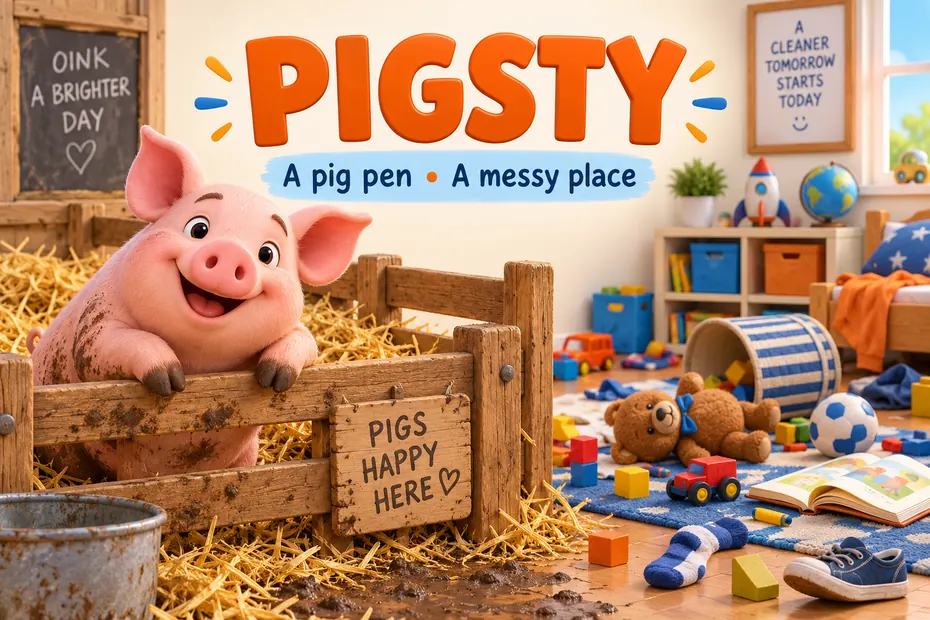
Pigsty in a sentence: “After the party, the kitchen looked like a pigsty.” A pigsty is literally a place where pigs are kept; figuratively, it describes a very dirty or untidy place. Use this countable noun with a, the, or another determiner, and write pigsties for the plural.
Pigsty at a glance
- Pigsty is a noun, not a verb meaning “to make messy.”
- The literal meaning refers to accommodation for pigs.
- The figurative meaning describes a dirty or disorderly place.
- The singular is pigsty; the plural is pigsties.
- Calling someone’s home a pigsty can sound insulting.
Literal or figurative: which meaning fits?
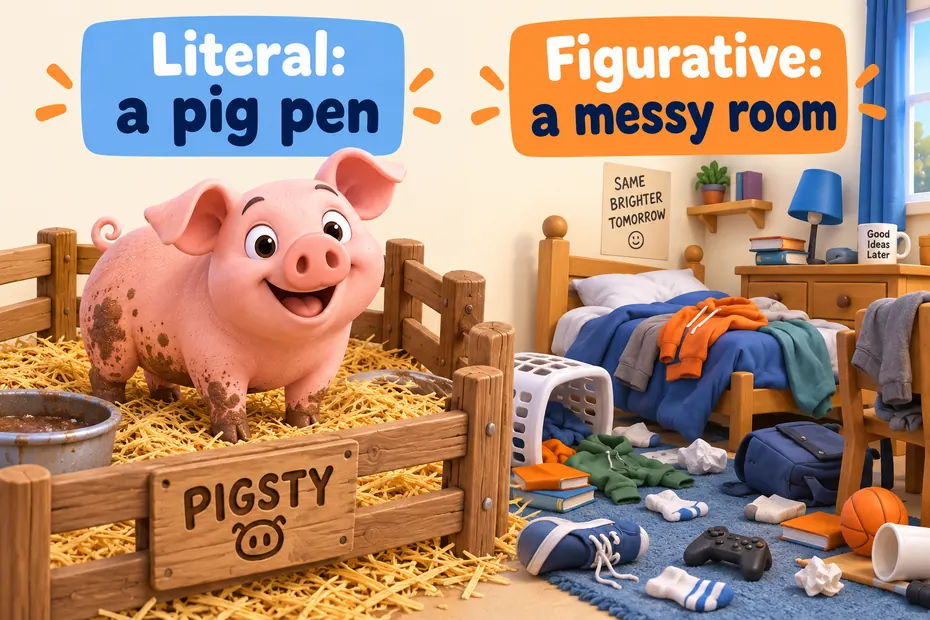
“The farmer repaired the pigsty” describes an actual animal enclosure. “Our spare room is a pigsty” compares a room with such an enclosure to criticize its condition. A sentence about cleaning, clothes, dishes, or scattered belongings usually signals the figurative meaning; a sentence about farm animals usually signals the literal one.
The word does not establish that a real pig enclosure is always dirty. The figurative comparison is a conventional expression, not an animal-care rule. The earlier examples below sometimes connect the literal noun with mud or smells, but neither mud nor a bad smell is required for a place to qualify as a pigsty.
How do you build a sentence with pigsty?
Use pigsty as the subject, an object, or a complement after a linking verb. “The pigsty needs a new gate” makes the enclosure the subject. “We cleaned the pigsty” makes it the object of cleaned. “The room became a pigsty” places the noun after became to describe the room.
| Pattern | Original example | Use |
|---|---|---|
| A pigsty | They built a pigsty beside the barn. | Introduces one enclosure. |
| The pigsty | The pigsty has a wooden gate. | Refers to a known enclosure. |
| Like a pigsty | The workshop looked like a pigsty. | Makes an explicit comparison. |
| Turn into a pigsty | The hallway turned into a pigsty. | Describes a change in condition. |
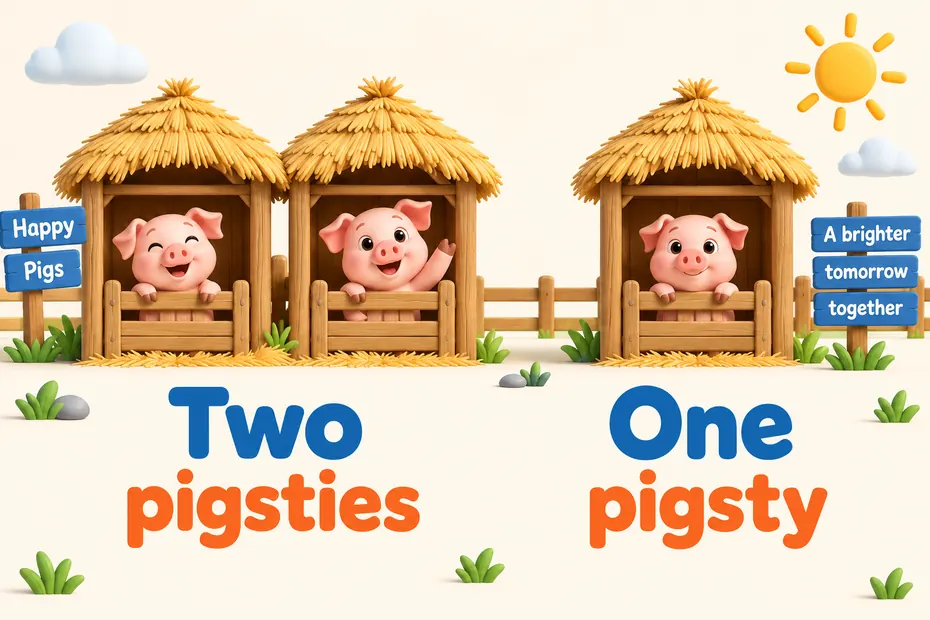
| Two pigsties | Two pigsties stood behind the barn. | Refers to more than one. |
Do not write “The room is pigsty” when you mean one messy place. The singular count noun normally needs a determiner: “The room is a pigsty.” Do not add -s to make “pigstys”; change the final y to ies. An apostrophe marks possession, not an ordinary plural: “the pigsty’s gate” means the gate belonging to one pigsty.
When is pigsty too strong?
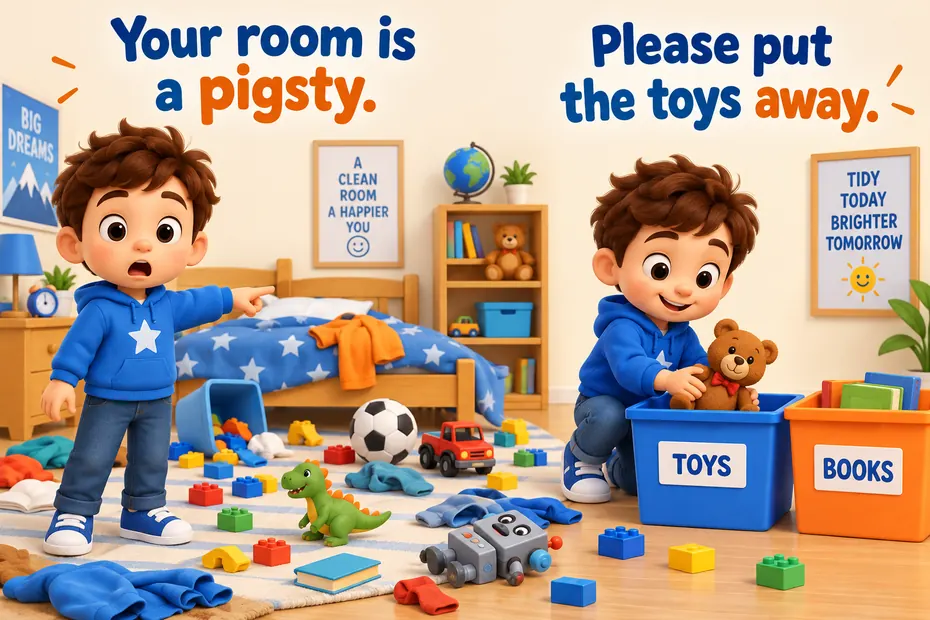
Pigsty is a vivid criticism, so it can be useful in informal storytelling but unhelpful in a request. “Please put the plates in the dishwasher” gives a clear action. “This kitchen is a pigsty” expresses frustration without telling the other person what to do. Choose the first version when the purpose is cooperation.
In a workplace report, describe what you observed: “Empty boxes blocked the aisle” or “Food containers were left on the desk.” Those statements are more precise than “The office was a pigsty.” Do not use the word as a label for a person; its ordinary figurative target is a place or its condition.
More original pigsty sentence examples
- The pigsty stood behind the old farmhouse.
- Fresh straw covered the floor of the pigsty.
- The children drew a pigsty on their farm map.
- We checked the pigsty’s gate before leaving.
- The two pigsties were separated by a path.
- My sewing corner looked like a pigsty after the project.
- He called the shed a pigsty, then helped sort the tools.
- Our room looked less like a pigsty once the laundry was put away.
Frequently asked questions about pigsty
Is pigsty written as one word?
The usual dictionary spelling is pigsty, written as one word. Keep that spelling in ordinary prose and schoolwork. The word combines pig with sty, but recognizing those parts does not mean a space is needed between them. Use the same one-word form when writing the plural pigsties.
Does a pigsty have to be a room?
No. Literally, the word names accommodation for pigs; figuratively, a speaker can apply it to another dirty or untidy place, such as a shed or kitchen. The comparison is easier to understand when the sentence identifies the place and supplies a concrete detail, such as scattered wrappers or unwashed dishes.
Is pigsty the same as pigpen?
The words overlap in their literal use, and dictionaries connect pigsty with pigpen. For a simple animal-enclosure sentence, either may work. If you need a technical description of housing, specify the actual structure instead. An ordinary vocabulary example does not establish the design or husbandry standards of that enclosure.
Can I use pigsty in formal writing?
You can use it when the literal enclosure is relevant or when discussing the expression itself. A figurative complaint may sound judgmental in a formal report. Replace it with the condition you can document: “The room contained discarded packaging” describes evidence, while “The room was a pigsty” supplies a personal evaluation.
Dictionary reference: See Merriam-Webster’s pigsty entry for the noun and its connection with pigpen. The example sentences above are original.
More pigsty sentence examples

Have you ever walked into a room that was so messy and unkempt that it reminded you of a pigsty? In the context of cleanliness and organization, a pigsty refers to a very dirty and disorderly living space, much like the messy quarters where pigs are often kept.
A pigsty can also be used metaphorically to describe any area that is extremely messy or untidy. In everyday conversation, you might hear someone jokingly refer to a cluttered room as a pigsty, implying that it is in desperate need of cleaning and organizing.
7 Examples Of Pigsty Used In a Sentence For Kids
- The pigsty is where the pigs live.
- The pigsty is not clean.
- The pigsty smells bad.
- Pigs like to play in the pigsty.
- We need to clean the pigsty.
- The pigsty has mud and straw.
- The pigsty is where the pigs sleep.
14 Sentences with Pigsty Examples
- College dorm rooms can easily turn into a pigsty if not cleaned regularly.
- After a long week of exams and projects, my apartment looked like a complete pigsty.
- When my roommates went home for the weekend, I took the opportunity to clean our shared pigsty of a living room.
- I couldn’t concentrate on my studies with my desk looking like a pigsty.
- It’s important to keep our study group sessions organized, or else our notes can quickly turn into a pigsty.
- The communal kitchen in our hostel often resembles a pigsty after the weekend parties.
- I made a mental note to declutter my study space before it became a chaotic pigsty.
- Instead of studying, I spent the afternoon cleaning up the pigsty of a common area in our hostel.
- My friends and I decided to have a cleaning party to tackle the pigsty that our apartment had become.
- It’s a good idea to establish a cleaning schedule with roommates to prevent your place from turning into a pigsty.
- I couldn’t believe how quickly my room turned into a pigsty after a few days of neglect.
- I had to do a major deep clean of my room to transform it from a pigsty to a cozy study space.
- It’s easy to get overwhelmed with college life and let your space become a pigsty.
- My friend helped me transform my messy room into a clean, organized space from what used to be a pigsty.
How To Use Pigsty in Sentences?
To use the word Pigsty correctly in a sentence, simply follow these guidelines:
-
Identify the context: Pigsty refers to a messy or dirty place where pigs are kept. Keep this definition in mind when constructing your sentence.
-
Formulate your sentence: Think of a sentence that accurately portrays the meaning of Pigsty. For example, “After neglecting to clean his room for weeks, Tim’s bedroom resembled a pigsty with clothes scattered everywhere.”
-
Place Pigsty in the appropriate position: Integrate the word Pigsty naturally into your sentence. Remember to use it in the context of a messy or dirty environment.
-
Check the structure: Ensure that your sentence has proper grammar and punctuation. Make any necessary adjustments to create a clear and coherent sentence.
-
Practice using Pigsty: Experiment with incorporating the word Pigsty into various sentences to familiarize yourself with its usage. The more you practice, the more comfortable you will become with using the word in different contexts.
By following these steps, you will be able to confidently use the word Pigsty in a sentence. Remember to consider its definition and context to convey your message effectively.
Conclusion
In conclusion, the term “pigsty” refers to a messy, untidy, or generally unkempt location, often associated with the uncleanliness of a pig’s living quarters. It is a metaphor used to describe disorderly and dirty places or situations. Examples of sentences using “pigsty” show how it can be employed to convey disorganization or chaos in various contexts, from describing a messy room to characterizing a workplace in need of tidying up. The word carries negative connotations of filth and neglect, emphasizing the need for cleanliness and orderliness in one’s surroundings.
Using “pigsty” adeptly in sentences can help paint a vivid picture of disorder and untidiness, creating a clear image for readers or listeners. By recognizing the implications of this term, individuals can reflect on the importance of maintaining a clean and organized environment in their daily lives to avoid living in a literal or metaphorical “pigsty.”