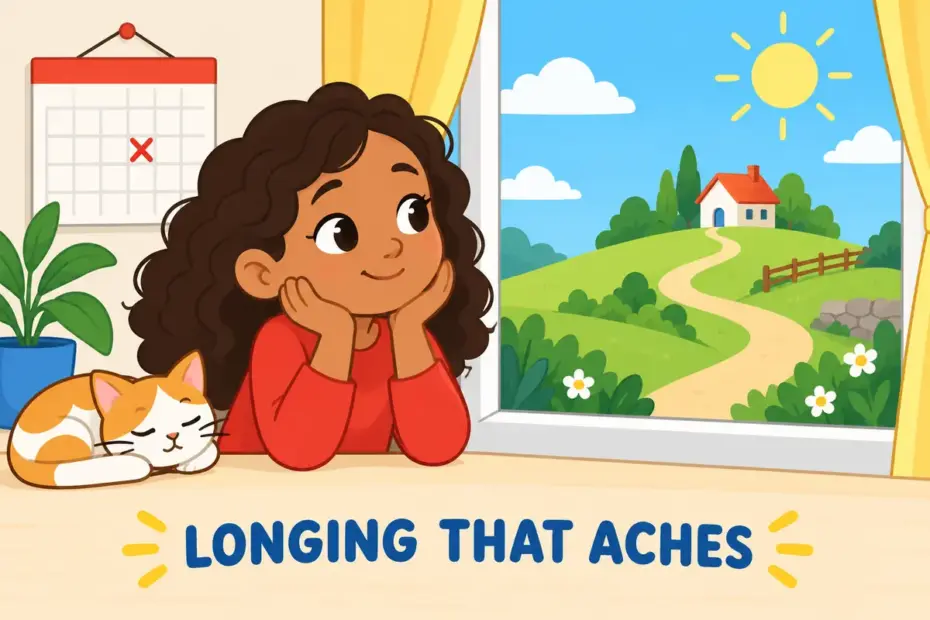
Pine is a verb meaning to long for someone or something so strongly that it hurts, and it is also a noun for the evergreen tree. To use pine in a sentence as a verb, pair it with for or after and name the object of the longing. The two senses never overlap, because the tree simply names an object.
Pine at a glance
- Pine is both a verb, meaning to yearn, and a countable noun for the evergreen tree.
- As a verb it almost always takes for or after, as in pine for the coast.
- Its regular forms are pines, pined and pining, and the participle doubles no n.
- The verb belongs to literary and emotional writing; the tree sense is neutral and everyday.
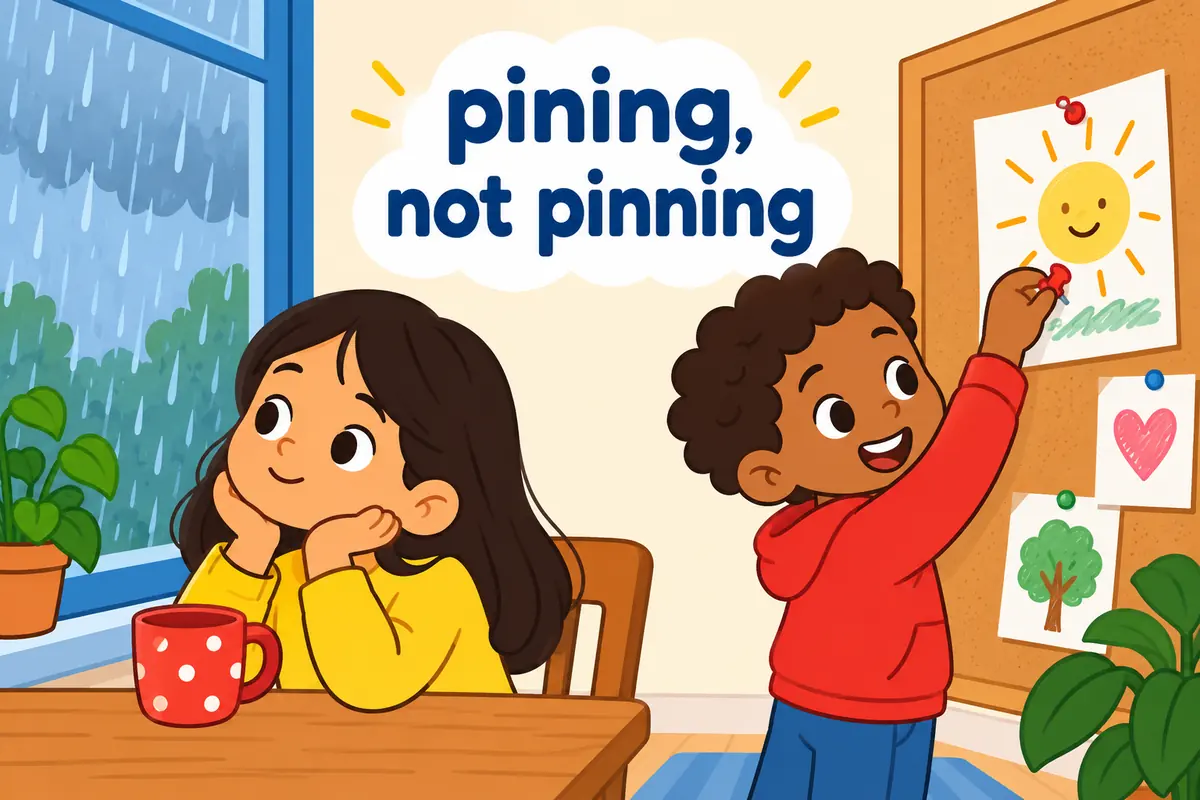
- The commonest error is confusing pining with pinning, which means fastening.
What does pine mean?
Pine is a verb meaning to feel a deep, often painful longing, and a noun meaning the evergreen conifer with needles and cones. The Cambridge entry for pine keeps the verb and the noun together, and the verb itself splits into two shades: longing for something absent, and wasting away with grief.
| Sense | Plain meaning | Example sentence |
|---|---|---|
| Verb: yearn | Long for someone or something absent | She pined for the noise of the city. |
| Verb: waste away | Grow weak through grief or longing | The dog pined away after the move. |
| Noun: the tree | An evergreen tree with needles and cones | A tall pine shaded the whole garden. |
The verb is a strong choice but an easy one to overdo. In a letter or a poem, pine carries real weight; in a school report or a business email, a plainer miss or want usually reads better, because pine signals a grief the occasion does not have.
How do you use pine in a sentence?
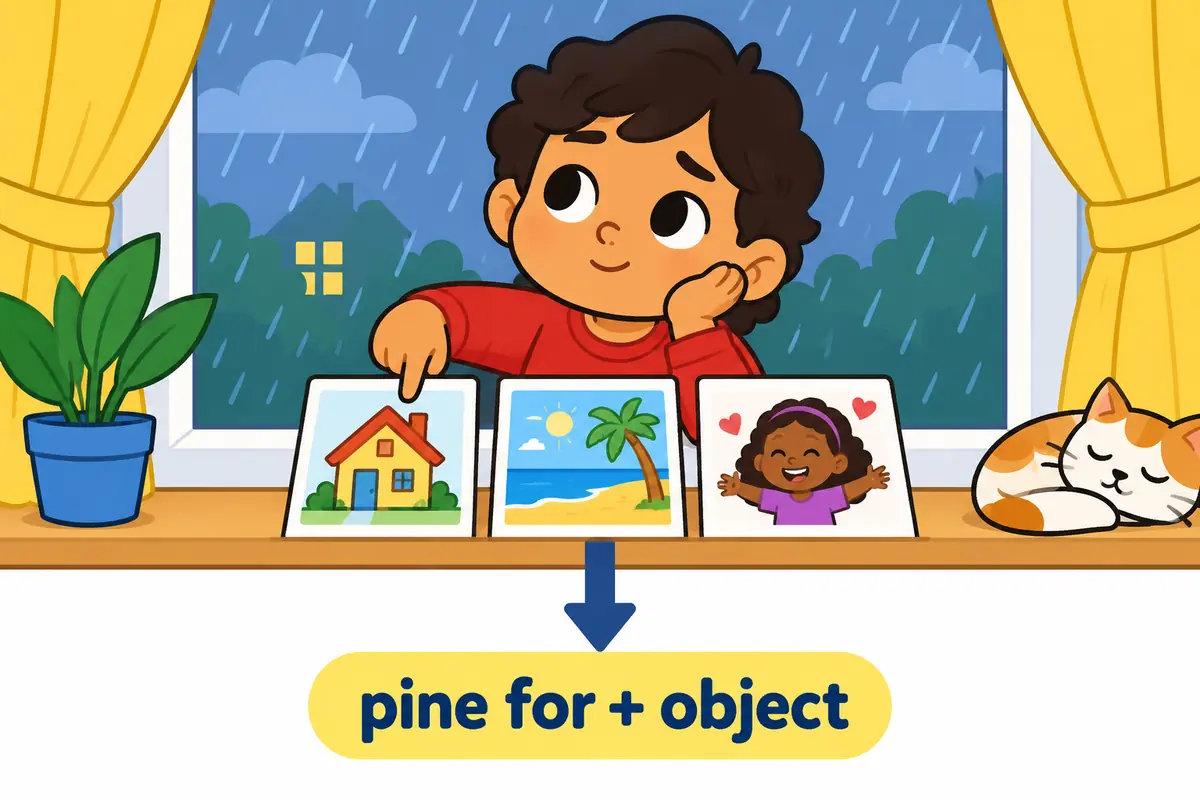
Put the person who longs first, the verb pine second, and for or after plus the object third. Four patterns cover nearly every real sentence, and the tree sense sits apart as a simple noun.
| Pattern | Example | What it signals |
|---|---|---|
| pine for + thing or place | He pined for the open fields of home. | A settled, lasting longing for something absent. |
| pine after + person | She pined after a friend who had moved away. | Longing pointed at one particular person. |
| pine away | The old horse pined away in the empty stable. | Longing that visibly weakens the one who feels it. |
| pine + to + verb | They pined to see the sea again. | Longing expressed as a wished-for action. |
The preposition carries the meaning. Pine for suits a place, a period or a thing; pine after usually points at a person and can suggest hopeless romance. Drop the preposition entirely and the sentence collapses, which is the mistake the practice section repairs.
Pine in a sentence: examples across contexts
The verb keeps its emotional charge as it moves between registers. The nine sentences below range from a diary to a nature guide, and each one names what is longed for.
| Context | Example sentence | Why this works |
|---|---|---|
| Diary | I pined for the long summer evenings at the lake. | The first person suits private writing about feeling. |
| Workplace email | The team pined for the quiet weeks before the launch. | Gentle, light irony without sentimentality. |
| News report | Villagers pined for the market that had closed in spring. | Names the lost thing and the people who miss it. |
| Literary prose | She pined after a childhood she could barely recall. | Pine after plus an abstraction suggests quiet grief. |
| Nature guide | A lone pine anchors the ridge against the wind. | The noun names a tree and takes an article. |
| Letter | We have pined for your cooking since you left. | Warm exaggeration between friends. |
| Academic prose | Emigrants pined for the landscapes they had abandoned. | Formal tone, with a plural subject and past tense. |
| Sports writing | Fans pined for the attacking play of last season. | Transfers longing to a shared memory. |
| Conversation | The cat pined away whenever we packed a suitcase. | Pine away with a household subject keeps it light. |
Pine vs yearn
Pine and yearn both mean to long for something, and other writers often swap them freely. The difference is intensity and habit: yearn is the general verb for a strong wish, while pine adds an ache and a sense of wasting under it.
| Attribute | pine | yearn |
|---|---|---|
| Strength | Ache and grief | Strong but calmer wish |
| Typical object | A lost place, person or past | Anything wanted, from rest to freedom |
| Usual preposition | for, after | for, after, to |
| Register | Literary and emotional | Formal to neutral |
| Implies suffering | Often yes | Only mildly |
Verdict: choose pine when the longing is painful and persistent, and yearn when you want a strong wish without the suggestion of grief. Where pine names a tree, neither verb applies at all.
Word forms and grammar of pine
Pine inflects as a regular verb, and the noun takes a plural like any other count noun. The table also lists the twin word learners mix up, pinning, which is unrelated.
| Form | Part of speech | Example |
|---|---|---|
| pine | verb, base form | Exiles often pine for their own language. |
| pines | verb, third person singular | He pines for the sea every winter. |
| pined | verb, past and past participle | They pined for rain through the dry months. |
| pining | verb, present participle | The bird is pining after its mate. |
| pine | noun, countable | Three pines stand at the edge of the field. |
| pinning | unrelated verb | She is pinning the notice to the board, not pining for it. |
The participle keeps a single n, so the correct spelling is pining, never pinning. A related noun, longing, often replaces the verb when a sentence needs a subject or an object.
Common mistakes with pine
- Incorrect:
He pined the mountains all winter.Correct: He pined for the mountains all winter. Rule: The verb needs for or after before its object; without it, pine reads as a noun. - Incorrect:
She was pining about her old school.Correct: She was pining for her old school. Rule: The fixed prepositions are for and after, not about or of. - Incorrect:
They were pinning for the coast.Correct: They were pining for the coast. Rule: Pinning means fastening with a pin; the longing verb has one n. - Incorrect:
A pine was standing in the garden, and I pined it.Correct: A pine stood in the garden, and I pined for the woods. Rule: The tree is a noun and cannot be used as a verb.
Practice using pine
Work through the six items, then check the reason beside each answer.
- Fill the gap: After the move, the children ______ for their old street.
- Choose the better word: The sailor (pined / pinned) for dry land.
- Correct the error: She pined of the quiet village.
- Build a sentence: use pine away about a pet left at home.
- Spot the register: which belongs in a formal essay — the settlers pined for the valleys they had left, or the settlers were totally pining?
- Rewrite with the noun: The driver pined for the open road. Use longing instead.
Answers
- pined — the past tense matches After the move, and for names the object.
- pined — the sailor longed; pinned would mean the sailor was fastened.
- She pined for the quiet village — the verb takes for, never of.
- Model answer: The puppy pined away beside the empty basket.
- The settlers pined for the valleys they had left — an essay avoids totally and keeps a plain past tense.
- The driver felt a sharp longing for the open road — the noun needs an article and a verb such as felt.
The bottom line
Use pine in a sentence as a verb when the longing is deep enough to hurt, and keep for or after before the object; use it as a noun when you simply mean the evergreen tree. Two nuances settle most cases: the verb is emotional and slightly literary, so a report may prefer crave or want, and the participle is spelled pining, not pinning. Choose the tree sense only when the sentence is about a plant, not a feeling.
Frequently asked questions about pine
Does pine mean to miss someone?
Pine means to long for someone or something with an ache, which is stronger than simply missing them. You can miss a bus without pining, but you pine for a person, a place or a time that is gone. The feeling is persistent rather than momentary, and it often suggests sadness.
Can pine be used without for?
Not when it means to long. The verb needs for or after before the object, as in pine for the coast or pine after a friend. A sentence such as she pined the coast is incomplete because the listener waits for the missing preposition. The only exception is the set phrase pine away.
What does pine away mean?
To pine away is to grow gradually weak or sad from longing. The particle away adds the sense of wasting rather than merely wanting, and it usually describes people or animals. A dog that pines away after a move eats less and loses weight, so the phrase implies a visible decline.
Is a pine tree the same word as to pine?
They are the same spelling but different words. To pine is a verb meaning to yearn, while a pine is a noun naming the evergreen tree. A dictionary lists both under one entry, yet a sentence about a pine tree has nothing to do with longing. Context alone tells a reader which one is meant.
Have you ever been walking through a forest and spotted a majestic tree with needle-like leaves and a fresh, woody scent? That beautiful tree is likely a pine, a type of evergreen known for its tall stature and pinecones.
Pines are coniferous trees that belong to the Pinaceae family, and are recognized by their long, thin needles and unique cone shapes. These trees are found in various regions around the world, from the snowy mountains to coastal shores, adding a touch of greenery and earthy aroma to diverse landscapes.
7 Examples Of Pine Used In a Sentence For Kids
- The pine tree has green needles.
- I like the smell of pine cones.
- Squirrels like to climb pine trees.
- The pine tree is tall and slender.
- We can make decorations with pine branches.
- The pine forest is a peaceful place.
- Pineapples do not grow on pine trees.
14 Sentences with Pine Examples
- Pine trees are commonly found in the hilly regions of India.
- Students often use pine scent diffusers in their dorm rooms to create a calming atmosphere.
- The college cafeteria serves delicious pineapple juice.
- During camping trips, students love to sit around a bonfire and roast marshmallows on pine cones.
- The woodworking class teaches students how to create beautiful furniture using pine wood.
- Pine nuts are a popular healthy snack among college students.
- The botanical garden on campus has a stunning collection of different types of pine trees.
- Pine forests provide a serene environment for students to go for nature walks and hikes.
- The college’s outdoor seating area is dotted with cozy pine benches.
- Students often enjoy picnics under the shade of towering pine trees on campus.
- The environmental science club educates students on the importance of preserving pine forests.
- The campus bookstore sells scented candles that smell like fresh pine.
- Some students prefer using pine desks in their dormitories for a touch of rustic charm.
- The college organizes annual tree planting events to help increase the number of pine trees on campus.
How To Use Pine in Sentences?
To use the word “Pine” in a sentence, you can follow these simple steps:
-
Identify Context: First, determine the context in which you want to use the word “Pine.” For example, you can use it to refer to a type of tree, a fragrance, a color, or a feeling.
-
Choose Sentence Structure: Decide how you want to incorporate the word “Pine” into your sentence. You can use it as a noun, verb, or adjective, depending on the message you want to convey.
-
Craft Your Sentence: Here are a few examples of how you can use the word “Pine” in a sentence:
- Noun: “The pine trees in the forest were tall and majestic.”
- Verb: “I pine for the days when we used to go hiking together.”
- Adjective: “She lit a pine-scented candle to create a cozy atmosphere.”
-
Check Grammar: Make sure your sentence is grammatically correct and conveys your intended meaning. Ensure that the sentence structure aligns with the part of speech you are assigning to the word “Pine.”
-
Practice: Finally, practice using the word “Pine” in different sentences to become more comfortable with its versatility and various meanings.
By following these steps, you can effectively use the word “Pine” in a sentence and enhance your communication skills.
Conclusion
In conclusion, sentences with “pine” refer to various phrases that contain the word “pine,” often describing the tree or its associated characteristics. These sentences can encompass a range of themes, from describing the scent of pine needles to the appearance of a pine forest, showcasing the versatility of the word in different contexts.
Whether evoking nostalgia for a childhood memory of a pine tree or setting the scene in a forest filled with towering pines, sentences with “pine” can paint vivid pictures and evoke strong emotions. By using this keyword effectively in writing, one can create imagery that resonates with the reader and brings to life the beauty and essence of the beloved pine tree.